



Edmund Hillary Early Life Everest Expedition Achievements and Contributions
Edmund Hillary was a renowned New Zealand mountaineer, explorer, and philanthropist who became one of the most celebrated figures in modern history after successfully climbing Mount Everest in 1953. Along with Sherpa mountaineer Tenzing Norgay, he became the first confirmed climber to reach the summit of the world’s highest peak. The Edmund Hillary biography is not only about mountaineering success but also about courage, leadership, and humanitarian work. His life story inspires students and adventurers to pursue determination, resilience, and service to humanity.
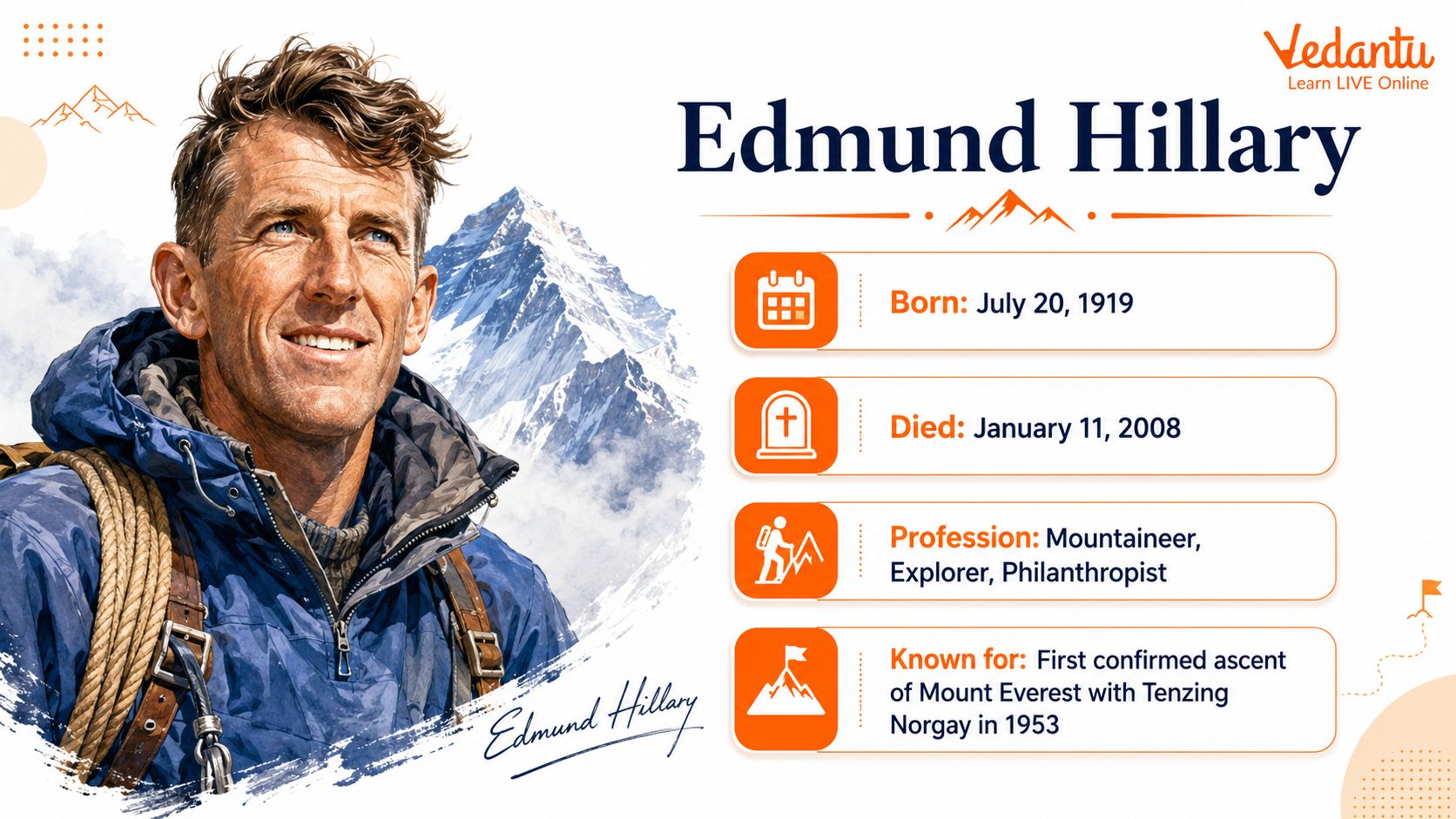
Who is Edmund Hillary?
Sir Edmund Percival Hillary was a New Zealand mountaineer, explorer, and humanitarian. He is best known for being one of the first two people to reach the summit of Mount Everest on 29 May 1953. Born in New Zealand, Hillary became an international hero after the historic climb. Beyond mountaineering, he dedicated much of his life to improving the lives of the Sherpa people of Nepal by building schools, hospitals, and infrastructure. The Edmund Hillary life history is widely studied in schools as an example of bravery, discipline, and social responsibility.
Basic Information About Edmund Hillary
| Detail | Information |
|---|---|
| Full Name | Sir Edmund Percival Hillary |
| Date of Birth | 20 July 1919 |
| Place of Birth | Auckland, New Zealand |
| Nationality | New Zealander |
| Known For | First successful ascent of Mount Everest |
| Date of Death | 11 January 2008 |
Early Life and Family Background
Edmund Hillary early life was shaped by modest living and a love for adventure. He grew up in a disciplined household and developed a strong sense of determination from a young age.
- Born on 20 July 1919 in Auckland, New Zealand.
- His father, Percival Hillary, was a beekeeper and newspaper editor.
- His mother, Gertrude Hillary, was a schoolteacher.
- He was a shy child but developed confidence through outdoor activities.
- A school trip to the mountains sparked his lifelong interest in climbing.
Education and Early Interests
Edmund Hillary education began at Tuakau Primary School and later at Auckland Grammar School. Although he was not physically strong in his early years, he gradually built stamina and strength through mountaineering.
- Studied at Auckland Grammar School.
- Developed a love for reading and adventure stories.
- Learned discipline and hard work while helping in the family beekeeping business.
- Started serious mountaineering in his late teenage years.
Career Journey and Major Life Events
Early Climbing Career
Hillary began climbing mountains in New Zealand in the 1930s. His first major climb was Mount Ollivier in 1939. Over time, he became known for his endurance and determination.
Mount Everest Expedition - 1953
The most important event in the Edmund Hillary biography was the successful ascent of Mount Everest. He was part of a British expedition led by John Hunt. On 29 May 1953, Hillary and Tenzing Norgay reached the summit, standing at 8,848 meters above sea level. This historic achievement brought global recognition and made him a national hero in New Zealand.
Exploration and Antarctic Expeditions
After Everest, Hillary continued exploring. He participated in expeditions to the South Pole and led scientific missions in Antarctica. He became the first person to reach the South Pole overland since Roald Amundsen.
Humanitarian Work in Nepal
Deeply grateful to the Sherpa community, Hillary founded the Himalayan Trust in 1960. Through this organization, he helped build schools, hospitals, airstrips, and bridges in Nepal.
Timeline of Important Events
| Year | Event |
|---|---|
| 1919 | Born in Auckland, New Zealand |
| 1939 | Climbed Mount Ollivier |
| 1953 | Reached the summit of Mount Everest |
| 1960 | Founded the Himalayan Trust |
| 1985 | Appointed New Zealand High Commissioner to India |
| 2008 | Passed away in Auckland |
Major Achievements of Edmund Hillary
- First confirmed ascent of Mount Everest in 1953.
- Knighted by Queen Elizabeth II in 1953.
- Led expeditions to the South Pole.
- Established the Himalayan Trust for community development in Nepal.
- Served as New Zealand’s High Commissioner to India.
Contributions of Edmund Hillary
Contribution to Mountaineering
- Set new standards for high-altitude climbing.
- Inspired future generations of climbers.
Contribution to Society
- Built schools and hospitals in remote Himalayan regions.
- Improved healthcare and education for Sherpa communities.
- Promoted international friendship between New Zealand and Nepal.
Ideology, Thoughts, and Values
Edmund Hillary believed in humility, teamwork, and service. Even after becoming famous, he remained modest and focused on helping others.
- Valued courage and determination.
- Respected teamwork and partnership, especially with Tenzing Norgay.
- Believed success should benefit society.
- Promoted cross-cultural understanding.
Challenges and Struggles
- Faced extreme weather and life-threatening conditions during Everest expedition.
- Had to overcome physical exhaustion and altitude sickness risks.
- Endured personal tragedy when his wife and daughter died in a plane crash in 1975.
- Continued humanitarian work despite personal loss.
Famous Works and Expeditions
| Expedition / Work | Importance |
|---|---|
| Mount Everest Expedition (1953) | First successful ascent of the world’s highest peak |
| Commonwealth Trans-Antarctic Expedition | Reached the South Pole overland |
| Himalayan Trust | Improved education and healthcare in Nepal |
Awards and Honours
| Award | Year | Significance |
|---|---|---|
| Knight Commander of the Order of the British Empire | 1953 | Honoured after Everest success |
| Order of New Zealand | 1987 | Highest civilian honour in New Zealand |
Later Life and Death
In his later years, Hillary remained active in humanitarian activities and public service. He served as New Zealand High Commissioner to India and continued supporting the Sherpa community. Edmund Hillary death occurred on 11 January 2008 in Auckland, New Zealand. He was given a state funeral, and his contributions were remembered worldwide.
Legacy and Historical Significance
- Remembered as one of the greatest explorers of the 20th century.
- Inspired generations of mountaineers and adventurers.
- Strengthened international cooperation through humanitarian work.
- His life is studied in schools as a model of courage and service.
Lessons Students Can Learn from Edmund Hillary
- Determination helps overcome the toughest challenges.
- Teamwork is essential for success.
- Success should be used to help others.
- Courage and preparation go hand in hand.
- Humility is important even after great achievements.
Quick Facts About Edmund Hillary
| Category | Details |
|---|---|
| Full Name | Sir Edmund Percival Hillary |
| Profession | Mountaineer, Explorer, Philanthropist |
| Famous For | First ascent of Mount Everest |
| Organization Founded | Himalayan Trust |
| Nationality | New Zealander |
Interesting Facts About Edmund Hillary
- He was a beekeeper before becoming a full-time explorer.
- He described himself as an ordinary person with extraordinary determination.
- His Everest success was announced on the day of Queen Elizabeth II’s coronation.
- He helped build more than 30 schools in Nepal.
- Mount Hillary in Antarctica is named after him.
- He appeared on New Zealand’s five-dollar banknote.
Conclusion
The Edmund Hillary biography reflects courage, perseverance, and compassion. From climbing Mount Everest to serving remote communities in Nepal, his life history shows that true greatness lies not only in achievement but also in service. His achievements and contributions continue to inspire students and adventurers worldwide. Edmund Hillary’s legacy remains a powerful reminder that determination and humility can change the world.
FAQs on Edmund Hillary Biography Life Achievements and Legacy
Edmund Hillary was a New Zealand mountaineer and explorer best known for being one of the first climbers to reach the summit of Mount Everest in 1953. He was born on 20 July 1919 in Auckland, New Zealand, and became an international hero after his historic Himalayan expedition. His biography highlights not only his mountaineering achievements but also his humanitarian contributions to the people of Nepal.
Edmund Hillary is famous for successfully climbing Mount Everest with Tenzing Norgay on 29 May 1953. This achievement marked the first confirmed ascent of the world’s highest peak at 8,848 meters. His success made him a symbol of courage, exploration, and determination in world history and mountaineering biography.
Edmund Hillary’s early life was shaped by simplicity, hard work, and a love for adventure. He grew up in a modest family where his father was a beekeeper. As a child, he was shy but developed an interest in climbing during a school trip to the mountains. His early experiences in the Southern Alps of New Zealand played a key role in shaping his mountaineering career and life history.
Edmund Hillary received his early education in Auckland, New Zealand. He studied at Auckland Grammar School, where he developed discipline and confidence. Although he did not pursue higher academic fame, his practical training in climbing and outdoor expeditions became the foundation of his successful mountaineering career.
Edmund Hillary achieved global recognition for his mountaineering and exploration feats. His major achievements include:
- First successful ascent of Mount Everest (1953) with Tenzing Norgay
- Participation in expeditions to the South Pole (1958)
- Exploration of the North Pole
- Establishing schools and hospitals in Nepal through the Himalayan Trust
Edmund Hillary contributed significantly to the welfare of the Sherpa community in Nepal. After his Everest success, he founded the Himalayan Trust in 1960 to support education, healthcare, and infrastructure in remote Himalayan regions. His humanitarian work became an important part of his biography and strengthened Indo-Nepal relations.
Edmund Hillary faced extreme weather, altitude sickness risks, and dangerous terrain during the Everest expedition. The 1953 British Everest Expedition dealt with freezing temperatures, snow blindness, and oxygen shortages. Despite these life-threatening challenges, Hillary and Tenzing Norgay showed teamwork, resilience, and leadership to achieve this historic milestone.
Edmund Hillary received several prestigious awards for his achievements and contributions. Some important honours include:
- Knight Commander of the Order of the British Empire (KBE) in 1953
- Appointment to the Order of New Zealand
- Recognition as a national hero in New Zealand
Edmund Hillary’s legacy lies in courage, exploration, and humanitarian service. He is remembered not only as a mountaineering legend but also as a compassionate leader who improved the lives of Himalayan communities. His life history continues to inspire students, explorers, and leaders across the world.
Several interesting facts highlight Edmund Hillary’s adventurous and service-oriented life.
- He worked as a beekeeper before becoming a famous explorer
- He was one of the few people to reach both the summit of Everest and the South Pole
- His image appeared on the New Zealand five-dollar note
- He passed away on 11 January 2008 in Auckland
