




What is Culex Mosquito classification structure life cycle and diseases
Culex is a genus of mosquitoes that generally serves as a vector for spreading diseases to birds, humans, and many different animals. This topic is from Chapter 8: ‘Human Health and Diseases.’ Apart from being an important topic for Class 12, this topic is also important for different entrance-level exams.
We will discuss every detail of the Culex mosquito, starting from the Culex mosquito life cycle to the disease caused by the Culex mosquito in this article, along with some FAQs. This topic is full of facts and should be memorised and revised frequently to remember all the facts. Studying this topic will also help students understand the whole chapter accurately.
Culex Mosquito
Culex Mosquito has a size of around 4-10 mm. The body is divided into the head, thorax, and abdomen. The forewings are present in the abdomen region, and the second pair of wings is modified to halteres. Culex mosquito identification is important for the control of the disease. The first identification is based on whether the mosquito is anopheline or culicine. The proboscis of a mosquito is the main part involved in sucking blood from the host.
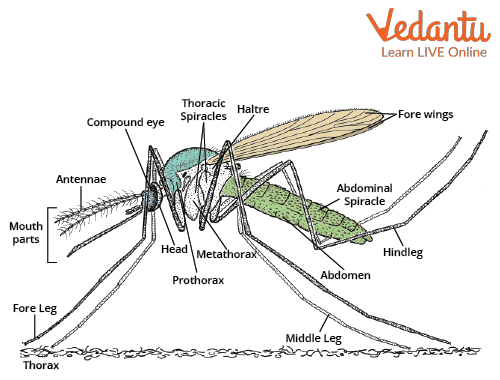
Culex Mosquito Diagram
Hierarchy Classification
Kingdom - Animalia
Phylum - Arthropoda
Class - Insecta
Order - Diptera
Family - Culicidae
Subfamily - Culicinae
Genus - Culex
Culex Mosquito Life Cycle
The life cycle of Culex mosquitoes is divided into 4 stages.
The first stage is the egg stage. Adult female mosquitoes lay eggs on the surface of fresh or stagnant water like barrels, ponds, unmaintained swimming pools, and marshy areas. The female Culex mosquito can lay 100-300 eggs one at a time, sticking together and floating on water.
The second stage is the larval stage. Larvae hatch from mosquito eggs, live in water, and are very active. Larvae shed their skin (moult) several times during this stage and feed on various things found in the water.
The third stage is the pupa stage. Pupae also live in water, and as they do not have external mouthparts, they do not feed during this stage. An adult mosquito emerges from the pupa stage.
The fourth stage is the adult stage. Adult female mosquitoes bite people and animals as they need blood to produce eggs. After feeding on blood, female mosquitoes lay eggs in water. It takes several days to feed and look for a place to lay eggs. They bite human beings only when other animals are not present near them. Since Culex bites animals and people, they live outdoors or near homes, dirty water, garbage areas, and dirty places.
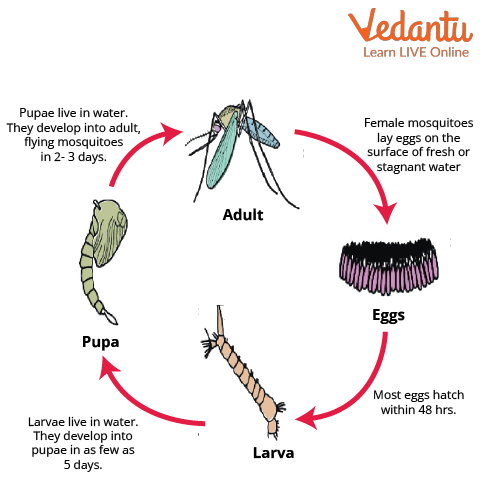
Culex Mosquito Life Cycle
Disease Caused by Culex Mosquito
There is a list of diseases caused by Culex mosquitoes. Arbovirus infections transmitted by various species of Culex include West Nile virus, Japanese encephalitis, St. Louis encephalitis, and Western and Eastern equine encephalitis. It is also under investigation if Culex species transmit the Zika virus. Nematode infections, mainly in the form of filariasis, may be borne by Culex mosquitoes and bloodsucking flies. The Culex mosquito causes many viral diseases in birds and horses.
Summary
The Culex mosquito genus is culex and belongs to the kingdom Animalia and phylum Arthropoda. The mosquito's body is divided into 3 regions: the head, thorax, and abdomen. The mosquito has a life cycle of 4 stages, starting from the egg, followed by larvae, pupa, and the adult stage. At adult age, only the mosquito can reproduce and form its offspring. The mosquito causes diseases like encephalitis, West Nile fever, and many more.
This article mentions all the necessary concepts related to Culex mosquitoes. This is an important topic for Class 12 under the chapter ‘Human Health and Diseases,’ and this article would help students understand the given topic. Apart from this, the student should study many other diseases for a better knowledge of the chapter.


FAQs on Culex Mosquito Biology and Medical Importance
1. What is a Culex mosquito?
A Culex mosquito is a genus of mosquitoes known for transmitting diseases such as West Nile virus and lymphatic filariasis.
- Belongs to the family Culicidae.
- Commonly called the house mosquito.
- Breeds mainly in stagnant or polluted water.
- Active mostly during evening and night.
2. What diseases are transmitted by Culex mosquitoes?
Culex mosquitoes transmit viral and parasitic diseases, most notably West Nile fever, Japanese encephalitis, and lymphatic filariasis.
- West Nile virus affects the nervous system.
- Japanese encephalitis virus causes brain inflammation.
- Wuchereria bancrofti (a filarial worm) causes elephantiasis.
3. How can you identify a Culex mosquito?
A Culex mosquito can be identified by its plain brown body and resting posture parallel to the surface.
- Medium-sized, dull brown coloration.
- Wings without distinct white markings.
- Rests with body parallel to the ground (unlike Anopheles).
- Eggs laid in floating clusters called egg rafts.
4. What is the life cycle of a Culex mosquito?
The life cycle of a Culex mosquito consists of four stages: egg, larva, pupa, and adult.
- Eggs: Laid in rafts on stagnant water.
- Larvae: Aquatic “wrigglers” that feed on microorganisms.
- Pupae: Aquatic, non-feeding “tumblers”.
- Adults: Terrestrial, flying stage that feeds and reproduces.
5. Where do Culex mosquitoes breed?
Culex mosquitoes breed mainly in stagnant and polluted water bodies.
- Drainage water and sewage.
- Dirty ponds and ditches.
- Water-filled containers around homes.
- Blocked gutters and septic tanks.
6. What is the difference between Culex and Anopheles mosquitoes?
The main difference between Culex and Anopheles mosquitoes lies in their resting posture, egg type, and diseases transmitted.
- Resting position: Culex rests parallel; Anopheles rests at an angle.
- Eggs: Culex lays egg rafts; Anopheles lays single eggs with lateral floats.
- Diseases: Culex spreads West Nile; Anopheles spreads malaria.
7. Why are only female Culex mosquitoes harmful?
Only female Culex mosquitoes are harmful because they require a blood meal for egg development.
- Females bite humans and animals to obtain proteins.
- Males feed only on plant nectar.
- Disease transmission occurs during female blood feeding.
8. How does a Culex mosquito transmit disease?
A Culex mosquito transmits disease by injecting pathogens into the bloodstream during a blood meal.
- Feeds on an infected host.
- Pathogen multiplies inside the mosquito (biological transmission).
- Infective stage enters a new host through saliva while biting.
9. What do Culex mosquito larvae feed on?
Culex mosquito larvae feed on microorganisms and organic matter in water.
- Consume bacteria and algae.
- Feed on decaying organic debris.
- Use mouth brushes to filter food particles.
10. How can Culex mosquito breeding be prevented?
Culex mosquito breeding can be prevented by eliminating stagnant water and improving sanitation.
- Regularly clean drains and gutters.
- Cover water storage containers.
- Use larvicides in stagnant water.
- Maintain proper sewage disposal systems.



