




Difference Between Dicotyledonous and Monocotyledonous Seed Structure and Examples
Understanding the Dicotyledonous Monocotyledonous Seed is essential to grasp the foundational differences in plant biology. These seeds form the basis of classifying angiosperms, which are crucial for global food supply, agriculture, and ecological balance. This topic explains definitions, structural features, examples, and practical relevance for students and enthusiasts.
Dicotyledonous Monocotyledonous Seed Definition
The distinction between dicotyledonous and monocotyledonous seeds is based primarily on the number of cotyledons present in the seed embryo. Dicotyledonous seeds (dicots) have two cotyledons, whereas monocotyledonous seeds (monocots) have only one. These differences impact the plant’s early growth, nutrient storage, and numerous structural aspects.
How to Identify and Compare Dicot and Monocot Seeds
You can quickly identify a dicotyledonous monocotyledonous seed by observing its parts. Dicot seeds, such as beans or peas, split into two halves, while monocot seeds like maize or rice cannot be split similarly. Both types have protective seed coats and contain embryos vital for germination.
- Dicots: Two cotyledons, broad and fleshy, sometimes storing food.
- Monocots: Single cotyledon (scutellum), often narrow and shield-like.
- Common embryo parts: Radicle (future root), plumule (future shoot).
- Seed coat: Outer protection for the embryo in both types.
Role of Seeds in Angiosperms
Flowering plants, or angiosperms, are grouped based on their seed type—dicotyledonous or monocotyledonous. These seeds develop inside fruits, unlike gymnosperms, which have exposed (“naked”) seeds. Angiosperm seeds are vital as they ensure food storage, help in plant dispersal, and provide resilience during harsh environmental conditions.
Dicotyledonous Seeds: Structure and Features
Dicotyledonous seeds show a unique structure that supports early plant growth. Their two cotyledons provide nutrition and are distinguishable by their size and shape. Let’s look at their primary characteristics.
- Two cotyledons: Store nutrients and often become the plant’s first leaves.
- Embryo axis: Includes the plumule and radicle for shoot and root development.
- Seed coat: Consists of two protective layers—testa (outer) and tegmen (inner).
- Hilum: The scar where the seed was attached to the fruit wall.
- Endosperm: Usually absent at maturity as nutrients transfer to the cotyledons.
Common dicotyledonous monocotyledonous seed examples include pea, bean, sunflower, cashew, mango, apple, and plum. Further plant structure details are also discussed in related topics such as Dicot Embryo.
Monocotyledonous Seeds: Core Structure and Characteristics
Monocotyledonous seeds are identified by their single cotyledon—called the scutellum—and their extensive storage of food within the endosperm. Here’s a breakdown of their anatomy and major features.
- Single cotyledon (scutellum): Lateral and shield-shaped, absorbs nutrients from the endosperm.
- Embryo axis: Plumule and radicle, each enclosed in sheaths (coleoptile and coleorhiza, respectively).
- Endosperm and aleurone layer: The endosperm is prominent and provides nutrients; the aleurone layer is rich in proteins and aids seedling growth.
- Seed coat: Often fused with the fruit wall (pericarp), less easy to separate.
Frequent monocotyledonous seed examples are maize, rice, wheat, barley, onion, and palm. These seeds are vital in agriculture due to their nutritional roles and are studied in detail in plant biology classes, especially for dicotyledonous monocotyledonous seed class 12.
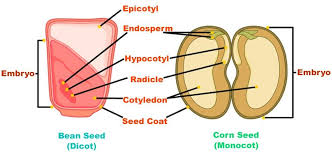
Monocot Seed Diagram vs. Dicot Seed Diagram
Visual representation helps to understand the core differences in structure. Monocot diagrams highlight a single cotyledon, endosperm, coleoptile, and coleorhiza. Dicot seed diagrams show two cotyledons flanking the embryo axis, a distinct seed coat, and usually a reduced endosperm at maturity. Such diagrams are essential for CBSE and NEET aspirants.
Comparing Dicotyledonous and Monocotyledonous Seed Characteristics
| Feature | Dicotyledonous Seed | Monocotyledonous Seed |
|---|---|---|
| No. of Cotyledons | Two | One (Scutellum) |
| Endosperm at Maturity | Usually absent (used up by embryo) | Present (nutritive tissue) |
| Protective Sheaths | Plumule and radicle exposed | Plumule (in coleoptile), radicle (in coleorhiza) |
| Seed Coat Layers | Distinct testa and tegmen | Often fused with pericarp, not distinct |
| Examples | Pea, bean, mustard, cashew, apple | Maize, rice, wheat, barley, onion |
This table highlights the main differences ideal for dicotyledonous monocotyledonous seed short notes or revision presentations.
20 Notable Monocotyledonous Seed Examples
Monocot seeds are widespread in modern agriculture and the environment. Here are twenty common examples that illustrate their diversity:
- Maize (corn)
- Wheat
- Rice
- Barley
- Oats
- Millets (pearl millet, finger millet)
- Sorghum
- Rye
- Bamboo seeds
- Sugarcane seeds
- Ginger
- Garlic
- Onion
- Banana
- Coconut
- Date palm
- Oil palm
- Lily
- Orchid
- Alstroemeria (Peruvian lily)
These seeds support global food systems, ecosystem diversity, and even ornamental horticulture. For further plant variety knowledge, explore topics like Difference Between Monocot and Dicot Stem.
Practical and Evolutionary Relevance of Seed Types
Dicotyledonous monocotyledonous seed explanation goes beyond basic plant identification. Understanding seed types is vital in biology and agriculture for:
- Crop improvement: Knowing seed structure helps in selecting and storing seeds efficiently for future planting.
- Ecological understanding: Seed strategy enables plants to colonise different habitats.
- Human nutrition: Dicots like legumes and monocots like cereals form dietary staples worldwide.
- Medicinal and cultural use: Many seeds are central to traditional remedies, religious ceremonies, and economies.
Seed strategies, such as dormancy, protect plant species against unpredictable climates. Plants like beans (dicots) enhance soil nitrogen—a key aspect of Food Science. Grains (monocots) drive staple food production globally.
Key Points for Dicotyledonous Monocotyledonous Seed Notes
- Dicotyledonous seeds have two cotyledons; monocotyledonous have one.
- Dicot seeds often store food in cotyledons, monocot seeds mostly in endosperm.
- Protective sheaths are present in monocots but not in dicots.
- Examples vary in both food crops and wild flora.
- Seed structure knowledge aids germination and crop selection.
For concise revision, these points also suit dicotyledonous monocotyledonous seed ppt or flashcards for quick study.
Sample Questions and MCQs on Dicotyledonous and Monocotyledonous Seeds
- Which group of plants encloses their seeds within fruits?
- A. Gymnosperms
- B. Angiosperms (Correct)
- C. Mosses
- D. Ferns
- What covers the radicle in a monocot seed?
- A. Coleoptile
- B. Coleorhiza (Correct)
- C. Testa
- D. Tegmen
- In dicots, which part usually stores food for the embryo?
- A. Cotyledons (Correct)
- B. Endosperm
- C. Aleurone layer
- D. Hilum
- Name a critical difference between dicot and monocot seeds.
- Monocots have one cotyledon, dicots have two.
- List a use of knowing seed structure in agriculture.
- Improved sowing and selection methods to boost germination rate.
Linking Seed Types to Broader Biology
The study of dicotyledonous and monocotyledonous seeds is vital beyond textbooks. Their role extends into topics such as Seed Germination, Parts of a Seed, and plant evolution. Students can connect these concepts with lessons on Inherited Traits and Adaptations in Plants available at Vedantu.
Understanding these seed differences links plant anatomy, physiology, genetics, agriculture, and ecosystem stability, integrating ideas for competitive exams and practical applications alike.
In summary, dicotyledonous monocotyledonous seeds distinguish the two largest groups of flowering plants with unique structures and functions vital to life on earth. Learning these differences prepares students for deeper studies in biology, agricultural science, and environmental stewardship, with wide applications in food production and biodiversity conservation.


FAQs on Dicotyledonous and Monocotyledonous Seeds in Flowering Plants
1. What is the difference between dicotyledonous and monocotyledonous seeds?
The main difference between dicotyledonous and monocotyledonous seeds is the number of cotyledons (seed leaves) present in the seed embryo.
- Dicotyledonous seeds (dicots) have two cotyledons.
- Monocotyledonous seeds (monocots) have one cotyledon.
- Dicots usually store food in cotyledons (e.g., bean, pea).
- Monocots often store food in a separate tissue called the endosperm (e.g., maize, wheat).
2. What is a dicotyledonous seed?
A dicotyledonous seed is a seed that contains two cotyledons in its embryo.
- It belongs to dicot plants (e.g., pea, bean, gram).
- The embryo consists of two cotyledons, plumule, and radicle.
- Food is usually stored in the cotyledons.
- Many dicot seeds are non-endospermic at maturity.
3. What is a monocotyledonous seed?
A monocotyledonous seed is a seed that contains only one cotyledon in its embryo.
- It belongs to monocot plants such as maize, rice, and wheat.
- The single cotyledon is called the scutellum in cereals.
- Food is mainly stored in the endosperm.
- Most monocot seeds are endospermic.
4. What are the main parts of a dicot seed?
The main parts of a dicot seed are the seed coat, cotyledons, and embryo.
- Seed coat – protective outer covering.
- Two cotyledons – store food for germination.
- Embryo – consists of the plumule (future shoot) and radicle (future root).
5. What are the main parts of a monocot seed?
The main parts of a monocot seed include the seed coat, endosperm, and embryo with one cotyledon.
- Seed coat – often fused with the fruit wall in cereals.
- Endosperm – stores food.
- Embryo – includes the scutellum (cotyledon), plumule, and radicle.
6. How does food storage differ in dicot and monocot seeds?
Food storage differs in that dicot seeds store food mainly in cotyledons, while monocot seeds store food in the endosperm.
- In dicot seeds, cotyledons absorb food from the endosperm during development.
- Mature dicot seeds are often non-endospermic.
- In monocot seeds, the endosperm remains as the main food reserve.
7. What are examples of dicotyledonous and monocotyledonous seeds?
Common examples of dicotyledonous seeds include pea and bean, while monocotyledonous seeds include maize and wheat.
- Dicot examples: pea, gram, bean, mustard.
- Monocot examples: maize, rice, wheat, barley.
8. What is the function of cotyledons in seeds?
The primary function of cotyledons is to store and supply food to the developing embryo during germination.
- They provide nutrients until the seedling forms true leaves.
- In dicots, they often act as the main food reserve.
- In monocots, the single cotyledon (scutellum) helps absorb nutrients from the endosperm.
9. Why are most monocot seeds called endospermic seeds?
Most monocot seeds are called endospermic seeds because they retain a large endosperm at maturity.
- The endosperm stores starch and other nutrients.
- The embryo remains small compared to the endosperm.
- Examples include maize, rice, and wheat.
10. How can you identify a dicot and monocot seed during practical examination?
You can identify dicot and monocot seeds by observing the number of cotyledons and internal structure.
- Count the cotyledons: two indicate a dicot, one indicates a monocot.
- Check food storage: dicots store food in cotyledons, monocots in the endosperm.
- Look for structures like scutellum, coleoptile, and coleorhiza in monocots.



