




What Is the Difference Between DNA and RNA Structure and Functions Explained
Life on Earth is incredibly diverse, ranging from single-celled organisms to complex multicellular plants and animals. At the molecular level, all living things are fundamentally built from the same essential components: DNA and RNA. Understanding the difference between DNA and RNA is crucial for comprehending how genetic information is stored, transmitted, and utilised within living organisms.
DNA (Deoxyribonucleic Acid) and RNA (Ribonucleic Acid) are both nucleic acids that play vital roles in genetics and cellular function. While they share some similarities, they have distinct differences in structure, function, and location within the cell.
Key Differences Between DNA and RNA
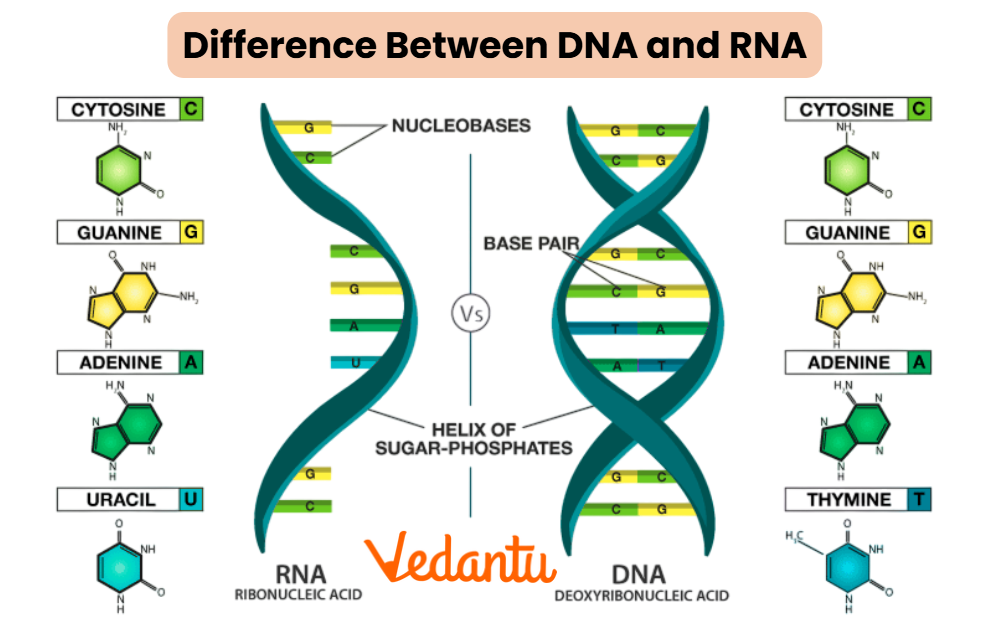
Structure of DNA and RNA
DNA Structure
DNA molecules carry the genetic blueprint for living organisms. Each DNA molecule consists of two long strands forming a double helix. These strands are composed of nucleotides, each containing a phosphate group, a deoxyribose sugar, and one of four nitrogenous bases: adenine (A), thymine (T), cytosine (C), or guanine (G).
Double Helix: The two DNA strands coil around each other, stabilised by hydrogen bonds between complementary bases (A-T and G-C).
Base Pairing: Adenine pairs with thymine, and guanine pairs with cytosine, ensuring accurate replication and transcription.
Chromosomes: In eukaryotic cells, DNA is tightly packed into structures called chromosomes. Humans have 23 pairs of chromosomes within each cell nucleus.
Read More: DNA Structure
RNA Structure
RNA is typically single-stranded and more versatile in structure compared to DNA. It plays several roles in the cell, primarily related to protein synthesis.
Single-Stranded: Unlike DNA, RNA usually exists as a single strand, allowing it to fold into complex shapes.
Bases: RNA contains adenine (A), uracil (U), cytosine (C), and guanine (G). Uracil replaces thymine found in DNA.
Types of RNA Structures: RNA can form secondary structures like hairpins and loops, enabling it to perform various functions.
Read More: RNA Structure
Types of DNA and RNA
Types of DNA
A-DNA:
Conditions: Forms in high-salt or dehydrated environments.
Structure: Right-handed helix with 11 base pairs per turn and a broader helical diameter.
B-DNA:
Conditions: Most common form under physiological conditions.
Structure: Right-handed helix with 10 base pairs per turn and a helical diameter of 20 Å.
Significance: Watson-Crick model is based on B-DNA.
C-DNA:
Conditions: Forms at lower humidity and specific ionic concentrations.
Structure: Right-handed helix with approximately 9.33 base pairs per turn.
Z-DNA:
Conditions: High-salt environments.
Structure: Left-handed helix with a zig-zag sugar-phosphate backbone, distinct from other forms.
Types of RNA
mRNA (Messenger RNA):
Function: Carries genetic information from DNA to ribosomes for protein synthesis.
tRNA (Transfer RNA):
Function: Brings amino acids to ribosomes during translation, matching them to the mRNA template.
rRNA (Ribosomal RNA):
Function: Combines with proteins to form ribosomes, the sites of protein synthesis.
snRNA (Small Nuclear RNA):
Function: Involved in RNA processing within the nucleus, such as splicing.
Other Types:
miRNA (MicroRNA) and siRNA (Small Interfering RNA): Involved in gene regulation and RNA interference.
Functions of DNA and RNA
DNA Functions
Genetic Information Storage: DNA holds the instructions for building and maintaining an organism.
Transmission of Traits: DNA is passed from parents to offspring, ensuring continuity of genetic information.
Protein Synthesis Blueprint: DNA sequences are transcribed into RNA, which then translates into proteins.
RNA Functions
Protein Synthesis: RNA translates genetic information from DNA into proteins through transcription and translation processes.
Gene Regulation: Certain RNA molecules regulate gene expression, controlling when and how genes are activated.
Catalytic Roles: Some RNA molecules act as enzymes (ribozymes) in biochemical reactions.
Proteins and Their Relationship with DNA and RNA
Proteins are essential macromolecules that perform a wide range of functions within living organisms, including photosynthesis, catalysing biochemical reactions, providing structural support, and regulating cellular processes.
Enzyme Function: Proteins act as enzymes, speeding up chemical reactions by lowering activation energy.
Structural Roles: Proteins like collagen and keratin provide structural integrity to cells and tissues.
Genetic Control: Proteins such as transcription factors regulate the expression of genes by interacting with DNA and RNA.
Synthesis Process:
Transcription: DNA is transcribed into mRNA in the nucleus.
Translation: mRNA is translated into proteins at the ribosome, with the help of tRNA and rRNA.
Additional Insights: The Central Dogma of Molecular Biology
Understanding the difference between DNA and RNA is fundamental to grasping the central dogma of molecular biology, which describes the flow of genetic information within a biological system:
DNA → RNA → Protein
Replication: DNA makes copies of itself.
Transcription: DNA is transcribed into RNA.
Translation: RNA is translated into proteins.
This process highlights the pivotal roles both DNA and RNA play in gene expression and protein synthesis.
Practical Applications
DNA and RNA in Biotechnology
Genetic Engineering: Manipulating DNA and RNA sequences to create genetically modified organisms (GMOs) with desirable traits.
Gene Therapy: Using RNA molecules to correct genetic defects by silencing faulty genes or replacing them with functional ones.
Forensic Science: DNA profiling is used in criminal investigations and paternity testing due to its unique genetic signatures.
RNA Therapeutics
mRNA Vaccines: Utilising mRNA to instruct cells to produce proteins that trigger an immune response, as seen in some COVID-19 vaccines.
RNA Interference (RNAi): A technology that uses small RNA molecules to silence specific genes, offering potential treatments for various diseases.
Conclusion
Grasping the distinguish between DNA and RNA is essential for understanding the molecular foundations of life. While both are crucial nucleic acids involved in storing and transmitting genetic information, their distinct structures and functions enable the complex processes that sustain living organisms. By distinguishing between DNA and RNA, students can better appreciate the intricacies of genetics, protein synthesis, and cellular function.
Explore More:
Test Your Knowledge: Interactive Quiz on the Difference Between DNA and RNA
Question 1: Which sugar is found exclusively in DNA and not in RNA?
A) Ribose
B) Glucose
C) Deoxyribose
D) Fructose
Question 2: Where is DNA primarily located within a eukaryotic cell?
A) Cytoplasm
B) Ribosomes
C) Nucleus
D) Endoplasmic reticulum
Question 3: Which nitrogenous base is present in RNA but not in DNA?
A) Thymine
B) Uracil
C) Adenine
D) Cytosine
Question 4: What is the main function of messenger RNA (mRNA)?
A) Carries amino acids to ribosomes
B) Forms the structure of ribosomes
C) Transports genetic information from DNA to ribosomes
D) Regulates gene expression
Question 5: Which form of DNA is most common under physiological conditions?
A) A-DNA
B) B-DNA
C) C-DNA
D) Z-DNA
Question 6: Which type of RNA is responsible for bringing amino acids to the ribosome during protein synthesis?
A) mRNA
B) rRNA
C) tRNA
D) snRNA
Question 7: How does DNA replicate compared to RNA?
A) DNA self-replicates, while RNA does not
B) RNA self-replicates, while DNA does not
C) Both DNA and RNA self-replicate
D) Neither DNA nor RNA can self-replicate
Question 8: Which of the following best describes the structure of RNA compared to DNA?
A) RNA is double-stranded, while DNA is single-stranded
B) RNA is single-stranded, while DNA is double-stranded
C) Both RNA and DNA are double-stranded
D) Both RNA and DNA are single-stranded
Check Your Answers:
1. C) Deoxyribose
DNA contains deoxyribose sugar, whereas RNA contains ribose.
2. C) Nucleus
In eukaryotic cells, DNA is primarily located in the nucleus, with some also in mitochondria.
3. B) Uracil
Uracil is found only in RNA; DNA contains thymine instead.
4. C) Transports genetic information from DNA to ribosomes
mRNA carries the genetic code from DNA to ribosomes for protein synthesis.
5. B) B-DNA
B-DNA is the most common DNA form under physiological conditions.
6. C) tRNA
tRNA transports amino acids to the ribosome during protein synthesis.
7. A) DNA self-replicates, while RNA does not
DNA can replicate itself, whereas RNA is synthesised from DNA when needed.
8. B) RNA is single-stranded, while DNA is double-stranded
RNA typically exists as a single strand, allowing it to fold into complex shapes, unlike the double-stranded DNA.


FAQs on Difference Between DNA and RNA in Structure and Function
1. What is the main difference between DNA and RNA?
The main difference between DNA and RNA is that DNA stores genetic information, while RNA helps in protein synthesis and gene expression.
- DNA (Deoxyribonucleic acid) is double-stranded and contains the sugar deoxyribose.
- RNA (Ribonucleic acid) is usually single-stranded and contains the sugar ribose.
- DNA uses the base thymine (T), while RNA uses uracil (U) instead of thymine.
- DNA is mainly found in the nucleus, whereas RNA can move to the cytoplasm.
2. What is the function of DNA and RNA?
The function of DNA is to store and transmit genetic information, while RNA functions in converting that information into proteins.
- DNA contains genes that determine inherited traits.
- mRNA carries genetic instructions from DNA to ribosomes.
- tRNA brings amino acids during protein synthesis.
- rRNA forms a major part of ribosomes.
3. Why is DNA double-stranded and RNA single-stranded?
DNA is double-stranded to provide stability and accurate replication, whereas RNA is single-stranded to allow flexibility during protein synthesis.
- The double helix structure of DNA protects genetic information.
- Complementary base pairing (A–T and G–C) ensures accurate copying.
- RNA’s single strand allows it to fold into different shapes.
- This flexibility helps RNA perform various roles in the cell.
4. What are the structural differences between DNA and RNA?
The structural differences between DNA and RNA involve their sugar type, nitrogenous bases, and strand number.
- DNA contains deoxyribose sugar; RNA contains ribose sugar.
- DNA has the base thymine; RNA has uracil.
- DNA is usually double-stranded; RNA is usually single-stranded.
- DNA forms a double helix, while RNA can form varied shapes.
5. Where are DNA and RNA found in the cell?
DNA is mainly found in the nucleus, while RNA is found in both the nucleus and cytoplasm.
- In eukaryotic cells, DNA is located in the nucleus and also in mitochondria.
- RNA is synthesized in the nucleus.
- RNA then moves to the cytoplasm to participate in protein synthesis.
- In prokaryotes, both DNA and RNA are found in the cytoplasm.
6. What are the types of RNA and their functions?
The three main types of RNA are mRNA, tRNA, and rRNA, and each plays a role in protein synthesis.
- mRNA (messenger RNA) carries genetic information from DNA to ribosomes.
- tRNA (transfer RNA) transports specific amino acids to the ribosome.
- rRNA (ribosomal RNA) forms the structural and functional core of ribosomes.
7. How does DNA replicate compared to RNA?
DNA replication is a semi-conservative process that copies the entire genome, while RNA is synthesized from DNA through transcription.
- DNA replication uses the enzyme DNA polymerase.
- Each new DNA molecule contains one old and one new strand.
- RNA is produced by RNA polymerase.
- RNA synthesis copies only specific genes, not the entire genome.
8. Why does RNA contain uracil instead of thymine?
RNA contains uracil instead of thymine because uracil is energetically cheaper to produce and suitable for short-term genetic messages.
- Uracil (U) pairs with adenine during transcription.
- DNA uses thymine (T) for greater stability in long-term storage.
- The presence of thymine helps DNA repair systems detect mutations.
9. Can RNA exist as genetic material like DNA?
Yes, RNA can act as genetic material in certain viruses known as RNA viruses.
- Some viruses, such as retroviruses, have RNA genomes.
- These viruses use reverse transcriptase to convert RNA into DNA inside host cells.
- However, in most living organisms, DNA is the primary genetic material.
10. Which is more stable, DNA or RNA?
DNA is more stable than RNA because it has deoxyribose sugar and a double-stranded structure.
- The lack of one oxygen atom in deoxyribose makes DNA less reactive.
- The double helix provides structural protection.
- RNA’s ribose sugar makes it more prone to hydrolysis.
- This stability allows DNA to store genetic information long-term.



