




What Is a Dihybrid Cross and How to Solve It Using a Punnett Square
The concept of a dihybrid cross plays a vital role in genetics, especially for students learning how traits are inherited from one generation to the next. The dihybrid cross explores how two different genes or traits are passed down when organisms are crossed, helping us understand complex inheritance patterns and genetic variation.
Dihybrid Cross Definition
Dihybrid cross refers to a genetic cross between two individuals that are both heterozygous for two distinct traits. This cross was first described by Gregor Mendel when studying pea plants. The classic dihybrid cross investigates how alleles for different genes independently assort and helps explain Mendel’s Law of Independent Assortment. In the context of genetics, understanding dihybrid cross forms the basis for predicting inheritance in more complex scenarios compared to monohybrid crosses.
Dihybrid Cross Explanation
In a dihybrid cross, we consider two pairs of contrasting traits at the same time. Mendel’s experiment involved crossing pea plants with round yellow seeds (RRYY) and those with wrinkled green seeds (rryy). The R and r alleles control seed shape (round or wrinkled), while Y and y alleles control seed colour (yellow or green). Each parent provides one allele for each trait, and their offspring inherit combinations based on the principles of probability.
Dihybrid Cross Diagram
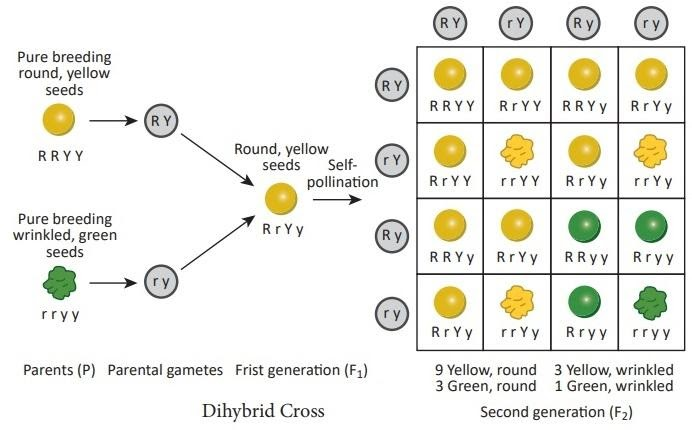
The above diagram shows a typical dihybrid cross between two heterozygous parents (RrYy × RrYy). Each parent produces four types of gametes: RY, Ry, rY, ry. Through the Punnett square, we see how different combinations appear in the F2 generation, resulting in a 9:3:3:1 phenotypic ratio. This ratio illustrates that offspring can exhibit a mix of traits, like round yellow or wrinkled green seeds, along with new combinations such as round green and wrinkled yellow—a direct result of independent assortment.
Dihybrid Cross Examples
Some classic dihybrid cross examples include studies in pea plants and animals. In pea plants:
- Round yellow seeds (RrYy) × Round yellow seeds (RrYy): This produces four possible phenotype combinations: round yellow, round green, wrinkled yellow, and wrinkled green.
- Monohybrid vs. Dihybrid Cross: While a monohybrid cross tracks one trait, the dihybrid cross examines two.
- Genetics in Humans: Dihybrid crosses also apply to human traits, like blood types and inherited disorders, though real-world genetics is often more complex due to linkage and epistasis.
This technique is widely used in agriculture, especially in plant breeding, to estimate inheritance patterns for crops that are important for food security. You may encounter these examples in class 12 boards or NEET preparation, where accurate dihybrid cross diagrams can score vital marks.
Process of a Dihybrid Cross
- Selection of Traits: Choose two distinct traits, each with two alleles (like seed shape and colour).
- Obtain True-Breeding Parents: Cross homozygous dominant (RRYY) with homozygous recessive (rryy) individuals.
- F1 Generation: All offspring will be heterozygous (RrYy) and show dominant traits.
- Self-Crossing F1: Cross two F1 individuals (RrYy × RrYy).
- Analyze F2 Generation: Use a Punnett square to determine phenotypic and genotypic ratios (usually 9:3:3:1 for phenotype).
Each step highlights how different combinations of traits emerge, revealing genetic variation in future generations. For deeper understanding of inheritance concepts, refer to the difference between acquired and inherited traits.
Mendel’s Laws in Dihybrid Cross
Mendel’s Law of Independent Assortment comes alive in a dihybrid cross. This law states that alleles for different traits segregate independently during gamete formation. The classic 9:3:3:1 ratio in the F2 generation is solid proof of this principle. These genetic laws extend beyond peas—they apply across plants, animals, and even microorganisms, supporting the study of life science and evolutionary genetics.
Dihybrid Cross Class 12: Tips and Applications
For class 12 Biology, mastering the dihybrid cross diagram and phenotypic ratio is essential for board exams and competitive tests. Practice MCQs focusing on trait calculation and genotype prediction. In real life, breeders use these principles to create crop varieties with beneficial trait combinations. Medicine and biotechnology also rely on similar genetic principles to understand and treat inherited human disorders, linking closely with endocrinology and food science.
Dihybrid Cross MCQs and Questions
Common dihybrid cross questions include:
- What is the expected phenotypic ratio from a dihybrid cross?
- Given parental genotypes, predict possible gametes and F2 phenotypes.
- True/False: Dihybrid cross supports Mendel’s Law of Independent Assortment.
- Draw and explain a dihybrid cross diagram with different plant traits.
Solving such questions improves understanding of inheritance, as well as the application of Punnett squares and genetic ratios in real exams or quizzes.
Significance of Dihybrid Cross in Modern Biology
The dihybrid cross remains important in biology for predicting inheritance, understanding genetic variation and supporting modern methods in agriculture, medicine, and genetic research. By revealing how different genes assort independently, it paves the way for the discovery of more complex genetic phenomena and aids in research concerning biological science, adaptation, and evolution.
Difference Between Monohybrid and Dihybrid Cross
| Feature | Monohybrid Cross | Dihybrid Cross |
|---|---|---|
| Number of Traits Involved | One | Two |
| Phenotypic Ratio in F2 Generation | 3:1 | 9:3:3:1 |
| Example | Seed shape in pea — round vs. wrinkled | Seed shape and color in pea — round/yellow, wrinkled/green, etc. |
| Law Demonstrated | Law of Segregation | Law of Independent Assortment |
This table helps differentiate between a monohybrid cross and a dihybrid cross, making it easier to answer textbook definitions and MCQs in exams.
Conclusion
The dihybrid cross is a cornerstone of classical genetics, helping us predict how two traits are inherited together. By understanding its principles, diagrams, and applications, students become proficient in solving genetics problems—a skill relevant for agriculture, health, and biological sciences. Keep practicing dihybrid cross questions to strengthen your foundation for exams and real-world applications.
The dihybrid cross provides a clear model for understanding how two traits are inherited independently, laying the foundation for genetics. By mastering its definition, diagram, examples, and significance, you gain valuable insights into biological inheritance, trait prediction, and the ever-expanding world of genetics both in exams and in real-life scenarios.


FAQs on Dihybrid Cross in Genetics and Mendelian Inheritance
1. What is a dihybrid cross?
A dihybrid cross is a genetic cross between two individuals that differ in two pairs of contrasting traits controlled by two different genes. It studies the inheritance of two characteristics at the same time.
- Each parent is usually heterozygous for both traits (e.g., RrYy × RrYy).
- It helps demonstrate the Law of Independent Assortment.
- A classic example is Mendel’s pea plants for seed shape (round/wrinkled) and seed color (yellow/green).
2. What is the phenotypic ratio of a dihybrid cross?
The phenotypic ratio of a typical dihybrid cross between two heterozygous parents is 9:3:3:1. This ratio appears in the F2 generation when both genes assort independently.
- 9 individuals show both dominant traits.
- 3 show the first dominant and second recessive trait.
- 3 show the first recessive and second dominant trait.
- 1 shows both recessive traits.
3. How do you do a dihybrid cross using a Punnett square?
A dihybrid cross Punnett square is made by combining all possible gametes from each parent in a 4×4 grid. Each parent produces four types of gametes.
- Step 1: Write the parental genotypes (e.g., RrYy × RrYy).
- Step 2: List all possible gametes (RY, Ry, rY, ry).
- Step 3: Draw a 4×4 Punnett square.
- Step 4: Fill in the boxes and determine genotypic and phenotypic ratios.
4. What is the difference between a monohybrid cross and a dihybrid cross?
The main difference is that a monohybrid cross studies one trait, while a dihybrid cross studies two traits simultaneously. Both follow Mendelian inheritance patterns.
- Monohybrid cross: Typically shows a 3:1 phenotypic ratio in F2.
- Dihybrid cross: Typically shows a 9:3:3:1 phenotypic ratio in F2.
- Dihybrid crosses demonstrate the Law of Independent Assortment.
5. What is Mendel’s law of independent assortment?
The Law of Independent Assortment states that alleles of different genes assort independently during gamete formation. This means the inheritance of one trait does not affect the inheritance of another, if the genes are unlinked.
- Occurs during meiosis I.
- Applies to genes located on different chromosomes or far apart on the same chromosome.
- Explains the 9:3:3:1 ratio in a dihybrid cross.
6. Can you give an example of a dihybrid cross?
A classic example of a dihybrid cross is Mendel’s pea plant experiment involving seed shape and seed color. He crossed plants heterozygous for both traits (RrYy × RrYy).
- R = round seeds (dominant), r = wrinkled seeds (recessive).
- Y = yellow seeds (dominant), y = green seeds (recessive).
- The F2 generation showed a 9:3:3:1 phenotypic ratio.
7. Why is the 9:3:3:1 ratio important in a dihybrid cross?
The 9:3:3:1 ratio is important because it confirms that two genes assort independently under Mendelian inheritance. It serves as evidence for the Law of Independent Assortment.
- Appears in the F2 generation of RrYy × RrYy crosses.
- Indicates no gene linkage.
- Helps predict offspring phenotypes in genetics problems.
8. What are the possible gametes in a dihybrid cross?
In a dihybrid cross, a heterozygous individual (e.g., RrYy) produces four types of gametes due to independent assortment. These gametes carry one allele from each gene pair.
- RY
- Ry
- rY
- ry
9. What happens in a dihybrid cross if the genes are linked?
If genes are linked, they do not assort independently and the 9:3:3:1 ratio will not appear. Linked genes are located close together on the same chromosome.
- They tend to be inherited together.
- Crossing over during meiosis may produce some recombinants.
- The phenotypic ratios will deviate from typical Mendelian expectations.
10. How do you determine the genotype ratio in a dihybrid cross?
The genotype ratio in a dihybrid cross is determined by listing all allele combinations in a 4×4 Punnett square and counting each genotype. For RrYy × RrYy, there are 16 possible genotype combinations.
- Count identical genotypes (e.g., RRYY, RrYy, rryy).
- Group them to find the genotypic ratio.
- There are 9 distinct genotypes in the F2 generation.



