




What Is an Ecosystem Definition Components Types and Functional Processes
An ecosystem is a dynamic community where living organisms interact with each other and their physical surroundings. Studying the ecosystem reveals the balance that supports all life on Earth. From understanding everyday environments to preparing for ecosystem MCQs in exams, this topic empowers students to connect biology with environmental issues, agriculture, and real-world sustainability.
Ecosystem Definition
Ecosystem refers to a biological community of organisms together with the non-living (abiotic) environment they inhabit and interact with. This includes relationships among plants, animals, fungi, bacteria, soil, water, air, sunlight, and minerals. Energy flows and nutrient cycles are central to the functioning of any ecosystem. The term is widely used in biology class 12, ranging from ecosystem short notes to ecosystem diagrams and ecosystem ppt presentations.
Structure of Ecosystem
Understanding the structure of an ecosystem involves identifying its main components. These are classified as:
- Biotic Components: All living things like plants, animals, microorganisms.
- Abiotic Components: Non-living factors such as soil, water, air, minerals, temperature, and sunlight.
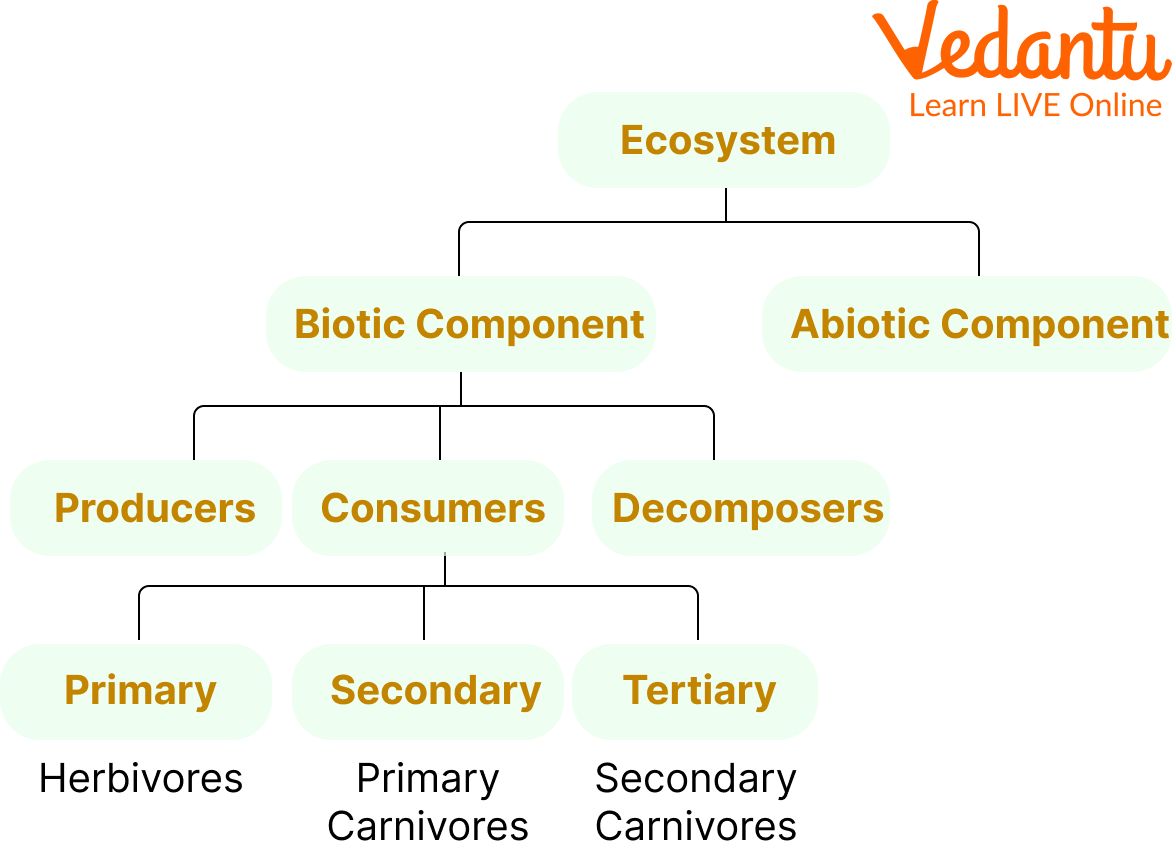
Producers (like green plants) use sunlight to make food. Consumers depend on plants or other animals for energy. Decomposers break down dead material, recycling nutrients for reuse.
Scales and Size of Ecosystem
An ecosystem can exist at many scales, from the tiny (a puddle, a moss patch) to the enormous (forests, oceans, or the Earth itself). There are no fixed boundaries for ecosystems, and often, one merges gradually into another through a transition zone called an ecotone. For instance:
- A small pond or the back of a tree can be an ecosystem.
- A forest, wetland, or large lake is a medium-scale ecosystem.
- Rainforests or coral reefs are large, complex ecosystems.
- The entire biosphere, including land, water, and air, is the largest ecosystem.
Physical barriers such as mountains, lakes, or deserts often influence the boundaries between different ecosystems.
Types and Examples of Ecosystems
Ecosystems can be broadly categorized based on where they are found. Here are two major types, along with ecosystem examples:
- Terrestrial Ecosystems: Found on land. Examples include forests, grasslands, deserts, and mountains. Learn more about terrestrial ecosystems.
- Aquatic Ecosystems: Occur in water. This includes freshwater (lakes, rivers, ponds) and marine (oceans, estuaries) ecosystems. Explore details at Vedantu's aquatic ecosystem page.
These divisions help us study how different living beings adapt and survive in specific environmental conditions.
Ecosystem Functioning and Processes
Every ecosystem operates through certain key processes that maintain life and energy balance. The main processes are:
- Energy Flow: Sunlight is captured by plants, passed to herbivores, then to carnivores, and finally to decomposers.
- Nutrient Cycling: Elements like carbon, nitrogen, and water move in cycles between living and non-living components.
- Decomposition: Dead matter is broken down, returning nutrients to soil or water.
- Trophic Levels: Organisms are grouped based on how they get energy, forming food chains and food webs.
Human actions such as agriculture, deforestation, and pollution directly affect these ecosystem processes. For current challenges, see effects of climate changes and pollution and calamities.
Ecosystem Diversity and Importance
Ecosystem diversity means the variety of unique ecosystems within a region. For example, India has deserts, forests, grasslands, wetlands, and islands. Maintaining this diversity supports:
- Clean air and water
- Balanced climate and soil fertility
- Pollination and food production
- Medicinal resources and materials
- Biodiversity conservation
Preserving ecosystem variety is vital for sustainable development. For deeper class 12 understanding, check out autotrophs and heterotrophs and life science.
Ecosystem Diagram
Ecosystem diagrams visually show the interaction between producers, consumers, decomposers, and abiotic factors. They help students grasp food chains, food webs, and nutrient cycles. To improve your ecosystem notes or ecosystem PPT presentation, try drawing labelled diagrams showing energy flow from the sun to plants, animals, and decomposers, or review CBSE class 7 important diagrams at Vedantu.
Ecosystem Questions and MCQs
Prepare for exams with practice ecosystem questions, MCQs, and case studies. Important areas include:
- Defining ecosystem and its components
- Identifying examples of various ecosystems
- Explaining energy flow, food chains, and food webs
- Describing ecosystem services and human impacts
Vedantu offers ecosystem MCQs, short notes, and questions for competitive exams and board studies.
Significance and Applications of Ecosystem Study
Ecology and ecosystem knowledge extends into many fields:
- Environmental science: Understanding global warming and natural resource management.
- Food science: Sustainable agriculture and food web insights. Learn more at food science.
- Medicine: Discovery of drugs from plants and microbes within specific ecosystems.
- Human health: Clean air, water, and stable climates come from healthy ecosystems.
Ecosystem study also helps in conserving endangered habitats and meeting global challenges such as food security and biodiversity loss.
Page Summary
Ecosystems unite living and non-living components to create self-sustaining environments for all life. Studying ecosystems helps us understand energy flow, species diversity, and environmental balance. This knowledge supports conservation, health, agriculture, and real-world problem solving. For further exploration, Vedantu provides detailed notes, diagrams, and MCQs tailored for student success.


FAQs on Ecosystem in Biology Complete Guide to Structure and Function
1. What is an ecosystem in biology?
An ecosystem is a community of living organisms interacting with each other and with their non-living environment. It includes:
- Biotic components – plants, animals, fungi, and microorganisms
- Abiotic components – sunlight, water, air, soil, and temperature
2. What are the main components of an ecosystem?
The main components of an ecosystem are biotic and abiotic factors. These include:
- Producers – organisms like green plants that make food through photosynthesis
- Consumers – animals that feed on plants or other animals
- Decomposers – bacteria and fungi that break down dead matter
- Abiotic factors – sunlight, water, minerals, air, and climate
3. What are the types of ecosystems?
Ecosystems are broadly classified into terrestrial and aquatic ecosystems. Major types include:
- Terrestrial ecosystems – forests, grasslands, deserts, tundra
- Aquatic ecosystems – freshwater (ponds, lakes, rivers) and marine (oceans, coral reefs)
4. How does energy flow in an ecosystem?
Energy flows in an ecosystem in a one-way direction from the sun to producers and then to consumers. The process occurs as follows:
- Sunlight is captured by producers through photosynthesis
- Energy passes to primary consumers (herbivores)
- Then to secondary and tertiary consumers (carnivores)
- Finally, decomposers break down organic matter
5. What is a food chain in an ecosystem?
A food chain is a linear sequence showing how energy and nutrients pass from one organism to another. It typically includes:
- Producer → makes food (e.g., grass)
- Primary consumer → eats plants (e.g., rabbit)
- Secondary consumer → eats herbivores (e.g., fox)
- Tertiary consumer → top predator (e.g., lion)
6. What is the difference between a food chain and a food web?
The main difference is that a food chain shows a single pathway of energy flow, while a food web shows multiple interconnected food chains. Key differences include:
- Food chain – linear and simple
- Food web – complex and interconnected
- Food webs provide greater ecosystem stability
7. What are trophic levels in an ecosystem?
Trophic levels are the different feeding positions organisms occupy in a food chain or food web. The main trophic levels are:
- First trophic level – producers
- Second trophic level – primary consumers
- Third trophic level – secondary consumers
- Fourth trophic level – tertiary consumers
8. Why are decomposers important in an ecosystem?
Decomposers are important because they recycle nutrients back into the ecosystem. Organisms such as bacteria and fungi:
- Break down dead plants and animals
- Convert organic matter into simpler inorganic substances
- Return nutrients to the soil and water
9. What is ecosystem balance or ecological balance?
Ecological balance is the stable state of an ecosystem where organisms and environmental factors remain in equilibrium. It is maintained by:
- Stable population sizes of species
- Balanced predator–prey relationships
- Efficient energy flow and nutrient cycling
10. What is an example of an ecosystem?
A pond ecosystem is a common example of a natural ecosystem. It includes:
- Producers – algae and aquatic plants
- Consumers – insects, fish, frogs
- Decomposers – bacteria and fungi
- Abiotic factors – water, sunlight, dissolved oxygen, minerals



