




Definition structure parts and functions of a flower with diagram and types
Flowers are among the most fascinating and essential parts of a plant. They play a pivotal role in reproduction while also serving as a food source for many organisms. This article provides an in-depth explanation of the parts and functions of a flower, their role in pollination, and some unique insights to enhance understanding.
Parts of a Flower
Flowers can be categorised as complete or incomplete, based on their structure:
Complete Flowers: Contain all four primary parts – sepals, petals, stamens, and pistils.
Incomplete Flowers: Lack one or more of these structures.
A flower is composed of two main parts:
Vegetative Parts: Include petals and sepals, which do not directly participate in reproduction.
Reproductive Parts: Include stamens (male reproductive organ) and pistils (female reproductive organ).
Read about Flowers and Inflorescence in Detail for More Information.
Flower – Labelled Diagram
For a clear understanding, here’s a labelled diagram of a flower showing its major parts and their positions.
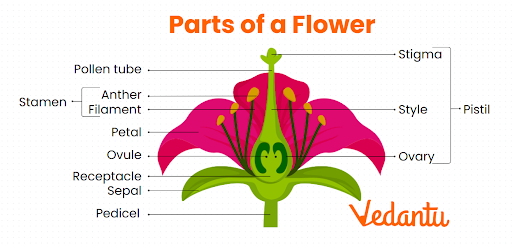
Vegetative Parts of a Flower
Petals:
Brightly coloured to attract pollinators like bees, birds, and insects.
The colours and shapes vary across different plants, aiding identification.
Sepals:
Green structures beneath the petals protect the flower bud.
Sepals may be fused (gamosepalous) or free (polysepalous).
Reproductive Parts of a Flower
Stamen (Male Reproductive Part):
Composed of anther and filament.
Anther: Produces and stores pollen grains.
Filament: Supports the anther.
Pistil (Female Reproductive Part):
Composed of stigma, style, and ovary.
Stigma: Receives pollen grains.
Style: Connects the stigma to the ovary.
Ovary: Contains ovules where seeds develop after fertilisation.
Whorls of a Flower
A flower also has four concentric whorls:
Calyx: Outermost whorl; consists of sepals that protect the flower during bud formation.
Types: Persistent (stay until fruiting), caducous (fall before full bloom), and deciduous (fall after fertilisation).
Corolla: Second whorl; comprises petals that attract pollinators. Petals may be free (polypetalous) or fused (gamopetalous).
Androecium: Male whorl; consists of stamens.
Gynoecium: Female whorl; contains carpels.
Students can refer to - Sexual Reproduction in Flowering Plants to learn more.
Functions of a Flower
Flowers perform several essential functions:
Reproduction:
Facilitate the union of male and female gametes.
After fertilisation, the ovary develops into a fruit, enclosing seeds.
Pollinator Attraction:
Bright petals and nectar attract pollinators.
Seed Formation:
Flowers facilitate seed formation for propagation.
Nectar Production:
Provide food for pollinators, ensuring mutual benefit.
Environmental Importance:
Enhance biodiversity by supporting pollination and ecosystem balance.
Pollination
Pollination is the transfer of pollen from the anther to the stigma. It can occur through various agents, as outlined below:
Real-World Applications of Flowers
Food Source:
Flowers like broccoli and cauliflower are consumed as vegetables.
Honey Production:
Bees collect nectar from flowers to produce honey.
Medicine:
Many flowers, such as chamomile and hibiscus, are used for medicinal purposes.
Crop Pollination:
Flowers play a vital role in crop yield through pollination.
Fragrances and Dyes:
Jasmine and rose are used in perfumes, while marigold provides natural dyes.
Quizzes and Mnemonics
Identify the Part: Match the flower parts to their functions.
Example: What is the function of the stigma? a) Produces pollen grains
b) Attracts pollinators
c) Receives pollen grains
Answer: c) Receives pollen grainsTrue or False:
The calyx protects the flower during its bud stage. (True)
Petals are the male reproductive part of a flower. (False)
Multiple Choice:
Which of the following is not a type of pollination? a) Hydrophilous
b) Ornithophilous
c) Pedophilous
Answer: c) Pedophilous
Mnemonics
For Flower Whorls:
"Can Cats Always Grow?"
C: Calyx
C: Corolla
A: Androecium
G: Gynoecium
For Pollination Types:
"Happy Cats Always Enjoy Snacking Oranges"
H: Hydrophilous
C: Chiropteriphilous
A: Anemophilous
E: Entomophilous
S: Snails (Malacophilous)
O: Ornithophilous
For Reproductive Parts:
"Some People Smell Stinky Oranges"
S: Stigma
P: Pistil
S: Style
S: Stamens
O: Ovary


FAQs on Flower Anatomy and Reproductive Structure in Plants
1. What is a flower in biology?
A flower is the reproductive structure of flowering plants (angiosperms) that produces seeds. It contains specialized organs responsible for sexual reproduction in plants.
- The male part is the stamen, which produces pollen.
- The female part is the pistil (carpel), which contains the ovary and ovules.
- After fertilization, the ovule develops into a seed and the ovary becomes a fruit.
2. What are the main parts of a flower and their functions?
The main parts of a flower are sepals, petals, stamens, and carpels, each with a specific reproductive function.
- Sepals: Protect the flower bud before it opens.
- Petals: Attract pollinators with color and scent.
- Stamens: Male reproductive organs that produce pollen in the anther.
- Carpel (Pistil): Female reproductive organ containing stigma, style, and ovary.
3. What is the function of a flower in plants?
The primary function of a flower is sexual reproduction in flowering plants. It ensures the production of seeds through pollination and fertilization.
- Attracts pollinators such as insects, birds, or wind.
- Produces male gametes in pollen grains.
- Houses female gametes inside ovules.
- Forms seeds and fruit after fertilization.
4. What is pollination in flowers?
Pollination is the transfer of pollen from the anther to the stigma of a flower. It is the first step in the fertilization process of flowering plants.
- Self-pollination: Pollen is transferred within the same flower or plant.
- Cross-pollination: Pollen is transferred between different plants of the same species.
5. What is fertilization in a flower?
Fertilization in a flower is the fusion of male and female gametes to form a zygote. In angiosperms, this occurs inside the ovule within the ovary.
- Pollen lands on the stigma and forms a pollen tube.
- The male gametes travel through the pollen tube to the ovule.
- One gamete fuses with the egg cell to form a zygote.
6. What is the difference between a complete and incomplete flower?
A complete flower has all four main floral parts, while an incomplete flower lacks one or more of them.
- Complete flower: Contains sepals, petals, stamens, and carpels (e.g., hibiscus).
- Incomplete flower: Missing at least one of these parts (e.g., maize lacks petals).
7. What is the difference between a unisexual and bisexual flower?
A bisexual flower has both male and female reproductive organs, while a unisexual flower has only one. This distinction is based on reproductive structures.
- Bisexual (hermaphrodite): Contains both stamens and carpels (e.g., mustard).
- Unisexual: Has either stamens (male flower) or carpels (female flower) only (e.g., papaya).
8. How does a flower develop into a fruit?
A flower develops into a fruit after fertilization, when the ovary matures and the ovules become seeds. This transformation occurs in flowering plants.
- Fertilization occurs inside the ovule.
- The ovule develops into a seed.
- The ovary enlarges and forms the fruit.
9. What are the different types of flowers based on symmetry?
Flowers are classified by symmetry into radial and bilateral types. Symmetry refers to how a flower can be divided into equal halves.
- Actinomorphic (radial symmetry): Can be divided into equal halves in multiple planes (e.g., lily).
- Zygomorphic (bilateral symmetry): Can be divided into equal halves in only one plane (e.g., pea).
10. Why are flowers important in ecosystems?
Flowers are important in ecosystems because they enable plant reproduction and support pollinators. They play a central role in maintaining biodiversity.
- Provide nectar and pollen as food for insects and birds.
- Facilitate seed and fruit formation.
- Support food chains and agricultural crops.



