




What Is Hydrarch Succession Definition Process Stages and Examples
Succession is a unidirectional series of changes that brings about a change in community composition. As the succession progresses, it leads to the formation of a stable climax community. The transient stages in the progressive successional series are called the seral stages. Hydrarch succession is a primary type of succession which starts in aquatic environments like ponds and lakes.
Succession in the pond or lake starts with the settlement of a pioneer community like the phytoplankton, and that leads to the formation of the forest. Major examples of hydrarch succession can be observed in the Big Islands of Hawaii as this area is prone to volcanic eruption. As the lava flows in nearby regions, new rocks are formed, modifying the soil profile in the region. This leads to new flora and fauna development.
Types of Succession
Primary Succession: The succession occurs in barren or new areas where no species existed before. Example- new volcanic island.
Secondary Succession: It occurs in the region where the developed community has been eradicated by natural forces like flood, fire, or flooding. Example- forest destroyed by fire.
Autogenic Succession: It is a self-powered succession that occurs due to the interaction of organisms with the environment. Example- primary succession.
Allogenic Succession: The succession resulting from the variation in habitat due to external agencies is allogenic succession.
Autotrophic Succession: Succession in which plants are in greater quantity than animals, occuring in an inorganic-rich environment is known as autotrophic succession.
Heterotrophic Succession: In the initial stages, animals and fungi outpower the plant. This occurs in an organic-rich environment.
Progressive Succession: In this kind of succession, simple forms get transformed into complex forms by a series of sequential changes. Example: grassland converted to forest.
Stages of Hydrarch Succession
Hydrarch succession occurs gradually and includes stages of community formation. The sequence of events in hydrarch succession is explained below:
Phytoplankton Stage: This is the primary stage of hydrarch succession. In this stage, the quality of pond water is inferior in nutrients and does not support larger life forms. Simple organisms like bacteria, algae, phytoplankton, and zooplanktons form the first seral community of the hydrarch succession. They are called pioneer communities.
These organisms proliferate and perform several metabolic activities. In this process populations of simple life forms die, and decomposers begin to multiply bringing about decomposition, and enriching the pond with nutrients. The dead organism settles at the base of the pond to form a layer called a muck.
Submerged Stage: The loose muddy layer at the base of the pond is enriched with nutrients. This layer supports the growth of rooted hydrophytes like Hydrilla, Utricularia, Vallisneria, and Ceratophyllum. These plants emerge at the depth of about 10 feet or more. When these plants die they get buried at the base of the pond, which gradually raises the surface of the pond. This stratification process results in the growth of other plants.
Floating Stage: As the name suggests, the floating plants are the new inhabitants. The depth of the water now reaches about 4 to 8 feet. The broad leaves of floating plants obstruct the light rays to penetrate the water. This leads to the death of submerged plants that colonised the pond earlier. The death of submerged plants along with the evaporation of water and silt deposition from the nearby region makes the pons shallower. Examples of plants found in this stage are Trapa, Pistia, Nymphaea, Limnanthemum, etc.
Reed-Swamp Stage: As the depth of pond water gradually decreases the floating plants get replaced by amphibious plants. The prominent examples of such plants are Typha, Sagittaria, and Phragmites. The leafage of such plants cuts off the sunlight reaching the floating or submerged plants. This leads to death resulting in the deposition, thereby reducing the depth of water. The existing plant species have well-developed root systems and form densely wooded areas.
Sedge Meadow Stage: The stratification process results in the formation of marshy habitat. Plants species like Cyperaceae and Gramineae take over the vegetation. They form dense mat-like vegetation with the help of their creepy rootstock. As the depth gradually decreases, the muddy layer gets well exposed to the air resulting in rampant loss of water. Thus marshy condition gets replaced by mesic vegetation. At the end of this stage, soil loses water and becomes dry. The soil now gets dependent on rainfall and other climatic factors.
Woodland Stage: In this stage, shrubs and, later on, woody trees appear on land. The pioneers of this stage are Salix, Cornus, Alnus, etc. In this stage, the soil gets flourished with humus with abundant microflora. Thus soil gets mineralised, favouring the entrance of new species of plants. This stage leads to the final climax stage.
Climax Stage: Finally, the hydrosere leads to the evolution of climax vegetation. The level of the soil is raised, and the soil gets enriched with humus and other minerals. This habitat favours the growth of a well-adapted, reproductive stable plant community. All types of plants ranging from herbs to tall woody trees, are seen in the climax region. The dominant woody trees control the entire foliage. Thus, a stable, balanced climate-dependent climax community evolves.
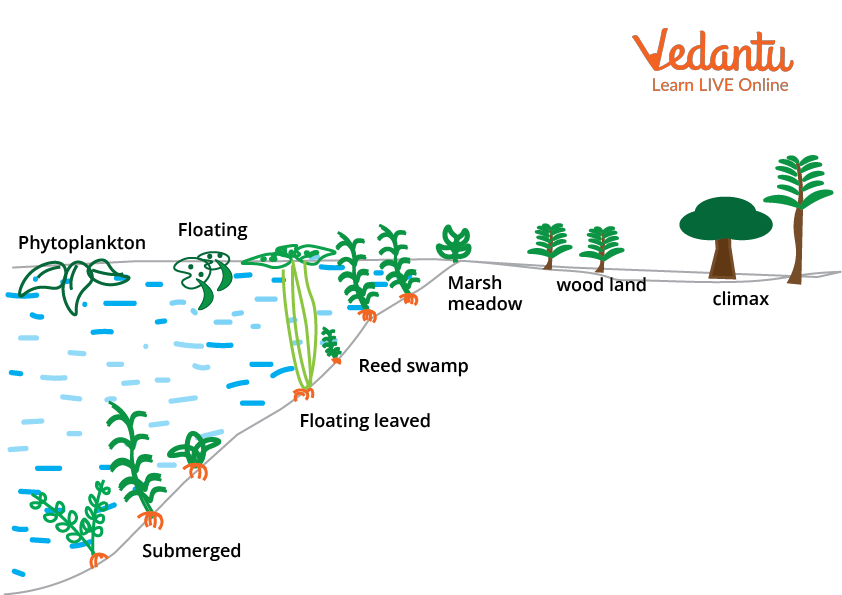
The Stages in Hydrosere
Xerarch Succession
The type of succession that begins in drier areas is called xerosere. The two seral stages are:
Lithosere: Succession occurs on barren rocks
Psammosere: Succession occurs in the sandy region
Differences between Hydrarch and Xerarch Succession
Interesting Facts
In southern Alaska, Glacier bay is one of the prominent examples of Primary Succession.
Due to global warming glaciers melted, and soon pioneer communities (Epilobium latifolium) and the mountain avens (Dryas octopetala) occupied the region.
These plants fixed nitrogen and modified the soil. Gradually taller shrubs, Sitka spruce (Picea sitchensis), western hemlock (Tsuga heterophylla), and mountain hemlock (T. mertensiana) became the dominant species of the region.
Important Questions
What are the pioneer species of hydrarch and xerarch succession?
Ans: Pioneers species of hydrarch succession are phytoplanktons. They grow independently in sunlight and are referred to as microalgae. In Xerarch Succession the pioneer community is lichen. Lichen is a symbiotic association of algae and fungi.
What are examples of secondary succession?
Ans: Secondary succession is a type where already living forms existed but natural calamities have destroyed the region. The classic example of secondary succession is oak and hickory forests, where wildfires are common. The wildfires destroy the flora and fauna. The nutrient is replenished in the form of ash which is used later for secondary succession.
Key Features
Max Witynski defines ecological succession as a gradual process that replaces species and habitats.
Hydrarch succession starts in moist places with phytoplankton as pioneer communities.
Xerarch succession starts in drier areas like sandy places or weathered abandoned rocks. The pioneer of this succession is lichens which gradually following various seral stages get transformed into woody foliage.


FAQs on Hydrarch Succession in Ecology and Its Stages
1. What is hydrarch succession?
Hydrarch succession is a type of ecological succession that begins in a water body and gradually leads to the formation of a terrestrial forest community. It starts in aquatic habitats such as ponds or lakes and progresses through stages where water is replaced by soil. Over time, plant communities change from simple aquatic forms to complex terrestrial vegetation until a stable climax community is established.
2. Where does hydrarch succession occur?
Hydrarch succession occurs in freshwater bodies like ponds, lakes, marshes, and swamps. It typically begins in shallow or newly formed water bodies. As sediments and organic matter accumulate, the water body becomes shallower, enabling different plant communities to establish step by step.
3. What are the stages of hydrarch succession?
Hydrarch succession proceeds through a series of well-defined stages from aquatic to terrestrial communities. The main stages include:
- Phytoplankton stage – Dominated by microscopic algae and bacteria.
- Submerged plant stage – Rooted underwater plants like Hydrilla grow.
- Floating plant stage – Free-floating or rooted floating plants like Pistia and Nymphaea appear.
- Reed-swamp stage – Amphibious plants like Typha dominate.
- Sedge-meadow stage – Sedges and grasses replace aquatic plants.
- Woodland stage – Shrubs and small trees develop.
- Climax forest stage – A stable terrestrial forest community forms.
4. How does hydrarch succession start?
Hydrarch succession starts with the colonization of a water body by phytoplankton such as algae and bacteria. These pioneer species float in the water and perform photosynthesis. When they die, their remains accumulate at the bottom, mixing with sediments to gradually reduce water depth and prepare the habitat for larger aquatic plants.
5. What is the pioneer community in hydrarch succession?
The pioneer community in hydrarch succession is the phytoplankton community. It mainly consists of microscopic algae, cyanobacteria, and other microorganisms. These organisms initiate ecological change by:
- Producing organic matter through photosynthesis
- Contributing to sediment formation after death
- Altering the aquatic environment for future plant colonization
6. How does hydrarch succession lead to the formation of a forest?
Hydrarch succession leads to forest formation by gradually converting a water body into dry land through sediment accumulation and plant replacement. The process involves:
- Deposition of silt and dead plant material
- Reduction in water depth
- Replacement of aquatic plants by marsh and meadow species
- Establishment of shrubs and finally trees
Eventually, a stable climax forest community adapted to the regional climate is formed.
7. What is the difference between hydrarch and xerarch succession?
The main difference between hydrarch and xerarch succession is that hydrarch begins in water while xerarch succession begins in dry habitats. Key differences include:
- Hydrarch succession – Starts in aquatic environments and ends in mesic forest.
- Xerarch succession – Starts on dry, barren land like rocks and gradually develops soil and vegetation.
- Hydrarch is also called hydrosere, while xerarch is called xerosere.
8. Why is hydrarch succession also called hydrosere?
Hydrarch succession is called hydrosere because it is a type of sere that begins in a water habitat. The term “sere” refers to the complete sequence of communities that develop during ecological succession. Since this sequence starts in aquatic conditions, it is specifically termed a hydrosere.
9. What is the climax community in hydrarch succession?
The climax community in hydrarch succession is usually a stable forest ecosystem adapted to the regional climate. This final stage is characterized by:
- Well-developed soil
- Large trees and diverse plant species
- Stable ecological balance
- Minimal further change unless disturbed
This stage represents ecological stability under prevailing environmental conditions.
10. Why is hydrarch succession important in ecology?
Hydrarch succession is important because it explains how aquatic ecosystems naturally transform into terrestrial ecosystems over time. It helps in understanding:
- Wetland formation and soil development
- Natural habitat changes
- Biodiversity increase through succession stages
- Long-term ecosystem dynamics
This concept is essential in studying ecology, wetland management, and environmental conservation.



