




What is the Law of Independent Assortment with examples and Punnett square
The law of independent assortment is a fundamental concept in genetics proposed by Gregor Mendel, often recognised as the “Father of Genetics.” It describes how different genes controlling distinct traits separate into gametes independently of one another. This principle, which is also Mendel’s second law of inheritance, has been pivotal in our understanding of how offspring can exhibit new combinations of traits not always visible in their parents.
In this article, we will explore what Mendel's second law of independent assortment is, how it differs from the law of segregation, relevant examples, a detailed law of independent assortment diagram, and more.
Introduction
In simple terms, Mendel’s second law of independent assortment states that when two or more genes are inherited together, their alleles (alternative forms of a gene) segregate into gametes independently. Essentially, inheriting a particular allele for one trait does not influence which allele is inherited for another trait.
Mendel arrived at this conclusion after performing dihybrid crosses with pea plants. He tracked the inheritance of two distinct traits simultaneously (e.g., seed shape and seed colour). The resulting progeny in these experiments exhibited combinations of traits that varied from their parents, proving that each pair of alleles assorted independently.
The F1 generation of dihybrid crosses showed dominant traits for both characters.
The F2 generation displayed a phenotypic ratio of 9:3:3:1.
Traits of colour and shape were assorted into gametes independently, resulting in new trait combinations.
Law of Independent Assortment Vs Law of Segregation
The law of independent assortment vs law of segregation comparison often helps clarify Mendel’s findings:
Law of Segregation (Mendel’s First Law): Each parent carries two alleles for any given trait. These alleles segregate (separate) during gamete formation, ensuring that each gamete contains only one allele for each gene.
Law of Independent Assortment (Mendel’s Second Law): The segregation of alleles for one gene is independent of the segregation of alleles for another gene, provided the genes are not located too close on the same chromosome (i.e., they are usually on different chromosomes or far apart on the same chromosome).
In short, the law of segregation focuses on how one pair of alleles separates during gamete formation, while the law of independent assortment highlights how different genes assort independently into gametes.
How Does the Law of Independent Assortment Work?
To understand the law of independent assortment, it’s crucial to know the basics of meiosis—a specialised type of cell division that reduces the chromosome number by half, forming haploid gametes (sperm and egg cells).
Formation of Haploid Cells: Each diploid organism carries two sets of chromosomes, one from each parent. During meiosis, these sets are halved, so each gamete receives only one copy of every chromosome.
Random Orientation: When homologous chromosomes align at the cell’s equator during meiosis I, they do so randomly. This random orientation ensures that chromosomes (and, therefore, the genes they carry) are assorted independently.
Independent Segregation of Genes: For two genes on different chromosomes, the alleles separate into gametes independently of each other. This means each new gamete can have any combination of maternal or paternal alleles.
Thus, if a parent’s genotype is RrYy, there is a 50% chance that a gamete will receive either R or r and similarly a 50% chance of receiving Y or y. Combining these probabilities gives four possible allele combinations (RY, Ry, rY, ry), which explains how traits recombine in the offspring.
Law of Independent Assortment Diagram
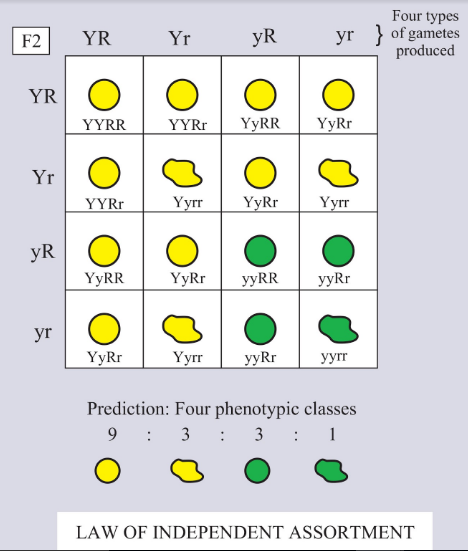
Although we cannot show an image here, you can visualise a law of independent assortment diagram by imagining two pairs of chromosomes:
Pair 1 with alleles R (dominant) and r (recessive).
Pair 2 with alleles Y (dominant) and y (recessive).
During meiosis, each pair segregates independently. Hence, you get four types of gametes: RY, Ry, rY, and ry. This visual representation typically highlights how each allele pair moves separately, reinforcing the principle that one trait’s inheritance does not impact another’s inheritance.
Law of Independent Assortment Example
One classic law of independent assortment example is Mendel’s dihybrid cross using pea plants for two traits—seed shape (round ‘R’ vs. wrinkled ‘r’) and seed colour (yellow ‘Y’ vs. green ‘y’):
Parental Generation (P): RRYY (round, yellow) × rryy (wrinkled, green).
F1 Generation: All offspring are RrYy (round, yellow) because the dominant alleles mask the recessive ones.
F2 Generation: When F1 plants self-pollinate, we observe four phenotypic classes in a 9:3:3:1 ratio:
Round, Yellow (9)
Round, Green (3)
Wrinkled, Yellow (3)
Wrinkled, Green (1)
This 9:3:3:1 pattern demonstrates that the genes for shape and colour were passed on independently.
Another law of independent assortment example includes considering two traits in rabbits: fur colour and eye colour. If we cross two rabbits that are hybrids for both traits, their offspring will display combinations of fur and eye colours in proportions that suggest independent sorting of each trait.
Quick Quiz
Try this short quiz to test your understanding of the law of independent assortment:
In a dihybrid cross of RrYy × RrYy, which of the following ratios represents the phenotypic distribution in the F2 generation?
a) 3:1
b) 9:3:3:1
c) 1:1:1:1
d) 2:1:1
Which cell division process is crucial for the law of independent assortment?
a) Mitosis
b) Meiosis
c) Binary Fission
d) Budding
In the context of the law of independent assortment vs the law of segregation, which statement is true?
a) Both laws refer to a single pair of alleles only.
b) The law of segregation talks about how different gene pairs segregate.
c) The law of independent assortment states that allele pairs for different traits segregate independently.
d) Neither law applies to dihybrid crosses.
(Answers: 1. b, 2. b, 3. c)
Feel free to explore our other resources on


FAQs on Law of Independent Assortment Explained
1. What is the Law of Independent Assortment?
The Law of Independent Assortment states that alleles of different genes are distributed independently of one another during gamete formation. This principle was proposed by Gregor Mendel based on his dihybrid crosses in pea plants.
- It applies to genes located on different chromosomes or far apart on the same chromosome.
- It occurs during meiosis I, when homologous chromosomes separate.
- It increases genetic variation in offspring.
2. What is an example of the Law of Independent Assortment?
A classic example of the Law of Independent Assortment is Mendel’s dihybrid cross involving seed shape and seed color in pea plants. When crossing round yellow (RRYY) with wrinkled green (rryy) plants:
- The F1 generation is all RrYy (round yellow).
- The F2 generation shows a 9:3:3:1 phenotypic ratio.
- This ratio demonstrates that the genes for seed shape and color assort independently.
3. How does the Law of Independent Assortment work during meiosis?
The Law of Independent Assortment works during metaphase I of meiosis, when homologous chromosome pairs align randomly at the cell equator. This random orientation determines how maternal and paternal chromosomes are distributed.
- Each homologous pair aligns independently of others.
- During anaphase I, chromosomes separate randomly.
- This produces gametes with different allele combinations.
4. Why is the Law of Independent Assortment important?
The Law of Independent Assortment is important because it increases genetic variation in sexually reproducing organisms. Independent distribution of chromosomes creates new allele combinations in gametes.
- It contributes to diversity within populations.
- It enhances adaptability and evolution.
- It works along with crossing over and random fertilization.
5. What is the difference between the Law of Segregation and the Law of Independent Assortment?
The Law of Segregation states that two alleles of a single gene separate during gamete formation, while the Law of Independent Assortment states that alleles of different genes assort independently.
- Segregation deals with one gene at a time.
- Independent assortment deals with two or more genes.
- Both laws operate during meiosis.
6. Does the Law of Independent Assortment apply to all genes?
The Law of Independent Assortment does not apply to genes that are closely located on the same chromosome. Such genes are said to be linked genes and tend to be inherited together.
- Independent assortment applies to genes on different chromosomes.
- It also applies to genes far apart on the same chromosome.
- Linked genes may only assort independently if separated by crossing over.
7. What is a dihybrid cross in relation to the Law of Independent Assortment?
A dihybrid cross is a genetic cross that examines the inheritance of two different traits simultaneously to demonstrate the Law of Independent Assortment. It typically involves individuals heterozygous for both traits.
- Example genotype: RrYy × RrYy.
- Produces a 9:3:3:1 phenotypic ratio in F2 generation.
- Shows independent distribution of alleles.
8. What is the 9:3:3:1 ratio in the Law of Independent Assortment?
The 9:3:3:1 ratio is the typical phenotypic ratio observed in the F2 generation of a dihybrid cross demonstrating the Law of Independent Assortment. It results from random combination of two independently assorting genes.
- 9 show both dominant traits.
- 3 show first dominant and second recessive.
- 3 show first recessive and second dominant.
- 1 shows both recessive traits.
9. Who discovered the Law of Independent Assortment?
The Law of Independent Assortment was discovered by Gregor Mendel in the 19th century through experiments on pea plants (Pisum sativum). He published his findings in 1866.
- He performed controlled cross-pollination experiments.
- He studied traits like seed shape and color.
- His work laid the foundation of classical genetics.
10. How does independent assortment increase genetic variation?
Independent assortment increases genetic variation by creating different combinations of maternal and paternal chromosomes in gametes. Each pair of homologous chromosomes aligns randomly during meiosis.
- Humans have 23 pairs of chromosomes.
- This results in about 2²³ (over 8 million) possible chromosome combinations.
- Variation is further increased by crossing over and random fertilization.



