




Difference between Law of Segregation and Law of Dominance with Examples and Punnett Square
Inheritance is the process through which offspring acquire genetic traits from their parents. Understanding how these traits are passed down has been a cornerstone of genetics, thanks to the pioneering work of Gregor Johann Mendel. In 1860, Mendel often hailed as the father of genetics, conducted experiments on pea plants. His observations led to the formulation of three fundamental laws of inheritance: the Law of Dominance, the Law of Segregation, and the Law of Independent Assortment. In this guide, we will understand the first two laws—the Law of Dominance and the Law of Segregation—providing clear explanations, examples, and diagrams to improve your understanding.
Also Read: Principles of Inheritance and Variation
Mendel’s Laws of Inheritance
Gregor Mendel's experiments with pea plants focused on how specific traits are inherited from one generation to the next. By cross-pollinating plants with contrasting traits, Mendel uncovered predictable patterns of inheritance, laying the foundation for modern genetics.
Also Read: Mendelian Genetics
Read More: Inherited Traits
The Law of Dominance
What is the Law of Dominance?
The Law of Dominance is the first of Mendel’s laws of inheritance. It states:
“When parents with pure, contrasting traits are crossed, only one form of the trait appears in the F₁ generation. The hybrid offspring exhibit only the dominant trait in their phenotype.”
Key Points:
Dominant Trait: The trait that appears in the F₁ generation.
Recessive Trait: The trait that is masked by the dominant trait.
Pure Traits: Homozygous Traits, meaning the organism has two identical alleles for a trait (e.g., TT or tt).
Example of the Law of Dominance:
Consider Mendel’s classic experiment with pea plants:
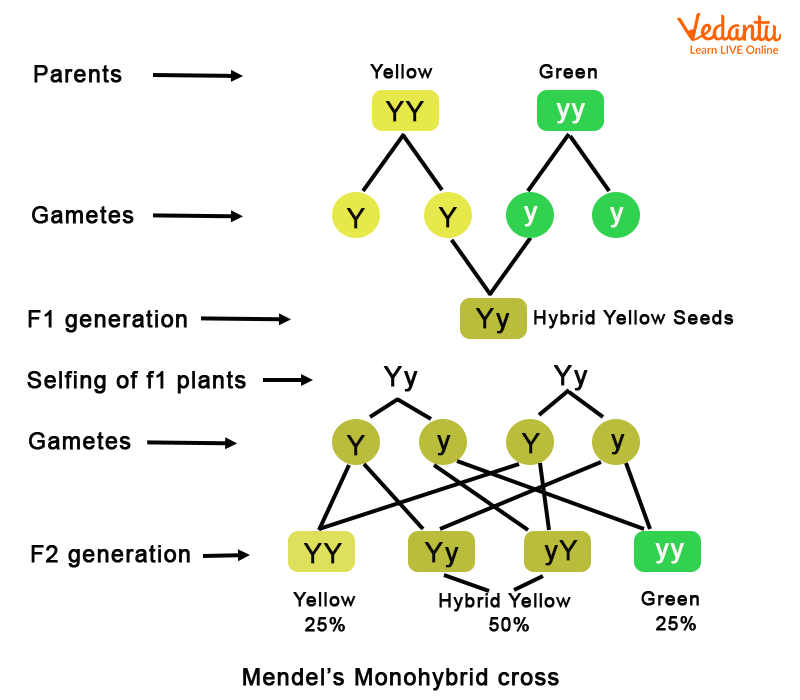
Tall Plants (TT) x Dwarf Plants (tt) → F₁ Generation: All Tall Plants (Tt)
Here, the tall trait (T) is dominant over the dwarf trait (t). Even though the offspring are heterozygous (Tt), only the dominant trait (tall) is visible in the phenotype.
The Law of Segregation
What is the Law of Segregation?
The Law of Segregation is Mendel’s second law of inheritance. It states:
“During the formation of gametes, the two alleles for each trait segregate so that each gamete carries only one allele for each trait.”
Key Points:
Alleles: Different forms of a gene (e.g., T and t for plant height).
Gametes: Reproductive cells (sperm and eggs) that carry only one allele for each trait.
Homozygous: Having two identical alleles (TT or tt).
Heterozygous: Having two different alleles (Tt).
Example of the Law of Segregation:
Continuing with the previous example:
F₁ Generation (Tt) self-pollinate → F₂ Generation:
TT (Tall)
Tt (Tall)
Tt (Tall)
tt (Dwarf)
This results in a phenotypic ratio of 3 tall plants to 1 dwarf plant, illustrating that the recessive trait reappears in the F₂ generation.
Comparing the Laws
The law of Dominance explains why only the dominant trait is visible in the F₁ generation.
The law of Segregation describes how alleles separate during gamete formation, allowing the recessive trait to reappear in the F₂ generation.
Additional Insights
Law of Independent Assortment
While our focus is on the Law of Dominance and the Law of Segregation, it's worth briefly mentioning Mendel’s third law—the Law of Independent Assortment. This law states that alleles for different traits segregate independently during the formation of gametes, leading to genetic variation.
Real-Life Applications
Understanding these laws is crucial in fields like agriculture, medicine, and genetics. For example, plant breeders use these principles to develop new crop varieties with desirable traits, while geneticists apply them to predict the inheritance of genetic disorders.
Also Read: Mendelian Disorders in Humans
Common Misconceptions
Incomplete Dominance: Not all traits follow simple dominance; some exhibit incomplete dominance where the heterozygote has a blended phenotype.
Multiple Alleles: Some genes have more than two alleles, adding complexity beyond Mendel’s initial findings.
These nuances highlight that while Mendel’s laws provide a foundational framework, genetics is a more intricate field with various exceptions and extensions.
Related Biology Topics


FAQs on Law of Segregation and Law of Dominance in Mendelian Genetics
1. What is the Law of Segregation?
The Law of Segregation states that the two alleles of a gene separate during gamete formation so that each gamete carries only one allele. This principle was proposed by Gregor Mendel based on his pea plant experiments.
- Each organism has two alleles for a trait (one from each parent).
- During meiosis, these alleles segregate into different gametes.
- At fertilization, alleles unite randomly to restore the pair.
2. What is the Law of Dominance?
The Law of Dominance states that when two different alleles are present in a heterozygous individual, one allele (dominant) masks the expression of the other (recessive). This concept was derived from Mendel’s monohybrid crosses.
- The dominant allele expresses its trait in both homozygous and heterozygous conditions.
- The recessive allele expresses only in the homozygous condition.
- Example: In pea plants, tall (T) is dominant over dwarf (t).
3. How does the Law of Segregation work during meiosis?
The Law of Segregation works during meiosis I, when homologous chromosomes separate into different gametes. Each chromosome carries one allele of a gene.
- Homologous chromosomes pair during prophase I.
- They separate during anaphase I.
- Each gamete receives only one allele for each trait.
4. What is the difference between the Law of Segregation and the Law of Dominance?
The main difference is that the Law of Segregation explains how alleles separate during gamete formation, while the Law of Dominance explains how one allele can mask another in expression.
- Law of Segregation: Focuses on separation of alleles during meiosis.
- Law of Dominance: Focuses on expression of dominant and recessive traits.
- Segregation explains inheritance pattern; dominance explains phenotype appearance.
5. Can you give an example of the Law of Segregation?
An example of the Law of Segregation is a monohybrid cross between tall (TT) and dwarf (tt) pea plants. The F1 generation becomes heterozygous (Tt).
- During gamete formation, T and t alleles separate.
- Each gamete carries either T or t.
- In F2 generation, the genotypic ratio is 1 TT : 2 Tt : 1 tt.
6. Can you give an example of the Law of Dominance?
An example of the Law of Dominance is when a tall (TT) pea plant is crossed with a dwarf (tt) plant, producing all tall (Tt) offspring in the F1 generation. The dominant allele (T) masks the recessive allele (t).
- T = Tall (dominant)
- t = Dwarf (recessive)
- F1 phenotype: All tall plants
7. Why is the Law of Segregation important in genetics?
The Law of Segregation is important because it explains how genetic variation is maintained through sexual reproduction. By separating alleles into different gametes, it ensures genetic diversity.
- Prevents blending of traits.
- Maintains distinct alleles across generations.
- Forms the basis of Mendelian inheritance patterns.
8. Why is the Law of Dominance not always applicable?
The Law of Dominance is not always applicable because some traits show incomplete dominance or codominance instead of complete dominance. In these cases, one allele does not completely mask the other.
- Incomplete dominance: Heterozygote shows an intermediate phenotype (e.g., pink flowers in snapdragon).
- Codominance: Both alleles express equally (e.g., AB blood group).
9. What happens to alleles after segregation?
After segregation, alleles are distributed into separate gametes and later recombine randomly during fertilization. This restores the pair of alleles in the offspring.
- Each gamete carries one allele.
- Fusion of gametes forms a zygote.
- The offspring’s genotype depends on allele combination.
10. How are the Law of Segregation and Law of Dominance related?
The Law of Segregation and Law of Dominance are related because segregation determines allele distribution, while dominance determines trait expression in the offspring. Together, they explain monohybrid inheritance.
- Segregation ensures one allele per gamete.
- Dominance explains why certain traits appear in heterozygotes.
- Both were proposed by Gregor Mendel.



