




How the Meselson and Stahl Experiment Demonstrated Semiconservative DNA Replication
The Meselson and Stahl Experiment is a cornerstone in molecular biology that proved how DNA replication occurs in cells. By cleverly using isotopes, Matthew Meselson and Franklin Stahl conclusively demonstrated the mechanism of semiconservative DNA replication. Understanding their experiment helps students master essential concepts about genetics, heredity, and biotechnology, all crucial for academic success and real-world problem-solving.
Meselson and Stahl Experiment Definition
Meselson and Stahl Experiment definition: This classic experiment, conducted in 1958, established that DNA replication is semiconservative. Each new DNA molecule consists of one original parental strand and one newly synthesized strand. The experiment is often discussed in NEET, class 12, and competitive exams to illustrate how scientific methods confirm core biological theories.
Background: Competing Models of DNA Replication
Before Meselson and Stahl’s experiment, scientists debated three main models of DNA replication: conservative, semiconservative, and dispersive. Here’s how they differ:
- Semiconservative replication: Each daughter DNA contains one old (parental) and one new strand.
- Conservative replication: One molecule is entirely old DNA, while the other is completely new.
- Dispersive replication: Both DNA strands are mixtures of old and new DNA segments throughout.
The correct model impacts our understanding of genetic inheritance, fidelity, and mutations. It is fundamental knowledge for advanced genetics and molecular biology fields.
Meselson and Stahl Experiment Procedure: Stepwise Explanation
The Meselson and Stahl experiment used E. coli bacteria cultured in different nitrogen isotopes to track DNA strands through generations. These are the main experimental steps:
- Heavy Nitrogen Incorporation: E. coli were grown in a medium containing the heavy nitrogen isotope 15N. After several generations, all bacterial DNA contained 15N, making it denser than normal.
- Shift to Light Medium: The bacteria were then transferred to a medium with light nitrogen (14N). Newly synthesized DNA incorporated 14N instead of 15N.
- Sampling DNA: Samples were collected after each round of DNA replication to analyze how much heavy and light nitrogen were present in DNA molecules.
- Density Gradient Centrifugation: DNA samples were spun in cesium chloride (CsCl) gradients. This technique separates DNA based on density, allowing scientists to observe distinct bands for DNA molecules of different nitrogen content.
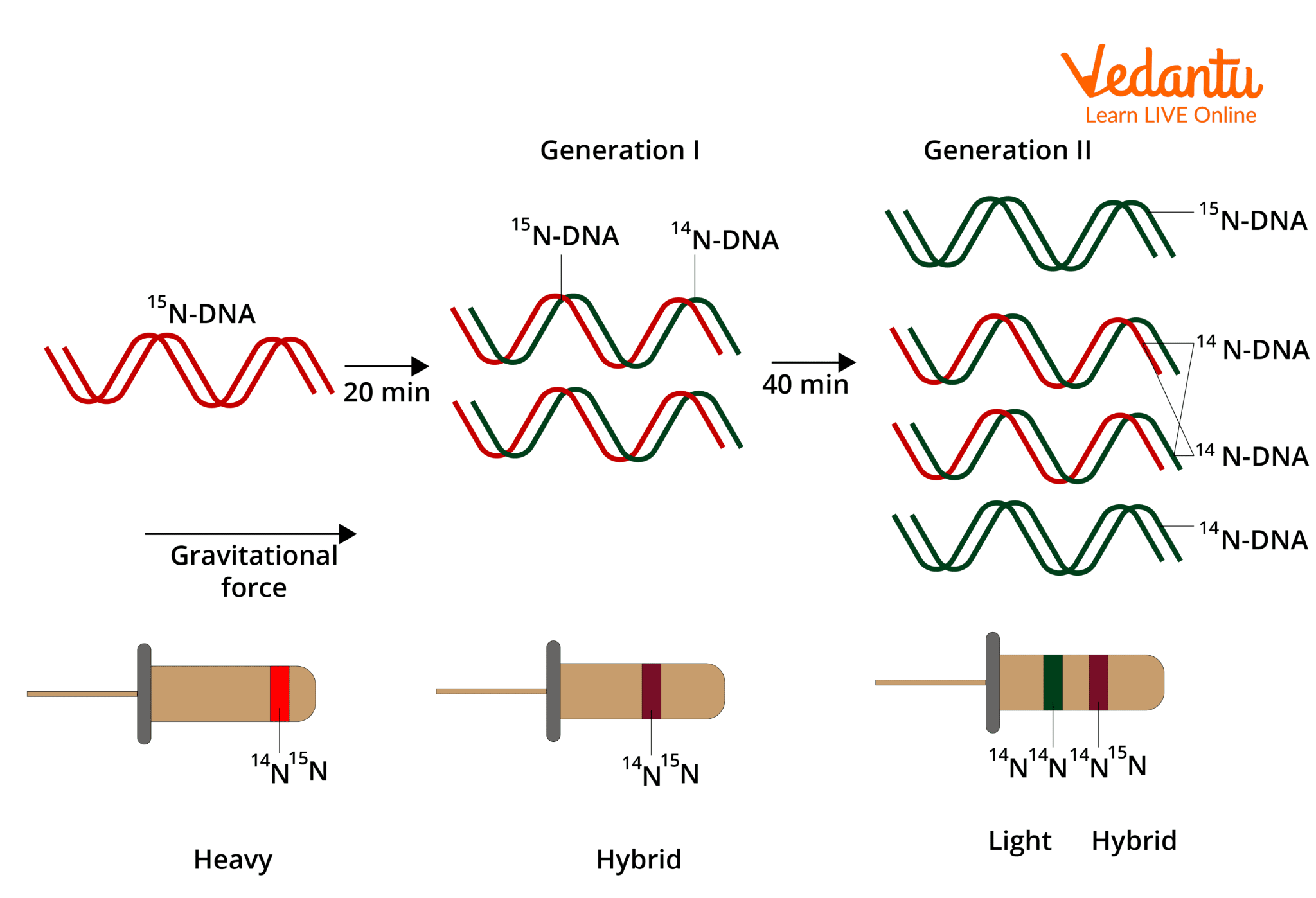
This brilliant process enabled the researchers to distinguish between the three DNA replication models, providing visual evidence through banding patterns in centrifuge tubes.
Isotopic Labeling: The Key Technique
To identify the path of the DNA strands, Meselson and Stahl used isotopic labeling. Nitrogen is present in DNA bases; by substituting 15N (heavier) with 14N (lighter), DNA composed of each type could be easily differentiated. The DNA’s density—affected by the actual nitrogen in its structure—shifted predictably, so each generation of replicated DNA formed unique bands after centrifugation.
Interpreting Results: Banding Patterns for Each Model
Each DNA replication model predicted a different pattern of DNA bands after one and two rounds of replication in the light nitrogen medium. Here’s how the models compare:
Expected DNA Banding Patterns
| Model | Main Concept | Band After 1st Generation | Band After 2nd Generation |
|---|---|---|---|
| Semi-conservative | Each new DNA: 1 old + 1 new strand | Intermediate (hybrid) | Hybrid + light |
| Conservative | Original DNA conserved, all new is light | Heavy + light | Heavy + light (same) |
| Dispersive | Each strand: mix of old and new segments | Hybrid (diffuse) | Single, more diffuse band |
The experiment’s actual results—one hybrid band after the first generation, then both hybrid and light bands after the second—matched only the semiconservative model. No heavy band appeared after the first generation, and the diffuse band predicted by the dispersive model was not observed.
Meselson and Stahl Experiment Explanation: Why Is It So Important?
The Meselson and Stahl Experiment explanation shows why DNA replication generates faithful copies of genetic material. Their method provided the first clear experimental proof supporting the Watson and Crick model of DNA as a double helix undergoing semiconservative replication. Today, this understanding powers research and innovations in genetics, molecular diagnostics, agriculture, and medicine, including human genome studies and genetic engineering.
Examples and Applications in Biology
The experiment’s logic applies widely in modern science. For example:
- Medical diagnostics often track labeled molecules to identify cell activity, mutations, or diseases.
- Gene therapy relies on accurate DNA copying, vital for treating inherited conditions.
- Agricultural biotechnology uses DNA replication for developing disease-resistant crops and analyzing genetic markers.
- Understanding semiconservative DNA replication is crucial for grasping recombinant DNA technology and molecular biology applications in diverse fields.
Meselson and Stahl Experiment in Exams: Common Questions
Students preparing for NEET, CBSE, and ICSE often encounter these popular Meselson and Stahl experiment questions:
- Define the Meselson and Stahl experiment and explain its procedure step-by-step.
- Draw and label the Meselson and Stahl experiment diagram. Interpret the observed DNA bands.
- What would the DNA patterns look like under the conservative or dispersive models?
- Explain the significance of nitrogen isotopes in this experiment.
- How does this experiment relate to the concept of genetic inheritance?
- For further conceptual clarity, see related topics on traits inheritance and cell theory.
Meselson and Stahl Experiment Diagram for Class 12
A well-labeled diagram clarifies the Meselson and Stahl experiment for class 12 and competitive exam students. Diagrams typically show:
- Growth of bacteria in 15N and transfer to 14N medium
- Sampling after each replication
- Centrifuge tubes with distinct bands showing hybrid, heavy, and light DNA positions
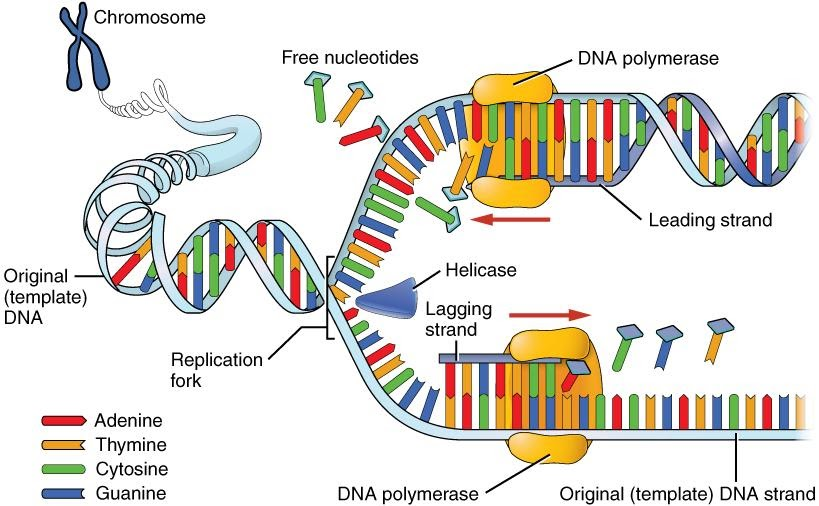
This makes it easier to visualize how isotopic labeling led to definitive conclusions about DNA replication models.
Difference Between Conservative, Semiconservative, and Dispersive DNA Replication
| Aspect | Conservative | Semi-conservative | Dispersive |
|---|---|---|---|
| Main Feature | Entire parental DNA remains intact | Each new molecule: 1 old + 1 new strand | DNA strands with mixed segments |
| 1st Generation Band | 2 bands (heavy & light) | 1 hybrid band | 1 intermediate, diffuse band |
| Genetic Stability | Less accurate inheritance | Accurate inheritance | Prone to more mixing errors |
Understanding these differences helps explain why the semiconservative model ensures faithful genetic transmission across generations.
Significance and Real-World Relevance
The Meselson and Stahl Experiment’s significance is vast. It paved the way for modern genetic engineering, biotechnology breakthroughs, and advances in diagnostics and agriculture. This experiment's logic and clarity are echoed in other landmark experiments like Hershey and Chase or Mendel’s work on inheritance. These scientific insights continue to influence how we fight diseases, breed crops, and study life at the molecular level.
Quick Meselson and Stahl Experiment MCQs for Practice
Test your understanding of the Meselson and Stahl experiment with these multiple-choice questions. Practice like this is helpful for board exams and entrance tests.
- Which isotope was used to label parental DNA in the Meselson and Stahl experiment?
- What banding pattern is seen after one round of replication in semiconservative replication?
- How does dispersive replication differ from semiconservative replication?
- What is the significance of CsCl gradient centrifugation in the experiment?
Conclusion
The Meselson and Stahl experiment is a classic in biology, illustrating scientific investigation's power to reveal life’s molecular rules. Its legacy continues in classrooms, research labs, agriculture, and hospitals—where understanding DNA replication impacts genetics, health, and biotechnology advancements.
In summary, the Meselson and Stahl experiment demonstrated the semiconservative DNA replication process, fundamentally changing how scientists understand heredity. This experiment’s stepwise approach, use of isotopic labeling, and practical applications make it essential knowledge for students and professionals. For further learning, Vedantu provides resources connecting these topics to broader biological science and biotechnology fields.


FAQs on Meselson and Stahl Experiment and the Proof of Semiconservative DNA Replication
1. What is the Meselson and Stahl experiment?
The Meselson and Stahl experiment was a 1958 experiment that proved DNA replicates by the semi-conservative model.
- Conducted by Matthew Meselson and Franklin Stahl.
- Used Escherichia coli (E. coli) bacteria.
- Demonstrated that each new DNA molecule contains one original (parental) strand and one newly synthesized strand.
2. What is the semi-conservative model of DNA replication?
The semi-conservative model states that each daughter DNA molecule contains one old (parental) strand and one newly synthesized strand.
- During replication, the two DNA strands separate.
- Each strand acts as a template for a new complementary strand.
- The result is two DNA molecules, each half old and half new.
3. How did Meselson and Stahl prove semi-conservative replication?
Meselson and Stahl proved semi-conservative replication using nitrogen isotopes and density gradient centrifugation.
- E. coli were first grown in heavy nitrogen (¹⁵N) medium.
- They were then shifted to light nitrogen (¹⁴N) medium.
- DNA was extracted after each generation.
- DNA density was analyzed using cesium chloride gradient centrifugation.
4. Why was nitrogen used in the Meselson and Stahl experiment?
Nitrogen was used because DNA contains nitrogen in its nitrogenous bases, allowing labeling with different isotopes.
- ¹⁵N is a heavy isotope of nitrogen.
- ¹⁴N is a lighter, common isotope.
- Incorporating these isotopes changed the density of DNA.
5. What is density gradient centrifugation in the Meselson and Stahl experiment?
Density gradient centrifugation is a technique that separates DNA molecules based on their density.
- DNA samples were mixed with cesium chloride (CsCl).
- High-speed centrifugation created a density gradient.
- Heavy DNA settled lower, light DNA higher, and hybrid DNA in between.
6. What were the results of the Meselson and Stahl experiment?
The results showed that DNA replication follows the semi-conservative model.
- After one generation in ¹⁴N medium, DNA showed an intermediate (hybrid) band.
- After two generations, two bands appeared: one light and one intermediate.
- No fully heavy DNA appeared after replication in light medium.
7. What is the difference between conservative, semi-conservative, and dispersive replication?
The three models differ in how parental DNA strands are distributed in daughter molecules.
- Conservative model: The original DNA remains intact, and a completely new copy is made.
- Semi-conservative model: Each daughter DNA has one old and one new strand.
- Dispersive model: Old and new DNA segments are mixed within each strand.
8. Why is the Meselson and Stahl experiment called the most beautiful experiment in biology?
The Meselson and Stahl experiment is called the most beautiful experiment because it elegantly and conclusively proved the mechanism of DNA replication.
- It used a simple yet powerful experimental design.
- It directly tested competing hypotheses.
- It produced clear, interpretable results.
9. Which organism was used in the Meselson and Stahl experiment?
The bacterium Escherichia coli (E. coli) was used in the Meselson and Stahl experiment.
- E. coli replicates rapidly, allowing observation across generations.
- It easily incorporates nitrogen isotopes into its DNA.
- It is a common model organism in molecular genetics.
10. What is the significance of the Meselson and Stahl experiment in molecular biology?
The significance of the Meselson and Stahl experiment is that it provided definitive proof of the semi-conservative nature of DNA replication.
- Confirmed predictions made by the Watson and Crick DNA model.
- Established the correct mechanism of genetic inheritance at the molecular level.
- Laid the foundation for modern molecular genetics and biotechnology.



