




What Is Microsporogenesis Definition Process and Stages Explained
Microsporogenesis is a fundamental biological process that plays a vital role in the reproduction of flowering plants. Understanding microsporogenesis helps elucidate how pollen grains form within the anther. This topic is essential for students, as it connects plant reproduction, genetics, and agricultural practices, offering insight into plant breeding and crop improvement.
What is Microsporogenesis?
Microsporogenesis refers to the sequence of events resulting in the formation of microspores from microspore mother cells inside the anther of flowering plants. Microspores later develop into pollen grains, which are crucial for plant fertilization. To define microsporogenesis simply: it is the process that ensures genetic diversity and successful sexual reproduction in plants, paralleling the importance of megasporogenesis in ovule formation.
Structure of the Anther in Microsporogenesis
The anther, the pollen-producing part of the stamen, contains several layers and tissues essential for microsporogenesis. The walls comprise the epidermis, endothecium, middle layers, and the innermost tapetum. At the core, sporogenous tissue gives rise to microspore mother cells, which initiate pollen development. A clear understanding of anther anatomy is fundamental when exploring the structure of microsporogenesis.

Process of Microsporogenesis
To describe the process of microsporogenesis, let’s follow the orderly stages occurring in the anther. Each step is essential for the formation of viable and genetically diverse pollen grains.
- Development of Archesporial Cells: Specialized cells in the anther’s sporogenous tissue form the archesporial cells.
- Formation of Primary Sporogenous Cells: Archesporial cells divide mitotically to produce primary sporogenous cells.
- Generation of Microspore Mother Cells: Primary sporogenous cells differentiate into microspore mother cells (also called pollen mother cells).
- Meiotic Division: Each microspore mother cell undergoes meiosis, yielding a tetrad of four haploid microspores.
- Tetrad Separation: The four microspores detach from each other following special enzymes secreted by the tapetum.
- Pollen Grain Maturation: Each microspore transforms into a mature pollen grain, released from the anther for pollination.
This reductional cell division ensures genetic variation, vital for crop improvement and resilience to environmental changes, as further discussed in meiosis.
Microsporogenesis Diagram
A diagram of microsporogenesis illustrates the sequence, from the microspore mother cell through meiosis to the formation of pollen grains. Understanding the microsporogenesis diagram helps visualize cellular changes and the emergence of pollen critical for plant fertilization.
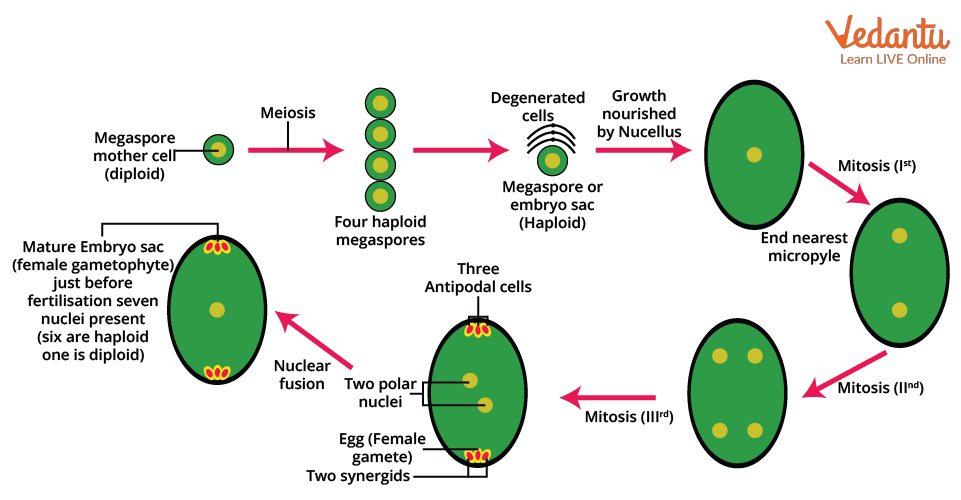
Observing these diagrams clarifies the intricate nature of plant reproductive biology and is commonly required in biology exams or projects, like those found in CBSE Class 7 Important Diagrams.
Comparison: Microsporogenesis and Megasporogenesis
| Aspect | Microsporogenesis | Megasporogenesis |
|---|---|---|
| Location | Anther (male part) | Ovule (female part) |
| Mother Cell | Microspore mother cell | Megaspore mother cell |
| Product | Microspores (pollen grains) | Megaspores (embryo sac formation) |
| Function | Leads to male gamete formation | Leads to female gamete formation |
While both processes involve meiosis and gametophyte development, microsporogenesis and megasporogenesis differ in their location and outcome, ensuring both male and female gametes are available for fertilization. This coordinated development supports the diversity and success of plant species.
Significance of Microsporogenesis
The process of microsporogenesis is critical for ensuring plant genetic diversity. It enables the formation of numerous pollen grains that contribute to cross-pollination, directly impacting food production and crop yields. Understanding microsporogenesis is essential in fields like food science and plant breeding, helping scientists develop resilient, high-yield crops crucial for global food security.
Applications and Real-World Relevance
Knowledge of microsporogenesis is used in modern agriculture, especially in hybrid seed production and plant breeding. By manipulating this process, researchers can enhance traits like disease resistance and yield. It also plays a role in understanding the effects of climate changes on reproductive success in plants, which is vital for adapting crops to changing environments.
Explore More Biology Topics
For deeper insight into plant development and related biological processes, explore topics like cell theory, biomolecules, and plant reproduction. Vedantu provides a comprehensive range of resources to support your learning at every stage.
In summary, microsporogenesis is a vital cellular process in plant reproduction. It not only produces the pollen required for fertilization but also ensures genetic variation and plant survival. Grasping its stages and significance empowers students and professionals to contribute meaningfully to fields like agriculture, botany, and environmental science.


FAQs on Microsporogenesis in Flowering Plants
1. What is microsporogenesis?
Microsporogenesis is the process by which diploid microspore mother cells (MMCs) undergo meiosis to produce haploid microspores that develop into pollen grains. It occurs in the anther of flowering plants and is an essential step in male gamete formation. The process ensures genetic variation through meiotic division and leads to the formation of four haploid microspores arranged in a tetrad.
2. Where does microsporogenesis occur in plants?
Microsporogenesis occurs in the microsporangia (pollen sacs) of the anther in flowering plants. Specifically:
- The anther typically contains four microsporangia.
- Each microsporangium houses microspore mother cells.
- These cells undergo meiotic division to form haploid microspores.
3. What are microspore mother cells?
Microspore mother cells are diploid (2n) cells in the anther that undergo meiosis to produce haploid microspores. Also called pollen mother cells (PMCs), they:
- Originate from the sporogenous tissue.
- Divide meiotically to form a tetrad of four haploid microspores.
- Play a crucial role in genetic recombination and variation.
4. What are the stages of microsporogenesis?
The stages of microsporogenesis include meiotic divisions that convert diploid cells into haploid microspores. The main stages are:
- Meiosis I – Reductional division producing two haploid cells.
- Meiosis II – Equational division forming four haploid cells.
- Tetrad formation – Four microspores remain temporarily attached.
5. What is a microspore tetrad?
A microspore tetrad is a group of four haploid microspores formed after meiosis of one microspore mother cell. These microspores:
- Remain temporarily enclosed in a common wall made of callose.
- May be arranged in different patterns such as tetrahedral or isobilateral.
- Eventually separate to form individual pollen grains.
6. What is the difference between microsporogenesis and microgametogenesis?
Microsporogenesis is the formation of haploid microspores by meiosis, whereas microgametogenesis is the development of microspores into mature pollen grains. The key differences are:
- Microsporogenesis: Involves meiotic division of diploid cells.
- Microgametogenesis: Involves mitotic divisions of haploid microspores.
- Outcome: Microsporogenesis forms microspores; microgametogenesis forms the male gametophyte.
7. Why is microsporogenesis important in plant reproduction?
Microsporogenesis is important because it produces haploid microspores that develop into pollen grains containing male gametes. Its significance includes:
- Ensuring genetic variation through meiosis.
- Forming the basis of sexual reproduction in angiosperms.
- Maintaining the correct chromosome number across generations.
8. How many microspores are formed from one microspore mother cell?
One microspore mother cell produces four haploid microspores after completing meiosis. This happens because:
- Meiosis I forms two haploid cells.
- Meiosis II divides each into two more cells.
- The result is a tetrad of four microspores.
9. What role does callose play in microsporogenesis?
Callose forms a temporary wall around the developing microspore tetrad during microsporogenesis. Its functions include:
- Separating meiotic products after division.
- Protecting developing microspores.
- Preventing cytoplasmic fusion between adjacent cells.
10. Can you give an example of microsporogenesis in a flowering plant?
Microsporogenesis in plants like Lilium (lily) occurs in the anther where diploid microspore mother cells undergo meiosis to form haploid microspores. In this example:
- Each anther contains four microsporangia.
- Microspore mother cells divide meiotically.
- Tetrahedral tetrads of microspores are commonly formed.



