



Muscle tissues are made up of specialised cells that have the capacity to contract and relax. They help in movement of an organism.There are three types of muscular tissues- skeletal muscles, smooth muscles and cardiac muscles. This is one of the most important parts of our body that is composed of cells. From this article, we can learn that,
Muscular tissue’s function, its characteristics and its types.
A detailed diagram of muscular tissue.

What Is Muscular Tissue Definition Types Structure and Functions
Our body is composed of various cells and organs that function in several ways. Each part of our internal organs has a specific role in its own for the smooth functioning of our body. But, the main system that helps in the movement, as well as protection of our body, is nothing but the muscular tissue system. As a number of organs and tissues have specific duties for our body, these tissues act as a protective coat for skeletons and also carry various jobs that we are not able to do on our own. These tissues prevent any cracking, or breaking of bones easily and help in the movement of arms, legs etc. Let us learn about this in a detailed manner.
What is Muscular Tissue?
A tissue that surrounds the entire skeleton structure of our body is termed muscular tissue. These tissues are made up of several cells that have the ability to shorten or contract in order to produce movement of the body parts. These cells are highly supplied with blood vessels, which carry blood to the required parts of the body. These tissues also help in stretching and have good characteristics of contractility and elasticity. There are types of muscle tissues in our body that perform their respective functions.
Types of Muscular Tissue
It is said that there are more than 600 muscles in our body, all characterised by their work inside the body. Some can help you digest the food and some can protect your heart. Some of the main types of muscular tissue are:
Skeletal: These muscles cover the skeleton parts of the body. These tissues also help us in balancing the weight of the skeletons and make movement on our own. This is one of the muscular tissues that we have control over. These are part of the musculoskeletal system, also working with tendons and ligaments, helping with posture.
Cardiac: The muscles that line up the outline of the heart are called cardiac muscles. These muscles are delicate, as well as non-voluntary. They are responsible for pumping blood and making it travel through the cardiovascular system. We cannot control these muscles as it works with the internal organs. But, the heart tells it to stop the contract on its own.
Smooth: These are the muscles that line up the other organs of our body, like the stomach, bladder, and intestines. They play a vital role on their own without us knowing. For instance, we can fill up the urinary bladder or move waste to the intestines. They also help in the female, and male reproductive system and respiratory systems.
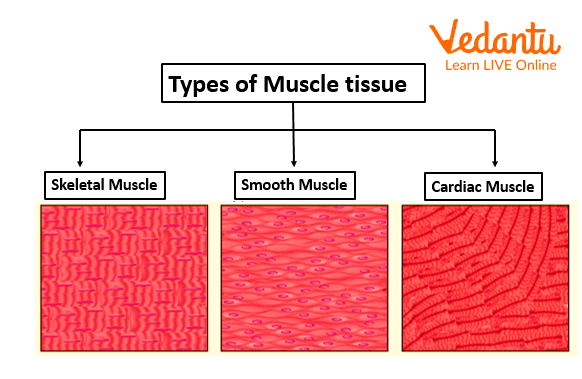
Types of Muscular tissue
Functions of Muscular Tissue
There are several tissues that work according to their functions. Some of the functions are:
Stability: These contribute to the joints, stabilising them. They also assist in lifting weights.
Mobility: Movements like walking, writing, running, etc. Are done with the help of the muscles.
Posture: Muscles help in straightening the posture of the body. Good posture relies on strong muscles, whereas bad posture relies on weak muscles.
Respiration: A normal activity like breathing too involves muscles. Diaphragm muscles help in steady respiration, helping the lungs with inhaling and exhaling air.
Circulation: Blood circulation also involves the help of muscle tissue. This happens when cardiovascular muscles pump blood to all parts of the body, involuntarily. The arteries and veins play a further role in the circulation of blood.
Digestion: Muscles on the abdomen and GI tract are involved in the process of digestion. When the digested food passes through the GI tract by peristalsis, the hollow muscles push the waste to the intestines to pass the food as stools.
Urination: The urinary bladder muscle is both smooth and skeletal muscle, that helps in holding urine and releasing it from the urinary bladder.
Characteristic of Muscular tissue
Muscles have various characteristics based on the work they do. They are:
Skeletal muscle: Long, striated and multinucleated (more than one nucleus) muscles.
Cardiac muscles: Muscles are short and narrow, rectangular in shape. They are about 0.02mm wide and 0.01mm long.
Smooth muscles: They are spindle-shaped and contain a single nucleus. They range from about 10 to 600 micrometres. They are elastic muscles.
Structure of Muscular Tissue
The Muscular tissues are bundled together and surrounded by tough connective tissues like epimysium. This epimysium surrounds the long nerve Fibre called fascicles, which is These epimysium surrounds the long nerve Fibre called fascicles, which is surrounded by perimysium. Another protective layer called endomysium surrounds the fibres. These layers of fibres in muscles help in muscle contraction.
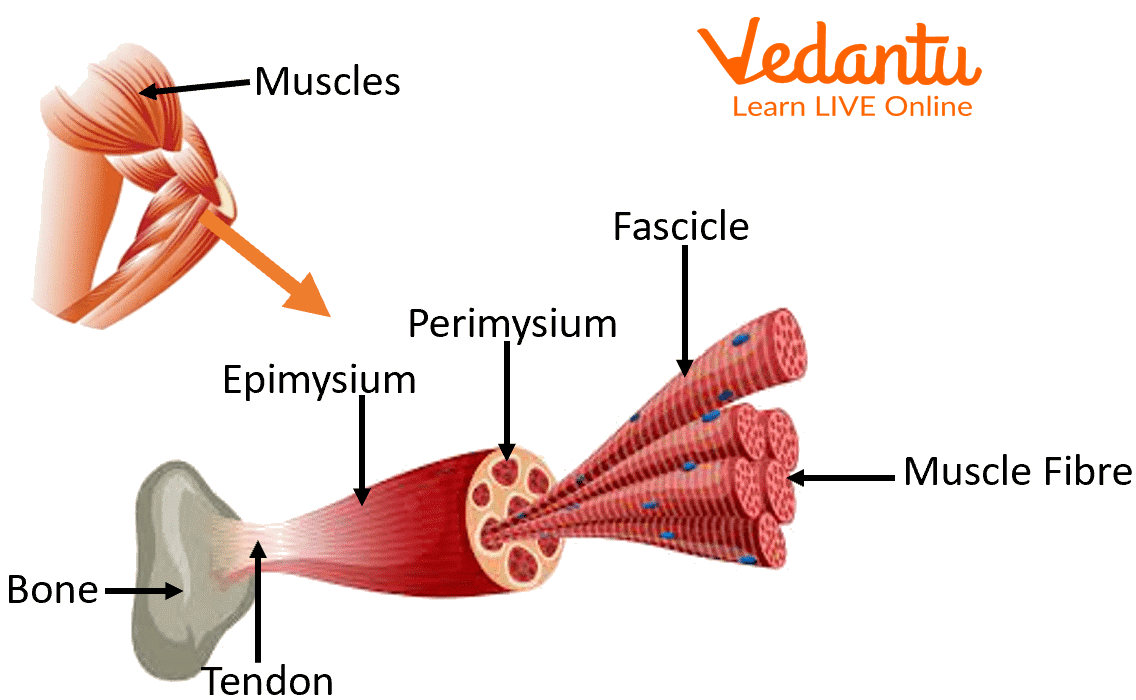
Structure of Muscular tissue
Interesting Facts
The largest muscle in our body is the gluteus Maximus
The strongest muscle in our body is the muscle of the tongue.
Muscles make up to 40% of the weight of our body.
The heart is the hardest working muscle in the entire body.
Key Features
Muscular tissue is composed of various fibres of tissues that work together.
There are mainly three types of muscles, skeletal muscle, cardiac muscle and smooth muscle.
Muscle helps us in day-to-day activities like waking, running, writing etc.
Some muscles are voluntary, while some are involuntary.


FAQs on Muscular Tissue Complete Overview of Structure and Function
1. What is muscular tissue?
Muscular tissue is a specialized tissue that enables movement by contracting and relaxing. It is composed of elongated cells called muscle fibers that contain contractile proteins responsible for generating force. In the human body, muscular tissue:
- Produces body movements
- Maintains posture
- Generates heat
- Moves substances inside organs
2. What are the three types of muscular tissue?
The three types of muscular tissue are skeletal muscle, cardiac muscle, and smooth muscle. Each type differs in structure and function:
- Skeletal muscle – voluntary, attached to bones, striated appearance
- Cardiac muscle – involuntary, found in the heart, branched and striated
- Smooth muscle – involuntary, non-striated, found in walls of internal organs
3. What is the function of skeletal muscle?
The main function of skeletal muscle is to produce voluntary body movements. It is attached to bones by tendons and contracts in response to signals from the somatic nervous system. Skeletal muscle also:
- Maintains posture
- Stabilizes joints
- Generates body heat through contraction
4. How does cardiac muscle differ from skeletal muscle?
Cardiac muscle differs from skeletal muscle in structure, control, and function. The key differences include:
- Cardiac muscle is involuntary and controlled by the autonomic nervous system.
- Skeletal muscle is voluntary and controlled consciously.
- Cardiac muscle cells are branched and connected by intercalated discs.
- Skeletal muscle fibers are long, cylindrical, and multinucleated.
5. What is smooth muscle and where is it found?
Smooth muscle is a non-striated, involuntary muscle tissue found in the walls of internal organs. It controls slow, sustained movements without conscious effort. Smooth muscle is located in:
- Digestive tract (stomach and intestines)
- Blood vessels
- Urinary bladder
- Uterus
6. How does muscle contraction occur?
Muscle contraction occurs through the sliding filament mechanism, where actin and myosin filaments slide past each other. The basic steps include:
- Release of calcium ions (Ca²⁺) inside the muscle fiber
- Binding of myosin heads to actin filaments
- Power stroke using ATP energy
- Shortening of the sarcomere
7. What are myofibrils and sarcomeres?
Myofibrils are long contractile structures inside muscle fibers, and sarcomeres are their basic functional units. Each sarcomere contains organized actin and myosin filaments responsible for muscle contraction. Key points include:
- Myofibrils run parallel within a muscle cell
- Sarcomeres give skeletal and cardiac muscle a striated appearance
- Shortening of sarcomeres causes muscle contraction
8. Why is muscular tissue important in the human body?
Muscular tissue is important because it enables movement, circulation, and vital organ function. Without muscular tissue:
- The body could not move or maintain posture
- The heart could not pump blood
- Food could not move through the digestive tract
9. What is the difference between voluntary and involuntary muscles?
Voluntary muscles are controlled consciously, while involuntary muscles function automatically without conscious control. The differences include:
- Voluntary muscles – mainly skeletal muscles, controlled by the somatic nervous system
- Involuntary muscles – cardiac and smooth muscles, controlled by the autonomic nervous system
10. What are the main characteristics of muscular tissue?
The main characteristics of muscular tissue are excitability, contractility, extensibility, and elasticity. These properties allow muscles to function effectively:
- Excitability – ability to respond to stimuli
- Contractility – ability to shorten and produce force
- Extensibility – ability to stretch
- Elasticity – ability to return to original shape
Muscle tissues are made up of specialised cells that have the capacity to contract and relax. They help in movement of an organism.There are three types of muscular tissues- skeletal muscles, smooth muscles and cardiac muscles. This is one of the most important parts of our body that is composed of cells. From this article, we can learn that,
Muscular tissue’s function, its characteristics and its types.
A detailed diagram of muscular tissue.



