




Process of Pollination Fertilization and Seed Formation in Angiosperms
Sexual reproduction in flowering plants involves the formation and fusion of male and female gametes. This process is unique to angiosperms (flowering plants), where the flower contains both reproductive organs. Below, we explore the structure of a flower, key stages like pollination and fertilisation, and additional insights that will help you understand this essential biological process.
Parts of a Flower
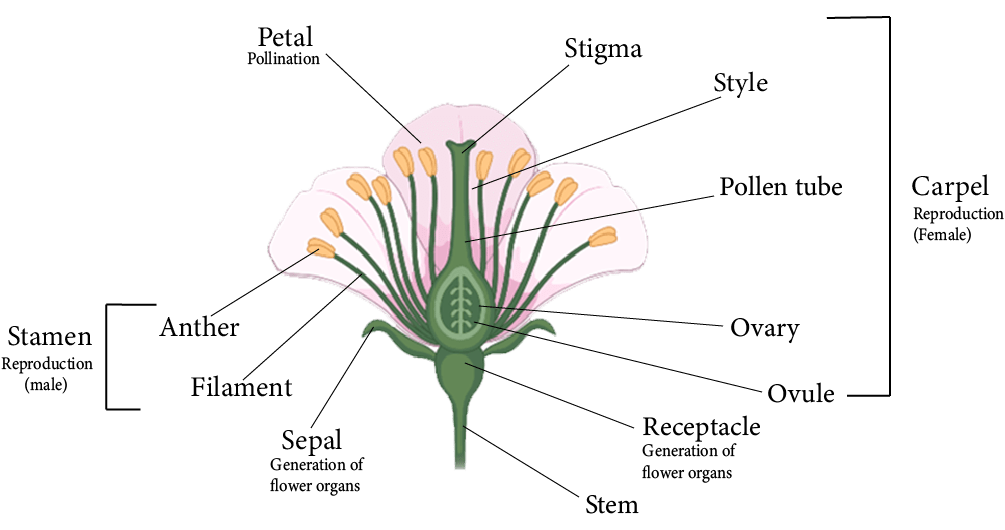
A typical flower is made up of four main whorls – calyx, corolla, androecium, and gynoecium. Some of these parts are reproductive, while others are protective or attractive structures.
Calyx (Sepals)
Outermost whorl, usually green and leaf-like.
Protects the flower when it is in the bud stage.
Sometimes, sepals can be coloured (petaloid).
Corolla (Petals)
Second, whorl petals are often brightly coloured and may produce fragrance.
Helps attract insects and other agents of pollination.
Androecium (Male Reproductive Part)
Third whorl, composed of stamens.
Each stamen has an anther (produces pollen) and a filament (a stalk that holds the anther).
Gynoecium (Female Reproductive Part)
Innermost whorl, made up of one or more pistils (also known as carpels).
Each pistil consists of a stigma (pollen receptor), style (tube-like stalk), and ovary (contains ovules).
Anther (microsporogenesis) → Pollen Formation
Ovary (megasporogenesis) → Egg Cell Formation
Pollination → Transfer of Pollen to Stigma
Pollen Tube Growth → Delivery of Male Gametes
Fertilisation → Zygote and Endosperm Formation
Seed and Fruit Formation
Using a labelled diagram can help visualise how these parts fit together in the flower.
Androecium and Microsporogenesis
The androecium comprises all the stamens in a flower. Within each anther, microsporogenesis takes place, leading to the production of pollen grains (male gametes).
Structure of the Anther
Each anther typically has two lobes, and each lobe usually contains two pollen sacs (microsporangia).
Inside each microsporangium, there are layers of cells that help in pollen development:
Epidermis: Outermost protective layer.
Endothecium: Lies just beneath the epidermis; often develops fibrous thickenings.
Middle Layer: Consists of thin-walled cells, usually three to four layers.
Tapetum: Innermost layer, provides nutrients to developing pollen.
Formation of Pollen Grains
The microspore mother cells (microsporocytes) undergo meiosis to form haploid microspores.
Each microspore develops into a pollen grain, which has two layers:
The outer layer (exine) contains a tough substance called sporopollenin.
The inner layer (intine) is made of cellulose and pectin.
Development of the Male Gametophyte
Within the pollen grain, one vegetative (tube) cell and one generative cell are formed after the first division.
The generative cell later divides to form two male gametes (sperm cells).
When the pollen grain lands on a stigma, the vegetative cell produces the pollen tube that carries the male gametes towards the ovule.
Gynoecium and Megasporogenesis
The gynoecium is the female reproductive organ comprising one or more pistils. Each pistil has:
Stigma: The top surface where pollen grains land.
Style: A tube-like structure that connects the stigma to the ovary.
Ovary: Enlarged basal part containing one or more ovules.
Formation of Ovules (Megasporogenesis)
Inside each ovule lies a megaspore mother cell (megasporocyte).
Through meiosis, this cell produces four haploid megaspores. Usually, only one megaspore remains functional while the others degenerate.
The functional megaspore undergoes divisions to form the female gametophyte (embryo sac), which contains the egg cell and other nuclei (including polar nuclei).
Pollination
Pollination is the process of transferring pollen from the anther to the stigma, which is essential for the sexual reproduction of flowering plants.
Self-Pollination: The pollen reaches the stigma of either the same flower or another flower on the same plant.
Cross-Pollination: The pollen moves from the anther of one plant to the stigma of a different plant of the same species.
Factors like wind, water, insects, and animals play a significant role in pollinating different plant species. Cross-pollination enhances genetic diversity within a population.
Fertilisation
After successful pollination, a pollen tube emerges from the pollen grain on the stigma and grows through the style to reach the ovary. This tube carries the two male gametes:
One male gamete fuses with the egg cell in the embryo sac to form the zygote.
The other male gamete fuses with the polar nuclei, forming the endosperm (a nutrient-rich tissue that supports the developing embryo).
This process, called double fertilisation, is characteristic of angiosperms.
After fertilisation, the ovule transforms into the seed, and the ovary usually develops into the fruit.
Functions of a Flower
Ensures sexual reproduction by producing and protecting male and female gametes.
Facilitates pollination through attractive petals, scents, and nectar.
Provides a site for fertilisation and seed (ovule) formation.
In many species, the fruit formed from the ovary helps in seed dispersal.
Additional Insights
Monocarpic Plants
Some plants (e.g., bamboo) flower only once in their lifetime, produce seeds, and then die. These are known as monocarpic plants.
Gregarious Flowering
In certain species of bamboo, all individuals of the same species flower at the same time, regardless of location, usually after intervals of several decades.
Quiz Time
Test your knowledge with these quick questions!
Which part of the flower holds the anther?
A. Style
B. Filament
C. Stigma
D. Ovary
Answer: B. Filament
Where does double fertilisation occur in a flowering plant?
A. Ovary
B. Anther
C. Petal
D. Sepal
Answer: A. Ovary
Which one is the male gamete-bearing structure in the pollen grain?
A. Vegetative cell
B. Generative cell
C. Endosperm
D. Tapetum
Answer: B. Generative cell
What type of pollination involves pollen transfer between different plants of the same species?
A. Self-pollination
B. Cross-pollination
C. Natural pollination
D. Synthetic pollination
Answer: B. Cross-pollination
Related Topics


FAQs on Sexual Reproduction in Flowering Plants Explained
1. What is sexual reproduction in flowering plants?
Sexual reproduction in flowering plants is the process by which male and female gametes fuse to form a zygote that develops into a seed. It occurs in the flower, the reproductive organ of angiosperms. The process involves:
- Formation of pollen grains (male gametophytes) in the anther
- Formation of the embryo sac (female gametophyte) in the ovule
- Pollination (transfer of pollen to stigma)
- Fertilization leading to seed and fruit formation
2. What are the male and female reproductive parts of a flower?
The male reproductive part is the stamen and the female reproductive part is the pistil (carpel).
- Stamen consists of:
- Anther – produces pollen grains
- Filament – supports the anther
- Pistil/Carpel consists of:
- Stigma – receives pollen
- Style – connects stigma to ovary
- Ovary – contains ovules
3. What is pollination in flowering plants?
Pollination is the transfer of pollen grains from the anther to the stigma of a flower. It is the first step in sexual reproduction and occurs before fertilization. There are two main types:
- Self-pollination – pollen is transferred to the stigma of the same flower or plant
- Cross-pollination – pollen is transferred to a flower on a different plant of the same species
4. What is double fertilization in angiosperms?
Double fertilization is a unique process in angiosperms where two fusion events occur inside the ovule. It involves:
- One male gamete fusing with the egg cell to form a zygote (syngamy)
- The other male gamete fusing with two polar nuclei to form the endosperm (triple fusion)
5. How does fertilization occur in flowering plants step by step?
Fertilization in flowering plants occurs when male gametes reach the ovule and fuse with female nuclei. The steps include:
- Pollen grain lands on the stigma
- Pollen tube grows through the style toward the ovary
- Male gametes travel through the pollen tube
- One gamete fuses with the egg (forming zygote)
- The second gamete forms the endosperm (double fertilization)
6. What is the structure and function of the ovule?
The ovule is the structure inside the ovary that contains the embryo sac and develops into a seed after fertilization. Its main parts include:
- Integuments – protective layers
- Micropyle – opening for pollen tube entry
- Nucellus – nutritive tissue
- Embryo sac – contains egg cell and polar nuclei
7. What is the difference between pollination and fertilization?
Pollination is the transfer of pollen to the stigma, while fertilization is the fusion of male and female gametes. Key differences include:
- Pollination: Occurs outside the ovule; no gamete fusion
- Fertilization: Occurs inside the ovule; involves gamete fusion
- Pollination precedes fertilization
8. What happens after fertilization in flowering plants?
After fertilization, the zygote develops into an embryo and the ovule becomes a seed. The changes include:
- Zygote develops into embryo
- Endosperm provides nutrition
- Ovule transforms into seed
- Ovary develops into fruit
9. What is the role of pollen grains in sexual reproduction?
Pollen grains are the male gametophytes that carry male gametes to the female reproductive part of the flower. Their functions include:
- Producing two male gametes
- Forming a pollen tube after landing on stigma
- Delivering gametes to the embryo sac
10. Why is sexual reproduction important in flowering plants?
Sexual reproduction is important because it produces genetic variation and ensures survival of plant species. Its significance includes:
- Creates new gene combinations
- Improves adaptability to environmental changes
- Leads to seed and fruit formation
- Supports evolution and biodiversity



