




What Is Spontaneous Generation and How Was It Disproved
Spontaneous generation refers to the old biological idea that living organisms could suddenly develop from nonliving matter. It was once believed that maggots could appear on decaying meat or that microbes and small animals might arise from mud, dust, or supposedly lifeless things. This theory tried to explain the origin of certain forms of life before modern biology provided scientific tools and observations for understanding life’s appearance.
Understanding Spontaneous Generation
The concept of spontaneous generation was based on everyday observations. For instance, when meat was left exposed, people noticed maggots would appear. Before the cause was known, many accepted that the meat itself gave rise to the maggots. Similarly, moulds or tiny living things seemed to materialize on spoiled food, giving rise to the belief in spontaneous creation of life.
Such beliefs were widespread because scientific knowledge about microorganisms and life cycles was limited. The theory tried to fill gaps in understanding by linking living and nonliving matter through direct transformation under the right conditions.
Key Examples of Spontaneous Generation
- Appearance of maggots on rotting meat.
- Formation of mould on decaying bread or fruit.
- Emergence of small creatures in stagnant water or mud.
People often linked such occurrences to spontaneous generation, as these seemed to involve life emerging from lifeless substances without an apparent parent organism.
Scientific Challenges and Experiments
Although spontaneous generation was a dominant idea, it was tested and questioned by many scientists over time. Key experiments demonstrated that living organisms do not simply arise from nonliving materials. Instead, life comes from existing life forms—even if that life is not immediately visible to the naked eye.
One classic example involved covering meat to prevent exposure to flies. In covered containers, no maggots developed, while maggots appeared only where flies could reach the meat. Such results suggested that life comes from life, not from nonliving matter.
Principles and Definitions
| Term | Definition |
|---|---|
| Spontaneous Generation | The hypothetical process by which living organisms develop from nonliving matter. |
| Nonliving Matter | Material that is not part of a living organism, such as meat, mud, or decaying substances. |
Experimental Breakdown: Observing Life Emergence
-
Meat is placed in an open environment.
- Maggots appear after some time.
-
The same meat is placed in a covered or sealed container.
- No maggots develop.
-
Comparing both outcomes leads to the conclusion that maggots do not arise from meat but from another source, such as flies.
These observations led many to question the idea that life could come directly from nonliving matter, forming the foundation for modern scientific understanding.
Scientific Significance
Understanding spontaneous generation and its eventual rejection is important because it demonstrates how scientific ideas change with better evidence. It also shows the value of careful observation and experimentation in biology. The rejection of spontaneous generation paved the way for studying life cycles, microorganisms, and the true origins of living things.
Realizing that living organisms come from other living things, rather than spontaneous appearance, is a central principle in modern biology.
Comparison Table: Spontaneous Generation vs. Scientific Explanation
| Aspect | Spontaneous Generation | Biological Explanation |
|---|---|---|
| Origin of Life | From nonliving matter without parent life | From pre-existing living organisms |
| Evidence | Based on observed appearances | Proven through experiments controlling exposure |
| Scientific Status | Outdated / Disproven | Accepted in biology |
Illustration of Scientific Efforts
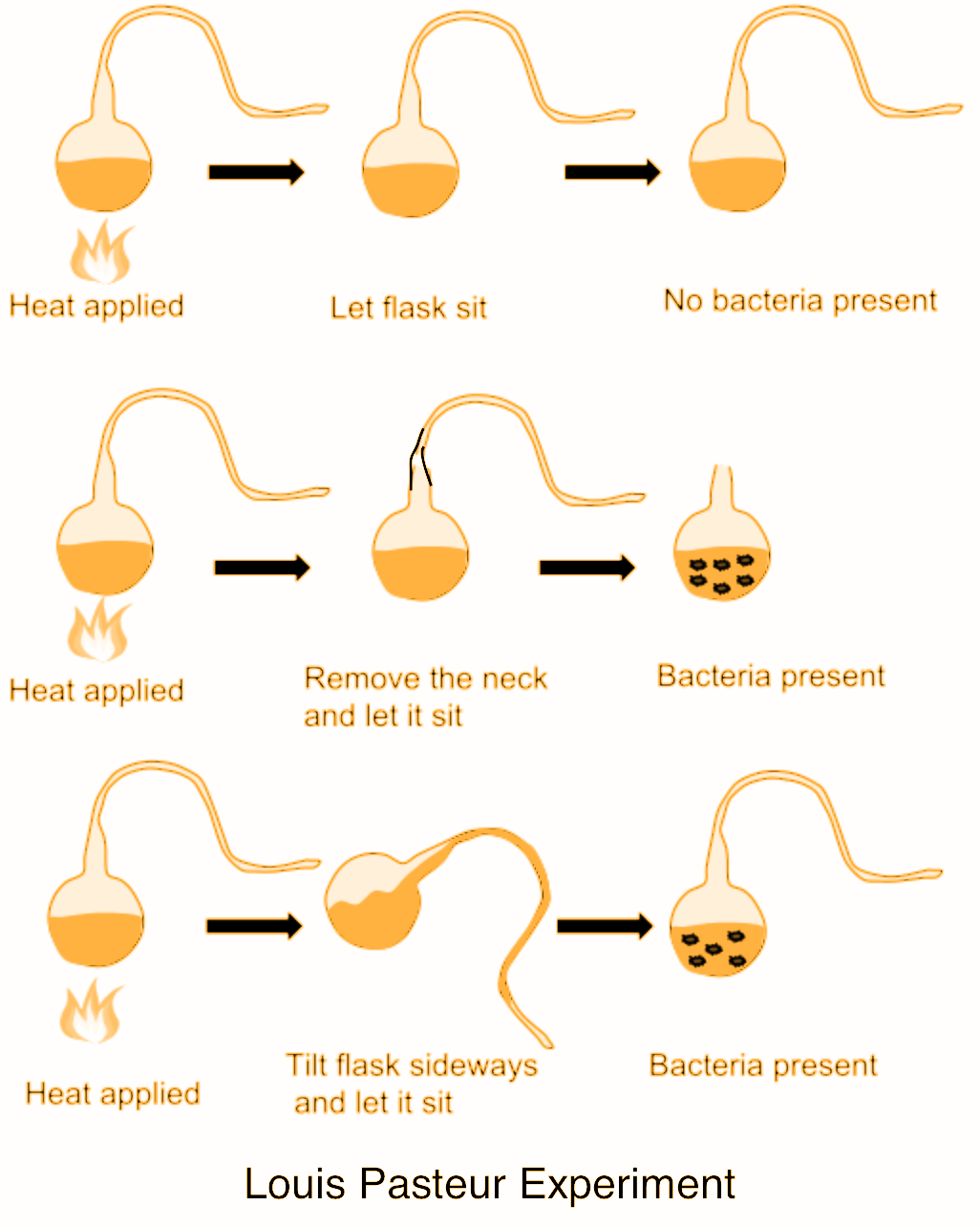
Scientific challenges to spontaneous generation involved systematic experiments. These laid the groundwork for understanding that living organisms arise only when other living things are present, not from nonliving substances in isolation.
Practice Questions and Next Steps
- What observations led people to believe in spontaneous generation?
- How can controlled experiments show the true source of new organisms?
- Why is it important to question and test old theories in science?
For further practice and explanation on this topic, students can explore more concepts and solved examples on spontaneous generation and related biology subjects.
Summary
Spontaneous generation was once used to explain how living things appear from nonliving materials. Careful scientific study has shown that life does not arise without a living source. Understanding this shift in thinking marks a key moment in the history of biology and helps students appreciate the importance of evidence-based science.


FAQs on Spontaneous Generation in Biology
1. What is spontaneous generation in biology?
Spontaneous generation is the outdated biological theory that living organisms arise directly from nonliving matter. This idea suggested that life could form without parents or reproduction.
- It was proposed in ancient times, especially by Aristotle.
- People believed maggots came from rotting meat and mice from dirty grain.
- The theory has been completely disproved and replaced by the concept of biogenesis.
2. Who proposed the theory of spontaneous generation?
The theory of spontaneous generation was first formally proposed by the Greek philosopher Aristotle in the 4th century BCE. He believed that life could arise from nonliving materials under the right conditions.
- Aristotle suggested that organisms like worms and insects formed from mud or decaying matter.
- His ideas influenced scientific thought for nearly 2,000 years.
- The theory remained widely accepted until experimental evidence disproved it.
3. What is the difference between spontaneous generation and biogenesis?
The key difference is that spontaneous generation claims life arises from nonliving matter, while biogenesis states that life comes only from pre-existing life. Biogenesis is the scientifically accepted principle.
- Spontaneous generation: Life from nonliving material.
- Biogenesis: Living cells arise from existing living cells.
- Biogenesis is supported by controlled experiments and modern cell theory.
4. How was spontaneous generation disproved?
Spontaneous generation was disproved through controlled experiments showing that microorganisms come from existing microorganisms, not nonliving matter. Several scientists contributed key evidence.
- Francesco Redi showed maggots come from flies, not meat.
- Lazzaro Spallanzani demonstrated that boiled broth remains sterile if sealed.
- Louis Pasteur used the swan-neck flask experiment to prove microbes arise from airborne microorganisms.
5. What was Louis Pasteur’s swan-neck flask experiment?
Louis Pasteur’s swan-neck flask experiment proved that microorganisms come from existing microbes in the air, not from spontaneous generation. He designed a flask with a curved neck that allowed air in but trapped dust and microbes.
- He boiled nutrient broth to kill existing microorganisms.
- The curved neck prevented airborne microbes from reaching the broth.
- No microbial growth occurred unless the flask was tilted or broken.
6. What is an example of spontaneous generation that people once believed?
A common example of spontaneous generation was the belief that maggots formed directly from rotting meat. Before microscopes and microbiology, people assumed life appeared suddenly from decay.
- Maggots were thought to develop from meat itself.
- Mice were believed to arise from dirty clothes and grain.
- Microorganisms were assumed to grow directly from broth.
7. Why was spontaneous generation widely accepted for so long?
Spontaneous generation was widely accepted because early scientists lacked microscopes and knowledge of microorganisms. People could not see microbial contamination or eggs laid by insects.
- Limited technology prevented accurate observation.
- Decay appeared to produce life suddenly.
- Aristotle’s authority influenced scientific thinking for centuries.
8. How does biogenesis support modern cell theory?
Biogenesis supports modern cell theory by stating that all living cells arise from pre-existing cells. This principle is a core component of cell theory.
- All organisms are made of one or more cells.
- The cell is the basic unit of life.
- New cells form by cell division from existing cells.
9. Is spontaneous generation the same as abiogenesis?
Spontaneous generation is not the same as abiogenesis, although both involve life from nonliving matter. Spontaneous generation suggested life forms regularly and suddenly under normal conditions, while abiogenesis refers to the gradual origin of the first life on early Earth.
- Spontaneous generation: Disproven theory about ongoing life formation.
- Abiogenesis: Scientific hypothesis about the origin of life billions of years ago.
- Abiogenesis involves chemical evolution over long periods.
10. What is the importance of disproving spontaneous generation in biology?
Disproving spontaneous generation was important because it established the principle of biogenesis and advanced modern microbiology. This shift transformed scientific understanding of life.
- It led to improved sterilization and aseptic techniques.
- It supported the development of the germ theory of disease.
- It strengthened experimental scientific methods.



