



History, Geography and Key Facts about Pakistan Occupied Kashmir for Students in Hindi
Pakistan Occupied Kashmir, commonly known as POK, is a politically sensitive and strategically important region in South Asia. It is part of the larger Jammu and Kashmir territory that has been disputed between India and Pakistan since 1947. Understanding the history, geography, political background, and important facts about Pakistan Occupied Kashmir is essential for students preparing for competitive exams and for general awareness. In this article, we will explore 15 interesting facts and the historical background of Pakistan Occupied Kashmir in Hindi for better understanding.
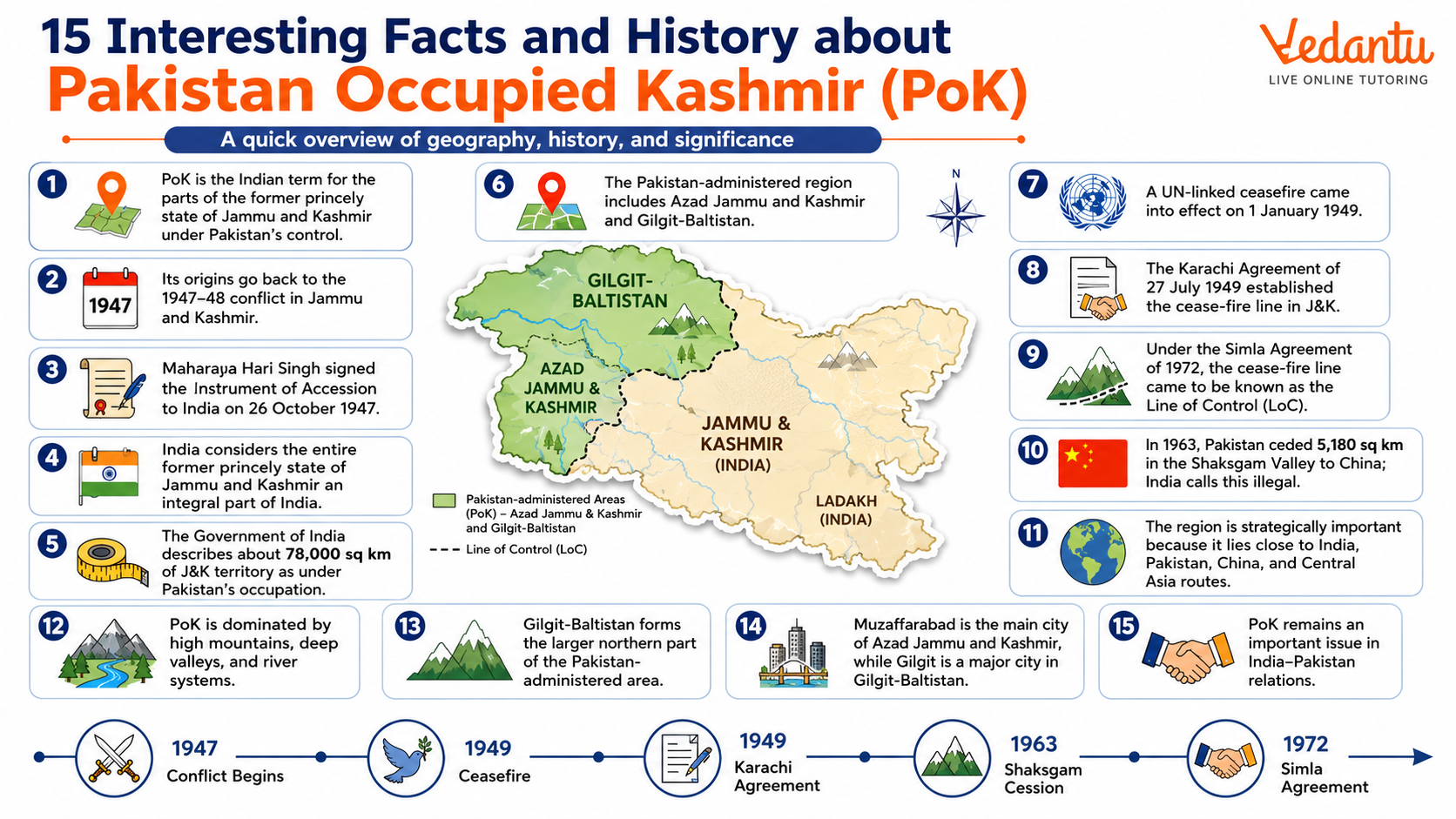
Overview of Pakistan Occupied Kashmir (POK)
Basic Information About POK
| Aspect | Details | Remarks |
|---|---|---|
| Full Name | Pakistan Occupied Kashmir | Part of former princely state of Jammu and Kashmir |
| Administrative Division | Azad Jammu and Kashmir and Gilgit Baltistan | Administered by Pakistan |
| Capital (AJK) | Muzaffarabad | Main administrative center |
Pakistan Occupied Kashmir consists mainly of two regions - Azad Jammu and Kashmir (AJK) and Gilgit Baltistan. India considers this entire region as an integral part of its territory, while Pakistan administers it separately.
Historical Background of Pakistan Occupied Kashmir
1. Accession of Jammu and Kashmir in 1947
After the partition of India in 1947, princely states were given the option to join either India or Pakistan. Maharaja Hari Singh, the ruler of Jammu and Kashmir, initially chose to remain independent. However, after tribal invasions supported by Pakistan, he signed the Instrument of Accession to India on 26 October 1947.
2. First Indo Pakistan War (1947-48)
Following the accession, war broke out between India and Pakistan. In 1948, a ceasefire was declared under the supervision of the United Nations. The ceasefire line later became known as the Line of Control (LoC). The area under Pakistan's control came to be known as Pakistan Occupied Kashmir.
3. United Nations Involvement
The United Nations called for a plebiscite to determine the wishes of the people, but it required Pakistan to withdraw its forces first. Since the conditions were never fulfilled, the plebiscite was never conducted.
15 Interesting Facts About Pakistan Occupied Kashmir
- POK covers approximately 13,000 square kilometers in Azad Jammu and Kashmir, while Gilgit Baltistan covers around 72,000 square kilometers.
- The Line of Control separates Indian administered Jammu and Kashmir from Pakistan Occupied Kashmir.
- Gilgit Baltistan was formerly known as the Northern Areas.
- The region is strategically important due to its borders with China and Afghanistan.
- The China Pakistan Economic Corridor (CPEC) passes through Gilgit Baltistan.
- Pakistan refers to part of POK as Azad Kashmir, meaning Free Kashmir.
- India officially considers POK as illegally occupied territory.
- The region is mountainous and includes parts of the Himalayas and Karakoram ranges.
- K2, the second highest mountain in the world, is located in Gilgit Baltistan.
- The region has significant water resources and rivers like the Jhelum and Indus flow through it.
- POK has its own elected assembly in Azad Jammu and Kashmir.
- Defense and foreign affairs of the region are largely controlled by Pakistan.
- The region is frequently discussed in India Pakistan diplomatic talks.
- Several wars between India and Pakistan have roots in the Kashmir issue.
- The constitutional status of Gilgit Baltistan has evolved over time but remains distinct from Pakistan's provinces.
Geographical Importance of POK
Pakistan Occupied Kashmir is geographically significant because of its high mountain ranges, glaciers, and rivers. It forms a crucial link between South Asia, Central Asia, and China. The Karakoram Highway, one of the highest paved roads in the world, passes through Gilgit Baltistan and connects Pakistan with China.
Political and Strategic Importance
The strategic location of POK makes it highly important in terms of defense and geopolitics. The presence of CPEC projects has increased its global relevance. For India, the region holds territorial, political, and emotional significance as it was part of the princely state that legally acceded to India in 1947.
Why Pakistan Occupied Kashmir is Important for Competitive Exams
- Frequently asked in UPSC, SSC, NDA, CDS, and state PSC exams.
- Important for understanding India Pakistan relations.
- Relevant in questions related to geography and international relations.
- Helps in essay and interview preparation.
Conclusion
Pakistan Occupied Kashmir is a region of immense historical, geographical, and political importance. The roots of the dispute go back to the partition of India in 1947 and continue to influence India Pakistan relations today. Understanding the history and key facts about POK helps students build strong general knowledge and prepares them for competitive examinations. A clear grasp of this topic also provides insight into one of the most significant geopolitical issues in South Asia.
FAQs on 15 Interesting Facts and History of Pakistan Occupied Kashmir (PoK) in Hindi
1. What is Pakistan Occupied Kashmir (PoK)?
Pakistan Occupied Kashmir (PoK) refers to the part of the former princely state of Jammu and Kashmir that has been under Pakistan’s control since 1947.
• It includes regions like Azad Jammu and Kashmir (AJK) and Gilgit-Baltistan.
• India considers PoK an integral part of its territory.
• The region came under Pakistani control after the 1947–48 Indo-Pak war.
• It remains a key issue in the Kashmir dispute between India and Pakistan.
2. How did Pakistan Occupied Kashmir come into existence?
PoK came into existence after the tribal invasion of Kashmir in 1947 following India’s independence.
• In October 1947, tribal militias supported by Pakistan entered Kashmir.
• Maharaja Hari Singh signed the Instrument of Accession with India.
• The first Indo-Pak war (1947-48) followed.
• A UN-brokered ceasefire in 1949 divided the region along the Line of Control (LoC).
3. What are the main regions included in PoK?
PoK mainly consists of two administrative regions under Pakistan’s control.
• Azad Jammu and Kashmir (AJK) – Capital: Muzaffarabad.
• Gilgit-Baltistan – Capital: Gilgit.
• Gilgit-Baltistan was earlier known as the Northern Areas.
• These regions have separate administrative systems but limited constitutional rights in Pakistan.
4. Why is Pakistan Occupied Kashmir important strategically?
PoK holds major strategic importance due to its location and connectivity.
• It borders India, China, and Afghanistan.
• The China-Pakistan Economic Corridor (CPEC) passes through Gilgit-Baltistan.
• It connects Pakistan to China via the Karakoram Highway.
• The region is crucial for military and geopolitical strategies in South Asia.
5. What is the Line of Control (LoC)?
The Line of Control (LoC) is the military control line dividing Indian-administered Kashmir and Pakistan Occupied Kashmir.
• It was established after the 1949 UN ceasefire agreement.
• The LoC is not an international border but a de facto boundary.
• It is heavily militarized due to frequent tensions.
• The LoC plays a central role in the India-Pakistan Kashmir conflict.
6. What are some interesting facts about Gilgit-Baltistan?
Gilgit-Baltistan is known for its natural beauty and geopolitical relevance.
• Home to K2, the world’s second-highest mountain.
• Contains parts of the Karakoram and Himalaya ranges.
• Rich in glaciers like Siachen Glacier (nearby region).
• It has diverse ethnic groups including Shina, Balti, and Burusho communities.
7. What is India’s official stance on PoK?
India officially considers PoK as an integral part of Jammu and Kashmir.
• India claims the entire region based on the Instrument of Accession (1947).
• Indian Parliament passed a resolution in 1994 affirming this claim.
• India refers to it as Pakistan Occupied Territory (PoT).
• The issue remains central in India-Pakistan diplomatic relations.
8. What is the role of the United Nations in the PoK issue?
The United Nations intervened in 1948 to mediate the Kashmir conflict.
• The UN called for a ceasefire between India and Pakistan.
• It proposed a plebiscite to determine the region’s future.
• The plebiscite was never conducted due to disagreements.
• The UN established the UNMOGIP to monitor ceasefire violations.
9. What are some historical events related to PoK?
Several key historical events shaped the status of Pakistan Occupied Kashmir.
• 1947 Tribal Invasion of Kashmir.
• 1947-48 Indo-Pak War.
• 1965 and 1971 Indo-Pak wars impacting Kashmir.
• Signing of the Simla Agreement (1972) establishing the LoC framework.
10. Why is PoK frequently discussed in competitive exams and GK topics?
PoK is a frequently asked topic in General Knowledge and competitive exams due to its political and strategic importance.
• Important for exams like UPSC, SSC, NDA, CDS.
• Related to topics such as India-Pakistan relations, Kashmir dispute, and international boundaries.
• Relevant in current affairs due to CPEC and border tensions.
• Helps students understand India’s territorial claims and foreign policy.
