



How Indian States Were Reorganised After Independence (1956 Act and Beyond)
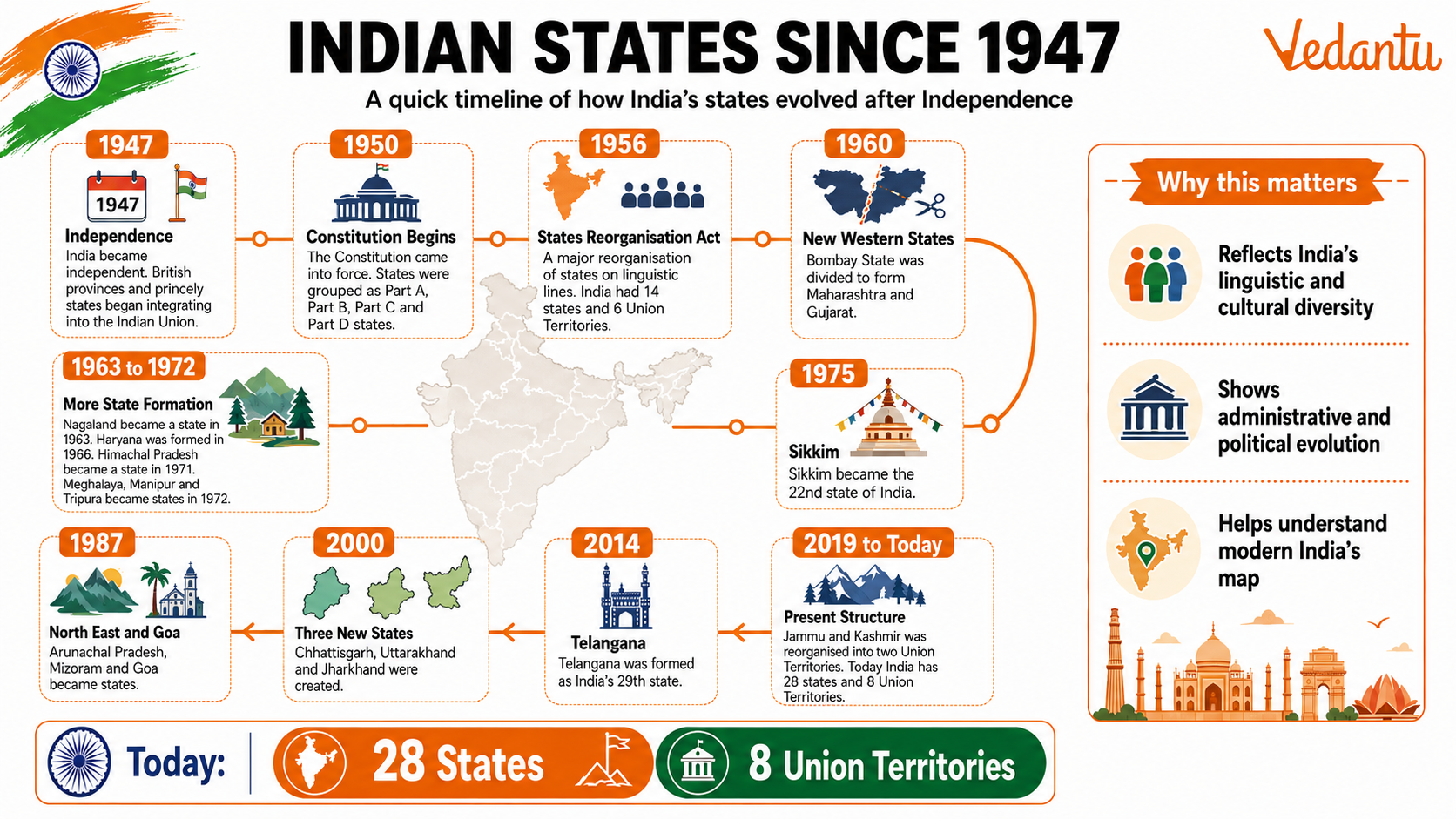
Indian States Since 1947 is an important General Knowledge topic that explains how the political map of India has evolved after Independence. Since 15 August 1947, India has undergone several territorial changes due to reorganization on linguistic, administrative, cultural, and political grounds. Understanding the formation of states, union territories, and constitutional amendments related to state reorganization is essential for students, competitive exam aspirants, and general readers. This topic frequently appears in examinations such as UPSC, SSC, State PSC, Banking, Railways, and other government exams.
Political Situation of India in 1947
At the time of Independence, India was divided into two main categories:
- British Provinces - Directly governed by the British Government.
- Princely States - Semi autonomous regions ruled by Indian princes under British supremacy.
There were more than 560 princely states which were integrated into the Indian Union under the leadership of Sardar Vallabhbhai Patel and V. P. Menon. The integration process was completed by 1950.
Classification of States After 1950
When the Constitution of India came into effect on 26 January 1950, states were classified into four categories:
- Part A - Former British provinces (e.g., Madras, Bombay, Uttar Pradesh).
- Part B - Former princely states (e.g., Hyderabad, Mysore).
- Part C - Chief Commissioner provinces (e.g., Delhi, Himachal Pradesh).
- Part D - Andaman and Nicobar Islands.
This classification was later abolished by the States Reorganisation Act, 1956.
States Reorganisation Act, 1956
The demand for linguistic states led to the appointment of the Fazl Ali Commission in 1953. Based on its recommendations, the States Reorganisation Act was passed in 1956. This Act reorganized states primarily on linguistic basis.
- Reduced the number of states.
- Abolished Part A, B, C, D classification.
- Created 14 states and 6 Union Territories in 1956.
Formation of Major States After 1956
| Year | State Formed | Carved From |
|---|---|---|
| 1960 | Maharashtra and Gujarat | Bombay State |
| 1966 | Haryana | Punjab |
| 1972 | Meghalaya, Manipur, Tripura | Assam and Union Territories |
| 2000 | Chhattisgarh, Uttarakhand, Jharkhand | MP, UP, Bihar |
| 2014 | Telangana | Andhra Pradesh |
These state formations were mainly based on linguistic identity, administrative convenience, tribal identity, and regional development demands.
Creation of Union Territories
Union Territories are directly governed by the Central Government. Over time, several Union Territories were created for strategic and administrative reasons.
- Delhi - National Capital Territory with special status.
- Chandigarh - Shared capital of Punjab and Haryana.
- Ladakh - Became a Union Territory in 2019 after reorganization of Jammu and Kashmir.
- Dadra and Nagar Haveli and Daman and Diu - Merged into a single UT in 2020.
Reorganization of Jammu and Kashmir (2019)
In August 2019, Article 370 was abrogated. The state of Jammu and Kashmir was reorganized into two Union Territories:
- Jammu and Kashmir - With legislature.
- Ladakh - Without legislature.
This was one of the most significant territorial changes in recent Indian history.
Present Structure of India
As of now, India consists of:
- 28 States
- 8 Union Territories
The Indian Constitution under Articles 2 and 3 empowers Parliament to create new states, alter boundaries, change names, or merge states.
Important Constitutional Provisions
- Article 1 - India is a Union of States.
- Article 2 - Admission or establishment of new states.
- Article 3 - Formation of new states and alteration of areas, boundaries, or names.
- 7th Constitutional Amendment Act, 1956 - Implemented state reorganization.
Why Indian States Since 1947 is Important for Exams
- Frequently asked in polity and geography sections.
- Questions related to formation years and parent states are common.
- Important for understanding federal structure of India.
- Relevant for current affairs and constitutional amendments.
Summary
Since 1947, India has transformed from a collection of British provinces and princely states into a well structured Union of 28 states and 8 Union Territories. The reorganization process reflects India's democratic spirit, respect for linguistic diversity, and administrative efficiency. The evolution of Indian states demonstrates the flexibility of the Constitution and the strength of cooperative federalism. A clear understanding of this topic provides strong conceptual clarity in Indian polity and enhances performance in competitive examinations.
FAQs on Indian States Since 1947: Evolution of State Boundaries in India
1. What major changes took place in Indian states after 1947?
After 1947, India underwent significant political and territorial reorganization to create a unified nation.
Major changes in Indian States since Independence include:
• Integration of over 500 princely states into the Indian Union
• Formation of states on a linguistic basis (States Reorganisation Act, 1956)
• Creation of new states like Haryana (1966), Chhattisgarh (2000), Telangana (2014)
• Special constitutional provisions under Article 370 and Article 371
These developments shaped the modern political map of India and strengthened national unity.
2. How were princely states integrated into India after Independence?
The integration of princely states was achieved through diplomacy, negotiation, and strategic action.
Key factors in the integration of princely states:
• Leadership of Sardar Vallabhbhai Patel and V.P. Menon
• Signing of the Instrument of Accession
• Military action in cases like Hyderabad (Operation Polo, 1948)
• Peaceful merger of most states into the Indian Union
This process ensured political stability and prevented fragmentation after Indian Independence 1947.
3. What was the States Reorganisation Act of 1956?
The States Reorganisation Act, 1956 reorganized Indian states primarily on linguistic lines.
Main features of the States Reorganisation Act:
• Based on recommendations of the Fazl Ali Commission
• Reduced 27 states into 14 states and 6 Union Territories
• Promoted administrative efficiency and cultural unity
This act remains a milestone in the reorganization of Indian states and federal development.
4. Why were Indian states reorganized on a linguistic basis?
Indian states were reorganized to align state boundaries with dominant regional languages.
Reasons for linguistic reorganization:
• Demand for preservation of regional languages and culture
• The movement for Andhra State (1953)
• Administrative convenience and better governance
• Reduction of regional conflicts
This strengthened India's federal structure while respecting linguistic diversity.
5. How many states and Union Territories does India have today?
As of now, India has 28 states and 8 Union Territories.
Important updates in the political map of India:
• Formation of Telangana (2014)
• Reorganization of Jammu and Kashmir (2019) into two Union Territories
• Creation of new states in 2000: Jharkhand, Chhattisgarh, Uttarakhand
These changes reflect the evolving nature of Indian federalism.
6. What was the significance of Article 370 in Indian states?
Article 370 granted special autonomous status to Jammu and Kashmir.
Key aspects of Article 370:
• Separate constitution for Jammu and Kashmir
• Limited application of Indian laws
• Special rights regarding land and citizenship
• Revoked on 5 August 2019
Its abrogation significantly impacted the constitutional status of Indian states.
7. What are Union Territories and how are they different from states?
Union Territories (UTs) are regions directly governed by the Central Government.
Difference between States and Union Territories:
• States have elected governments and full legislative powers
• UTs are administered by a Lieutenant Governor or Administrator
• Some UTs like Delhi and Puducherry have partial statehood powers
This distinction ensures flexibility in India’s administrative structure.
8. Which new states were created in India after 2000?
Several new states were formed after 2000 to improve governance and regional development.
States created after 2000:
• Chhattisgarh (from Madhya Pradesh, 2000)
• Jharkhand (from Bihar, 2000)
• Uttarakhand (from Uttar Pradesh, 2000)
• Telangana (from Andhra Pradesh, 2014)
These were formed due to demands for regional identity and better administration.
9. What role did Sardar Patel play in shaping Indian states?
Sardar Vallabhbhai Patel played a crucial role in unifying India after 1947.
His contributions include:
• Leading the integration of princely states
• Negotiating accession agreements
• Taking decisive action in Hyderabad and Junagadh
• Strengthening India's national unity and federal system
He is rightly called the “Iron Man of India” for consolidating the Indian Union.
10. How has the political map of India changed since Independence?
The political map of India has evolved through multiple reorganizations and state formations.
Major changes include:
• Integration of princely states (1947–1949)
• Linguistic reorganization under the States Reorganisation Act, 1956
• Creation of smaller states for administrative efficiency
• Reorganization of Jammu and Kashmir (2019)
These transformations reflect India’s dynamic federal structure and democratic governance.
