



Historical Background and Important Events in Pakistan-Occupied Kashmir
Pakistan Occupied Kashmir, commonly referred to as POK, is the part of the former princely state of Jammu and Kashmir that has been under Pakistan’s administrative control since 1947. It is a highly significant region in South Asian geopolitics due to its strategic location, historical background, and ongoing dispute between India and Pakistan. Understanding the interesting facts and history about Pakistan Occupied Kashmir is important for students, competitive exam aspirants, and general readers who want clarity on this sensitive and important topic.
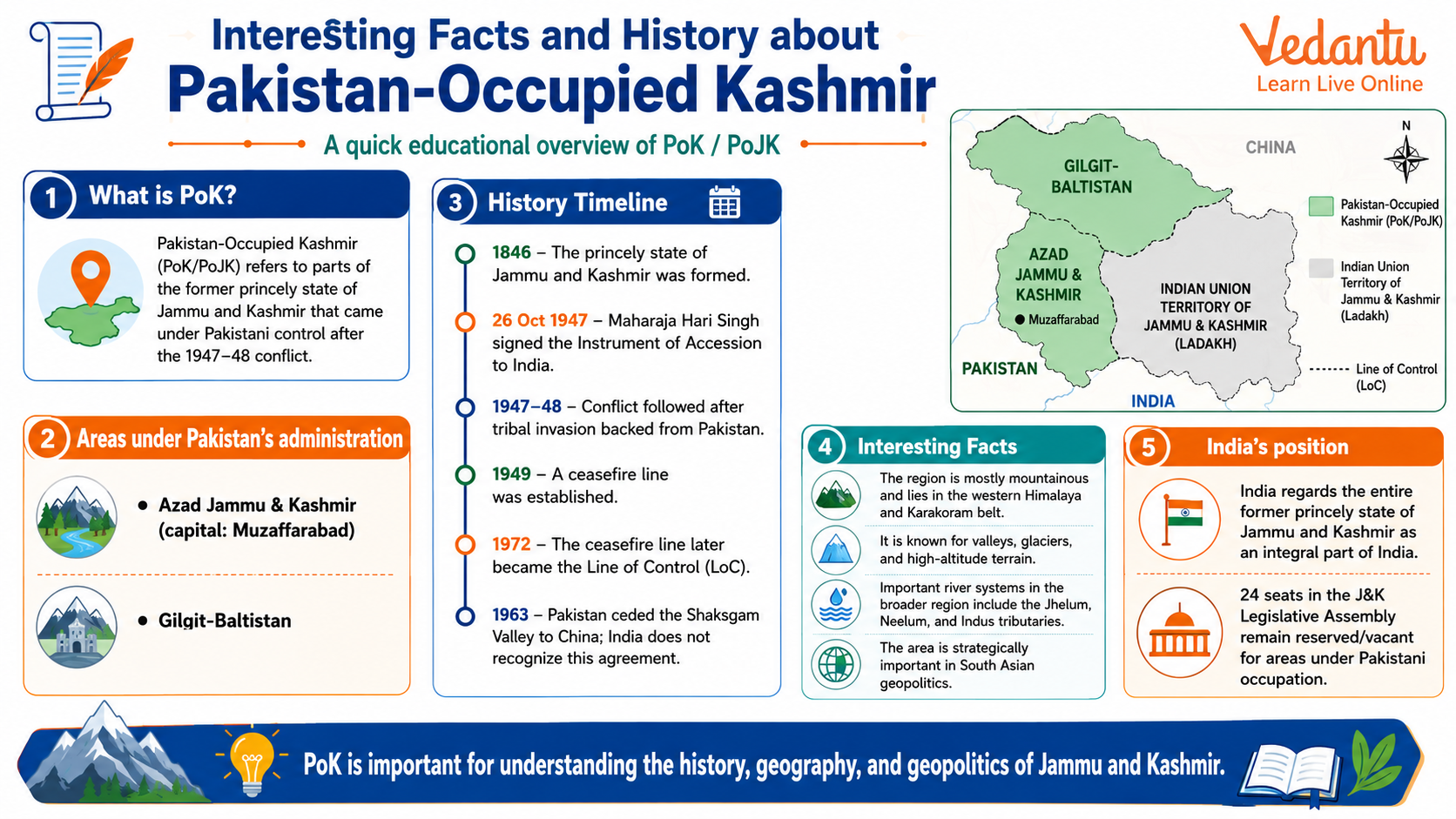
What is Pakistan Occupied Kashmir
Pakistan Occupied Kashmir refers to the territories of Jammu and Kashmir that came under Pakistan’s control after the first Indo Pakistan war in 1947 to 1948. India officially considers this region as an integral part of the Union Territory of Jammu and Kashmir, which is currently under illegal occupation by Pakistan.
- It includes two main administrative regions - Azad Jammu and Kashmir and Gilgit Baltistan.
- The total area is approximately 78,000 square kilometers.
- The Line of Control separates POK from the Indian administered Jammu and Kashmir.
Historical Background of Pakistan Occupied Kashmir
1. Princely State of Jammu and Kashmir
Before 1947, Jammu and Kashmir was a princely state ruled by Maharaja Hari Singh. At the time of India’s independence, princely states were given the option to join either India or Pakistan.
2. Tribal Invasion in 1947
In October 1947, tribal fighters from Pakistan’s North West Frontier Province, supported by Pakistani elements, invaded Kashmir. Facing this attack, Maharaja Hari Singh signed the Instrument of Accession to India on 26 October 1947.
3. First Indo Pakistan War 1947 to 1948
After the accession, Indian troops were airlifted to Kashmir. Fighting continued until a United Nations brokered ceasefire came into effect on 1 January 1949. The ceasefire line later came to be known as the Line of Control. The region under Pakistan’s control became known as Pakistan Occupied Kashmir.
Administrative Structure of POK
Administrative Divisions of Pakistan Occupied Kashmir
| Region | Capital | Administrative Status |
|---|---|---|
| Azad Jammu and Kashmir | Muzaffarabad | Self governed region under Pakistan |
| Gilgit Baltistan | Gilgit | Administered territory with limited autonomy |
Azad Jammu and Kashmir has its own president and prime minister, but major decisions related to defense, currency, and foreign affairs are controlled by Pakistan. Gilgit Baltistan was granted a form of provincial status in 2020, but it is not constitutionally recognized as a full province of Pakistan.
Interesting Facts About Pakistan Occupied Kashmir
- POK shares borders with Afghanistan and China, making it strategically very important.
- The China Pakistan Economic Corridor passes through Gilgit Baltistan, increasing its geopolitical importance.
- The region is home to some of the world’s highest mountain ranges, including parts of the Karakoram range.
- K2, the second highest mountain in the world, is located in Gilgit Baltistan.
- India officially claims the entire region as part of its sovereign territory.
- The Line of Control is heavily militarized due to frequent tensions between India and Pakistan.
Geographical Importance of POK
Pakistan Occupied Kashmir is geographically significant because it connects South Asia with Central Asia and China. The region consists of mountainous terrain, glaciers, and river systems. The Indus River flows through Gilgit Baltistan, making it important for water resources and hydroelectric projects.
- Mountain ranges - Karakoram and parts of the Himalayas.
- Important rivers - Indus, Jhelum, and Neelum.
- Strategic passes connecting China and Pakistan.
Political and International Significance
The Kashmir issue remains one of the most sensitive and long standing disputes between India and Pakistan. The United Nations passed resolutions in 1948 and 1949 calling for a ceasefire and suggesting a plebiscite under certain conditions. However, the issue remains unresolved.
India maintains that the entire region of Jammu and Kashmir, including POK, legally acceded to India in 1947. Pakistan considers POK as a separate administrative region and supports the idea of self determination for the people of Kashmir.
Key Events Timeline
Major Historical Events Related to Pakistan Occupied Kashmir
| Year | Event | Significance |
|---|---|---|
| 1947 | Tribal invasion and accession to India | Beginning of the Kashmir conflict |
| 1949 | UN brokered ceasefire | Creation of ceasefire line |
| 1972 | Simla Agreement | Ceasefire line renamed as Line of Control |
These events shaped the present status of Pakistan Occupied Kashmir and continue to influence diplomatic relations between India and Pakistan.
Why Pakistan Occupied Kashmir is Important for GK and Exams
Questions related to Pakistan Occupied Kashmir are frequently asked in competitive examinations such as UPSC, SSC, state PSC exams, and other general knowledge tests. Students should focus on its historical background, geographical features, administrative divisions, and international significance.
- Understand the 1947 accession and first Indo Pakistan war.
- Remember key geographical facts like K2 and the Indus River.
- Know the difference between Azad Jammu and Kashmir and Gilgit Baltistan.
- Be aware of the Line of Control and the Simla Agreement.
A clear understanding of the interesting facts and history about Pakistan Occupied Kashmir helps in developing strong conceptual clarity about one of South Asia’s most important geopolitical issues. It is not only significant for examinations but also for understanding India’s foreign policy and regional security concerns.
FAQs on Interesting Facts and History of Pakistan-Occupied Kashmir Explained
1. What is Pakistan Occupied Kashmir (POK)?
Pakistan Occupied Kashmir (POK) refers to the part of the former princely state of Jammu and Kashmir that is under Pakistan’s administration since 1947.
- Also called Azad Jammu and Kashmir (AJK) and Gilgit-Baltistan
- Came under Pakistani control after the Indo-Pak War of 1947–48
- Claimed by India as an integral part of its territory
- Frequently discussed in topics like Kashmir conflict, Line of Control (LoC), India-Pakistan dispute
2. How did Pakistan Occupied Kashmir come into existence?
POK was formed after the first Indo-Pak war in 1947–48 following tribal invasions supported by Pakistan.
- Maharaja Hari Singh signed the Instrument of Accession (1947) to join India
- War broke out between India and Pakistan
- A UN-brokered ceasefire in 1949 divided the region
- The ceasefire line later became the Line of Control (LoC)
3. What are the main regions included in Pakistan Occupied Kashmir?
POK consists of two major administrative regions under Pakistan’s control.
- Azad Jammu and Kashmir (AJK) – Capital: Muzaffarabad
- Gilgit-Baltistan – Capital: Gilgit
- Strategic areas near China, Afghanistan, and India
- Important in discussions about CPEC (China-Pakistan Economic Corridor)
4. Why is Pakistan Occupied Kashmir strategically important?
POK holds high strategic importance due to its geographic location and border connectivity.
- Borders India, China, and Afghanistan
- Close to Siachen Glacier and Karakoram Pass
- Key route for China-Pakistan Economic Corridor (CPEC)
- Central to India-Pakistan military tensions
5. What is the Line of Control (LoC)?
The Line of Control (LoC) is the de facto border dividing Indian-administered Kashmir and Pakistan Occupied Kashmir.
- Established after the 1972 Simla Agreement
- Originally called the Ceasefire Line (1949)
- Frequently witnesses cross-border firing and tensions
- Not an internationally recognized border
6. What are some interesting historical facts about Pakistan Occupied Kashmir?
POK has a complex history shaped by wars, diplomacy, and geopolitical interests.
- Part of the princely state ruled by Dogra dynasty
- Site of the 1947 tribal invasion
- Subject of several UN resolutions on Kashmir
- Important in the Kargil Conflict (1999)
7. What is India’s claim over Pakistan Occupied Kashmir?
India considers POK an integral part of its territory based on the 1947 Instrument of Accession.
- Legal accession signed by Maharaja Hari Singh
- Indian Parliament passed resolutions asserting claim
- Often mentioned in debates on Article 370, Jammu & Kashmir reorganization (2019)
- Featured in UPSC and competitive exam GK questions
8. What is Gilgit-Baltistan and why is it important?
Gilgit-Baltistan is the northern part of POK and is geopolitically significant.
- Formerly called Northern Areas
- Borders China’s Xinjiang region
- Location of Karakoram Highway
- Plays a key role in CPEC projects
9. What role does the United Nations play in the Kashmir issue?
The United Nations intervened in 1948 to mediate the India-Pakistan conflict over Kashmir.
- Passed UN Security Council Resolution 47
- Proposed a plebiscite under certain conditions
- Called for ceasefire and troop withdrawal
- The issue remains unresolved in international forums
10. Why is Pakistan Occupied Kashmir important for competitive exams?
POK is frequently asked in General Knowledge (GK), UPSC, SSC, and defense exams due to its political and strategic relevance.
- Questions on 1947 war, LoC, Simla Agreement
- Important for topics like India-Pakistan relations
- Linked with current affairs and international relations
- Helps in understanding geopolitics of South Asia
