



Key Functions of the International Bank for Reconstruction & Development (IBRD)
The International Bank for Reconstruction and Development (IBRD) is a global financial institution that provides loans and financial assistance to middle-income and creditworthy low-income countries. It is a part of the World Bank Group and plays a vital role in reducing poverty, promoting sustainable development, and supporting economic growth across the world. Established after World War II, the IBRD was initially created to help rebuild war-torn Europe. Today, it focuses on development projects such as infrastructure, education, healthcare, and environmental sustainability.
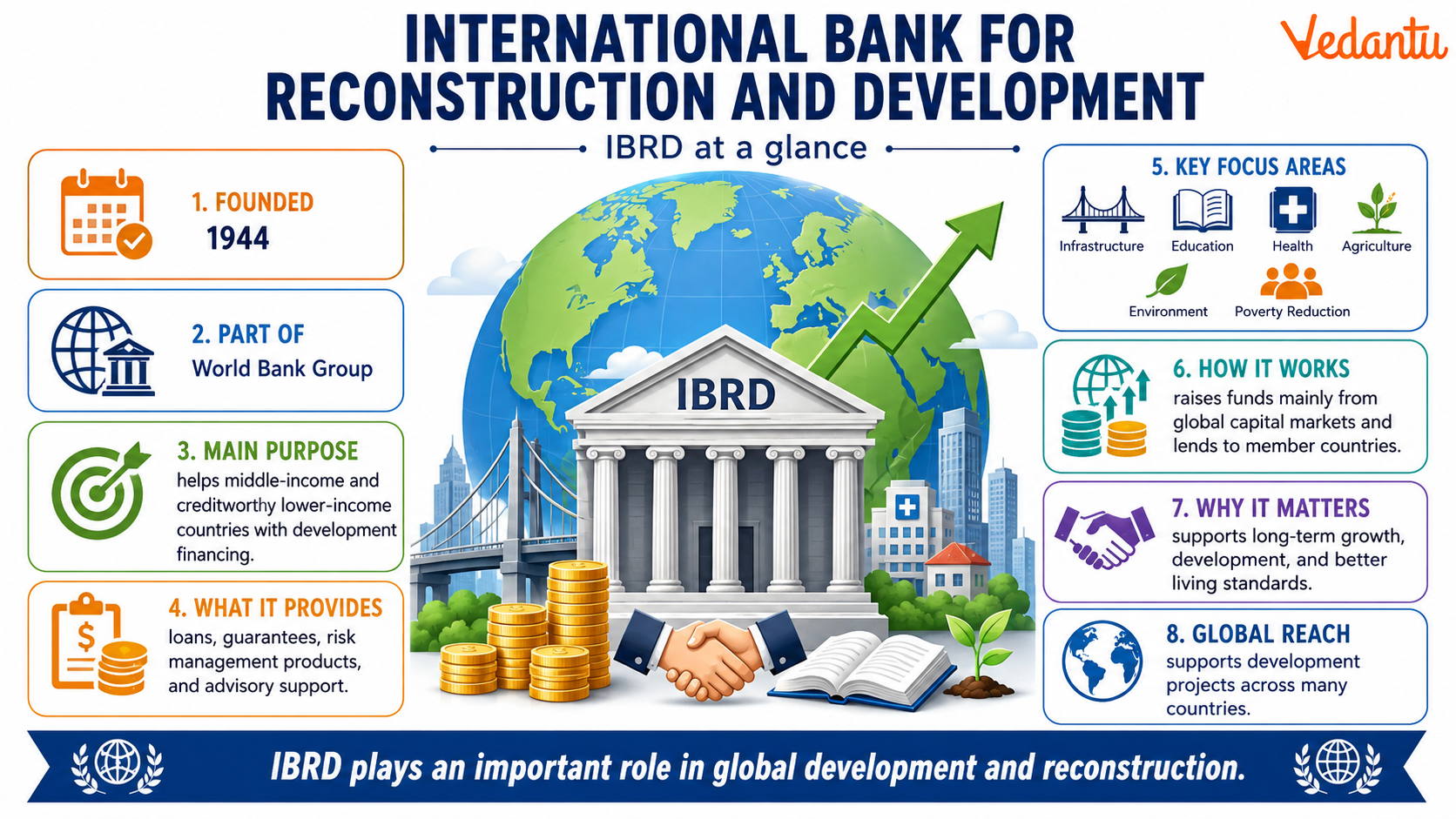
Overview of International Bank for Reconstruction and Development
The IBRD is one of the five institutions that make up the World Bank Group. It provides financial products, policy advice, and technical assistance to developing countries. Its main objective is to reduce poverty and promote shared prosperity by financing development projects and reforms.
- Founded in 1944 at the Bretton Woods Conference
- Began operations in 1946
- Headquarters in Washington, D.C., USA
- Part of the World Bank Group
- Provides loans and advisory services to member countries
Objectives of IBRD
The main objectives of the International Bank for Reconstruction and Development are focused on global economic stability and development. Its goals have evolved over time to meet changing global challenges.
- Reduction of poverty in developing nations
- Promotion of sustainable economic development
- Support for infrastructure projects like roads, dams, and power plants
- Encouragement of private foreign investment
- Promotion of balanced growth in international trade
Functions of IBRD
The IBRD performs several important functions that support economic development and financial stability in member countries.
1. Providing Loans
IBRD provides long-term loans to governments of developing countries at relatively low interest rates. These loans are mainly used for development projects.
2. Technical Assistance
It offers expert advice and technical support to help countries design and implement effective development programs.
3. Policy Guidance
IBRD assists governments in economic reforms and policy planning to improve governance and financial management.
4. Risk Management Products
The bank provides financial tools to manage risks related to interest rates, currency exchange, and natural disasters.
Key Facts about IBRD
| Feature | Details | Relevance |
|---|---|---|
| Established | 1944 | Post World War II reconstruction |
| Headquarters | Washington, D.C. | Global financial operations center |
| Membership | 189+ Countries | Global participation |
The table above highlights essential information about the International Bank for Reconstruction and Development, which is frequently asked in competitive examinations and General Knowledge assessments.
Sources of Funds
The IBRD raises most of its funds from international capital markets rather than relying solely on member contributions. This allows it to provide large-scale financing for development projects.
- Sale of bonds in international financial markets
- Capital contributions from member countries
- Retained earnings from previous operations
IBRD and India
India is one of the founding members of the IBRD and has been a major borrower. The bank has supported India in sectors such as rural development, infrastructure, education, health, and renewable energy.
- Funding for highway and transport projects
- Support for clean energy initiatives
- Assistance in poverty reduction programs
Difference Between IBRD and IDA
The International Development Association (IDA) is another institution under the World Bank Group. While both aim to reduce poverty, they differ in their target countries and lending terms.
| Basis | IBRD | IDA |
|---|---|---|
| Target Countries | Middle-income countries | Poorest countries |
| Loan Terms | Near market interest rates | Interest-free or low interest |
Understanding the distinction between IBRD and IDA is important for competitive exams and General Knowledge preparation.
Importance of IBRD in Global Economy
The International Bank for Reconstruction and Development plays a crucial role in maintaining global economic stability. By financing development projects and supporting policy reforms, it helps countries strengthen their economies and improve living standards. Its involvement in infrastructure, climate change mitigation, and social sector development makes it a key pillar of international financial cooperation.
For students and competitive exam aspirants, the IBRD is an important topic under international organizations and economic development. Key areas to focus on include its establishment, objectives, functions, funding sources, and its role within the World Bank Group.
FAQs on International Bank for Reconstruction & Development: Meaning and Role in Global Finance
1. What is the International Bank for Reconstruction and Development (IBRD)?
The International Bank for Reconstruction and Development (IBRD) is a global financial institution that provides loans and financial assistance to middle-income and creditworthy low-income countries for development projects.
• Established in 1944 at the Bretton Woods Conference
• A key part of the World Bank Group
• Focuses on reducing poverty and promoting sustainable development
• Provides loans, risk management products, and policy advice
It is often searched as World Bank IBRD, IBRD full form, and International Reconstruction Bank.
2. When and why was the IBRD established?
The IBRD was established in 1944 to help rebuild countries devastated by World War II.
• Formed during the Bretton Woods Agreement
• Began operations in 1946
• Initially focused on post-war reconstruction in Europe
• Later shifted to global development and poverty reduction
It is commonly associated with terms like post-war reconstruction, global economic recovery, and international financial institutions.
3. What are the main objectives of the IBRD?
The main objective of the IBRD is to promote sustainable development and reduce poverty worldwide.
• Provide long-term loans for infrastructure and development projects
• Support education, healthcare, and environmental sustainability
• Promote economic stability and growth
• Encourage private foreign investment
These objectives align with economic development, poverty alleviation, and sustainable growth.
4. How does the IBRD differ from the IMF?
The IBRD provides long-term development loans, while the IMF focuses on short-term financial stability.
• IBRD: Funds infrastructure and development projects
• IMF (International Monetary Fund): Provides short-term balance of payments support
• IBRD works on poverty reduction; IMF ensures monetary stability
• Both were created at Bretton Woods (1944)
People often compare IBRD vs IMF, World Bank and IMF difference, and global financial institutions.
5. Who are the members of the IBRD?
The IBRD has 189 member countries, which are also members of the IMF.
• Membership is open to IMF members
• Each member contributes capital shares
• Voting power depends on financial contribution
• Major shareholders include the USA, Japan, China, Germany, and the UK
This structure is often searched under IBRD member countries and World Bank membership.
6. How does the IBRD raise funds?
The IBRD raises funds mainly by issuing bonds in international capital markets.
• Issues World Bank bonds
• Backed by member country guarantees
• Maintains high credit ratings (AAA)
• Uses funds to provide development loans
This process is linked with global capital markets, development finance, and international bonds.
7. What types of projects does the IBRD finance?
The IBRD finances infrastructure and social development projects in member countries.
• Transportation (roads, railways, ports)
• Energy and renewable resources
• Water supply and sanitation
• Education and healthcare systems
• Climate change and environmental protection
These are commonly related to development projects, infrastructure financing, and sustainable development goals (SDGs).
8. Where is the headquarters of the IBRD located?
The headquarters of the IBRD is located in Washington, D.C., USA.
• Shares headquarters with the World Bank Group
• Works closely with the IMF
• Operates globally through regional offices
This is frequently searched as IBRD headquarters and World Bank location.
9. What is the relationship between IBRD and the World Bank?
The IBRD is a major component of the World Bank Group.
• The term World Bank often refers to IBRD and IDA (International Development Association)
• IBRD serves middle-income countries
• IDA assists the poorest countries
• Both aim at poverty reduction and development
People also search for World Bank structure and IBRD and IDA difference.
10. Why is the IBRD important for developing countries?
The IBRD is important because it provides financial support and expertise for economic growth and development.
• Offers long-term loans at favorable terms
• Provides technical and policy advice
• Supports poverty reduction programs
• Encourages sustainable economic reforms
Its role is widely discussed under global development banking, economic assistance, and international development finance.
