



How the Intertropical Convergence Zone Influences Rainfall and Monsoons
The Intertropical Convergence Zone (ITCZ) is a low-pressure belt near the Equator where the trade winds of the Northern and Southern Hemispheres converge. It is one of the most important components of the Earth's atmospheric circulation system and plays a crucial role in global weather patterns, tropical rainfall, and monsoon systems. The ITCZ is characterized by rising warm air, cloud formation, and heavy precipitation, making it a significant climatic feature for tropical regions across the world.
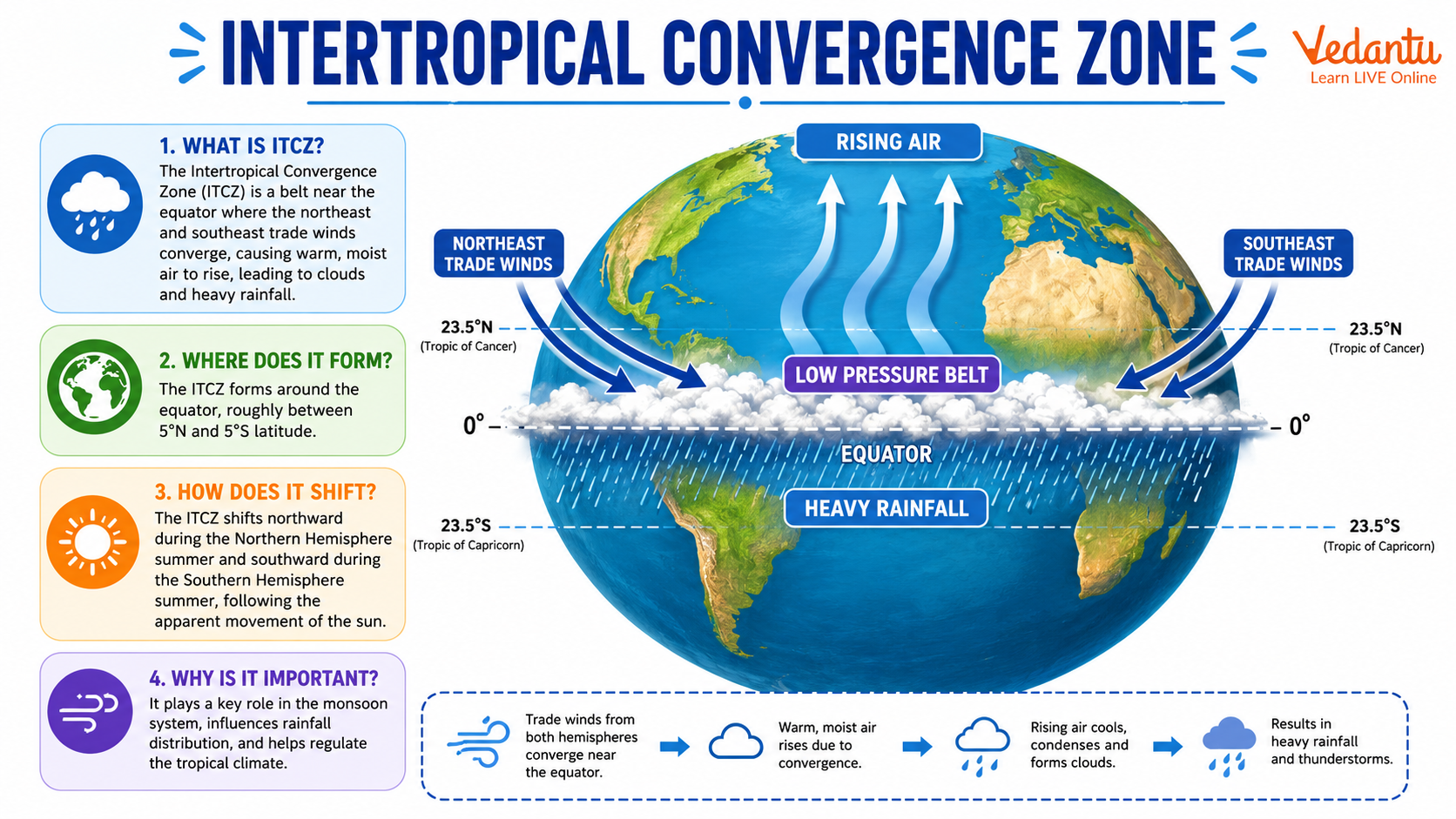
What is the Intertropical Convergence Zone?
The Intertropical Convergence Zone is a region encircling the Earth near the Equator where the northeast trade winds and southeast trade winds meet. Due to intense solar heating at the Equator, air becomes warm and rises, creating a low-pressure area. As the trade winds converge in this zone, the rising air cools and condenses to form clouds and heavy rainfall.
- Located roughly between 5°N and 5°S latitude, but shifts seasonally
- Characterized by low atmospheric pressure
- Associated with convectional rainfall and thunderstorms
- Also known as the Equatorial Convergence Zone
Formation of the ITCZ
The formation of the ITCZ is directly related to uneven heating of the Earth's surface. The Equator receives maximum solar radiation, causing intense heating of land and ocean surfaces. Warm air rises due to convection, creating a low-pressure belt.
- Strong solar heating at the Equator warms the surface.
- Warm air expands and rises, forming a low-pressure zone.
- Trade winds from both hemispheres move toward this low-pressure area.
- Air convergence forces further uplift, leading to cloud formation and heavy rainfall.
Seasonal Shifting of the ITCZ
The position of the ITCZ is not fixed. It shifts northward and southward with the apparent movement of the Sun. During the Northern Hemisphere summer, the ITCZ moves north of the Equator. During the Southern Hemisphere summer, it shifts southward. This seasonal migration significantly influences tropical rainfall and monsoon systems.
- Moves northward in June and July
- Moves southward in December and January
- Responsible for onset and withdrawal of monsoons
- Influences tropical cyclone formation
Climatic Importance of the ITCZ
The ITCZ plays a vital role in maintaining the Earth's heat balance and regulating tropical climates. Regions under the ITCZ experience high humidity, dense cloud cover, and frequent rainfall. The zone is also associated with the doldrums, an area of calm winds due to weak horizontal air movement.
- Controls rainfall distribution in tropical regions
- Essential for agricultural productivity in equatorial areas
- Influences global atmospheric circulation cells such as the Hadley Cell
- Contributes to formation of tropical rainforests
Key Features of the Intertropical Convergence Zone
| Feature | Description | Climatic Impact |
|---|---|---|
| Location | Near the Equator, shifting seasonally | Controls tropical rainfall |
| Pressure Type | Low-pressure belt | Promotes rising air and convection |
| Wind Convergence | Meeting of trade winds | Leads to cloud formation and storms |
The above features highlight why the ITCZ is a dominant driver of tropical weather systems. Its shifting nature directly affects seasonal rainfall patterns and global atmospheric circulation.
ITCZ and Monsoon Connection
The movement of the ITCZ is closely linked to the monsoon system, especially in South Asia. During summer, intense heating over the Indian subcontinent shifts the ITCZ northward. This shift draws moist air from the oceans, resulting in heavy monsoon rainfall. When the ITCZ retreats southward, the monsoon weakens and eventually withdraws.
Role in Indian Monsoon
- Summer heating creates a continental low-pressure area
- ITCZ shifts north of the Equator
- Moist southwesterly winds bring rainfall
- Retreat of ITCZ marks end of monsoon season
Why is the ITCZ Important for Students?
The Intertropical Convergence Zone is frequently asked in geography and environmental science examinations. Understanding its formation, characteristics, and seasonal movement helps in answering questions related to climate, monsoons, and global wind systems. It also provides conceptual clarity about atmospheric circulation and tropical ecosystems.
- Important for competitive exams and academic studies
- Helps in understanding global climate mechanisms
- Essential for topics related to monsoons and tropical weather
In summary, the Intertropical Convergence Zone is a dynamic and influential climatic feature that governs rainfall and atmospheric circulation in tropical regions. Its seasonal migration shapes weather patterns, supports biodiversity in equatorial regions, and drives major monsoon systems across the globe.
FAQs on Intertropical Convergence Zone (ITCZ) and Global Climate Patterns
1. What is the Intertropical Convergence Zone (ITCZ)?
The Intertropical Convergence Zone (ITCZ) is a low-pressure belt near the equator where the trade winds from the Northern and Southern Hemispheres meet. It is characterized by:
• Converging northeast and southeast trade winds
• Rising warm, moist air
• Heavy rainfall and thunderstorms
• High humidity and cloud formation
The ITCZ plays a crucial role in global climate, monsoon systems, and tropical weather patterns.
2. Where is the Intertropical Convergence Zone located?
The ITCZ is located near the equator, generally between 5°N and 5°S latitude, but its position shifts seasonally. It:
• Moves northward during the Northern Hemisphere summer
• Moves southward during the Southern Hemisphere summer
• Is most prominent over oceans like the Atlantic, Pacific, and Indian Oceans
This seasonal shift influences monsoons, rainfall distribution, and tropical climate zones.
3. Why is the ITCZ important for monsoon formation?
The ITCZ is crucial for monsoon formation because it creates a low-pressure area that draws moist winds inland. It contributes to:
• Development of the Southwest Monsoon in India
• Seasonal wind reversal patterns
• Heavy rainfall in tropical regions
• Agricultural productivity in Asia and Africa
The shifting ITCZ directly affects monsoon onset, intensity, and rainfall variability.
4. How does the ITCZ affect global climate?
The ITCZ regulates global climate by redistributing heat and moisture across the tropics. Its impact includes:
• Formation of tropical rainforests
• Control of wet and dry seasons
• Influence on El Niño and La Niña events
• Contribution to the global atmospheric circulation system
It is a key component of the Hadley Cell circulation in Earth’s climate system.
5. What type of weather is associated with the ITCZ?
The ITCZ is associated with hot, humid, and stormy weather due to rising moist air. Common weather conditions include:
• Frequent thunderstorms
• Heavy convectional rainfall
• Thick cloud cover
• Low atmospheric pressure
This region often experiences tropical showers and intense precipitation throughout the year.
6. Why does the ITCZ shift north and south?
The ITCZ shifts due to the apparent movement of the Sun between the Tropic of Cancer and Tropic of Capricorn. This shift occurs because:
• The Earth is tilted at 23.5°
• Solar heating changes seasonally
• Land heats faster than water
This seasonal migration influences monsoon winds, rainfall belts, and tropical climate patterns.
7. What is the relationship between the ITCZ and trade winds?
The ITCZ forms where the trade winds converge near the equator. Specifically:
• Northeast Trade Winds blow from the Northern Hemisphere
• Southeast Trade Winds blow from the Southern Hemisphere
• Their convergence causes rising air and low pressure
This convergence zone is essential for tropical rainfall and atmospheric circulation.
8. How does the ITCZ influence tropical rainforests?
The ITCZ provides continuous rainfall necessary for tropical rainforests. It supports:
• High annual precipitation
• Dense vegetation growth
• Rich biodiversity in regions like the Amazon Basin and Congo Basin
• Evergreen forest ecosystems
Without the ITCZ, equatorial regions would not sustain humid tropical climates.
9. What is another name for the Intertropical Convergence Zone?
The ITCZ is also known as the Doldrums due to calm wind conditions in some areas. It is sometimes referred to as:
• Equatorial Convergence Zone
• Intertropical Front
• Equatorial low-pressure belt
These terms are commonly used in geography, meteorology, and competitive exams.
10. How is the ITCZ relevant for competitive exams?
The ITCZ is an important topic in geography for competitive exams like UPSC, SSC, and state PSC exams. It is frequently asked in relation to:
• Monsoon mechanism
• Global atmospheric circulation
• Climate zones and vegetation
• Trade winds and pressure belts
Understanding the Intertropical Convergence Zone helps in answering conceptual and map-based questions in General Knowledge (GK).
