



Which Are the Largest Moons in Our Solar System?
Natural satellites, commonly known as moons, are celestial bodies that orbit planets and dwarf planets in our Solar System. These moons vary greatly in size, composition, and structure. Some are small rocky objects, while others are larger than planets like Mercury. Understanding the list of biggest natural satellites in the Solar System is important for General Knowledge, astronomy studies, and competitive exams. The largest moons reveal valuable information about planetary formation, gravitational forces, and the evolution of our Solar System.
What is a Natural Satellite?
A natural satellite is a celestial body that revolves around a planet or a dwarf planet due to gravitational attraction. Unlike artificial satellites launched by humans, natural satellites are formed naturally in space. The Earth has one natural satellite, the Moon, while giant planets like Jupiter and Saturn have dozens of moons.
Key Characteristics of Natural Satellites
- They orbit planets or dwarf planets.
- They do not produce their own light and reflect sunlight.
- They vary in composition such as rocky, icy, or gaseous.
- Some have atmospheres and geological activity.
Largest Natural Satellites in the Solar System
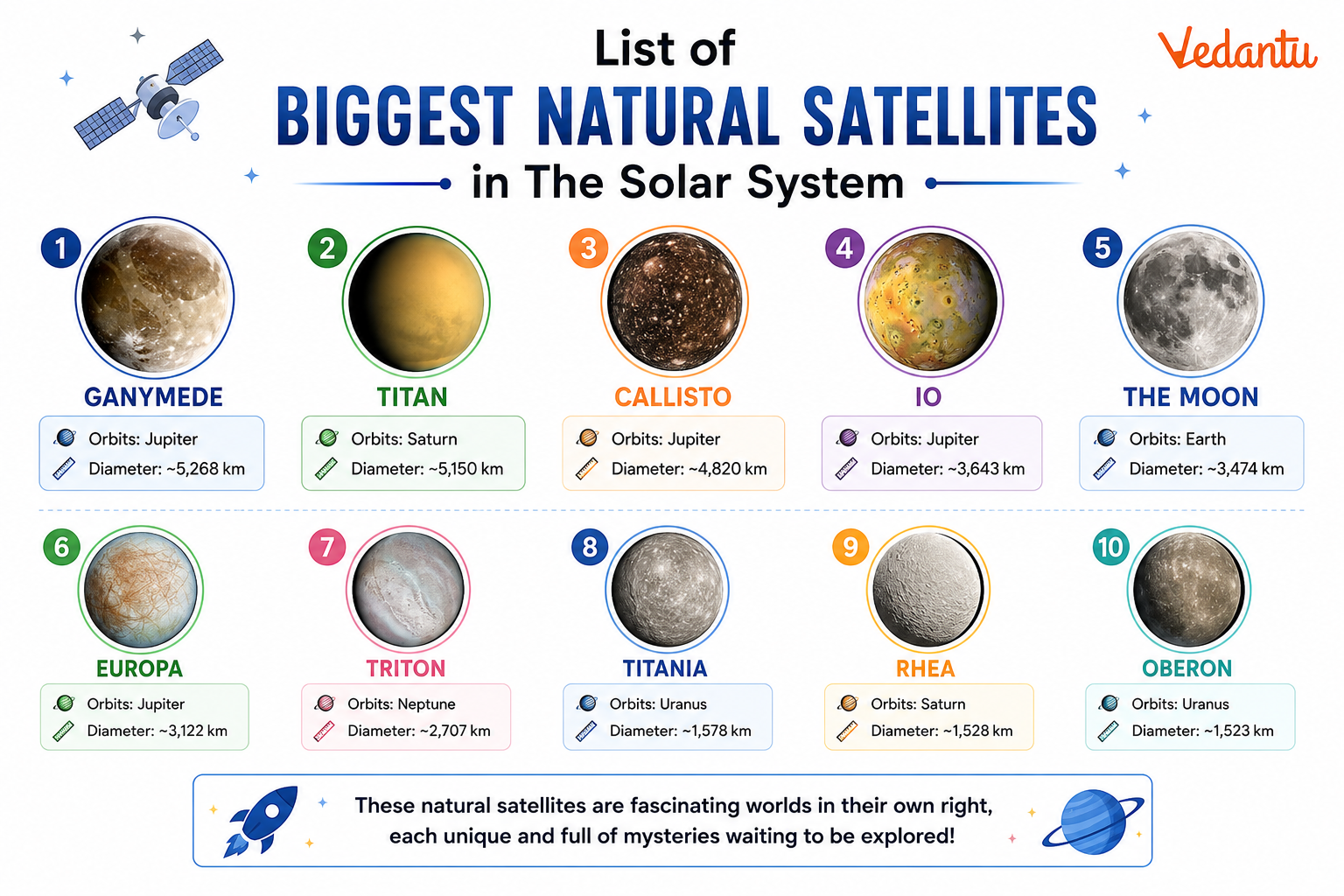
The following table lists the biggest natural satellites in the Solar System based on their diameter. These moons are larger than many dwarf planets and even bigger than the planet Mercury in some cases.
Top 10 Biggest Natural Satellites in the Solar System
| Moon | Parent Planet | Diameter (km) |
|---|---|---|
| Ganymede | Jupiter | 5268 |
| Titan | Saturn | 5150 |
| Callisto | Jupiter | 4821 |
| Io | Jupiter | 3643 |
| Moon | Earth | 3474 |
| Europa | Jupiter | 3122 |
| Triton | Neptune | 2706 |
| Titania | Uranus | 1578 |
| Rhea | Saturn | 1528 |
| Oberon | Uranus | 1523 |
Ganymede, a moon of Jupiter, is the largest natural satellite in the Solar System. It is even larger than the planet Mercury. Titan, Saturn's largest moon, is the second largest and is known for its thick atmosphere. Jupiter dominates the list with four of the top six largest moons.
Brief Description of the Largest Moons
1. Ganymede
Ganymede is the largest moon and the only moon known to have its own magnetic field. It has a mixture of rocky material and water ice, and scientists believe it may have a subsurface ocean.
2. Titan
Titan is unique because it has a dense atmosphere rich in nitrogen. It also has lakes and rivers of liquid methane and ethane on its surface.
3. Callisto
Callisto is heavily cratered and is considered one of the oldest surfaces in the Solar System. It may also have an underground ocean.
4. Io
Io is the most volcanically active body in the Solar System. Its surface is covered with sulfur compounds due to intense volcanic eruptions.
5. Earth’s Moon
The Moon is the fifth largest natural satellite. It strongly influences Earth's tides and stabilizes the planet's axial tilt.
Interesting Facts About the Biggest Natural Satellites
- Ganymede is larger than Mercury but has less mass.
- Titan is the only moon with a thick atmosphere.
- Jupiter has the highest number of large moons in the top ranking.
- Io experiences tidal heating due to Jupiter's strong gravity.
- Europa is considered a strong candidate in the search for extraterrestrial life.
Importance for Competitive Exams and GK
Questions about the largest natural satellites frequently appear in school exams, Olympiads, and competitive examinations. Common questions include identifying the largest moon, comparing diameters, and matching moons with their parent planets. For exam preparation, students should remember the top five largest moons and their respective planets.
Quick Revision Points
- Largest moon in the Solar System - Ganymede.
- Second largest moon - Titan.
- Jupiter has four of the six largest moons.
- Titan has a thick nitrogen rich atmosphere.
- Earth's Moon ranks fifth in size.
Conclusion
The biggest natural satellites in the Solar System are fascinating celestial bodies that provide deep insights into planetary science and space exploration. Ganymede leads the list, followed by Titan and Callisto. These massive moons are not just objects orbiting planets but are dynamic worlds with unique features such as magnetic fields, atmospheres, oceans, and volcanic activity. Learning about them enhances general knowledge and strengthens preparation for academic and competitive examinations.
FAQs on List of Biggest Natural Satellites in the Solar System Ranked by Size
1. What is the biggest natural satellite in the Solar System?
Ganymede is the biggest natural satellite in the Solar System and is even larger than the planet Mercury.
- It is a moon of Jupiter.
- Diameter: 5,268 km.
- Discovered by Galileo Galilei in 1610.
- It has its own magnetic field.
Ganymede is often searched under terms like largest moon in the solar system and biggest satellite of Jupiter.
2. Which are the top 5 largest natural satellites in the Solar System?
The top five largest natural satellites are dominated by Jupiter and Saturn’s moons.
1. Ganymede (Jupiter)
2. Titan (Saturn)
3. Callisto (Jupiter)
4. Io (Jupiter)
5. Moon (Earth)
These moons are frequently included in GK questions about the largest moons in order and natural satellites of planets.
3. Is Ganymede bigger than Mercury?
Yes, Ganymede is larger than Mercury in diameter but not in mass.
- Ganymede diameter: 5,268 km
- Mercury diameter: 4,880 km
- Mercury is more massive due to higher density.
This comparison is common in competitive exams under topics like planet vs moon size comparison.
4. Which planet has the most largest moons?
Jupiter has the highest number of large natural satellites in the Solar System.
- Major large moons: Ganymede, Callisto, Io, Europa
- Known as the Galilean moons
- Discovered in 1610
Jupiter is often searched in relation to planet with most moons and largest Jovian satellites.
5. Which is the second largest natural satellite in the Solar System?
Titan, a moon of Saturn, is the second largest natural satellite.
- Diameter: 5,151 km
- Larger than Mercury in size
- Has a thick nitrogen-rich atmosphere
Titan is important in studies of Saturn’s moons and moons with atmosphere.
6. What is the rank of Earth’s Moon among the largest satellites?
Earth’s Moon ranks fifth among the largest natural satellites in the Solar System.
- Diameter: 3,474 km
- Only natural satellite of Earth
- Plays a key role in tides and eclipses
It is commonly asked in GK as position of Moon in size ranking.
7. Why is Titan unique among large natural satellites?
Titan is unique because it has a dense atmosphere and liquid hydrocarbon lakes.
- Moon of Saturn
- Thick nitrogen atmosphere
- Presence of methane and ethane lakes
Titan is frequently discussed under moons with atmosphere and habitable environment studies.
8. Which is the most volcanically active large moon?
Io, a moon of Jupiter, is the most volcanically active natural satellite.
- Fourth largest moon
- Contains hundreds of active volcanoes
- Heated by tidal forces from Jupiter
Io is important in topics like volcanic moons and Jupiter’s satellites.
9. Are all the largest natural satellites found around giant planets?
Yes, most of the largest natural satellites orbit giant planets like Jupiter and Saturn.
- Jupiter: Ganymede, Callisto, Io
- Saturn: Titan
- Uranus & Neptune also have large moons
This is a common concept in outer planets and their moons for competitive exams.
10. What are natural satellites in the Solar System?
Natural satellites are celestial bodies that orbit planets and are commonly called moons.
- They revolve around planets due to gravity.
- Examples: Moon (Earth), Ganymede (Jupiter), Titan (Saturn)
- Differ from artificial satellites made by humans.
They are frequently searched under definition of natural satellite and types of satellites in the solar system.
