



Why Governments Use Deficit Financing for Economic Development
Deficit financing is an important concept in Economics under the subject of English-medium General Knowledge. It refers to the method adopted by a government to finance its budget deficit by borrowing money or printing new currency. In simple terms, when government expenditure exceeds its revenue, the gap is filled through deficit financing. This concept plays a significant role in economic development, especially in developing countries. Understanding the meaning and purposes of deficit financing is essential for students, competitive exam aspirants, and anyone interested in public finance and economic policy.
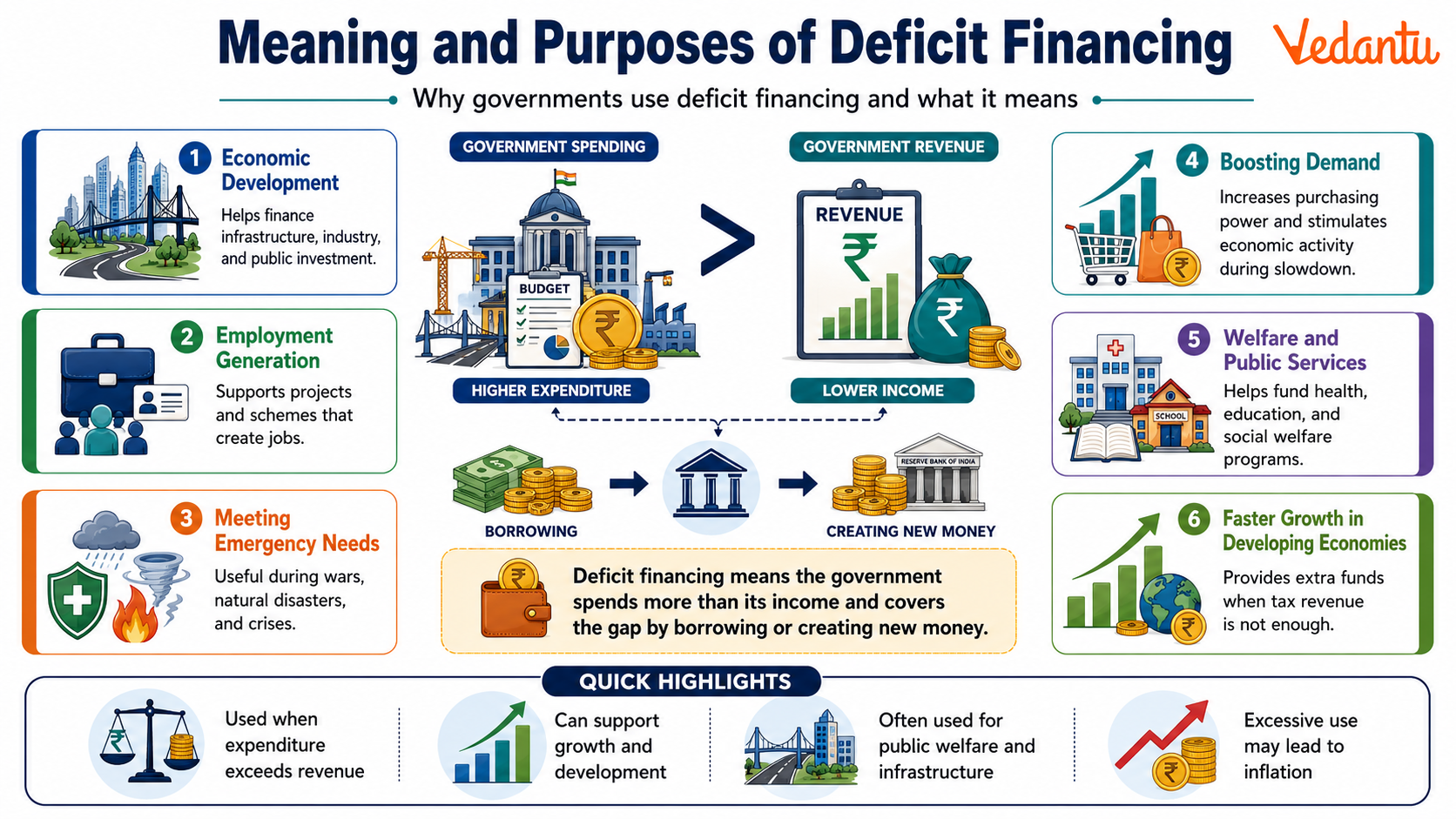
Meaning of Deficit Financing
Deficit financing occurs when a government spends more money than it earns in revenue during a financial year and covers the difference by borrowing or creating new money. It is a deliberate fiscal policy tool used to manage economic growth, development, and emergencies.
Simple Definition
Deficit financing means financing the budget deficit of the government by borrowing from the central bank or by issuing new currency.
Key Features of Deficit Financing
- Occurs when government expenditure exceeds government revenue.
- The gap is filled by borrowing or printing new money.
- Common in developing economies to promote growth.
- May lead to inflation if used excessively.
Basic Concept of Deficit Financing
| Situation | Government Revenue | Government Expenditure |
|---|---|---|
| Balanced Budget | Equal | Equal |
| Deficit Budget | Less | More |
When expenditure is more than revenue, the government faces a deficit. This deficit is managed through deficit financing methods such as borrowing from the central bank or issuing government securities.
Purposes of Deficit Financing
Deficit financing is not always negative. It is often used intentionally by governments to achieve specific economic and developmental objectives. The main purposes are explained below.
1. Economic Development
Developing countries use deficit financing to fund large development projects such as infrastructure, power plants, roads, and education systems. These investments increase productive capacity and promote long-term growth.
2. Employment Generation
By increasing public expenditure on construction, industries, and public works, the government creates job opportunities. This helps in reducing unemployment and raising income levels.
3. Boosting Aggregate Demand
During periods of recession or low demand, deficit financing increases government spending. This raises overall demand in the economy and stimulates production.
4. Managing Emergencies
In times of war, natural disasters, pandemics, or financial crises, governments may not have sufficient revenue. Deficit financing helps meet urgent expenses quickly.
5. Financing Welfare Programs
Governments use deficit financing to fund social welfare schemes such as healthcare, poverty alleviation programs, and subsidies for essential goods.
Methods of Deficit Financing
Governments can adopt different methods to finance their deficit depending on economic conditions and policy decisions.
- Borrowing from the central bank.
- Issuing government bonds and securities to the public.
- External borrowing from foreign institutions or countries.
- Printing new currency.
Advantages of Deficit Financing
- Accelerates economic growth.
- Helps in capital formation.
- Reduces unemployment.
- Supports infrastructure development.
Disadvantages of Deficit Financing
- Leads to inflation if excessive money is printed.
- Increases public debt burden.
- May reduce purchasing power of people.
- Can create economic instability if not managed properly.
Conclusion
Deficit financing is a powerful fiscal tool used by governments to manage economic growth, development, and emergencies. While it helps in accelerating development, generating employment, and boosting demand, excessive use can lead to inflation and rising public debt. Therefore, it must be used carefully and in a balanced manner. A clear understanding of the meaning and purposes of deficit financing helps students grasp important concepts of public finance and prepares them effectively for competitive examinations.
FAQs on Meaning and Purpose of Deficit Financing Explained
1. What is the meaning of deficit financing?
Deficit financing refers to a situation where the government’s expenditure exceeds its revenue and the gap is filled by borrowing or printing new money. • It involves raising funds through borrowing from the central bank or issuing new currency • Common in developing economies for economic growth • Also known as budget deficit financing or monetized deficit • Frequently asked in GK, UPSC, SSC, and economics exams
2. What are the main purposes of deficit financing?
The main purpose of deficit financing is to promote economic development and manage financial crises. • Funds public projects like roads, schools, and hospitals • Stimulates economic growth and employment • Helps during recession or depression • Supports welfare schemes and poverty reduction programs • Encourages capital formation in developing countries
3. How does deficit financing affect the economy?
Deficit financing impacts the economy by increasing money supply and influencing inflation and growth. • Boosts aggregate demand and production • May cause inflation if excessive money is printed • Can increase public debt • Useful for short-term economic stimulus • Often debated in terms of fiscal policy and macroeconomic stability
4. What are the advantages of deficit financing?
The advantages of deficit financing include faster development and crisis management. • Promotes infrastructure development • Creates employment opportunities • Encourages industrial and agricultural growth • Helps overcome economic slowdown • Supports long-term national income growth
5. What are the disadvantages of deficit financing?
The disadvantages of deficit financing mainly relate to inflation and rising debt burden. • Leads to inflationary pressure • Increases public debt and interest payments • May reduce purchasing power of people • Can cause economic instability if uncontrolled • Risk of currency devaluation in extreme cases
6. Is deficit financing the same as budget deficit?
Deficit financing and budget deficit are related but not exactly the same concepts. • A budget deficit occurs when government spending exceeds revenue • Deficit financing is the method used to finance that deficit • Methods include borrowing, printing money, or issuing bonds • Common terms searched: fiscal deficit, revenue deficit, primary deficit
7. Why is deficit financing important for developing countries?
Deficit financing is important for developing countries to accelerate economic development. • Lack of sufficient private investment requires government intervention • Funds industrialization and infrastructure • Helps reduce poverty and unemployment • Encourages capital formation and modernization • Frequently discussed in Indian economic planning
8. How does deficit financing lead to inflation?
Deficit financing can cause inflation when excessive money supply exceeds production levels. • Printing new currency increases money circulation • Higher demand with limited supply raises prices • Known as demand-pull inflation • Impacts cost of living and savings • Controlled deficit is necessary to avoid hyperinflation
9. What are the types of deficit in government finance?
There are three main types of deficits in public finance used in economic analysis. • Revenue Deficit – when revenue expenditure exceeds revenue receipts • Fiscal Deficit – total expenditure minus total receipts (excluding borrowings) • Primary Deficit – fiscal deficit minus interest payments • These concepts are important in GK and competitive exams
10. How can deficit financing be controlled?
Deficit financing can be controlled through prudent fiscal management and policy measures. • Increase tax revenue and non-tax revenue • Reduce unnecessary government expenditure • Promote economic growth to widen tax base • Follow fiscal responsibility laws like FRBM • Balance between development needs and price stability
