



Why Oil and Water Do Not Mix Together: Polarity and Density Explained
Oil and water are two common liquids that we see in everyday life, yet they do not mix together. When poured into the same container, oil floats on top of water and forms a separate layer. This simple observation is based on important scientific principles related to molecular structure, polarity, and intermolecular forces. Understanding why oil and water do not mix helps students grasp key concepts in chemistry, especially for competitive exams like NEET. Let us explore the scientific reason behind this phenomenon in a clear and structured way.
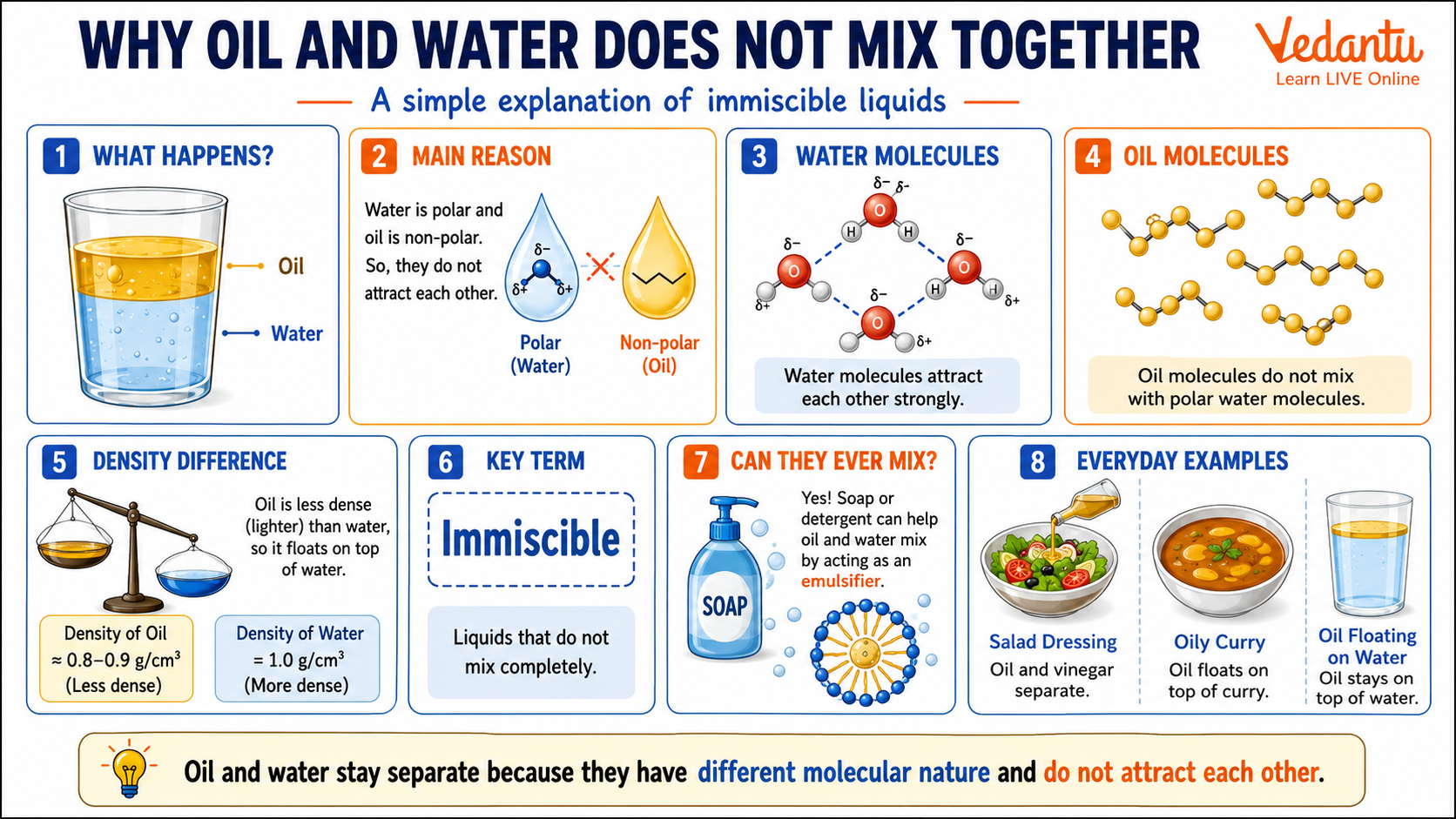
Basic Concept - Immiscible Liquids
Liquids that do not mix with each other are called immiscible liquids. Oil and water are classic examples of immiscible liquids. Even if they are shaken together, they temporarily form tiny droplets, but eventually separate into two distinct layers.
- Water is a polar molecule.
- Oil is a non-polar substance.
- Polar and non-polar substances do not mix easily.
What is Polarity?
Polarity refers to the distribution of electric charge within a molecule. A molecule is polar if it has a partial positive charge on one side and a partial negative charge on the other side.
Water as a Polar Molecule
Water molecules have an uneven distribution of charge. Oxygen is more electronegative than hydrogen, so it pulls shared electrons closer. This creates:
- A partial negative charge near the oxygen atom
- Partial positive charges near the hydrogen atoms
Because of this polarity, water molecules form strong hydrogen bonds with each other.
Oil as a Non-Polar Substance
Oil is mainly made up of hydrocarbons, which contain carbon and hydrogen atoms. These atoms have similar electronegativities, so electrons are shared almost equally. As a result:
- There is no significant charge separation
- Oil molecules are non-polar
- They do not form hydrogen bonds with water
Why Oil and Water Do Not Mix - Scientific Explanation
The main reason oil and water do not mix is based on the principle "like dissolves like." Polar substances dissolve in polar solvents, and non-polar substances dissolve in non-polar solvents.
- Water molecules are strongly attracted to each other through hydrogen bonding.
- Oil molecules are attracted to each other through weak van der Waals forces.
- Water molecules cannot form strong attractions with oil molecules.
- As a result, both substances stay separate to maintain stable interactions.
When mixed, water molecules prefer bonding with other water molecules rather than interacting with oil molecules. This leads to separation into two layers.
Comparison Between Oil and Water
| Property | Water | Oil |
|---|---|---|
| Nature | Polar | Non-polar |
| Main Forces | Hydrogen bonding | Van der Waals forces |
| Density | Higher | Lower |
Since oil has lower density than water, it floats on top when both are placed in a container. The difference in polarity and intermolecular forces is the main reason they remain separate.
What Happens When You Shake Oil and Water?
When oil and water are shaken together, oil breaks into tiny droplets and temporarily disperses in water. This forms an emulsion. However, this mixture is unstable and separates after some time.
- The droplets merge together again.
- Oil rises to the top due to lower density.
- Two distinct layers are formed.
Role of Emulsifiers
An emulsifier is a substance that helps oil and water mix. It contains both polar and non-polar parts. Soap and detergents are common examples.
The polar part of the emulsifier interacts with water, and the non-polar part interacts with oil. This reduces surface tension and allows stable mixing, forming an emulsion.
Importance for NEET and Competitive Exams
The concept of oil and water not mixing is important in chemistry and biology. Questions related to polarity, intermolecular forces, hydrogen bonding, and emulsification are frequently asked in NEET.
- Understand the principle "like dissolves like."
- Learn differences between polar and non-polar molecules.
- Revise intermolecular forces regularly.
- Practice MCQs based on solutions and mixtures.
Conclusion
Oil and water do not mix because of differences in polarity and intermolecular forces. Water is polar and forms hydrogen bonds, while oil is non-polar and interacts through weak forces. Since polar and non-polar substances do not attract each other effectively, they remain separate. This simple observation demonstrates fundamental chemical principles that are essential for understanding solutions, mixtures, and molecular interactions in everyday life as well as in competitive exams like NEET.
FAQs on Why Oil and Water Do Not Mix in Simple Terms
1. Why do oil and water not mix together?
Oil and water do not mix because they have different molecular structures and polarity.
• Water is a polar molecule with positive and negative charges.
• Oil is a non-polar substance with no charge separation.
• According to the rule "like dissolves like", polar substances mix with polar, and non-polar mix with non-polar.
• Since oil is hydrophobic (water-repelling), it separates from water.
This concept explains why oil floats on water and is commonly asked in GK and science exams.
2. What is polarity and how does it affect oil and water?
Polarity refers to the distribution of electric charge within a molecule, which determines whether substances can mix.
• Water molecules are polar due to uneven charge distribution.
• Oil molecules are non-polar and lack charged ends.
• Polar and non-polar substances do not attract each other.
• This difference causes immiscibility between oil and water.
Understanding polarity in chemistry helps explain many everyday phenomena like soap cleaning grease.
3. Why does oil float on top of water?
Oil floats on water because it is less dense and does not mix with water.
• Density of oil is lower than the density of water.
• Oil molecules stay together due to non-polar bonding.
• Water molecules form hydrogen bonds with each other.
• The two liquids form separate layers.
This separation demonstrates differences in density and molecular bonding.
4. Can oil and water ever mix together?
Oil and water can mix temporarily with the help of an emulsifier.
• Substances like soap and detergents act as emulsifying agents.
• Emulsifiers have both polar and non-polar ends.
• They reduce surface tension and allow mixing.
• The mixture formed is called an emulsion.
Examples include milk, mayonnaise, and salad dressing.
5. What is an emulsifier and how does it help oil and water mix?
An emulsifier is a substance that helps two immiscible liquids like oil and water mix together.
• It contains both hydrophilic (water-attracting) and hydrophobic (oil-attracting) parts.
• It surrounds oil droplets and keeps them dispersed in water.
• Common emulsifiers include soap, egg yolk, and detergents.
This process is important in food science, cosmetics, and cleaning products.
6. What scientific rule explains why oil and water do not mix?
The rule "like dissolves like" explains why oil and water do not mix.
• Polar substances dissolve in polar solvents.
• Non-polar substances dissolve in non-polar solvents.
• Water is polar, while oil is non-polar.
• Therefore, they remain separate.
This principle is fundamental in basic chemistry concepts and competitive exams.
7. What happens when you shake oil and water together?
When shaken, oil and water form a temporary mixture that quickly separates.
• Tiny oil droplets disperse in water.
• This forms a temporary unstable emulsion.
• After some time, oil droplets combine again.
• Two distinct layers reappear.
This shows that oil and water are immiscible liquids.
8. Why is water considered a polar molecule?
Water is considered polar because its molecules have unequal charge distribution.
• Oxygen attracts electrons more strongly than hydrogen.
• This creates partial positive and negative charges.
• The molecule has a bent shape.
• It forms strong hydrogen bonds.
This polarity is the key reason behind why oil does not dissolve in water.
9. What are some real-life examples of oil and water not mixing?
Oil and water separation can be seen in many everyday situations.
• Oil spills floating on oceans.
• Salad dressing separating into layers.
• Cooking oil floating on soup.
• Petroleum products on water surfaces.
These examples highlight concepts of density, immiscibility, and polarity.
10. Is the oil and water experiment important for students?
Yes, the oil and water experiment is important because it explains basic chemistry principles.
• Demonstrates polarity and molecular structure.
• Shows differences in density.
• Explains emulsification and cleaning action of soap.
• Frequently asked in school exams and competitive tests.
It is a simple yet powerful way to understand why oil and water do not mix together.
