




Convert chloro benzene to phenol.
Answer
 Verified
532k+ views
Hint: We know that Dow's process is one of the ways of conversion of chlorobenzene to phenol. To obtain phenol from chlorobenzene, first we have to react with chlorobenzene with sodium hydroxide, then phenoxide ion forms. The acidification of phenoxide ions results in phenol.
Complete answer:
In Dow's process, hydrolysis of chlorobenzene results in phenol. First step is treating chlorobenzene with aqueous sodium hydroxide at a temperature of 623 K and pressure of 300 bar to convert it into sodium phenoxide.
Now, we write the reaction of formation of sodium phenoxide ion by reaction of chlorobenzene with sodium hydroxide.

The next step is the acidification of phenoxide ions. This can be done by reacting phenoxide ion with hydrochloric acid. The result of this reaction is the production of phenol.
Now, we write the reaction of production of phenol by acidification of phenoxide ions.

Hence, by Dow’s process, we are able to convert chloro benzene to phenol by Dow’s process.
Additional information:
When one hydrogen atom of the benzene ring is replaced by a hydroxide ion, then the compound is known as phenol. Phenols are commonly used as intermediates in industrial synthesis and in household products. For example, phenol is used as a disinfectant (in low concentrations) in household and mouthwash cleaners. Phenol was probably the first antiseptic surgery. Phenol is also known as carbonic acid, hydroxybenzene and phenolic acid.
Note:
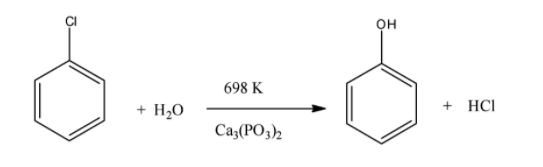
Another way to convert chlorobenzene to phenol is by reacting phenol with steam at 698 K in presence of calcium phosphate. The reaction gives phenol and hydrochloric acid.
Complete answer:
In Dow's process, hydrolysis of chlorobenzene results in phenol. First step is treating chlorobenzene with aqueous sodium hydroxide at a temperature of 623 K and pressure of 300 bar to convert it into sodium phenoxide.
Now, we write the reaction of formation of sodium phenoxide ion by reaction of chlorobenzene with sodium hydroxide.
The next step is the acidification of phenoxide ions. This can be done by reacting phenoxide ion with hydrochloric acid. The result of this reaction is the production of phenol.
Now, we write the reaction of production of phenol by acidification of phenoxide ions.
Hence, by Dow’s process, we are able to convert chloro benzene to phenol by Dow’s process.
Additional information:
When one hydrogen atom of the benzene ring is replaced by a hydroxide ion, then the compound is known as phenol. Phenols are commonly used as intermediates in industrial synthesis and in household products. For example, phenol is used as a disinfectant (in low concentrations) in household and mouthwash cleaners. Phenol was probably the first antiseptic surgery. Phenol is also known as carbonic acid, hydroxybenzene and phenolic acid.
Note:
Another way to convert chlorobenzene to phenol is by reacting phenol with steam at 698 K in presence of calcium phosphate. The reaction gives phenol and hydrochloric acid.
Recently Updated Pages
Which of the following contains the highest percentage class 12 chemistry JEE_Main

Protein can be most easily removed from A Alkanes B class 12 chemistry JEE_Main
PhCOCHBr2xrightarrowOHAxrightarrowOHBxrightarrowH+C class 12 chemistry JEE_Main
When alcohol reacts with conc H2SO4 intermediate compound class 12 chemistry JEE_Main
A nanopeptide contains peptide linkages A 10 B 8 C class 12 chemistry JEE_Main
Which one of the following is paramagnetic A NO B N2O class 12 chemistry JEE_Main
Trending doubts
JEE Main 2026: Exam Dates, Session 2 Updates, City Slip, Admit Card & Latest News
Hybridisation in Chemistry – Concept, Types & Applications
Understanding the Electric Field of a Uniformly Charged Ring
Derivation of Equation of Trajectory Explained for Students
Understanding Collisions: Types and Examples for Students
Understanding Average and RMS Value in Electrical Circuits
Other Pages
CBSE Class 12 Chemistry Question Paper 2026 PDF Download (All Sets) with Answer Key
NCERT Solutions For Class 12 Chemistry Chapter 10 Biomolecules - 2025-26
NCERT Solutions For Class 12 Chemistry Chapter 4 The D And F Block Elements - 2025-26
JEE Advanced Marks vs Ranks 2025: Understanding Category-wise Qualifying Marks and Previous Year Cut-offs
NCERT Solutions For Class 12 Chemistry Chapter 2 Electrochemistry - 2025-26
NCERT Solutions For Class 12 Chemistry Chapter 1 Solutions - 2025-26