



How To Find Area Of Shaded Region With Formula And Solved Examples
The area of the shaded region is basically the difference between the area of the complete figure and the area of the unshaded region. For finding the area of the figures, we generally use the basic formulas of the area of that particular figure. There is no specific formula to find the area of the shaded region of a figure as the amount of the shaded part may vary from question to question for the same geometric figure.
What is Area ?
Area is basically the amount of space occupied by a figure. The unit of area is generally square units; it may be square meters or square centimeters and so on.
Formula for Area of Geometric Figures :
Area of a square \[ = \] side \[ \times \] side
Area of a triangle \[ = \dfrac{1}{2} \times \] base \[ \times \] height
Area of a circle \[ = \] \[\pi {{\rm{r}}^2}\]
Area of a parallelogram \[ = \] base \[ \times \] height
Area of a trapezium \[ = \dfrac{1}{2}\] \[ \times \]sum of the length of the parallel sides \[ \times \] height
Area of rhombus \[ = \dfrac{1}{2}\] \[ \times \] product of the diagonals
What is the Area of the Shaded Region ?
In a given geometric figure if some part of the figure is coloured or shaded, then the area of that part of figure is said to be the area of the shaded region.
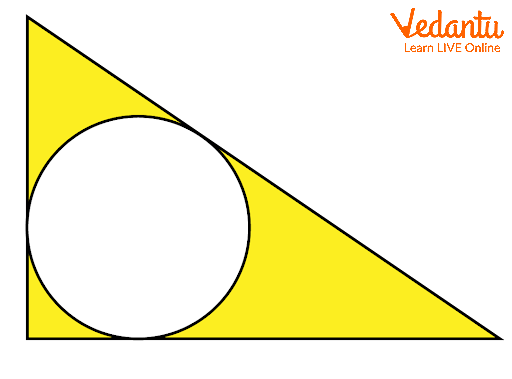
Example on how to Find Area of the Shaded Region
How to Find the Area of the Shaded Region?
So, the area of the shaded or coloured region in a figure is equal to the difference between the area of the entire figure and the area of the part that is not coloured or not shaded.
Area of the shaded region \[ = \] Area of the complete figure \[ - \] Area of the unshaded part
In the above image, if we are asked to find the area of the shaded region; we will calculate the area of the outer right angled triangle and then subtract the area of the circle from it. The remaining value which we get will be the area of the shaded region.
Solved Examples :
1. Find the area of the shaded region from the given figure :

Area of the Shaded Region
Solution :
Here, the length of the given rectangle is 48 cm and the breadth is 22 cm.
We can observe that the outer rectangle has a semicircle inside it. From the figure we can observe that the diameter of the semicircle and breadth of the rectangle are common.
So from this figure we can understand that the area of the shaded region for this figure will be equal to the difference between the area of the outer rectangle and the area of the inner semicircle.
We know that, Area of rectangle = length \[ \times \] breadth
∴ Area of the given rectangle = 48 cm \[ \times \] 22 cm \[ = 1056\] sq.cm
Also, Area of a semicircle = \[\dfrac{1}{2}\pi {r^2}\]
Here, diameter \[ = 22\] cm
So, Radius \[ = \dfrac{1}{2} \times \] Diameter \[ = \dfrac{1}{2} \times 22 = 11\]cm
Area of the given semicircle \[ = \dfrac{1}{2} \times \dfrac{{22}}{7} \times 11 \times 11 = \dfrac{{2662}}{{14}} = 190.14\]sq.cm
Therefore, Area of the shaded region = Area of rectangle - Area of semicircle
So, Area of the shaded region in the given figure = 1056 - 190.14 = 865.86 sq.cm
Area of the shaded region in the given figure is 865.86 sq.cm.
2. Find the area of the shaded region from the given figure :
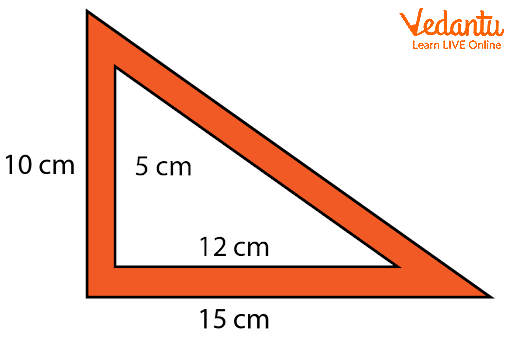
Area of the Shaded Region
Solution :
Here, the base of the outer right angled triangle is 15 cm and its height is 10 cm.
Similarly , the base of the inner right angled triangle is given to be 12 cm and its height is 5 cm.
We can observe that the outer right angled triangle has one more right angled triangle inside.
So from this figure we can understand that the area of the shaded region for this figure will be equal to the difference between the area of the outer triangle and the area of the inner triangle.
We know that, Area of a triangle \[ = \] \[\dfrac{1}{2}\] \[ \times \] base \[ \times \] height
∴ Area of the outer right
angled triangle \[ = \dfrac{1}{2} \times 15 \times 10 = \dfrac{1}{2} \times 150 = 75\] sq.cm.
Similarly, area of the inner
right angled triangle \[\dfrac{1}{2} \times 12 \times 5 = \dfrac{1}{2} \times 60 = 30\]sq.cm.
Therefore, Area of the shaded
region = Area of the outer triangle - Area of the inner triangle
We know that, Area of a triangle \[ = \dfrac{1}{2} \times {\rm{base}}\times{\rm{height}}\]
∴ Area of the outer right angled triangle \[ = \dfrac{1}{2} \times 15 \times 10 =\dfrac{1}{2}\times 150 = 75\] sq.cm.
Similarly,
area of the inner right angled triangle \[\dfrac{1}{2} \times 12 \times 5 = \dfrac{1}{2} \times 60 = 30\] sq.cm.
Therefore, Area of the shaded region \[ = \] Area of the outer triangle \[ - \] Area of the triangle. So, Area of the shaded region in the given figure \[ = 75 - 30 = 45\] sq.cm
Area of the shaded region in the given figure is 45 sq.cm.
3. Find the area of the shaded region from the given figure :
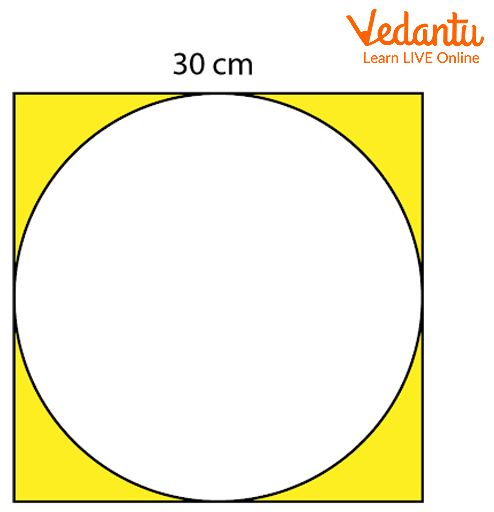
Area of the Shaded Region
Solution :
Here, the length of the side of the given square is 30 cm.
We can observe that the outer square has a circle inside it. From the figure we can see that the value of the side of the square is equal to the diameter of the given circle.
So from this figure we can understand that the area of the shaded region for this figure will be equal to the difference between the area of the outer square and the area of the inner circle. We know that, Area of square = side x side
∴ Area of the given square \[ = \] 30 cm \[ \times \] 30 cm \[ = \] 900 sq.cm
Also, Area of a circle \[ = \pi {r^2}\]
Here, diameter \[ = 30\] cm
So, Radius \[ = \dfrac{1}{2} \times \] Diameter \[ = \dfrac{1}{2} \times 30 = 15\]cm
Area of the given circle\[ = \dfrac{{22}}{7} \times 15 \times 15 = 49507 = 707.14\] sq.cm
\[ = \dfrac{{22}}{7} \times 15 \times 15 = \dfrac{{4950}}{7} = 707.14\] sq.cm
Therefore, Area of the shaded region = Area of square - Area of circle
So, Area of the shaded region in the given figure \[ = 900 - 707.14 = 192.86\] sq.cm
Area of the shaded region in the given figure is 192.86 sq.cm.
Conclusion
The area of the shaded region is in simple words the area of the coloured portion in the given figure. So, the ways to find and the calculations required to find the area of the shaded region depend upon the shaded region in the given figure.
FAQs on Area Of Shaded Region Explained With Formula And Steps
1. What is the area of a shaded region in Maths?
The area of a shaded region is the amount of space covered by the shaded part inside a figure, measured in square units. It is usually found by subtracting or adding areas of known shapes.
- If the shaded part is inside a larger shape, use Area of larger shape − Area of smaller shape.
- If it is made of multiple parts, add the areas of each part.
- Always express the final answer in square units such as cm², m², or units².
2. How do you find the area of a shaded region between two shapes?
To find the area between two shapes, subtract the area of the inner shape from the outer shape. The formula is Area of shaded region = Area of outer shape − Area of inner shape.
- Example: A circle of radius 7 cm inside a square of side 14 cm.
- Area of square = 14² = 196 cm².
- Area of circle = π × 7² = 49π ≈ 153.94 cm².
- Shaded area = 196 − 153.94 ≈ 42.06 cm².
3. What is the formula for the area of a shaded region in a circle?
The formula depends on the shaded part, but commonly it is πr² − area of inner part for circular regions. For a ring (annulus), the formula is π(R² − r²), where R is the outer radius and r is the inner radius.
- Example: R = 10 cm, r = 6 cm.
- Area = π(100 − 36) = 64π ≈ 201.06 cm².
4. How do you calculate the area of a shaded region in a triangle?
To calculate the shaded area in a triangle, use the triangle area formula and subtract any unshaded part. The basic formula is Area = ½ × base × height.
- Example: Base = 8 cm, height = 5 cm.
- Total area = ½ × 8 × 5 = 20 cm².
- If a smaller triangle of area 5 cm² is removed, shaded area = 15 cm².
5. How do you find the area of a shaded region using algebra?
To find the area of a shaded region using algebra, express each dimension in terms of a variable and apply area formulas. Simplify the final expression.
- Example: Square with side (x + 2).
- Area = (x + 2)² = x² + 4x + 4.
- If a smaller square of side x is removed, shaded area = (x² + 4x + 4) − x² = 4x + 4.
6. What is the area of a shaded region in a rectangle?
The area of a shaded region in a rectangle is found using length × width, then subtracting any unshaded portion. The basic rectangle formula is A = l × w.
- Example: Rectangle 12 m by 5 m.
- Total area = 60 m².
- If 20 m² is unshaded, shaded area = 40 m².
7. How do you find the shaded area of a semicircle?
The area of a semicircle is half the area of a circle, given by ½πr². If only part of the semicircle is shaded, subtract the unshaded area.
- Example: r = 14 cm.
- Area = ½ × π × 14² = 98π ≈ 307.88 cm².
8. What are the steps to solve area of shaded region problems?
The steps to solve area of shaded region problems are: identify shapes, apply formulas, and add or subtract appropriately.
- Identify all basic shapes (circle, triangle, rectangle, etc.).
- Write the correct area formulas.
- Calculate each area carefully.
- Add or subtract areas as required.
- State the final answer in square units.
9. What is the difference between total area and shaded area?
The total area is the area of the entire figure, while the shaded area is only the highlighted or selected portion of that figure. The shaded area is often found by subtracting unshaded parts from the total area.
- Total area includes every part of the shape.
- Shaded area excludes unmarked regions.
- Formula commonly used: Shaded area = Total area − Unshaded area.
10. What are common mistakes when finding the area of a shaded region?
Common mistakes when calculating the area of shaded regions include using wrong formulas or forgetting to subtract correctly. Avoid these errors:
- Confusing radius and diameter in circle formulas.
- Forgetting to square units (e.g., writing cm instead of cm²).
- Not subtracting the correct inner area.
- Calculation errors with π (use π ≈ 3.14 or 22/7 as instructed).
