



What Are Benchmark Fractions and How to Use Them to Compare Fractions
What are Benchmark Fractions?
Before understanding the meaning of benchmark fractions, let us first learn what do/es the term ‘Benchmark’ mean? Benchmark can be defined as the standard or reference point against which you can measure or compare something. Whereas, Benchmark fractions are common fractions to which we can compare less common fractions. For example, if you want to compare two fractions, 15 and 27, then in such a case, by finding a benchmark which lies between the two fractions, you can compare if a fraction is greater than, lesser than, or equals to another fraction.
Benchmark Fractions
What are the most Common Benchmark Fractions?
The most common benchmark fractions are zero, one-half, and 1. Sometimes thirds or tenths are also used.
How to Compare Fractions using Benchmark Fractions?
Students often use benchmark fractions to compare fractions with different or unlike denominators. You can use benchmarks on a number line to compare fractions. Also, you can use the relationship between numerator and denominator of a fraction to compare to a known benchmark fraction and then use this information to compare the given fractions.
Let us understand with an example:
Suppose, you want to compare 47 and 25, then in such case, you can see 47 is greater than 12 ( 47 > 12) , whereas 25 is less than 12 (25 < 12). Hence, we can say that 47 > 25.
How You Can Use Benchmarks On A Number Line To Compare Fractions?
Let us understand with an example how to use benchmark fraction on a number line to compare a given fraction.
Suppose, you want to know whether 26 is greater than or less than 12, then in such a case you can draw a number as shown below.
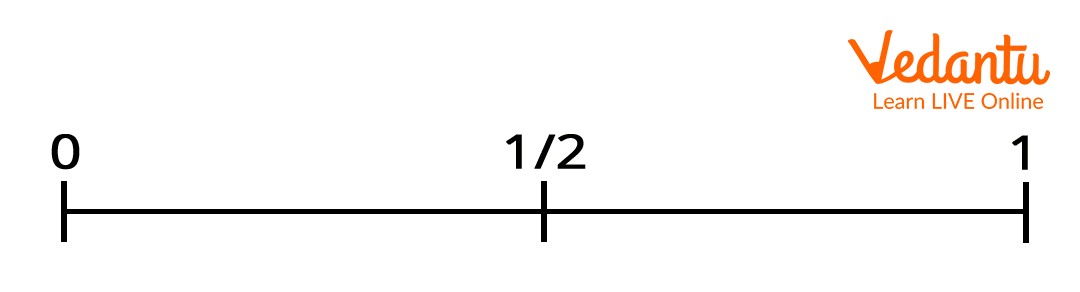
Step 1: First draw a number line and mark it with benchmark 0, 12 and one whole or 1 as shown below.
Step 2: Now check how many sixths are there in one whole using the number line given below.
There are toal 6 sixths in one whole.
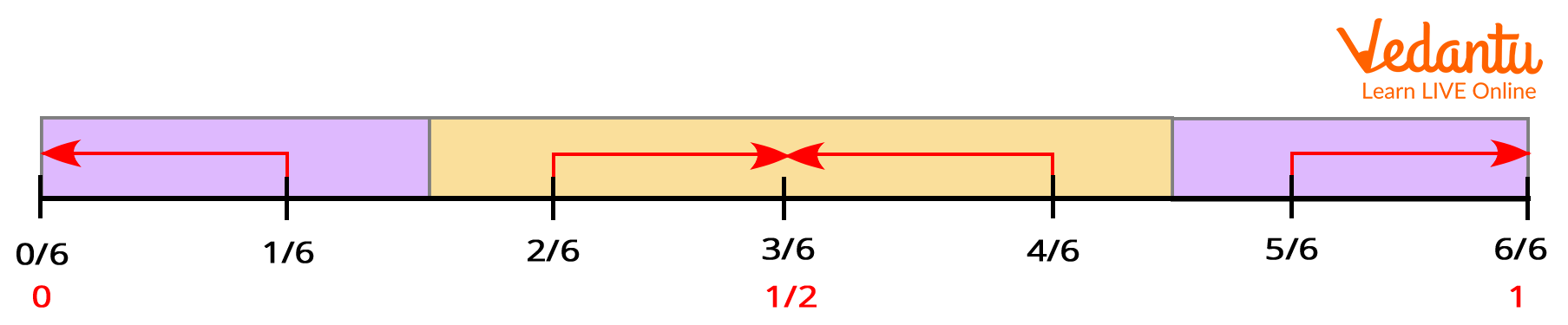
Also, we can see 36 is same as 12 in the above number line,
Now compare whether 26 is greater or lesser than 36 .
We can see 26 is lesser than 36 , because 26 is closer to 0 on a number line. And, we know a fraction is smaller if it is closer to 0 on a number line.
Accordingly, 26 <12
Benchmark Fraction Examples Using Number Line
1. Find 316 + 1259 using benchmark fraction on a number line.
Solution:
In number line below, we can see 16 is closer to 0, hence, 316 is close to 3.
In the below number line, we can see 49 is close to 12, hence, 1249 is close to 1212.
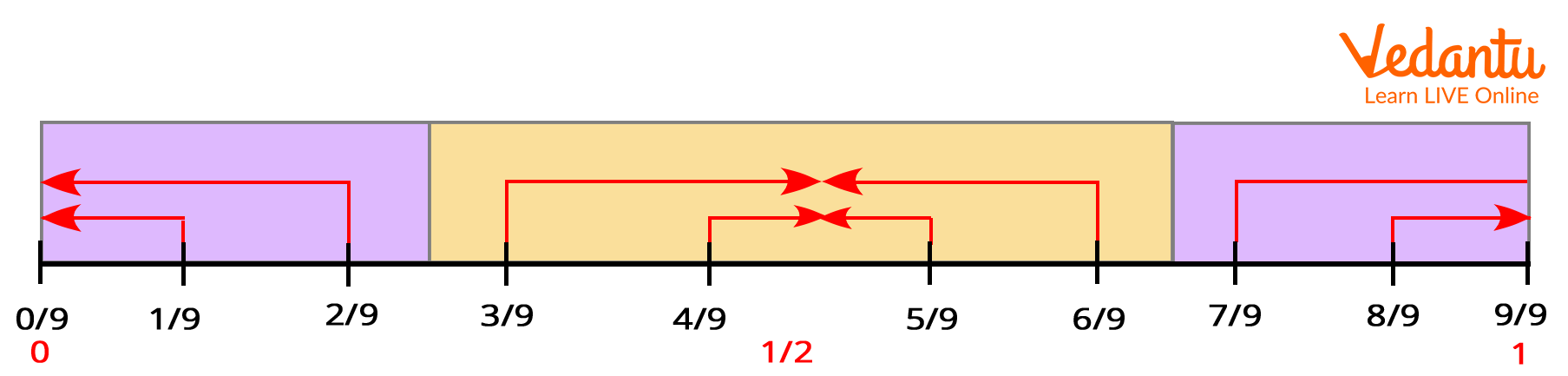
Hence, 316 + 1249 is close to 3 + 1212
Therefore, 316 + 1249 is close to 1512.
Benchmark Fraction Guidelines For Rounding Fraction
Round the given fraction to 0 if the numerator is much smaller than the denominator. For example: 18, 321, 417, etc.
Round the given fraction to 12, if the numerator is almost half the denominator. For example, 37, 613, 817, etc.
Round the given fraction to 1, if the numerator is nearly equal to the denominator. For example, 78, 2123, 97100, etc.
Benchmark Fraction Example For Rounding Fraction
1. Estimate 79 - 15
Solution:
Let us first round each fraction
79 is rounded to 1
15 is rounded to 0
Now subtract
1 - 0 = 1
Hence, 79 - 15 is close to 1.
2. Estimate 459 + 318
Solution:
Let us first round each fraction
In 459, 59 is rounded to 12. Hence, 459 is rounded to 412.
In 318, 18 is rounded to 0. Hence, 318 is rounded to 3.
Now Add,
412 + 3 = 712
Hence, 459 + 318 is close to 712.
Hope you have clearly understood the concept of benchmark fractions through these solved examples. You can find many more information on any math topic and solved examples on our website.
FAQs on Benchmark Fractions Explained for Easy Comparison
1. What are benchmark fractions?
Benchmark fractions are common, easy-to-recognize fractions used to estimate, compare, or understand the size of other fractions.
- They are typically 0, 1/4, 1/2, 3/4, and 1.
- They help students quickly judge whether a fraction is less than, equal to, or greater than a familiar value.
- They are often used in fraction comparison, estimation, and number line problems.
2. What are the most common benchmark fractions?
The most common benchmark fractions are 0, 1/4, 1/2, 3/4, and 1.
- 0 represents no part of a whole.
- 1/2 represents half of a whole.
- 1 represents one complete whole.
- 1/4 and 3/4 help estimate values between 0 and 1.
3. How do you use benchmark fractions to compare fractions?
You use benchmark fractions by comparing each fraction to a common value like 1/2 or 1.
- Step 1: Choose a benchmark (for example, 1/2).
- Step 2: Decide if each fraction is greater than or less than the benchmark.
- Step 3: Compare based on their position relative to the benchmark.
- 3/8 is less than 1/2.
- 5/8 is greater than 1/2.
4. Why is 1/2 considered an important benchmark fraction?
The fraction 1/2 is an important benchmark because it represents the exact middle between 0 and 1.
- It helps determine whether a fraction is less than or greater than half.
- Many fractions are easily compared to 1/2.
- It simplifies mental math and estimation.
5. How do benchmark fractions help with estimating sums and differences?
Benchmark fractions help estimate sums and differences by rounding fractions to the nearest familiar value like 0, 1/2, or 1.
- Step 1: Round each fraction to the nearest benchmark.
- Step 2: Perform the operation using the benchmark numbers.
- 4/9 ≈ 1/2
- 5/8 ≈ 1/2
6. How do you know if a fraction is greater than or less than 1/2?
A fraction is greater than 1/2 if the numerator is more than half of the denominator.
- If numerator × 2 > denominator, the fraction is greater than 1/2.
- If numerator × 2 < denominator, the fraction is less than 1/2.
- For 5/12: 5 × 2 = 10, and 10 < 12 → less than 1/2.
- For 7/12: 7 × 2 = 14, and 14 > 12 → greater than 1/2.
7. Can you give an example of using benchmark fractions on a number line?
You can use benchmark fractions on a number line by marking 0, 1/2, and 1 as reference points.
- Place 0 at the start and 1 at the end.
- Mark 1/2 in the middle.
- Position other fractions based on whether they are less or greater than these benchmarks.
8. What is the difference between benchmark fractions and equivalent fractions?
The difference is that benchmark fractions are reference points for comparison, while equivalent fractions represent the same value in different forms.
- Benchmark example: 1/2 used to compare 3/5.
- Equivalent example: 1/2 = 2/4 = 4/8.
9. How do benchmark fractions help in real-life situations?
Benchmark fractions help in real life by making quick mental estimates when exact calculations are unnecessary.
- Cooking: Knowing 1/2 cup is half a cup.
- Shopping: Estimating discounts close to 1/4 or 1/2.
- Time management: Understanding half or quarter portions.
10. What are common mistakes when using benchmark fractions?
A common mistake with benchmark fractions is assuming closeness without properly comparing numerator and denominator.
- Not checking if a fraction is truly above or below 1/2.
- Confusing benchmark fractions with equivalent fractions.
- Forgetting that estimation is approximate, not exact.
