



Curved Surface Area Formula for Cylinder Cone and Sphere with Examples
Introduction to Curved Surface
You might have various closed objects like your lunch box, water bottle, a rolled wire, and so on. What are they actually? Well, they are shapes. Now, if I ask you what you see in the image below, please mark your answer:
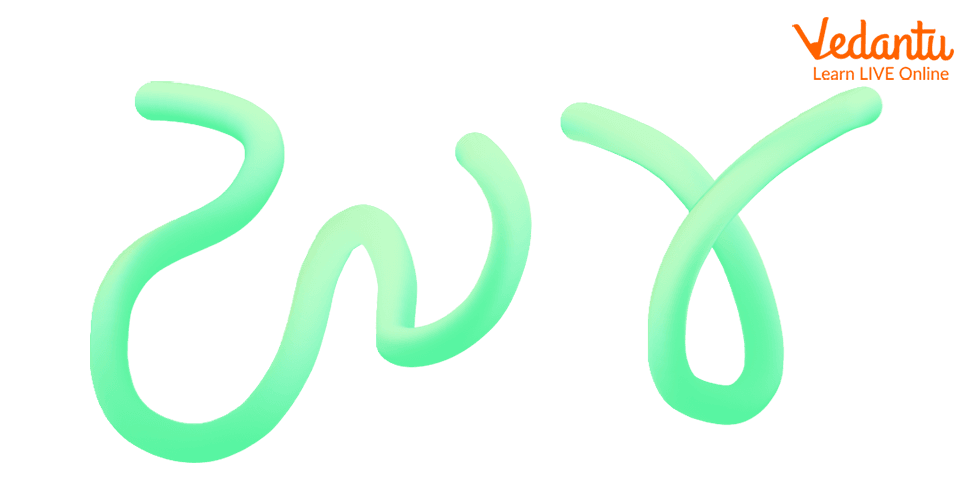
Well, these are simply wires that are rolled in different forms. However, in Maths, we call these randomly folded wires curves. So, what are curves basically? Well, a curve is an abstract term used to describe the path of a continuously moving point. We notice that these curves are made of a straight line bent to form different shapes called curves.
Now, let us understand various types of curves and also the difference in each.
Definition of a Curve
A curve is a smoothly flowing continuous line that has bent. It does not have any sharp turns. The technique to identify the curve is that the line bends and changes its direction at least once for all.
Various curve shapes other than the ones mentioned in the above image are circles, ellipses, parabolas, and hyperbolas, even arcs, sectors, and segments, they are all two-dimensional curved shapes. However, curves are three-dimensional shapes as well, such as spheres, cylinders, and cones; we all have these three-dimensional curved shapes.
Different Types of Curves
Curves are categorised into different forms. Let us have a look at different types of curves with their representations:
Simple Curve
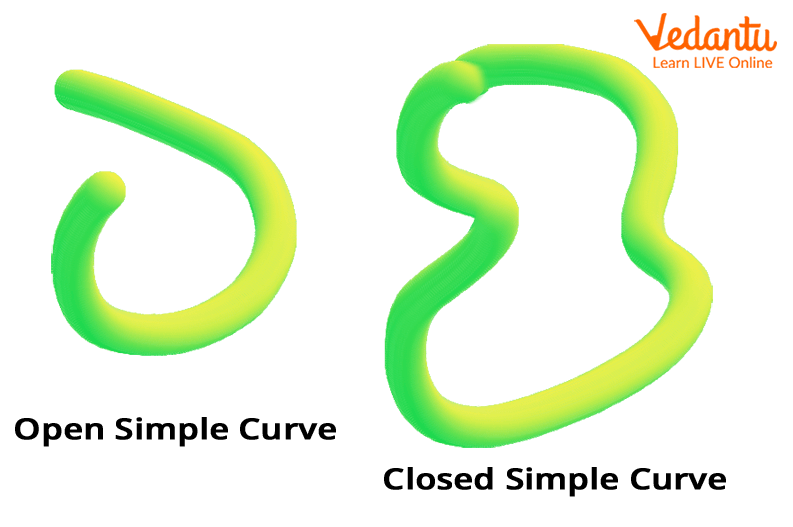
A curve that changes its direction and does not intersect itself is a simple curve. A simple curve may be open or closed. This is what it looks like:
Non-Simple Curve
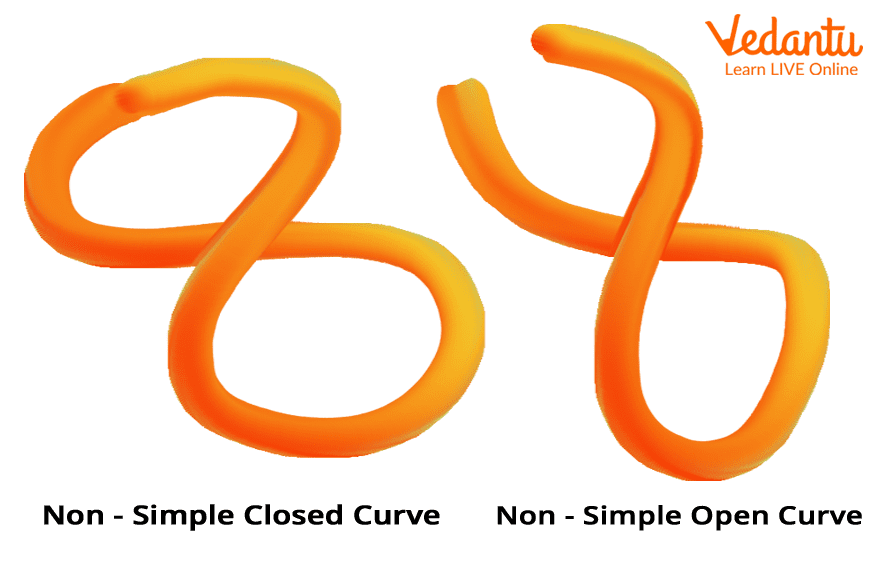
A type of curve other than a simple curve that crosses its path is a non-simple curve. It means the curve intersects itself while altering its direction. This is what it looks like:
Open Curve
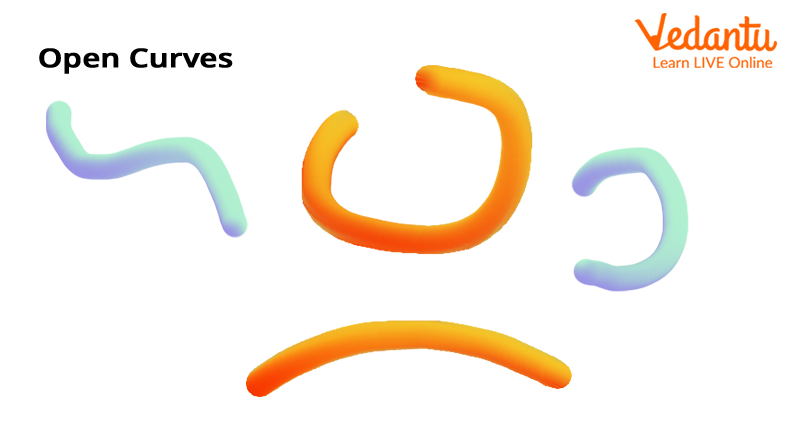
A curve that has two endpoints and does not enclose the area within itself is known as an open curve. Some of the examples of open curves are shown below:
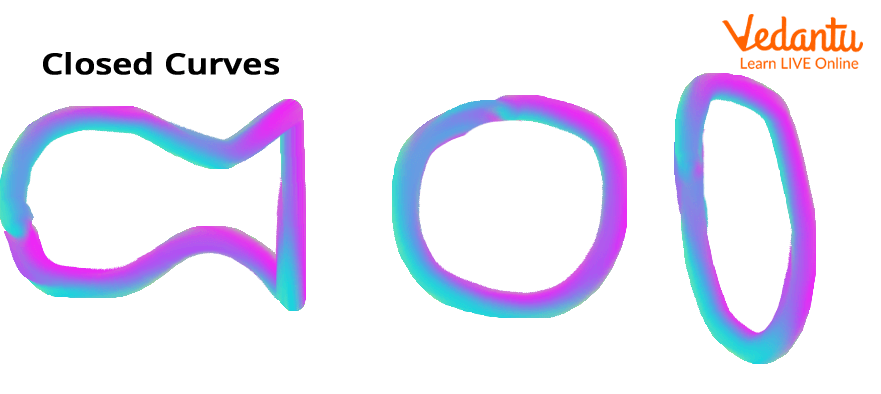
Closed Curve
A curve that has no endpoints and when it encloses the region an area forms, such a type of curve is known as the closed curve. A closed curve is formed by joining the two endpoints of the open curve. The best example of such types of curves are circles, ellipses, etc.
Curved Line
A bent line is called a curved line. If the curvature is not zero, we consider it a curve line, which is generally smooth and continuous.
Curved Line Images
We observe many objects in our surroundings that are in the shape of a curved line. Some of them incorporate the following:
Railways at the turning points,
Track of a roller coaster,
Paths of roads in hilly areas, and so on.
Apart from the real-life examples, we can also observe the curve-shaped lines in Maths; for example, the graph of a quadratic polynomial including parabola, ogive curve, arrows, etc.
So, this is how we understand curve Maths and the types of curves we find in our surroundings.
FAQs on Curved Surface Area in Geometry
1. What is a curved surface in geometry?
A curved surface is a surface that is not flat and continuously bends, unlike a plane surface. In geometry, curved surfaces are found in 3D shapes such as:
- Cylinder (side surface)
- Cone (slanted surface)
- Sphere (entire outer surface)
2. What is the curved surface area of a cylinder?
The curved surface area (CSA) of a cylinder is given by the formula 2πrh. Here:
- r = radius of the base
- h = height of the cylinder
3. What is the formula for the curved surface area of a cone?
The curved surface area of a cone is πrl, where l is the slant height. Here:
- r = radius of the base
- l = slant height
4. What is the curved surface area of a sphere?
The curved surface area of a sphere is 4πr². A sphere has no flat surface, so its total surface area equals its curved surface area.
- r = radius of the sphere
5. What is the difference between curved surface area and total surface area?
The curved surface area includes only the curved part of a solid, while the total surface area includes both curved and flat surfaces.
- For a cylinder: TSA = 2πrh + 2πr²
- For a cone: TSA = πrl + πr²
6. How do you find the slant height of a cone for curved surface area?
The slant height (l) of a cone is calculated using the formula l = √(r² + h²). Here:
- r = radius
- h = vertical height
7. Why is the curved surface area of a cylinder 2πrh?
The curved surface area of a cylinder is 2πrh because its curved surface forms a rectangle when unrolled. When opened:
- Length = circumference of base = 2πr
- Breadth = height = h
8. Can you give a real-life example of curved surface area?
A common real-life example of curved surface area is calculating the label needed to wrap around a cylindrical can. For a can with radius 5 cm and height 12 cm:
- CSA = 2πrh
- = 2 × π × 5 × 12 = 120π cm²
9. What are common mistakes when calculating curved surface area?
A common mistake in finding curved surface area is confusing it with total surface area. Students often:
- Add base areas when only CSA is required
- Use height instead of slant height in cones
- Forget to square the radius in sphere formula 4πr²
10. Is the curved surface area of a sphere the same as its total surface area?
Yes, the curved surface area of a sphere is the same as its total surface area, which is 4πr². This is because a sphere has no flat faces or edges, so its entire outer surface is curved.
