



What Are Equations Definition Types Formulas and Solved Examples
What are Equations in Math?
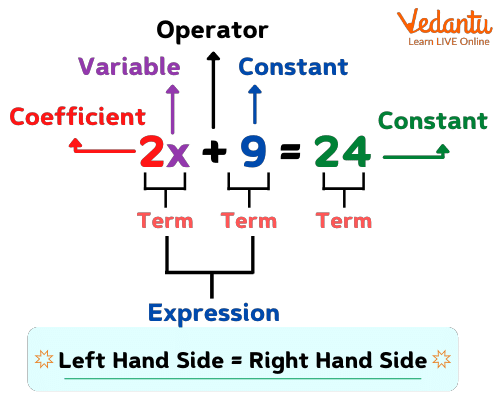
Equations are something that we can understand as the combination of numbers, operators on the left hand side and the result on the right hand side separated by an equal to ‘=’ sign’. The operators that we study in math are +, -, , and .
For example, my mom brought two chocolates of Dairy milk and three 5-star chocolates for my younger sister, so how many chocolates does my sister have? Well, here, we will be using the addition (+) operator because the total is being asked here.
2 + 3 = 5
So, the numbers on adding give 5 as the result on the right-hand side. This is how we understand equations in math. Here, on this page, we will go through certain more equation examples.
Certain Examples for Equations in Math
Example 1: Yesterday, Shrishti purchased apparel worth Rs. 350. Today, she decided to buy another dress but before that she has to count how much she is left with. Like earlier, she had Rs. 1000 in her pocket, so which approach she follows to determine the amount she has at present?
Answer: Well, it is so easy to determine the remaining amount so that she could decide either to buy a new dress or not.
So, original amount she had = Rs. 1000
Amount she spent yesterday = Rs. 350
Now, the amount she has left with is ‘?’
So, 350 + ? = 1000
Here, when we take 350 on the right-hand side, the sign before it changes from ‘+’ to ‘-’, so we have:
? = 1000 - 350
Please note that the process of moving a term from one side of the equation to the other side and changing the sign before the term is transposition.
And, now using the concept of borrowing (subtraction regrouping), we have:
Here, 5 is greater than 0, so we borrow ‘1’ from the next place value, which is again ‘0’ and then again we go the other digit at the next place value, we find ‘1’ there. Now, when we take ‘1’ from here, the number in the minuend becomes 10 which is greater than ‘5’ in the subtrahend, so we get 10 - 5 = 5.
Also, earlier in one’s place, we had 0 - 0, which was clearly ‘0’.
So, last two digits becomes ‘50’, now moving to the next digit, which after giving ‘1’ to the minuend corresponding to ‘5’ in the subtrahend becomes ‘9’ in place of ‘10’, so now we have a new minuend corresponding to ‘3’ as 9 and subtracting 9 from 3, i.e., 9 - 3 = 6.
Now, our answer becomes 650. This means that Shrishti is left with Rs. 650 after purchasing apparel of Rs. 350 yesterday.
Example 2: Suppose your brother’s height is three times your height and this is just an assumption, means that you are not aware of your height. Now, if you subtract ‘5’ from your brother’s height and suppose that 13 is the result, how do you interpret this information in an equation form?
Answer: Well, it is pretty simple to understand and follow the underlines steps:
Step: Assume that your height is ‘b’ cm and then your brother’s height becomes three times, i.e., ‘3b’ cm. And here you have assumed that the result is around 13 cm after subtracting ‘5’ from your brother’s height, so let us form an equation now:
3b - 5 = 13
3b = 13 + 5 (‘-’ sign on the LHS becomes ‘+’ when migrating to the right-hand side)
3b = 18
b = 18 3
So, b = 6 cm
Hence, your interpretation for the height turns out to be a single digit number, i.e., your height is 6 cm.
From the above text, we understand that equations are statements of equality between two expressions which are composed of numbers, variables, and operators. Going through these examples will help you understand what equations are and how we solve them.


FAQs on Equations Explained with Clear Examples and Solutions
1. What is an equation in maths?
An equation is a mathematical statement that shows two expressions are equal using the equals sign (=).
An equation usually contains:
- Variables (like x or y)
- Constants (fixed numbers)
- Mathematical operations (+, −, ×, ÷)
2. How do you solve a simple linear equation?
To solve a linear equation, isolate the variable on one side of the equation.
Example: Solve 2x + 5 = 11
- Step 1: Subtract 5 from both sides → 2x = 6
- Step 2: Divide both sides by 2 → x = 3
3. What is a quadratic equation with an example?
A quadratic equation is an equation of degree 2 written in the form ax² + bx + c = 0, where a ≠ 0.
Example: x² − 5x + 6 = 0
- Factorise: (x − 2)(x − 3) = 0
- Solutions: x = 2 or x = 3
4. What is the quadratic formula?
The quadratic formula is x = (−b ± √(b² − 4ac)) / 2a and is used to solve equations of the form ax² + bx + c = 0.
Example: Solve 2x² + 3x − 2 = 0
- a = 2, b = 3, c = −2
- Discriminant: b² − 4ac = 9 + 16 = 25
- x = (−3 ± 5)/4
- Solutions: x = 1/2 or x = −2
5. What is the difference between an equation and an expression?
The main difference is that an equation has an equals sign (=), while an expression does not.
- Expression example: 3x + 5
- Equation example: 3x + 5 = 11
6. How do you solve equations with variables on both sides?
To solve equations with variables on both sides, collect like terms and isolate the variable.
Example: Solve 3x + 2 = x + 10
- Step 1: Subtract x from both sides → 2x + 2 = 10
- Step 2: Subtract 2 → 2x = 8
- Step 3: Divide by 2 → x = 4
7. What is a system of equations with an example?
A system of equations consists of two or more equations solved together to find common solutions.
Example:
2x + y = 7
x + y = 5
- Subtract second equation from first → x = 2
- Substitute into x + y = 5 → y = 3
8. What is a solution of an equation?
A solution of an equation is a value of the variable that makes the equation true.
Example: For 4x = 20
- Divide both sides by 4 → x = 5
- Check: 4(5) = 20 ✔
9. How do you check if an answer to an equation is correct?
You check a solution by substituting the value back into the original equation.
Example: Check x = 3 in 2x + 4 = 10
- Substitute: 2(3) + 4 = 6 + 4 = 10
10. What are common mistakes when solving equations?
Common mistakes in solving equations include incorrect sign changes and not performing the same operation on both sides.
Typical errors:
- Forgetting to change the sign when moving terms
- Dividing only one side instead of both sides
- Arithmetic mistakes in simplification
- Not checking the final answer
