



How to Convert Fractions to Decimals and Percentages
When a complete item is divided into equal pieces, each component is referred to as a fraction. A fraction, in other terms, is a portion of the total. A fraction is composed of two parts: the numerator and the denominator. It is written as a numerator/denominator. The numerator indicates how many total factors are taken, whereas the denominator indicates the total number of equal parts.
What is a Mixed Fraction?
Improper fractions are represented more simply using mixed numbers. Improper Fraction: Do you know what it is? A fraction is referred to be an improper fraction if it cannot be further simplified and has a numerator that is more than or equal to the denominator. A mixed fraction is one generated by mixing a whole number and a fraction. Conversion of fraction example: if 3 is a whole number and \[\dfrac{5}{9}\] is the fraction part then, \[3\dfrac{5}{9}\] is the mixed fraction.
Conversion of Improper Fraction Into a Mixed Fraction(Mixed Number Converter)
An improper fraction has a numerator greater than a denominator. In order to convert this fraction into a mixed fraction, we can follow the following steps.
Step one- Divide the fraction (numerator divided by denominator)
Step two- Obtain the remainder.
Step three- The whole number part of the mixed fraction would be the quotient obtained after dividing and the numerator part will be the remainder, which we got in step two. In this, the denominator(divisor) will remain the same.
Example – \[\dfrac{12}{5}\] will have 2 as a remainder and 2 as the quotient. So, the mixed fraction would be \[2\dfrac{2}{5}\].
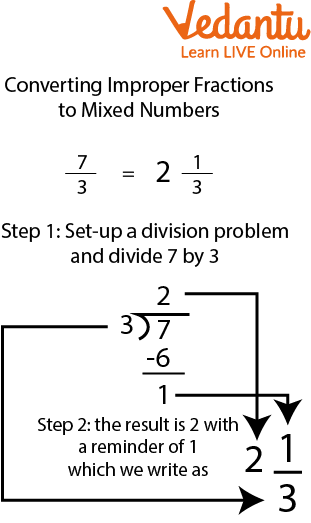
Converting Improper Fraction to Mixed Fraction
Conversion of Mixed Fraction Into an Improper Fraction
The mixed fraction can be changed easily into an improper fraction by following the given steps.
Step one- Multiple the denominator with the whole number part of the equation.
Step two- The product obtained will then be added to the numerator of the given mixed fraction.
Step three- The result we got would be the numerator of the improper fraction and the denominator would remain.
Example- \[7\dfrac{2}{3}\] in this mixed fraction we will multiply 3 and 7 and the product we will get is 21 which will then be added to 2 giving the result as 23. So, the improper fraction will turn out as \[\dfrac{23}{3}\].
Methods of Reduction of Different Fractions
The methods through which the complex fraction can be changed into the simplest form so that it further can be divided. There are different methods by which the fraction can be reduced. By dividing the numerator and denominator by a common divisor until the common factor equals 1, we may simplify fractions by reducing them. To put it another way, a fraction can only be divided by 1 or another whole integer. Consider the fraction 8/24 as an illustration. Here is how to decrease the fraction step by step.
Step 1: Write the denominator and numerator's factors in Step 1. The factors of 24 are 1, 2, 3, 4, 6, 8, 12, and 24 while the factors of 8 are 1, 2, 4, and 8.
Step 2: The second step is to identify the shared factors between the numerator and the denominator. 1, 2, 4, and 8 are the factors that 8 and 24 have in common.
Step 3: Subtract the common factors from the numerator and denominator until there is only one common factor remaining: 1. This gives you the fraction in its reduced form.
Let's start dividing by 2: \[\dfrac{{8}}{{24}} = \dfrac{{8 \div 2}}{{24 \div 2}} = \dfrac{4}{12}\]. We will continue to divide by 2 until we can't go any further. So, we have \[\dfrac{{4 \div 2}}{{12 \div 2}} = \dfrac{2}{6} = \dfrac{{2 \div 2}}{{6 \div 2}} = \dfrac{1}{3}\].
Therefore, the reduced form of \[\dfrac{8}{{24}}\]is \[\dfrac{1}{{3}}\].
Tips for Reducing Fractions
So you now understand the different methods for reducing a fraction to its simplest form. Here are some tips to assist you in fast-reducing fractions. When reducing fractions to their simplest form, use these techniques.
If a fraction's numerator or denominator is a prime number, the fraction cannot be simplified anymore.
A fraction with 1 in the numerator cannot be further lowered.
To simplify an improper fraction, first, express it as a mixed fraction and then simplify it as you would a proper fraction.
For application of any arithmetic operation convert into like fraction so that they have the same denominator.
Sample Questions
1) Convert \[4\dfrac{1}{3}\] into an improper fraction.
Ans)
The first step is to multiply the denominator by the whole number component of the equation.
Step two is to add the resulting product to the numerator of the current mixed fraction.
Step three- the outcome would be the improper fraction's numerator and the denominator would remain.
\[\begin{array}{l}4\dfrac{1}{3} = 3 \times 4 + 1 = 13\\ = \dfrac{{13}}{3}\end{array}\]
2) Convert \[\dfrac{16}{5}\] into a mixed fraction.
Ans)
Step one: divide the numerator by the denominator
Step two: get the remainder
Step three: The quotient produced after dividing the whole number component of the mixed fraction will be the numerator part, which we received in step two. The denominator (divisor) will remain constant in this case.
\[\dfrac{{16}}{5} = 16 \div 5 = 3\]
Remainder = 1
Fraction \[3\dfrac{1}{5}\]
3) Add \[1\dfrac{3}{4}\] and \[2\dfrac{5}{6}\].
Ans)
Convert the mixed fraction into an improper fraction.
As the denominators are different, take LCM and make the denominator the same.
Now add the numerator.
\[\begin{array}{l}1\dfrac{3}{4} = \dfrac{7}{4}\\2\dfrac{5}{6} = \dfrac{{17}}{6}\end{array}\]
LCM of 4 and 6 is 12.
\[\dfrac{{21}}{{12}} + \dfrac{{34}}{{12}} = \dfrac{{55}}{{12}}\]
4) Multiply \[3\dfrac{4}{7}\] and \[4\dfrac{5}{9}\] .
Ans) Convert the mixed fraction into an improper fraction and then multiply the numerators and denominators separately.
\[\begin{array}{l}3\dfrac{4}{7} = \dfrac{{25}}{7}\\4\dfrac{5}{9} = \dfrac{{41}}{9}\\\dfrac{{25}}{7} \times \dfrac{{41}}{9} = \dfrac{{1025}}{{63}}\end{array}\]
5) Reduce the fraction \[\dfrac{18}{81}\] by GCF method.
Ans) As the highest common factor is 9 for the given fraction, it needs to be divided by 9 to reduce it.
\[\begin{array}{l}\dfrac{{18}}{{81}}\\ = 18 \div 9,81 \div 9\\ = \dfrac{2}{9}\end{array}\]
6) Reduce the following fractions by the GCF method. a) 16/64, b) 18/81
Solution: We will use the GCF method to reduce fractions.
a) The greatest common factor of 16 and 64 is 16. Dividing the numerator and the denominator by 16, we get the fraction reduced to \[\dfrac{1}{4}\].
\[\dfrac{{16}}{{64}} = \dfrac{{16 \div 16}}{{64 \div 16}} = \dfrac{1}{4}\]
Therefore, the reduced form of \[\dfrac{{16}}{{64}}\] is \[\dfrac{1}{4}\]
b) The greatest common factor of 18 and 81 is 9. Dividing the numerator and the denominator by 9, we get the fraction reduced to \[\dfrac{2}{9}\]
\[\dfrac{{18}}{{81}} = \dfrac{{19 \div 9}}{{81 \div 9}} = \dfrac{2}{9}\]
Therefore, the reduced form of \[\dfrac{{18}}{{81}}\] is \[\dfrac{2}{9}\].
Conclusion
A fraction consists of a numerator and a denominator. The fraction can be like a fraction, unlike fractions and mixed fractions. The mixed fraction can be converted into an improper fraction or unlike fraction and vice versa. Like fraction is a fraction whose denominator is the same and is greater than the numerator.
FAQs on Understanding Fraction Conversion in Maths
1. What is fraction conversion in Maths?
Fraction conversion is the process of changing a fraction from one form to another, such as to a decimal, percentage, or another equivalent fraction. It helps in comparing, simplifying, and solving mathematical problems. Common types of fraction conversion include:
- Converting a fraction to a decimal
- Converting a fraction to a percentage
- Converting between improper fractions and mixed numbers
- Finding equivalent fractions
2. How do you convert a fraction to a decimal?
To convert a fraction to a decimal, divide the numerator by the denominator. The decimal form is obtained using long division or a calculator.
- Example: Convert 3/4 to decimal.
- Step 1: Divide 3 ÷ 4
- Step 2: Result = 0.75
3. How do you convert a fraction to a percentage?
To convert a fraction to a percentage, multiply the fraction by 100%. This shows the fraction as parts per hundred.
- Formula: (Fraction × 100)%
- Example: 3/5 × 100 = 60%
4. How do you convert a mixed number to an improper fraction?
To convert a mixed number to an improper fraction, multiply the whole number by the denominator and add the numerator. Place the result over the original denominator.
- Formula: (Whole × Denominator + Numerator) / Denominator
- Example: 2 1/3 = (2 × 3 + 1)/3 = 7/3
5. How do you convert an improper fraction to a mixed number?
To convert an improper fraction to a mixed number, divide the numerator by the denominator. The quotient is the whole number and the remainder becomes the new numerator.
- Example: 9/4
- Step 1: 9 ÷ 4 = 2 remainder 1
- Step 2: Mixed number = 2 1/4
6. What is an equivalent fraction and how do you find it?
An equivalent fraction is a fraction that has the same value as another fraction but different numbers. You find it by multiplying or dividing both numerator and denominator by the same non-zero number.
- Example: 1/2 × 2/2 = 2/4
- Both 1/2 and 2/4 represent the same value.
7. How do you simplify a fraction?
To simplify a fraction, divide the numerator and denominator by their greatest common factor (GCF). This reduces the fraction to its lowest terms.
- Example: Simplify 8/12
- GCF of 8 and 12 = 4
- 8 ÷ 4 / 12 ÷ 4 = 2/3
8. How do you convert a decimal to a fraction?
To convert a decimal to a fraction, write the decimal as a fraction over a power of 10 and simplify. The denominator depends on the number of decimal places.
- Example: 0.75 = 75/100
- Simplify by dividing by 25
- Final answer = 3/4
9. What is the easiest way to compare two fractions?
The easiest way to compare two fractions is to convert them to a common denominator or decimal form. This makes their values directly comparable.
- Example: Compare 2/3 and 3/4
- Convert to decimals: 2/3 ≈ 0.67 and 3/4 = 0.75
- Since 0.75 > 0.67, 3/4 is greater
10. Why is fraction conversion important in real life?
Fraction conversion is important because it helps in everyday calculations involving measurements, money, and percentages. Converting fractions makes values easier to understand and compare.
- In cooking: converting 1/2 cup to 0.5 cups
- In shopping: converting 1/4 to 25% discount
- In measurements: changing mixed numbers to improper fractions for calculation
