



Steps to Bisect an Angle Using Compass and Straightedge
Angle bisectors can be seen quite often in our daily life. They are defined as a ray or a line that splits an angle into two equal halves. It is important to know their use and methods to construct them.
What Are Angle Bisectors and Their Use
Before we learn what angle bisectors are, Let’s look at what an angle is and what bisectors are. An angle is a combination of two rays having a common endpoint. This common endpoint is known as the vertex of the angle and the spacing between the rays is called the measure of an angle. A bisector is simply a line (a ray in our case) that divides the angle into two equal parts.
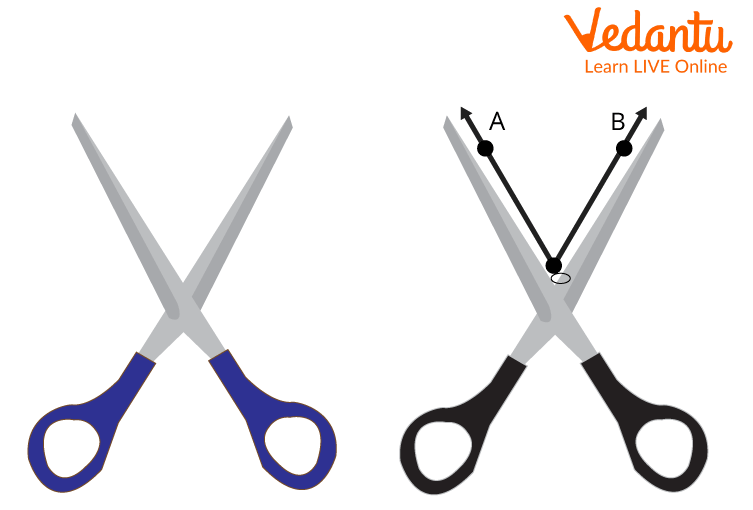
Scissor Showing an Angle
The scissor pivot is called the angle's vertex. The line passing through the vertex divides the scissor into two symmetrical portions and is called the bisector. If a bisector bisects an angle, it is called an angle bisector.
Real-world applications for angle bisectors include quilting, baking, and architecture. Numerous games, including rugby, football, and pool, use angle bisectors.
How to Draw an Angle Bisector?
Let’s take a fun approach in trying to make an angle bisector. Take a paper and make an angle on it. Now fold the paper so that the first line completely overlaps the second line. Make a crease. Now unfold the paper and draw a line along the crease.
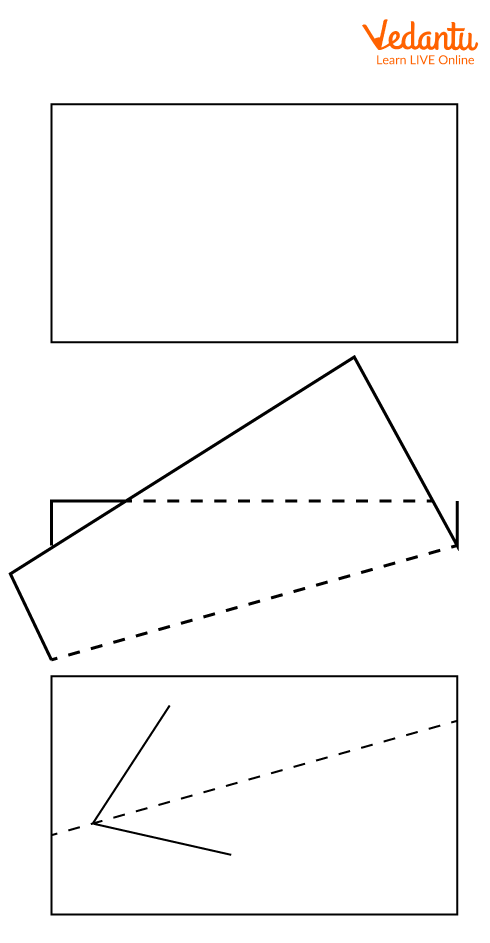
Angle Bisector Using Paper Fold
What are the Properties of Angle Bisectors?
It is essential to know the properties of angle bisectors. Since we cannot call all lines angle bisectors, we need to know a few distinct properties of angle bisectors. These are:
It must pass through the vertex of the angle.
It must be equally inclined[spaced] between the rays of the angle.
The angle bisector is also the line of symmetry of the angle.
In the case of a straight line, the angle bisector is perpendicular to the line.
For example, the first image shows a slice of pizza unevenly portioned by the line. Thus the line is not the angle bisector. However, the pizza is evenly portioned by the line in the second image. Hence it can be called an angle bisector.
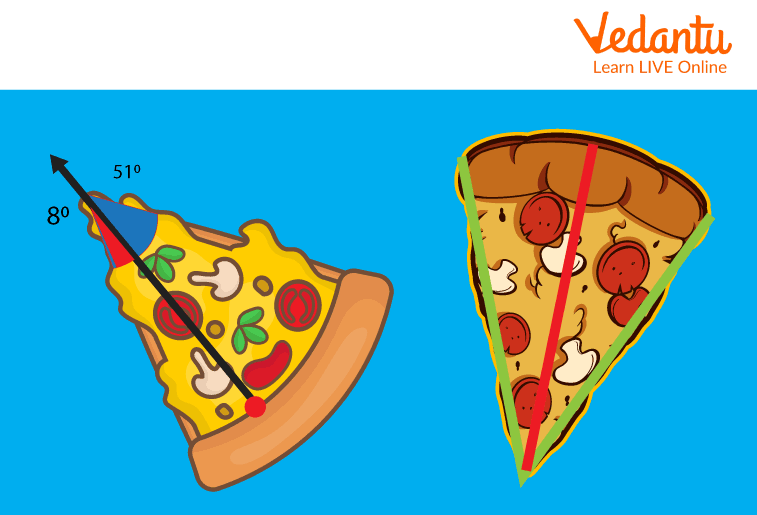
Pizza Showing Angle Bisector
Construction of Angle Bisectors
Construction of Angle Bisectors using Protractor
We have to bisect ∠PQR. We measure the angle using a protractor. Let’s say the measure is 110°. The half of 110° is 55°. So we make an angle of measure 55°, called ∠PQS. QS is the required angle bisector. And ∠SQR \[ = \] ∠PQS \[ = \] 55°.
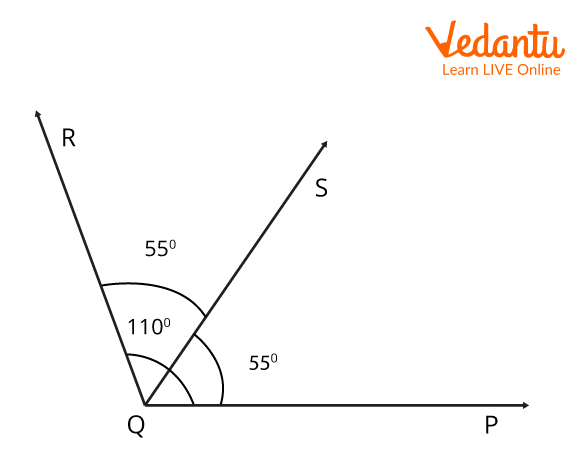
Drawing Angle Bisector using a Protractor
Let us now move on to learn how to construct an angle bisector using a compass.
Construction of Angle Bisectors using a compass
We have to bisect ∠ABC. To do that,
We first place the needle end of the compass on vertex B.
Draw an arc, letting the arc intersect AB and BC at R and P, respectively.
Now we place the needle end of the compass on P and draw a big enough arc.
Do the same at point R and let these two arcs meet at point S.
Join BS.
We have our required angle bisector for ∠ABC.
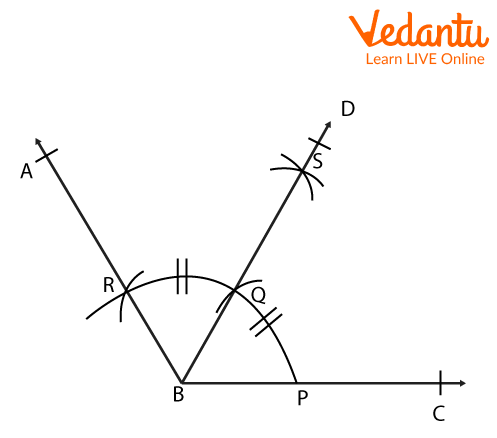
Constructing Angle Bisector using Compass.
Great! You have now understood what angle bisectors are, their main properties, and their construction. Now, let us take a look at some solved examples below.
Solved Examples
1. Given an ∠ABC \[ = \] 40°. Find the measure of the angle after an angle bisector bisects it.
Using the property that the angle bisector divides the angle into two equal parts, angle bisectors, we can find the measure of the angle. Let this measure be x. We have \[{\rm{x + x}} = {40^ \circ }\]. This gives \[{\rm{x}} = {20^ \circ }\]. Hence, the measure of the angle after its bisection is 20°.
2. Consider an angle ∠AOB. Write the steps to construct its angle bisector using a compass.
Steps to construct an angle bisector using a compass. First, draw the angle using a protractor.
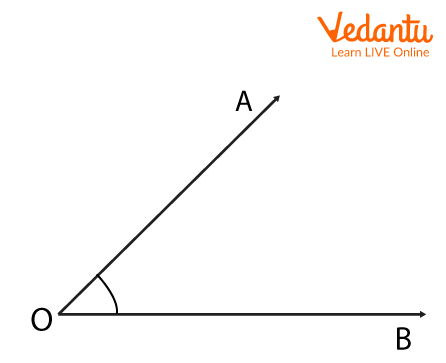
Steps to Construct an Angle Bisector using a Compass
1. Make an arc of any radius using the compass with the needle on point O. Let’s name the points where the arc cuts the rays of angle AOB
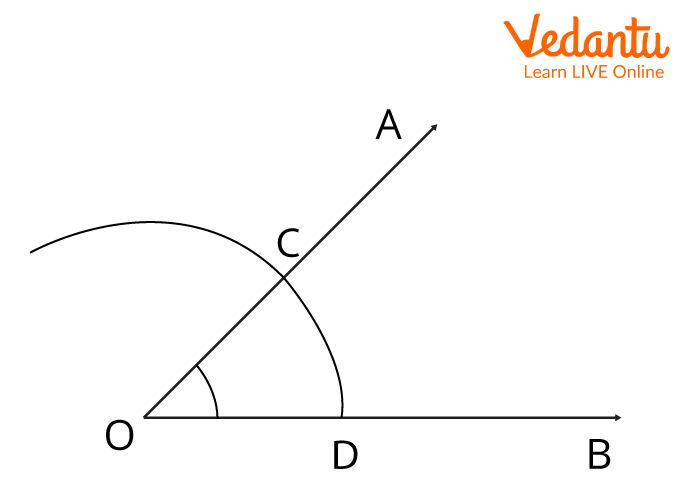
Steps to Construct an Angle Bisector using a Compass
2. Now with the needle on Point C, draw an arc with a greater radius. Now put the needle on Point D and draw an arc of the same length. And let these arcs intersect at Point E.
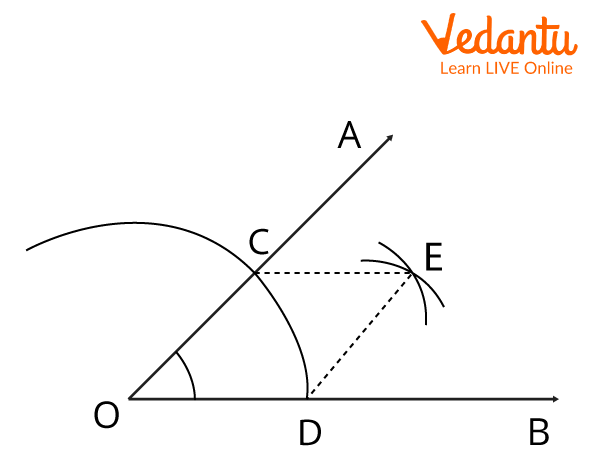
Steps to Construct an Angle Bisector using a Compass
3. Join OE. This completes the construction of the angle bisector.
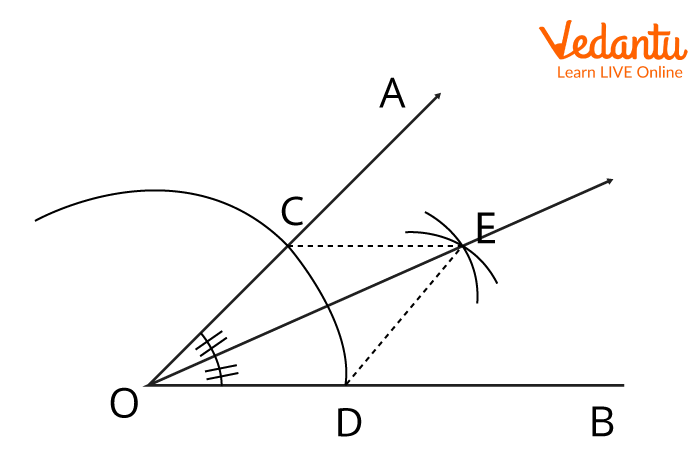
Steps to Construct an Angle Bisector using a Compass
Conclusion
The angle bisectors are very important in proving complicated proofs. Great! We now know how to identify angles, how to construct angle bisectors, and their construction and mathematical implementation of angle bisectors.
FAQs on How to Bisect an Angle in Geometry
1. What does it mean to bisect an angle?
To bisect an angle means to divide it into two equal angles. An angle bisector is a line or ray that starts at the vertex and splits the original angle into two congruent parts. For example, if a 60° angle is bisected, each new angle measures 30°. Angle bisection is a basic construction in geometry.
2. How do you bisect an angle using a compass and ruler?
You can bisect an angle using a compass and ruler by constructing equal arcs from the vertex and connecting their intersection point to the vertex.
- Draw an arc from the vertex cutting both arms of the angle.
- From each intersection point, draw arcs that intersect each other.
- Draw a line from the vertex through the intersection of the arcs.
3. What is the formula for an angle bisector?
The Angle Bisector Theorem states that in a triangle, the angle bisector divides the opposite side in the ratio of the other two sides. The formula is:
BD/DC = AB/AC
Where AD is the angle bisector in triangle ABC. This formula helps find unknown side lengths in triangles.
4. What is the Angle Bisector Theorem?
The Angle Bisector Theorem states that an angle bisector in a triangle divides the opposite side into segments proportional to the adjacent sides. In triangle ABC, if AD bisects angle A, then:
BD/DC = AB/AC
This theorem is commonly used in triangle geometry problems involving ratios and lengths.
5. How do you calculate the measure of each angle after bisection?
To find each angle after bisection, divide the original angle measure by 2. For example:
- If the angle is 80°, each part is 80° ÷ 2 = 40°.
- If the angle is 135°, each part is 67.5°.
6. Can you give an example of bisecting an angle in a triangle?
Yes, in triangle ABC, if angle A is 50° and AD is the angle bisector, then each new angle measures 25°. If AB = 6 cm and AC = 4 cm, then using the Angle Bisector Theorem:
BD/DC = 6/4 = 3/2
This shows how the opposite side is divided proportionally.
7. What is the difference between an angle bisector and a median?
An angle bisector divides an angle into two equal angles, while a median divides the opposite side into two equal lengths. Key differences:
- Angle bisector focuses on equal angles.
- Median focuses on equal side segments.
- They are generally different lines unless the triangle is isosceles.
8. Does an angle bisector always divide the opposite side equally?
No, an angle bisector does not always divide the opposite side equally unless the triangle is isosceles. It divides the side in the ratio of the adjacent sides according to:
BD/DC = AB/AC
Only when AB = AC will the opposite side be divided into two equal parts.
9. How do you bisect an angle without a protractor?
You can bisect an angle without a protractor by using a compass construction method.
- Draw an arc from the vertex cutting both arms.
- Draw equal arcs from those two points.
- Join the intersection point to the vertex.
10. Why is angle bisection important in geometry?
Angle bisection is important because it helps create equal angles and apply proportional reasoning in triangles. It is used in:
- Proving triangle properties
- Solving ratio problems using the Angle Bisector Theorem
- Geometric constructions and proofs
