



How to Count Write and Recognize Number 5 with Examples
Raise your 5 Fingers! - Learn Number 5
Raise all your fingers in one hand and yes you are representing the number 5! Do you understand what 5 is? This is a number in maths. These 5 will help us in the counting of numbers and also in mathematical calculations. 5 is the fifth number in the number system, the number is pretty cool too, as the number is related to many fun facts as well. Why wait for more? Let us learn about this amazing number in the content of ‘What is 5?’
Number 5 in Mathematics
In the mathematics number system, the number 5 represents the quantity or the value of 5. The number 5 lies between two numbers which are 4 and 6. The number 5 precedes number 6 and succeeds number 4.
(Tip: Precedes means the previous number and succeeds means the following number)
Meet Steve
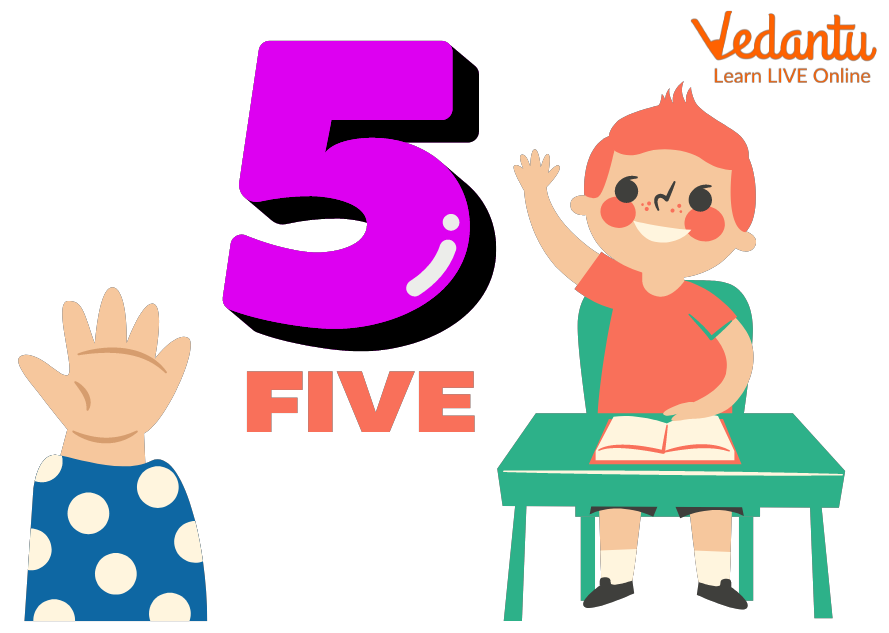
Little Steve wanted to know about the number 5, so he raised his 5 fingers and counted them. 1, 2, 3, 4, and 5! He was delighted that he could count to the number 5. Then little Steve counted further:

He counted 5 balloons
He counted 5 birds
Counted 5 apples
Did you see Steve’s progress in learning the number 5? Let us progress too. We will count the number 5 together.
Let Us Count to Number 5!
Here we begin - 1, 2, 3, 4, and here it is 5!
Count the following crayons -

In this, we have many crayons. They are violet, red, green, blue, and orange in colour. Can you count the number of crayons?
Crayon Violet - 1
Crayon Red - 2
Crayon Green - 3
Crayon Blue - 4
Crayon Orange - 5
Yay! We counted to 5. Nice Progress. Now you deserve a song!
Singing the Number 5
Let’s sing!
Five little squirrels play the congo,
Five little squirrels waddle in a row.
Look at them dance to the sound of the leaves,
One, two, three, four, and five squirrels altogether
We sang about 5 little squirrels who play congo together, waddle in a row together and also danced together to the sound of the leaves.
The Cool Number 5! - Fun Facts on Number 5

Here we are presenting a number of fun facts which is about the cool number 5, let us check:
5 is a natural number in the number system.
5 is an odd number in the number system.
5 is the one and only prime number that has a sum of two consecutive prime numbers which are 2 and 3.
5 is a prime number that ends with 5 in one's place as well.
On a dice, the pattern with 5 dots is known as the quincunx.
There are 5 rings in the Olympic Rings which represent 5 competing continents - America, Europe, Asia, Africa, and Oceania.
We clap ‘high 5’ with our friends, this is a gesture of celebration.
In the English alphabet, there are 5 vowels - A, E, I, O, and U.
In the basketball game, there are 5 players in each team.
So, did you see how cool the number 5 is? We also learnt the number 5 in the number system, counted to the number 5, and as a reward also sang a song which has 5 squirrels together! You are required to practise more with this number. For this, you can practise by counting the vegetables, fruits, or books to the number 5.
FAQs on Learning the Number 5 in Early Maths
1. What is the number 5 in maths?
The number 5 is a natural number that comes after 4 and before 6. It is an odd number used for counting, measuring, and ordering.
- It is written as 5 in digits.
- In words, it is written as five.
- It represents a quantity of five objects, such as 5 apples or 5 books.
2. How do you write the number 5 in words and numerals?
The number 5 is written as 5 in numerals and five in words. In early maths learning, children practice both forms to understand number recognition.
- Numeral: 5
- Word form: five
- Roman numeral: V
3. Is 5 an odd or even number?
The number 5 is an odd number because it is not divisible by 2. When divided by 2, it leaves a remainder of 1.
- 5 ÷ 2 = 2 remainder 1
- Odd numbers end in 1, 3, 5, 7, or 9
4. What are the factors of 5?
The factors of 5 are 1 and 5. A factor is a number that divides another number exactly without leaving a remainder.
- 5 ÷ 1 = 5
- 5 ÷ 5 = 1
- So, the factors are 1 and 5
5. Is 5 a prime number?
Yes, 5 is a prime number because it has exactly two factors: 1 and itself. Prime numbers are numbers greater than 1 with only two factors.
- Factors of 5: 1, 5
- No other number divides 5 exactly
6. What comes before and after the number 5?
The number before 5 is 4, and the number after 5 is 6. These numbers are consecutive counting numbers.
- 4, 5, 6
- 5 is greater than 4
- 5 is less than 6
7. How do you show the number 5 using objects?
You can show the number 5 by counting five objects. This helps in understanding quantity and basic counting skills.
- ⭐⭐⭐⭐⭐ (5 stars)
- 5 fingers on one hand
- Count aloud: 1, 2, 3, 4, 5
8. What is 5 added to another number?
Adding 5 to a number means increasing that number by 5. Addition is a basic arithmetic operation.
- 5 + 3 = 8
- 5 + 0 = 5
- 5 + 5 = 10
9. What is 5 multiplied by a number?
Multiplying a number by 5 means adding that number five times. Multiplication helps in repeated addition.
- 5 × 2 = 10
- 5 × 3 = 15
- 5 × 4 = 20
10. Why is learning the number 5 important in early maths?
Learning the number 5 is important because it builds strong counting and number sense skills. It is a foundational number used in addition, subtraction, and multiplication.
- Helps understand counting up to 10
- Forms part of the base-10 number system
- Used in everyday examples like 5 fingers on one hand
