



What Is a Protractor and How to Measure Angles Correctly
A protractor is a transparent plastic device used for measuring angles. The simplest protector includes a semicircle disc ranging in degrees from 0⁰ to 180⁰. The first real protectors were made 500 years ago. By the 17th century, protractors were used by sailors for navigation at sea. Later, by the 18th century, protractors were widely used in Geometry and Mathematics.
Definition of Protractor
Protractor is defined as a device used for measuring angles. The protectors we find in geometry boxes are generally made up of plastic, but there are other protractors that are made up of wood, steel, and also in glasses. Often, protractors measure angles in degrees but there are few protractors that measure angles in radians. These are termed as Radian-Scale Protractor.
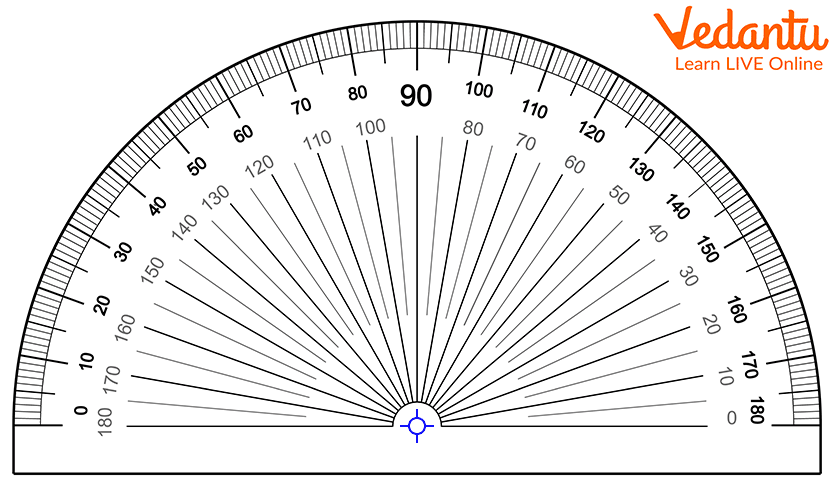
Protractor
Protractor Shapes
Protractors are available in two shapes. The two shapes of the protractor are:
Semi-circular Shape
Circular Shape
The semi circle shaped protractor is split into 180 equal parts which shows angle measurement from 0⁰ to 180⁰ as shown in the image given below.
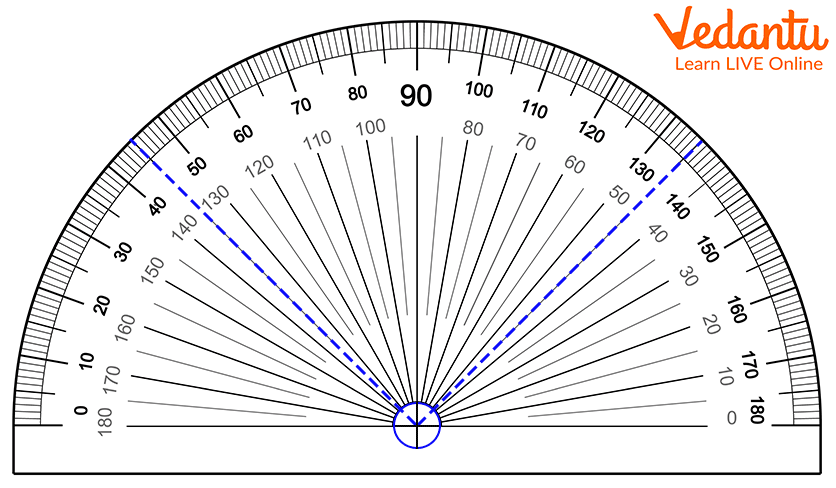
Semi-circular shaped protractor
Similarly, the circular shaped protractor given below shows angle measurement from 0⁰ to 360⁰ as shown in the figure below.
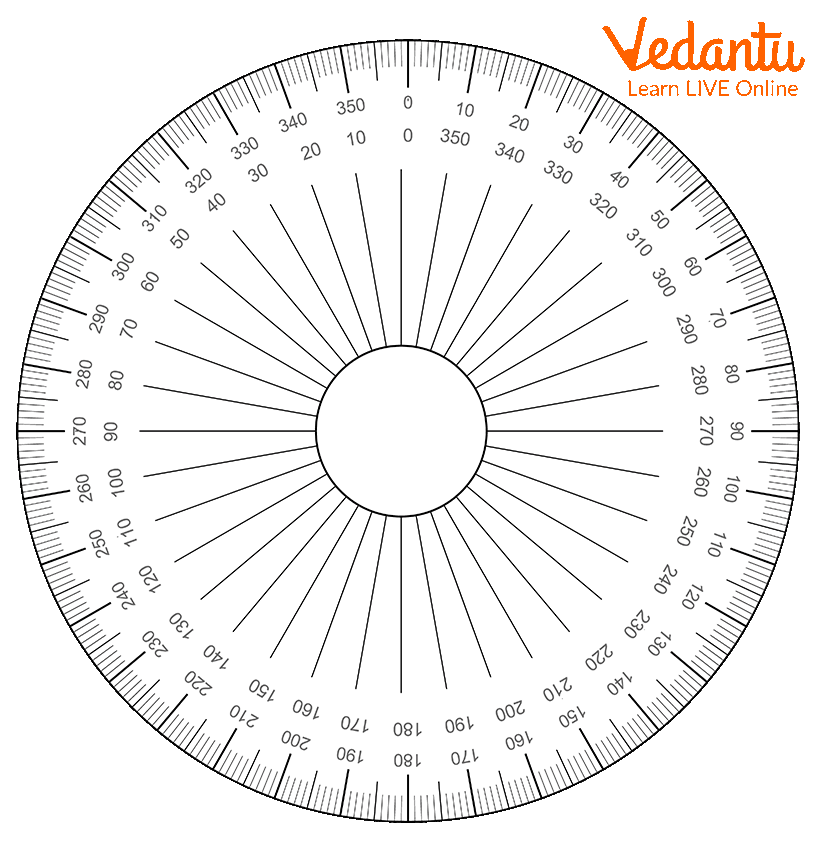
Circular shape protractor
Scales of Protractor
There are two scales of protractor. The two scales are:
Outer Scales: The outer scale runs from 0 to 180 degrees going clockwise.
Inner Scale: The inner scale runs from 0 to 180 degrees going anticlockwise.
Note: If angle opens to the right sides from the centre of the protractor, use the inner scale. On the other hand, If the angel opens to the left side from the centre of the protractor, use the outer scale.
Also remember, while constructing the acute angles (i.e. angles less than 90 degrees), also mark the angles on the right side of the protractor.
Contrarily, while constructing the obtuse angles (i.e.angles more than 90 degrees but less than 180 degrees), always mark the angles on the left side from the centre of the protractor.
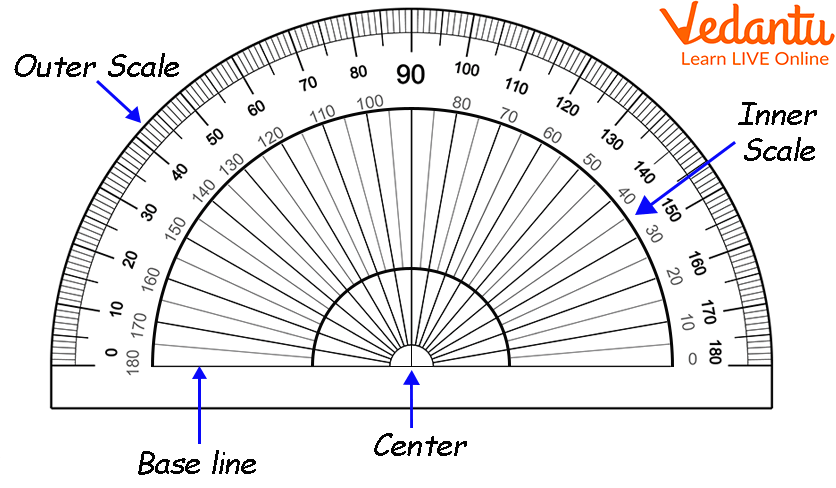
Inner and outer scales of the protractor
Let’s learn how to construct and measure an angle using a protractor.
How to Construct an Angle Using the Protractor?
Let's construct an angle whose measure is 60 degrees. Here, we will construct ∠XYZ= 60°.
Material Required: Pencil, Protractor, and Ruler.
Following are the steps to construct ∠XYZ= 60°.
Step 1: Draw a line YZ using a ruler.
Step 2: Place your protractor over the line YZ such that the baseline of the protractor co-exist with the line YZ and the midpoint or the centre of the baseline of the protractor co-exist with the point Y.
Step 3: Mark a point X where you find 60 degrees on the right side from the centre of the protractor as 60 degrees is an acute angle.
Step 4: Join XY using the ruler.
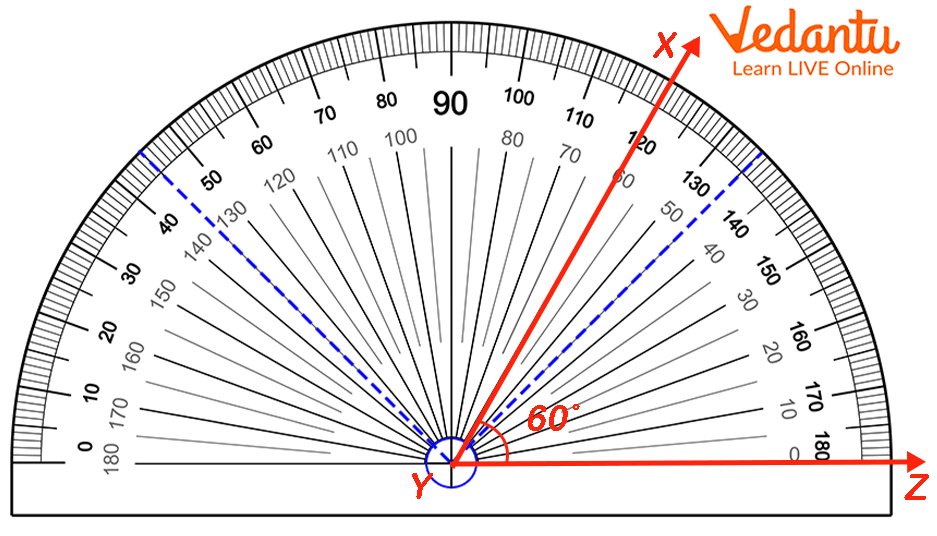
Construction-of--∠60⁰-using-protractor
How to Measure Angles Using a Protractor?
To measure an angle ABC using a protractor, place the midpoint or centre of the protractor on the vertex O of the angle. The base OA arm is placed on the baseline of the protractor as shown in the figure given below.
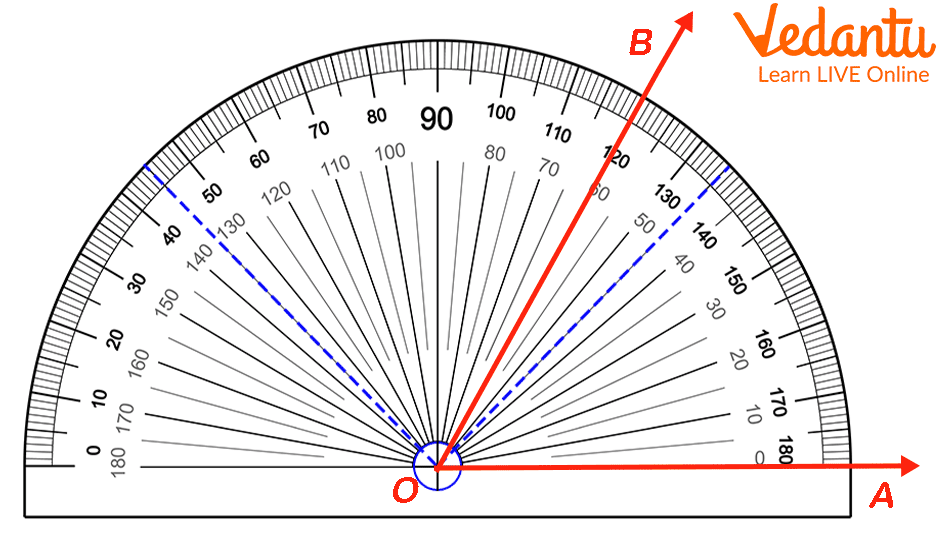
∠AOB = 60°
Now, measure the angle on the protractor counting from 0 up to the point where the arm OB lies on the protractor. As the angle in the above figure is opened on the right side from the centre of the protractor, we will use the inner scale. Accordingly, ∠AOB = 60°.
Conclusion
In short, a protractor is a measuring device, generally made up of transparent plastic or glass, used for drawing angles. The most commonly found protractor is semi-circular in shape ranging from 0° to 180°. Apart from drawing angles using protractors, we can also draw angles using a compass and measure those angles using protractors by applying certain geometrical properties.
FAQs on Protractor in Geometry for Kids with Simple Definition
1. What is a protractor in geometry for kids?
A protractor is a geometry tool used to measure and draw angles in degrees. It is usually shaped like a semicircle and marked from 0° to 180°. Kids use a protractor to find how wide an angle opens or to draw angles of a specific size in maths.
2. What is a protractor used for in geometry?
A protractor is used to measure angles and draw angles accurately in geometry. It helps students:
- Measure an angle in degrees (°)
- Draw angles like 30°, 45°, 90°, etc.
- Check if an angle is acute, right, or obtuse
3. How do you use a protractor to measure an angle?
To measure an angle with a protractor, place its center on the vertex and read the degree where the second arm crosses the scale.
- Place the center point of the protractor on the vertex.
- Align the baseline (0° line) with one arm of the angle.
- Read the number where the other arm crosses the scale.
4. How do you draw an angle using a protractor?
To draw an angle using a protractor, mark the required degree and join it to the vertex.
- Draw a base line.
- Place the protractor’s center at one end of the line.
- Mark the required degree (for example, 60°).
- Draw a line from the vertex through the marked point.
5. What are the parts of a protractor?
The main parts of a protractor are the center point, baseline, and degree scale.
- Center point – placed on the vertex of the angle
- Baseline – the straight edge marked 0°
- Degree scale – numbered markings from 0° to 180°
6. What is the difference between a 180-degree and 360-degree protractor?
A 180-degree protractor measures angles up to 180°, while a 360-degree protractor measures full круг angles up to 360°.
- 180° protractor – semicircle shape, most common in schools
- 360° protractor – full circle, used for advanced measurements
7. How do you read a protractor correctly?
To read a protractor correctly, always start from the 0° mark that aligns with the angle’s base line.
- Check which 0° line matches your base arm.
- Follow that scale (inner or outer numbers).
- Read the degree where the second arm crosses.
8. Can you give an example of measuring an angle with a protractor?
If the second arm of an angle crosses the scale at 75°, then the angle measures 75 degrees.
- Center placed on vertex
- Baseline aligned with 0°
- Second arm crosses at 75°
9. What types of angles can you measure with a protractor?
A protractor can measure acute, right, obtuse, and straight angles.
- Acute angle – less than 90°
- Right angle – exactly 90°
- Obtuse angle – between 90° and 180°
- Straight angle – exactly 180°
10. What are common mistakes when using a protractor?
The most common mistake when using a protractor is reading the wrong scale or not placing the center correctly.
- Not aligning the center point with the vertex
- Starting from the wrong 0° scale
- Tilting the protractor
