



Rate of Dividend Formula with Definition and Solved Examples
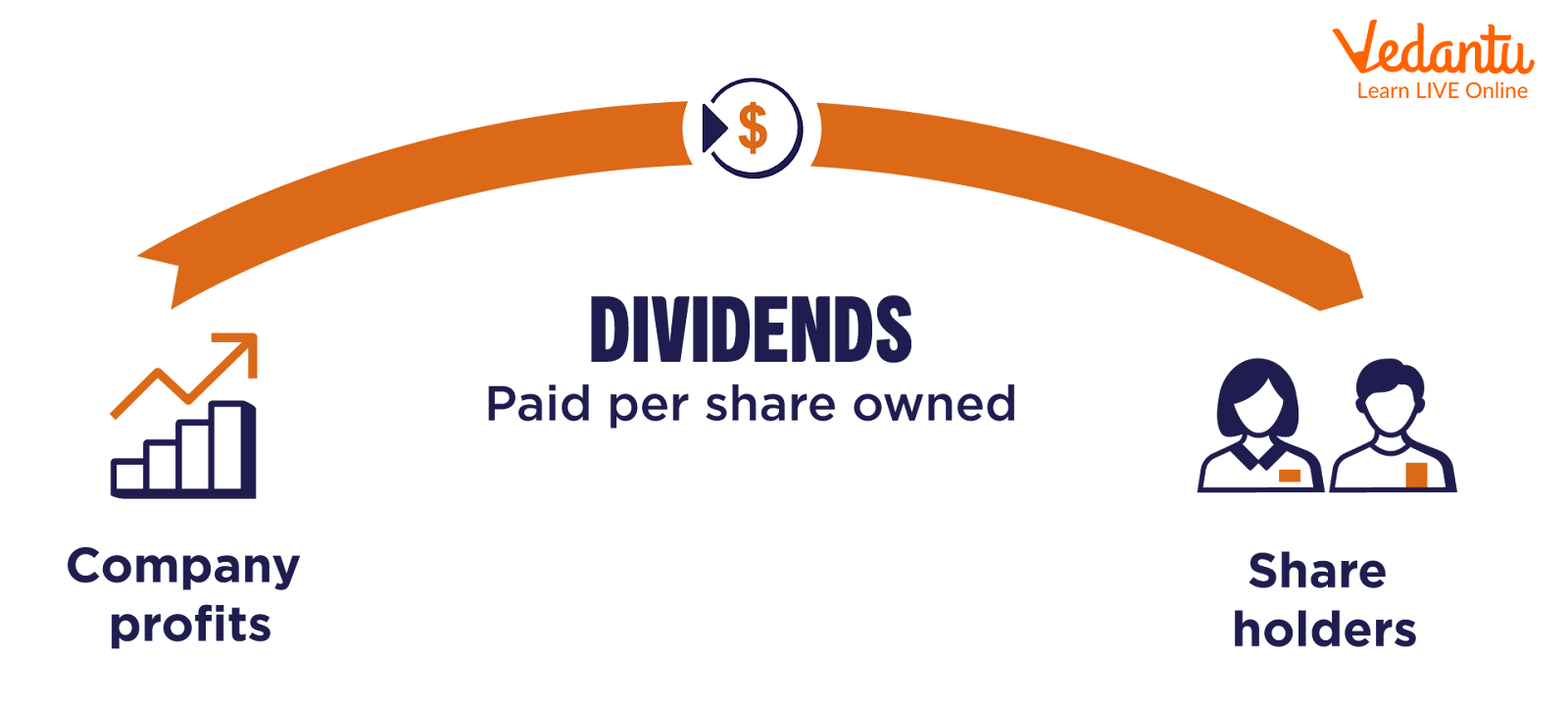
Dividends are a way for companies to distribute a portion of their profits to their shareholders. The dividend rate measures how much a company's earnings are being paid to shareholders and is often expressed as a percentage. It is an essential metric for investors as it indicates the company's financial health and potential for future growth. The dividend rate is calculated to determine the amount of money a shareholder will receive for each share of stock they own. In this article, we will explain the rate of dividends and its formula in an easy-to-understand way.
What is a Dividend?
Dividends are amounts that must be divided by other amounts. An algebraic expression, a fraction, or an integer could be used. In algebra, the division is usually represented by placing the dividend over the divisor and separating them with a horizontal line. This horizontal line is also known as a "fraction bar." For example, x divided by y can be written as x/y, which means "x over y" or "divide x by y." In this case, x is the dividend, and y is the divisor.
Take 3 to 4. 3 is the dividend, and 4 is the divisor in this fraction. In fractions, the divisor is referred to as the numerator, and the dividend is the denominator. The outcome of dividing the dividend by a divisor is either an integer or a decimal number.
Rate of Dividend Formula
Formula of Dividend
The dividend rate is the amount of cash a shareholder gets divided by the value of the shareholder's stock on the market. Divide the annual dividend per share by the stock price to get the dividend rate per share.
Rate of dividend formula = Dividend per share / Price per share at the moment
Example of Dividend Rate
Let's say a company called "CandyCo" makes and sells candy. They made $100,000$ in profits this year. The company decides to give $20,000$ of those profits back to their shareholders as dividends. To calculate the dividend rate, we divide the number of dividends paid ($20,000)$ by the total profits ($100,000)$. So:
$20,000$ (dividends) ÷ $100,000$ (profits) = 0.2 or 20%
So the dividend rate for CandyCo is 20%. This means that for every dollar of profit, the company makes, 20 cents is paid out to shareholders as dividends.
In a simpler way, you can think of it as a company with a big jar of money (the profits), and they share some of it with the people who own part of the company (the shareholders) as a thank you. The dividend rate is like a "share" of that jar of money they give back to shareholders.
Formula: Dividend Rate = Dividend Per Share / Current Share Price
Defining Payout Ratio for Dividends
The payout ratio for dividends measures how much of a company's profits are being paid out to shareholders as dividends. It's calculated by dividing the number of dividends paid by the company's earnings per share (EPS).
For example, if a company has an EPS of $1$ and pays out $0.50$ in dividends, the payout ratio would be 50%. This means that 50% of the company's profits are paid out to shareholders through tips. Another way to think about it is like a company's "sharing plan" or "sharing jar" with its shareholders. The payout ratio tells you what percentage of the company's profits they share with their shareholders as dividends.
A lower payout ratio may indicate that a company is keeping a more significant portion of its profits to reinvest in growth or to build up cash reserves. A higher payout ratio may suggest that the company returns more of its earnings to shareholders.
Formula: Payout ratio for dividends = Total dividends / Net income
Conclusion
The dividend rate is the annual total projected dividend payments from an investment, fund, or portfolio. It also includes any extra non-recurring dividends that an investor may get during that time. The rate of dividend is fixed or changeable, depending on what the company wants and how it wants to do business. The dividend rate and dividend yield are two terms that are often used interchangeably.
FAQs on Rate of Dividend in Shares and Stock Explained
1. What is the rate of dividend in mathematics?
The rate of dividend is the percentage return a company gives to shareholders based on the face value of a share. It shows how much dividend is paid per ₹100 (or per unit face value) of share capital.
- It is declared as a percentage.
- It is calculated on the face value, not the market value.
- Example: A 10% dividend on a ₹100 share means ₹10 dividend per share.
2. What is the formula for calculating the rate of dividend?
The formula for rate of dividend is (Dividend per Share ÷ Face Value) × 100.
- Rate of Dividend = (Dividend ÷ Face Value) × 100
- If dividend per share = ₹8 and face value = ₹100:
- Rate = (8 ÷ 100) × 100 = 8%
3. How do you calculate dividend when the rate of dividend is given?
Dividend is calculated using Dividend = (Rate of Dividend × Face Value) ÷ 100.
- Multiply the rate by the face value.
- Divide by 100.
- Example: If rate = 12% and face value = ₹50:
- Dividend = (12 × 50) ÷ 100 = ₹6 per share.
4. What is the difference between rate of dividend and yield?
The rate of dividend is calculated on face value, while yield is calculated on market value.
- Rate of Dividend = (Dividend ÷ Face Value) × 100
- Yield = (Dividend ÷ Market Value) × 100
- Rate shows company declaration percentage.
- Yield shows actual return on investment.
5. How do you calculate the total dividend received?
Total dividend received is calculated as Number of Shares × Dividend per Share.
- First find dividend per share using the rate.
- Multiply by total shares owned.
- Example: 200 shares, ₹5 dividend per share:
- Total Dividend = 200 × 5 = ₹1000
6. Is rate of dividend calculated on face value or market value?
The rate of dividend is always calculated on the face value of the share.
- It is declared as a percentage of face value.
- Market value is used only when calculating yield.
- Example: 15% dividend on ₹100 face value means ₹15, even if market price is ₹120.
7. Can you give an example of a rate of dividend problem?
Yes, a typical rate of dividend problem involves finding dividend or income from shares.
- Example: A person owns 150 shares of ₹100 each.
- Company declares 10% dividend.
- Dividend per share = (10 × 100) ÷ 100 = ₹10
- Total income = 150 × 10 = ₹1500
8. What happens to dividend if the rate of dividend increases?
If the rate of dividend increases, the dividend per share also increases proportionally.
- Dividend = (Rate × Face Value) ÷ 100
- Higher rate → Higher dividend amount.
- Example: On ₹100 face value:
- At 8% → ₹8 dividend
- At 12% → ₹12 dividend
9. How is rate of dividend used in commercial mathematics?
The rate of dividend is used in commercial mathematics to calculate income from shares and compare investment returns.
- Finding dividend per share.
- Calculating total income from shares.
- Comparing rate of dividend and yield.
- Solving word problems in exams.
10. What are common mistakes when calculating rate of dividend?
A common mistake is calculating dividend on market value instead of face value.
- Always use face value for rate of dividend.
- Do not confuse rate of dividend with yield.
- Apply the correct formula: (Dividend ÷ Face Value) × 100.
- Check percentage calculations carefully.
