



How to Find the Remainder Using Division Formula and Examples
According to the Merriam-Webster Dictionary, the remainder is, “a remaining group, part, or trace/ the number left after a subtraction/ the final undivided part after the division that is less or of lower degree than the divisor”. In simple words, the term "remainder" refers to the part that remains after the division process has been completed. If we divide 8 pencils equally among 7 children, we are left with 1 pencil. In this example, the remaining 1 pencil represents the remainder. Also, if we divide 33 by 2, the quotient is 16 and the remainder is 1. The divisor is always greater than the remainder.
Understanding Remainder in Maths in Detail
The remainder refers to the portion of the dividend that the divisor cannot divide fairly. You may end up with a fraction of the dividend left over after dividing whole numbers to determine the quotient; this is the remainder. It is a decimal or a fraction that represents a portion of the dividend. Let us consider one example.
Suppose you have 23 chocolates and you want to divide it equally among 4 of your friends. So, how many will each friend get? How many chocolates will remain after distributing the chocolates equally? The answer is: Each friend will get 5 chocolates, so 20 chocolates can be distributed equally among 4 friends and 3 chocolates will remain which cannot be distributed. So, here, 23 is the dividend, 4 is the divisor, 5 is the quotient and 3 is the remainder.
Remainder Formula
As we know,
Dividend = Divisor × Quotient + Remainder
Accordingly, the remainder formula is given as:
In the above remainder formula,
The dividend is the number or value that is being divided.
The divisor is the number that divides another number.
The quotient is the result that is obtained after the division of two numbers.
The remainder is the value that is left after the division.
How to Find the Remainder After a Division?
We can't always show in pictures how we divide the number of things equally among the groups to find the remainder. Instead, we can use the long division method to find the remainder. Here is a memory trick to always remember the steps of long division:
Does McDonald’s Sell Cheeseburgers Daily?
Step I: Does - Divide the dividend by the divisor.
Step II: McDonald’s - Multiply the partial quotient times the divisor.
Step III: Sell - Subtract the product from the first digits of the dividend.
Step IV: Cheese - Compare the difference with the divisor; the difference must be smaller.
Step V: Burger’s Daily - Bring down the next digit of your dividend and begin again.
Let us understand in simple terms. Consider the following image:
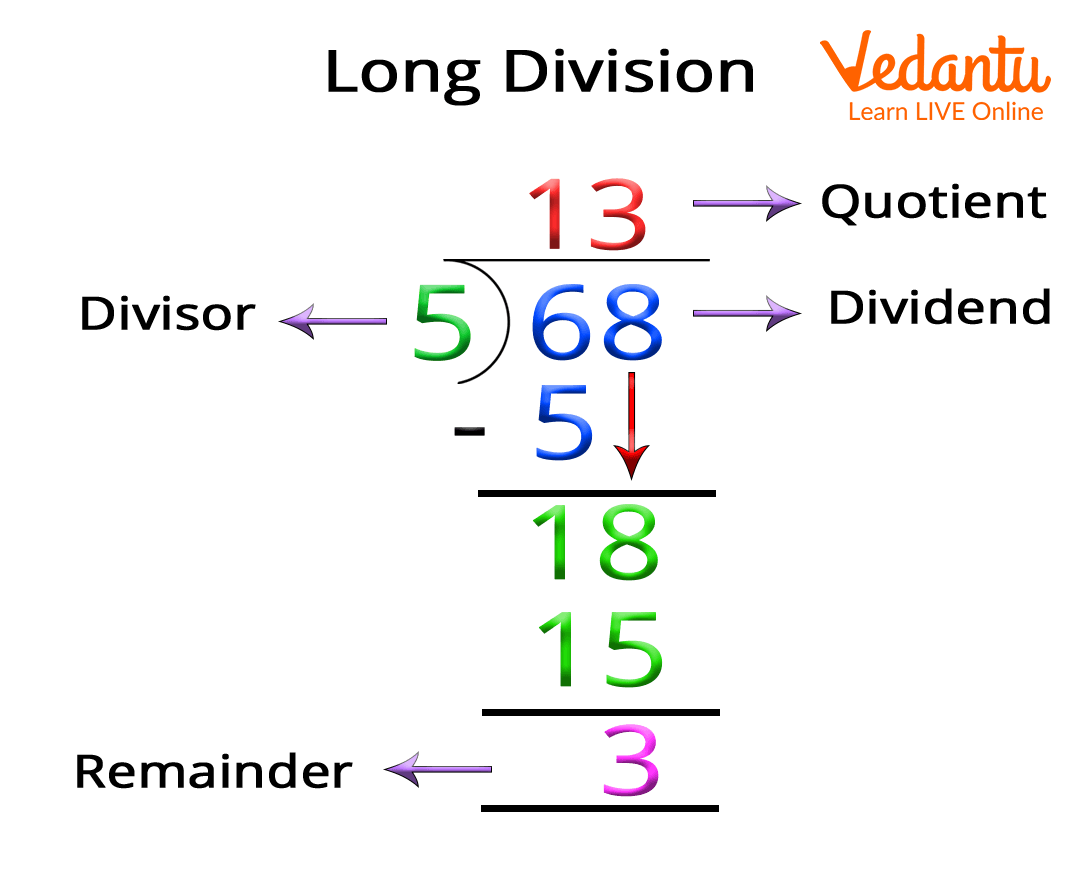
Here, 68 is the dividend, 5 is the divisor, 13 is the quotient and 3 is the remainder.
At first, 6 is divided by 5 and we got the first digit of the quotient 1. We multiplied 1 and 5 and wrote the result below 5. Then, we subtracted 5 (5 x 1 = 5) from 6 and got 1. Then, we brought down 8 and got the number 18. In the next step, we divided 18 with 5 and got the second digit of the quotient i,e 3. So, after multiplying, the number came to 15. On subtracting 15 from 18, we got 3. So, 3 is the remainder.
How to Write Remainders?
There are several ways to express the remainder of a division problem. The remainder can be either a whole number or a faction. One way to write the remainder is to separate the quotient and the remainder with a "R." 7/2 = Q=3 and R=1 is the formula for dividing 7 by 2. In this case, Q=3 is a quotient, and R=1 is a remainder.
Another way to represent the remainder is as a component of a mixed fraction. 7/2 = 3 12 is the formula for dividing 7 by 2.
Properties of Remainders
The following are the properties of the remainder:
The divisor is always less than the remainder. The division is wrong if the remainder is either more than or equal to the divisor.
When one number (divisor) entirely divides the other number (dividend), the remainder is 0.
The remainder can be more than, equal to, or less than the quotient.
Remainder Examples
Here are a few examples of remainders that will help you understand the term remainder in Maths in a better way.
1. A teacher had 315 chocolates. She divides all chocolate evenly among 30 students. Find
How many chocolates did the teacher give to each of the students?
How many chocolates are left with the teacher after distributing them among the student?
Solution:
Total number of students in class = 30
Total number of chocolates teacher has = 315
Now, we will divide 315 by 30
(Image will be uploaded soon)
i) The quotient value of the above division represents the number of chocolate each student gets is 10.
Therefore,
Chocolates each students gets = 10
ii) The remainder value of the above division represents the number of chocolate left with the teacher.
Therefore,
Chocolates left with the teacher after distribution = 15
2. What is the remainder when 53 is divided by 8?
Solution: To find the value of the remainder, when 53 is divided by 8, we consider the multiples of 8.
8 × 1 = 8
8 × 2 = 16
8 × 3 = 24
8 × 4 = 32
8 × 5 = 40
8 × 6 = 48
8 × 7 = 56
As 8 × 6 = 48 and 8 × 7 = 56, only six 8’s can go into 53. Then the value left over is 53 - 48 = 5. Hence, the value of the remainder when 53 is divided by 8 is 5.
Do You Know?


FAQs on Remainder in Division Meaning and Method
1. What is a remainder in division?
A remainder is the amount left over after dividing one number by another when the division is not exact. In whole number division, it is always less than the divisor.
- Dividend = number being divided
- Divisor = number you divide by
- Quotient = result of division
- Remainder = leftover part
2. How do you find the remainder in long division?
To find the remainder in long division, subtract the product of the divisor and quotient from the dividend. Follow these steps:
- Divide the dividend by the divisor.
- Multiply the divisor by the quotient.
- Subtract the result from the dividend.
3. What is the formula for remainder?
The formula for remainder is Dividend = Divisor × Quotient + Remainder. This is called the division algorithm.
- Remainder = Dividend − (Divisor × Quotient)
- Condition: 0 ≤ Remainder < Divisor
4. Can a remainder be greater than the divisor?
No, a remainder cannot be greater than or equal to the divisor in standard division. The remainder must always be smaller than the divisor.
- If remainder ≥ divisor, divide again.
- This ensures the division process is complete.
5. What is the remainder when a number is divided by 10?
The remainder when a number is divided by 10 is its last digit. This works because 10 is the base of our number system.
- 47 ÷ 10 → remainder is 7
- 123 ÷ 10 → remainder is 3
6. How do you find the remainder using the modulus method?
The modulus method finds the remainder using the mod symbol (%). The expression a % b gives the remainder when a is divided by b.
- 17 % 5 = 2
- 23 % 6 = 5
7. What is the remainder theorem?
The Remainder Theorem states that when a polynomial f(x) is divided by (x − a), the remainder is f(a).
- If f(x) = x² + 3x + 2
- Divide by (x − 1)
- Compute f(1) = 1 + 3 + 2 = 6
8. What is the remainder when a number is divided by 2?
The remainder when a number is divided by 2 is 0 for even numbers and 1 for odd numbers.
- If remainder = 0 → even number
- If remainder = 1 → odd number
9. How do you check if a division answer with remainder is correct?
To check a division with remainder, use the formula Dividend = Divisor × Quotient + Remainder.
- Example: 19 ÷ 4 = 4 remainder 3
- Check: 4 × 4 + 3 = 16 + 3 = 19
10. What is the difference between quotient and remainder?
The quotient is the whole number result of division, while the remainder is the leftover part. Both are parts of the division process.
- Dividend = Divisor × Quotient + Remainder
- Example: 22 ÷ 6 = 3 remainder 4
- Quotient = 3
- Remainder = 4
