



What Is the X Axis with Solved Examples and Graph Explanation
What is an X-Axis?
When you enter your room, you start moving across the floor and see one standing line or a beam too. So, what is this floor and a beam are? Well, the floor is an x-axis and the beam standing on the floor is a y-axis. In the reverse case, if you consider the beam as an x-axis, the floor becomes your y-axis, but what are these x and y-axis?
Well, if you look at the following image, you will clearly understand what an axis is:
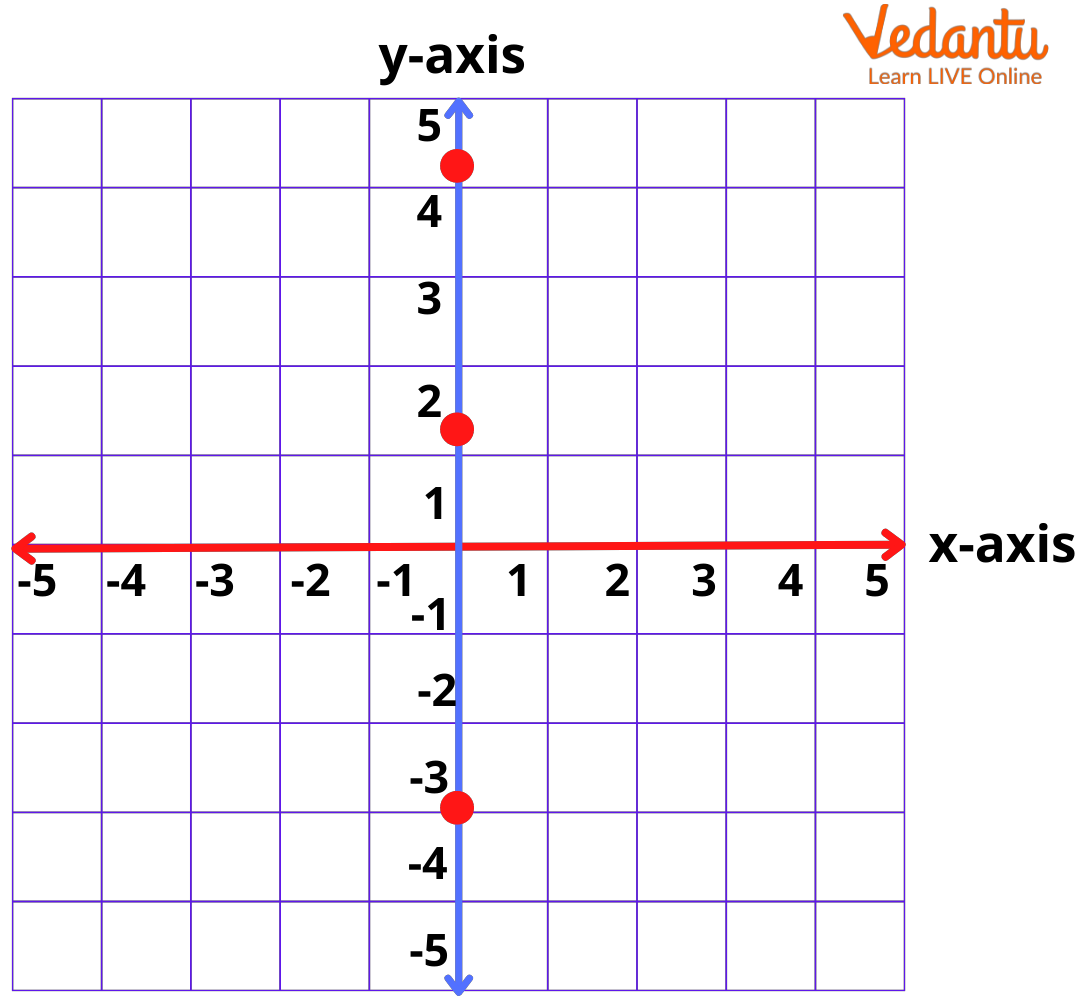
Here, on this page, we will understand all about an x-axis along with certain x axis examples.
What Do You Understand by Axis?
From the above text, we understand that the floor is horizontal and the beam is vertical (that is standing). Also, this horizontal line is an axis, that’s why we call the x-axis the horizontal axis as well.
Furthermore, the y-axis is across a vertical line, so we call it a vertical axis as well.
Now, let us see some questions to understand what an x-axis is.
X Axis Examples
1. Which of the following graphs do you find P on the x-axis?

Graph 1
Graph 2
None of these
Ans: Option B
Here, we have two graphs: Graph 1 and Graph 2. Here, graph 1 has P lying along the vertical line/vertical axis or y-axis.
In Graph 2, we have P lying along the horizontal line or horizontal axis or an x-axis.
So, we confirm that graph 2 has P lying on an x-axis, which is our required answer.
2. Which of the following points lie on an x-axis?
1, 1
1, 0
0, 1
−1, −1
Ans: Option b
Here, we need to understand that we are focusing on the x-axis only, which means that the value of a point on the y-axis must be eliminated and it must be zero.
So, let us see which coordinate has the y-axis as zero:
Please note that points that lie on a graph are coordinates. Here,
1, 1 means 1 is on the x-axis and 1 is one y-axis
1 lies on the x-axis and 0 on the y-axis
0 on the x-axis and 1 on the y-axis
- 1 on the x-axis and -1 on the y-axis
We notice that option b has the y-axis as zero, which means that the point (1, 0) lies on the axis only (not considering the y-axis here).
Lastly, we understand the following differences between the x and the y-axis on a graph:
From the above text, we understand the following points:
The coordinates of the middle of the origin of a graph ‘0’ are (0, 0).
If a point lies on the x-axis, then the point on the y-axis is 0. So if there is a point A on the x-axis, its coordinates become (x, 0).
However, if the point lies on the y-axis, then the point on the x-axis is zero. So if there is a point A on the y-axis, its coordinates become (0, y).
The arrows on the x and the y-axis suggest that both lines are endless.
FAQs on X Axis Examples in Coordinate Geometry
1. What is the x-axis in a graph?
The x-axis is the horizontal line on a coordinate plane that represents the values of the independent variable. In the Cartesian coordinate system:
- The x-axis runs left to right.
- It is used to measure horizontal distances.
- Any point on the x-axis has a y-coordinate of 0.
2. What are some examples of points on the x-axis?
Points on the x-axis always have a y-coordinate equal to 0. Examples include:
- (1, 0)
- (-3, 0)
- (7, 0)
3. How do you find the x-intercept of a graph?
The x-intercept is found by setting y = 0 and solving the equation for x. Steps:
- Take the equation (e.g., y = 2x − 4).
- Set y = 0 → 0 = 2x − 4.
- Solve for x → 2x = 4 → x = 2.
4. What is the equation of the x-axis?
The equation of the x-axis is y = 0. This means:
- Every point on the x-axis has a y-value of zero.
- The x-coordinate can be any real number.
5. What is the difference between the x-axis and y-axis?
The x-axis is horizontal, while the y-axis is vertical in a coordinate plane. Key differences:
- X-axis represents horizontal values.
- Y-axis represents vertical values.
- Points on the x-axis have y = 0.
- Points on the y-axis have x = 0.
6. Can you give a real-life example of the x-axis on a graph?
In real-life graphs, the x-axis usually represents the independent variable such as time. For example:
- In a distance-time graph, time (hours) is on the x-axis.
- In a sales chart, months may be on the x-axis.
7. What does it mean if a graph crosses the x-axis?
If a graph crosses the x-axis, it means the function has a value of y = 0 at that point. This point is called the x-intercept. For example, if a parabola crosses at (−1, 0) and (3, 0), those are the solutions or roots of the equation.
8. How do you plot points on the x-axis?
To plot a point on the x-axis, move horizontally to the given x-value and keep the y-value at 0. Steps:
- Start at the origin (0, 0).
- Move left or right according to the x-value.
- Do not move up or down.
9. What happens when x is zero on a graph?
When x = 0, the point lies on the y-axis. In coordinate form:
- Any point (0, y) is on the y-axis.
- Example: (0, 4) or (0, −2).
10. Why is the x-axis important in coordinate geometry?
The x-axis is important because it defines horizontal position and helps locate points in the coordinate plane. It is used to:
- Plot ordered pairs (x, y).
- Find x-intercepts of equations.
- Represent independent variables in graphs.
