



 Watch Video




Class 9 Maths Exercise 11.1 – Surface Areas and Volumes Solutions
Class 9 Maths Chapter 11 Exercise 11.1 introduces students to calculating the surface areas of different solid shapes. These Class 9 Maths Chapter 11 Exercise 11.1 solutions explain each problem in a simple, step-by-step manner, helping students understand how formulas are applied correctly. The Exercise 11.1 Class 9 questions focus on practical numerical problems that build clarity and accuracy. Practising Ex 11.1 Class 9 helps students gain confidence while solving surface area questions and avoid common calculation mistakes. All Class 9 Maths Chapter 11 Exercise 11.1 solutions are prepared by experienced teachers at Vedantu and follow the latest CBSE guidelines. These solutions help students complete homework smoothly and understand the marking pattern used in exams.
 Table of Content


NCERT Solutions For Class 9 Maths Chapter 11 Surface Areas And Volumes Exercise 11.1 (2025-26)


 Share
ShareExercise 11.1
1. Diameter of the base of a cone is $\text{10}\text{.5 cm}$ and its slant height is $\text{10 cm}$. Find its curved surface area. $\left[ \text{Assume }\!\!\pi\!\!\text{ = }\frac{\text{22}}{\text{7}} \right]$
Ans:
We are Given the Following:
The slant height $\left( \text{l} \right)$ of the cone $\text{= 10 cm}$
The diameter of the base of cone $\text{= 10}\text{.5 cm}$
So, the radius $\left( \text{r} \right)$ of the base of cone $\text{= }\frac{\text{10}\text{.5}}{\text{2}}\text{ cm = 5}\text{.25 cm}$
The curved surface area of cone, $\text{A = }\!\!\pi\!\!\text{ rl}$
$\Rightarrow \text{A = }\left( \frac{\text{22}}{\text{7}}\text{ }\!\!\times\!\!\text{ 5}\text{.25 }\!\!\times\!\!\text{ 10} \right)\text{ c}{{\text{m}}^{\text{2}}}$
$\Rightarrow \text{A = }\left( \text{22 }\!\!\times\!\!\text{ 0}\text{.75 }\!\!\times\!\!\text{ 10} \right)\text{ c}{{\text{m}}^{\text{2}}}$
$\Rightarrow \text{A = 165 c}{{\text{m}}^{\text{2}}}$
Therefore, the curved surface area of the cone is $\text{165 c}{{\text{m}}^{\text{2}}}$.
2. Find the total surface area of a cone, if its slant height is $\text{21 m}$and diameter of its base is $\text{24 m}$. $\left[ \text{Assume }\!\!\pi\!\!\text{ = }\frac{\text{22}}{\text{7}} \right]$
Ans:
We are Given the Following:
The slant height $\left( \text{l} \right)$ of the cone $\text{= 21 m}$
The diameter of the base of cone $\text{= 24 m}$
So, the radius $\left( \text{r} \right)$ of the base of cone $\text{= }\frac{\text{24}}{\text{2}}\text{ m = 12 m}$
The total surface area of cone, $\text{A = }\!\!\pi\!\!\text{ r}\left( \text{l + r} \right)$
$\Rightarrow \text{A = }\left( \frac{\text{22}}{\text{7}}\text{ }\!\!\times\!\!\text{ 12 }\!\!\times\!\!\text{ }\left( \text{21 + 12} \right) \right)\text{ }{{\text{m}}^{\text{2}}}$
$\Rightarrow \text{A = }\left( \frac{\text{22}}{\text{7}}\text{ }\!\!\times\!\!\text{ 12 }\!\!\times\!\!\text{ 33} \right)\text{ }{{\text{m}}^{\text{2}}}$
$\Rightarrow \text{A = 1244}\text{.57 }{{\text{m}}^{\text{2}}}$
Therefore, the total surface area of the cone is $\text{1244}\text{.57 }{{\text{m}}^{\text{2}}}$.
3. Curved surface area of a cone is $\text{308 c}{{\text{m}}^{\text{2}}}$ and its slant height is $\text{14 cm}$. Find
i. Radius of the Base
Ans:
It is given that the slant height $\left( \text{l} \right)$ of the cone $\text{= 14 cm}$
The curved surface area of the cone $\text{= 308 c}{{\text{m}}^{\text{2}}}$
Let us assume the radius of base of cone be $\text{r}$.
We know that curved surface area of the cone $\text{= }\!\!\pi\!\!\text{ rl}$
$\therefore \text{ }\!\!\pi\!\!\text{ rl = 308 c}{{\text{m}}^{\text{2}}}$
$\Rightarrow \left( \frac{\text{22}}{\text{7}}\text{ }\!\!\times\!\!\text{ r }\!\!\times\!\!\text{ 14} \right)\text{ cm = 308 c}{{\text{m}}^{\text{2}}}$
$\Rightarrow \text{r = }\frac{\text{308}}{\text{44}}\text{ cm}$
$\Rightarrow \text{r = 7 cm}$
Hence, the radius of the base is $\text{7 cm}$.
ii. Total Surface Area of the Cone. $\left[ \text{Assume }\!\!\pi\!\!\text{ = }\frac{\text{22}}{\text{7}} \right]$
Ans:
The total surface area of the cone is the sum of its curved surface area and the area of the base.
Total surface area of cone, $\text{A = }\!\!\pi\!\!\text{ rl + }\!\!\pi\!\!\text{ }{{\text{r}}^{\text{2}}}$
$\Rightarrow \text{A = }\left[ \text{308 + }\frac{\text{22}}{\text{7}}\text{ }\!\!\times\!\!\text{ }{{\left( \text{7} \right)}^{\text{2}}} \right]\text{ c}{{\text{m}}^{\text{2}}}$
$\Rightarrow \text{A = }\left[ \text{308 + 154} \right]\text{ c}{{\text{m}}^{\text{2}}}$
$\Rightarrow \text{A = 462 c}{{\text{m}}^{\text{2}}}$
Hence, the total surface area of the cone is $\text{462 c}{{\text{m}}^{\text{2}}}$.
4. A conical tent is $\text{10 m}$ high and the radius of its base is $\text{24 m}$. Find
i. slant height of the tent
Ans:
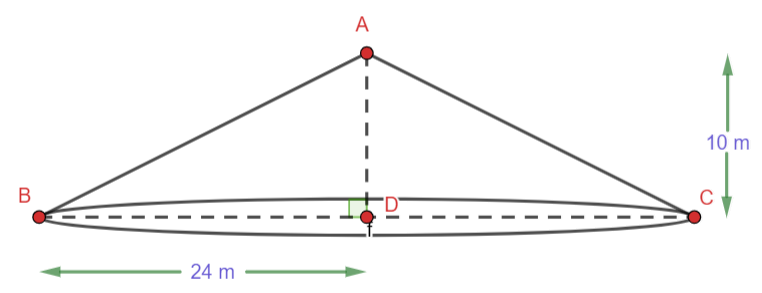
From the figure we can say that $\text{ABC}$ is a conical tent.
It is given that the height $\left( \text{h} \right)$ of conical tent $\text{= 10 m}$
The radius $\left( \text{r} \right)$ of conical tent $\text{= 24 m}$
Let us assume the slant height as $\text{l}$.
In $\text{ }\!\!\Delta\!\!\text{ ABD}$, we will use Pythagorean Theorem.
$\therefore \text{A}{{\text{B}}^{\text{2}}}\text{ = AD}{{\text{ }}^{\text{2}}}\text{ + B}{{\text{D}}^{\text{2}}}$
$\Rightarrow {{\text{l}}^{\text{2}}}\text{ = }{{\text{h}}^{\text{2}}}\text{ + }{{\text{r}}^{\text{2}}}$
\[\Rightarrow {{\text{l}}^{\text{2}}}\text{ = }{{\left( \text{10 m} \right)}^{\text{2}}}\text{ + }{{\left( \text{24 m} \right)}^{\text{2}}}\]
$\Rightarrow {{\text{l}}^{\text{2}}}\text{ = 676 }{{\text{m}}^{\text{2}}}$
$\Rightarrow \text{l = 26 m}$
The slant height of the tent is $\text{26 m}$.
ii. cost of canvas required to make the tent, if cost of $\text{1 }{{\text{m}}^{\text{2}}}$ canvas is $\text{Rs}\text{. 70}$. $\left[ \text{Assume }\!\!\pi\!\!\text{ = }\frac{\text{22}}{\text{7}} \right]$
Ans:
The curved surface area of the tent, $\text{A = }\!\!\pi\!\!\text{ rl}$
$\Rightarrow \text{A = }\left( \frac{\text{22}}{\text{7}}\text{ }\!\!\times\!\!\text{ 24 }\!\!\times\!\!\text{ 26} \right)\text{ }{{\text{m}}^{\text{2}}}$
$\Rightarrow \text{A = }\left( \frac{13728}{7} \right)\text{ }{{\text{m}}^{\text{2}}}$
It is given that the cost of $\text{1 }{{\text{m}}^{\text{2}}}$ of canvas $\text{= Rs}\text{. 70}$
So, the cost of $\frac{13728}{7}\text{ }{{\text{m}}^{\text{2}}}$ canvas $\text{= Rs}\text{. }\left( \frac{\text{13728}}{\text{7}}\text{ }\!\!\times\!\!\text{ 70} \right)\text{ = Rs}\text{. 137280}$
Hence, the cost of canvas required to make the tent is $\text{Rs}\text{. 137280}$.
5. What length of tarpaulin $\text{3 m}$ wide will be required to make conical tent of height $\text{8 m}$ and base radius $\text{6 m}$? Assume that the extra length of material that will be required for stitching margins and wastage in cutting is approximately $\text{20 cm}$. $\left[ \text{Use }\!\!\pi\!\!\text{ = 3}\text{.14} \right]$
Ans:
We are Given the Following:
The base radius $\left( \text{r} \right)$ of tent $\text{= 6 m}$
The height $\left( \text{h} \right)$ of tent $\text{= 8 m}$
So the slant height of the tent, $\text{l = }\sqrt{{{\text{r}}^{\text{2}}}\text{ + }{{\text{h}}^{\text{2}}}}$
$\Rightarrow \text{l = }\left( \sqrt{{{\text{6}}^{\text{2}}}\text{ + }{{\text{8}}^{\text{2}}}} \right)\text{ m}$
$\Rightarrow \text{l = }\left( \sqrt{\text{100}} \right)\text{ m}$
$\Rightarrow \text{l = 10 m}$
The curved surface area of the tent, $\text{A = }\!\!\pi\!\!\text{ rl}$
$\Rightarrow \text{A = }\left( \text{3}\text{.14 }\!\!\times\!\!\text{ 6 }\!\!\times\!\!\text{ 10} \right)\text{ }{{\text{m}}^{\text{2}}}$
$\Rightarrow \text{A = 188}\text{.4 }{{\text{m}}^{\text{2}}}$
It is give the width of tarpaulin $\text{= 3 m}$
Let us assume the length of the tarpaulin sheet required be $\text{x}$.
It is given that there will be a wastage of $\text{20 cm}$.
So, the new length of the sheet $\text{=}\left( \text{x - 0}\text{.2} \right)\text{ m}$
We know that the area of the rectangular sheet required will be the same as the curved surface area of the tent.
$\therefore \left[ \left( \text{x - 0}\text{.2} \right)\text{ }\!\!\times\!\!\text{ 3} \right]\text{ m = 188}\text{.4 }{{\text{m}}^{\text{2}}}$
$\Rightarrow \text{x - 0}\text{.2 m = 62}\text{.8 m}$
$\Rightarrow \text{x = 63 m}$
The length of tarpaulin sheet required is $\text{63 m}$.
6. The slant height and base diameter of a conical tomb are $\text{25 m}$ and $\text{14 m}$ respectively. Find the cost of white-washing its curved surface at the rate of $\text{Rs}\text{. 210}$ per $\text{100 }{{\text{m}}^{\text{2}}}$. $\left[ \text{Assume }\!\!\pi\!\!\text{ = }\frac{\text{22}}{\text{7}} \right]$
Ans:
We are Given the Following:
The base radius $\left( \text{r} \right)$ of tomb $\text{= 7 m}$
The slant height $\left( \text{l} \right)$ of tomb $\text{= 25 m}$
The curved surface area of the conical tomb, $\text{A = }\!\!\pi\!\!\text{ rl}$
$\Rightarrow \text{A = }\left( \frac{22}{7}\text{ }\!\!\times\!\!\text{ 7 }\!\!\times\!\!\text{ 25} \right)\text{ }{{\text{m}}^{\text{2}}}$
$\Rightarrow \text{A = 550 }{{\text{m}}^{\text{2}}}$
It is given that the cost of white-washing $\text{1 }{{\text{m}}^{\text{2}}}$ area $\text{= Rs}\text{. 210}$
So, the cost of white-washing $550\text{ }{{\text{m}}^{\text{2}}}$ area $\text{= Rs}\text{. }\left( \frac{\text{210}}{\text{100}}\text{ }\!\!\times\!\!\text{ 550} \right)\text{ = Rs}\text{. 1155}$
Hence, the cost of white-washing the curved surface area of a conical tomb is $\text{Rs}\text{. 1155}$.
7. A joker’s cap is in the form of a right circular cone of base radius $\text{7 cm}$ and the height $\text{24 cm}$. Find the area of the sheet required to make $\text{10}$ such caps. $\left[ \text{Assume }\!\!\pi\!\!\text{ = }\frac{\text{22}}{\text{7}} \right]$
Ans:
We are Given the Following:
The base radius $\left( \text{r} \right)$ of conical cap $\text{= 7 cm}$
The height $\left( \text{h} \right)$ of conical cap $\text{= 24 cm}$
So the slant height of the tent, $\text{l = }\sqrt{{{\text{r}}^{\text{2}}}\text{ + }{{\text{h}}^{\text{2}}}}$
$\Rightarrow \text{l = }\left( \sqrt{{{\text{7}}^{\text{2}}}\text{ + 2}{{\text{4}}^{\text{2}}}} \right)\text{ cm}$
$\Rightarrow \text{l = }\left( \sqrt{625} \right)\text{ cm}$
$\Rightarrow \text{l = 25 cm}$
The curved surface area of one conical cap, $\text{A = }\!\!\pi\!\!\text{ rl}$
$\Rightarrow \text{A = }\left( \frac{22}{7}\text{ }\!\!\times\!\!\text{ 7 }\!\!\times\!\!\text{ 25} \right)\text{ c}{{\text{m}}^{\text{2}}}$
$\Rightarrow \text{A = 550 c}{{\text{m}}^{\text{2}}}$
So, the curved surface area of $\text{10}$ conical caps $\text{= }\left( \text{550 }\!\!\times\!\!\text{ 10} \right)\text{ c}{{\text{m}}^{\text{2}}}\text{ = 5500 c}{{\text{m}}^{\text{2}}}$
Therefore, the total area of the sheet required is $\text{5500 c}{{\text{m}}^{\text{2}}}$.
8. A bus stop is barricaded from the remaining part of the road, by using $\text{50}$ hollow cones made of recycled cardboard. Each cone has a base diameter of $\text{40 cm}$ and height $\text{1 m}$. If the outer side of each of the cones is to be painted and the cost of painting is $\text{Rs}\text{. 12}$ per ${{\text{m}}^{\text{2}}}$, what will be the cost of painting all these cones?
$\left[ \text{Use }\!\!\pi\!\!\text{ = 3}\text{.14 and take }\sqrt{\text{1}\text{.04}}\text{=1}\text{.02} \right]$
Ans:
We are Given the Following:
The base radius $\left( \text{r} \right)$ of cone $\text{= }\frac{\text{40}}{\text{2}}\text{ = 20 cm = 0}\text{.2 m}$
The height $\left( \text{h} \right)$ of cone $\text{= 1 m}$
So the slant height of the cone, $\text{l = }\sqrt{{{\text{r}}^{\text{2}}}\text{ + }{{\text{h}}^{\text{2}}}}$
$\Rightarrow \text{l = }\left( \sqrt{{{\left( \text{0}\text{.2} \right)}^{\text{2}}}\text{ + }{{\left( \text{1} \right)}^{\text{2}}}} \right)\text{ m}$
$\Rightarrow \text{l = }\left( \sqrt{1.04} \right)\text{ m}$
$\Rightarrow \text{l = 1}\text{.02 m}$
The curved surface area of one cone, $\text{A = }\!\!\pi\!\!\text{ rl}$
$\Rightarrow \text{A = }\left( \text{3}\text{.14 }\!\!\times\!\!\text{ 0}\text{.2 }\!\!\times\!\!\text{ 1}\text{.02} \right)\text{ }{{\text{m}}^{\text{2}}}$
$\Rightarrow \text{A = 0}\text{.64056 c}{{\text{m}}^{\text{2}}}$
So, the curved surface area of $\text{50}$ cones $\text{= }\left( \text{50 }\!\!\times\!\!\text{ 0}\text{.64056} \right)\text{ }{{\text{m}}^{\text{2}}}\text{ = 32}\text{.028 }{{\text{m}}^{\text{2}}}$
It is given that the cost of painting $\text{1 }{{\text{m}}^{\text{2}}}$ area $\text{= Rs}\text{. 12}$
So, the cost of painting $32.028\text{ }{{\text{m}}^{\text{2}}}$ area $\text{= Rs}\text{. }\left( \text{32}\text{.028 }\!\!\times\!\!\text{ 12} \right)\text{ = Rs}\text{. 384}\text{.336}$
We can also write the cost approximately as $\text{Rs}\text{. 384}\text{.34}$.
Therefore, the cost of painting all the hollow cones is $\text{Rs}\text{. 384}\text{.34}$.
Conclusion
NCERT of class 9 maths surface area and volume exercise 11.1, provides a clear understanding of calculating the surface areas of geometric shapes, specifically right circular cones. Students should focus on grasping the concepts of curved surface area and total surface area to solve related problems effectively. Vedantu’s detailed solutions offer step-by-step explanations that simplify complex problems. Practicing these exercises enhances problem-solving skills and builds confidence, helping students perform well in their Class 9 Maths exams.
Class 9 Maths Chapter 11: Exercises Breakdown
CBSE Class 9 Maths Chapter 11 Other Study Materials
Chapter-Specific NCERT Solutions for Class 9 Maths
Given below are the chapter-wise NCERT Solutions for Class 9 Maths. Go through these chapter-wise solutions to be thoroughly familiar with the concepts.
Important Study Materials for CBSE Class 9 Maths


FAQs on NCERT Solutions For Class 9 Maths Chapter 11 Surface Areas And Volumes Exercise 11.1 (2025-26)
1. What is included in Class 9 Maths Chapter 11 Surface Areas and Volumes NCERT Solutions?
Class 9 Maths Chapter 11 Surface Areas and Volumes NCERT Solutions include all exercise-wise questions from the chapter, solved step by step as per the NCERT textbook and CBSE guidelines.
2. Who should use Surface Areas and Volumes Class 9 Maths solutions?
Surface Areas and Volumes Class 9 Maths solutions are designed for Class 9 students who want accurate, NCERT-aligned answers for school homework, tests, and exams.
3. Do NCERT Solutions for Class 9 Maths Chapter 11 follow CBSE marking patterns?
Yes, NCERT Solutions for Class 9 Maths Chapter 11 Surface Areas and Volumes follow CBSE answer-writing standards, including proper steps and clear presentation.
4. What type of questions are covered in Class 9 Maths Chapter 11 Surface Areas and Volumes?
Class 9 Maths Chapter 11 Surface Areas and Volumes covers all NCERT-prescribed exercise questions, including different question formats given across the chapter exercises.
5. Are all exercises included in Surface Areas and Volumes Class 9 Maths NCERT Solutions?
Yes, Surface Areas and Volumes Class 9 Maths NCERT Solutions include all exercises from Class 9 Maths Chapter 11, with answers arranged exercise-wise.
6. How are answers presented in Class 9 Maths Chapter 11 NCERT Solutions?
Answers in Class 9 Maths Chapter 11 Surface Areas and Volumes are presented in a clear, stepwise format so students can understand how marks are allocated in exams.
7. Can NCERT Solutions for Class 9 Maths Chapter 11 Surface Areas and Volumes be used for school exams?
Yes, NCERT Solutions for Class 9 Maths Chapter 11 Surface Areas and Volumes can be confidently used for school exams as they are fully aligned with NCERT and CBSE requirements.
8. Is Surface Areas and Volumes Class 9 Maths important from an exam perspective?
Yes, Surface Areas and Volumes Class 9 Maths Chapter 11 is an important chapter in the Class 9 syllabus, and all expected NCERT question formats are covered in its solutions.
9. Do Class 9 Maths Chapter 11 NCERT Solutions follow NCERT question order?
Yes, Class 9 Maths Chapter 11 Surface Areas and Volumes NCERT Solutions follow the exact question numbering and sequence given in the NCERT textbook.
10. Why do students prefer Surface Areas and Volumes Class 9 Maths NCERT Solutions?
Students prefer Surface Areas and Volumes Class 9 Maths NCERT Solutions because they provide accurate answers, clear steps, and a structure that matches the NCERT textbook exactly.
