



 Watch Video




Class 9 Maths Exercise 11.2 – Surface Areas and Volumes Solutions
Class 9 Maths Chapter 11 Exercise 11.2 helps students understand how to calculate the surface area of solid shapes like spheres and hemispheres. These Class 9 Maths Exercise 11.2 solutions explain each sum clearly, making it easier to apply formulas correctly and avoid common mistakes.
 Table of Content
The Exercise 11.2 Class 9 answers follow the NCERT method step by step, helping students solve numerical problems with confidence. Practising Ex 11.2 Class 9 strengthens problem-solving skills and improves accuracy in geometry questions.
All Class 9 Maths Chapter 11 Exercise 11.2 solutions are prepared by Vedantu’s subject experts and aligned with the latest CBSE guidelines. Students can use these solutions to complete homework smoothly and understand how marks are awarded in exams.


NCERT Solutions For Class 9 Maths Chapter 11 Surface Areas And Volumes Exercise 11.2 (2025-26)


 Share
ShareExercise 11.2
Assume π = $\frac{22}{7}$ , unless stated otherwise.
1. Find the surface area of a sphere of radius:
i. $\text{10}\text{.5 cm}$
Ans:
Given radius of the sphere $\text{r = 10}\text{.5 cm}$
The surface area of the sphere $\text{A = 4 }\!\!\pi\!\!\text{ }{{\text{r}}^{\text{2}}}$
$\Rightarrow \text{A = }\left[ \text{4 }\!\!\times\!\!\text{ }\frac{\text{22}}{\text{7}}\text{ }\!\!\times\!\!\text{ }{{\left( \text{10}\text{.5} \right)}^{\text{2}}} \right]\text{ c}{{\text{m}}^{\text{2}}}$
$\Rightarrow \text{A = }\left( \text{88 }\!\!\times\!\!\text{ 1}\text{.5 }\!\!\times\!\!\text{ 10}\text{.5} \right)\text{ c}{{\text{m}}^{\text{2}}}$
$\Rightarrow \text{A = 1386 c}{{\text{m}}^{\text{2}}}$
Hence, the surface area of the sphere is $\text{1386 c}{{\text{m}}^{\text{2}}}$.
ii. $\text{5}\text{.6 cm}$
Ans:
Given radius of the sphere $\text{r = 5}\text{.6 cm}$
The surface area of the sphere $\text{A = 4 }\!\!\pi\!\!\text{ }{{\text{r}}^{\text{2}}}$
$\Rightarrow \text{A = }\left[ \text{4 }\!\!\times\!\!\text{ }\frac{\text{22}}{\text{7}}\text{ }\!\!\times\!\!\text{ }{{\left( \text{5}\text{.6} \right)}^{\text{2}}} \right]\text{ c}{{\text{m}}^{\text{2}}}$
$\Rightarrow \text{A = }\left( \text{88 }\!\!\times\!\!\text{ 0}\text{.8 }\!\!\times\!\!\text{ 5}\text{.6} \right)\text{ c}{{\text{m}}^{\text{2}}}$
$\Rightarrow \text{A = 394}\text{.24 c}{{\text{m}}^{\text{2}}}$
Hence, the surface area of the sphere is $\text{394}\text{.24 c}{{\text{m}}^{\text{2}}}$.
iii. $\text{14 cm}$
Ans:
Given radius of the sphere $\text{r = 14 cm}$
The surface area of the sphere $\text{A = 4 }\!\!\pi\!\!\text{ }{{\text{r}}^{\text{2}}}$
$\Rightarrow \text{A = }\left[ \text{4 }\!\!\times\!\!\text{ }\frac{\text{22}}{\text{7}}\text{ }\!\!\times\!\!\text{ }{{\left( \text{14} \right)}^{\text{2}}} \right]\text{ c}{{\text{m}}^{\text{2}}}$
$\Rightarrow \text{A = }\left( \text{4 }\!\!\times\!\!\text{ 44 }\!\!\times\!\!\text{ 14} \right)\text{ c}{{\text{m}}^{\text{2}}}$
$\Rightarrow \text{A = 2464 c}{{\text{m}}^{\text{2}}}$
Hence, the surface area of the sphere is $\text{2464 c}{{\text{m}}^{\text{2}}}$.
2. Find the surface area of a sphere of diameter:
i. $\text{14 cm}$
Ans:
Given diameter of the sphere $\text{= 14 cm}$
So, the radius of the sphere $\text{r = }\frac{\text{14}}{\text{2}}\text{ = 7 cm}$
The surface area of the sphere $\text{A = 4 }\!\!\pi\!\!\text{ }{{\text{r}}^{\text{2}}}$
$\Rightarrow \text{A = }\left[ \text{4 }\!\!\times\!\!\text{ }\frac{\text{22}}{\text{7}}\text{ }\!\!\times\!\!\text{ }{{\left( \text{7} \right)}^{\text{2}}} \right]\text{ c}{{\text{m}}^{\text{2}}}$
$\Rightarrow \text{A = }\left( \text{88 }\!\!\times\!\!\text{ 7} \right)\text{ c}{{\text{m}}^{\text{2}}}$
$\Rightarrow \text{A = 616 c}{{\text{m}}^{\text{2}}}$
Hence, the surface area of the sphere is $\text{616 c}{{\text{m}}^{\text{2}}}$.
ii. $\text{21 cm}$
Ans:
Given diameter of the sphere $\text{= 21 cm}$
So, the radius of the sphere $\text{r = }\frac{\text{21}}{\text{2}}\text{ = 10}\text{.5 cm}$
The surface area of the sphere $\text{A = 4 }\!\!\pi\!\!\text{ }{{\text{r}}^{\text{2}}}$
$\Rightarrow \text{A = }\left[ \text{4 }\!\!\times\!\!\text{ }\frac{\text{22}}{\text{7}}\text{ }\!\!\times\!\!\text{ }{{\left( \text{10}\text{.5} \right)}^{\text{2}}} \right]\text{ c}{{\text{m}}^{\text{2}}}$
$\Rightarrow \text{A = 1386 c}{{\text{m}}^{\text{2}}}$
Hence, the surface area of the sphere is $\text{1386 c}{{\text{m}}^{\text{2}}}$.
iii. $\text{3}\text{.5 m}$
Ans:
Given diameter of the sphere $\text{= 3}\text{.5 m}$
So, the radius of the sphere $\text{r = }\frac{\text{3}\text{.5}}{\text{2}}\text{ = 1}\text{.75 m}$
The surface area of the sphere $\text{A = 4 }\!\!\pi\!\!\text{ }{{\text{r}}^{\text{2}}}$
$\Rightarrow \text{A = }\left[ \text{4 }\!\!\times\!\!\text{ }\frac{\text{22}}{\text{7}}\text{ }\!\!\times\!\!\text{ }{{\left( \text{1}\text{.75} \right)}^{\text{2}}} \right]\text{ }{{\text{m}}^{\text{2}}}$
$\Rightarrow \text{A = 38}\text{.5 }{{\text{m}}^{\text{2}}}$
Hence, the surface area of the sphere is $\text{38}\text{.5 }{{\text{m}}^{\text{2}}}$.
3. Find the total surface area of a hemisphere of radius $\text{10 cm}$. $\left[ \text{Use }\!\!\pi\!\!\text{ = 3}\text{.14} \right]$
Ans:
Given the radius of hemisphere $\text{r = 10 cm}$
The total surface area of the hemisphere is the sum of its curved surface area and the circular base.
Total surface area of hemisphere $\text{A = 2 }\!\!\pi\!\!\text{ }{{\text{r}}^{\text{2}}}\text{ + }\!\!\pi\!\!\text{ }{{\text{r}}^{\text{2}}}$
$\Rightarrow \text{A = 3 }\!\!\pi\!\!\text{ }{{\text{r}}^{\text{2}}}$
$\Rightarrow \text{A = }\left[ \text{3 }\!\!\times\!\!\text{ 3}\text{.14 }\!\!\times\!\!\text{ }{{\left( \text{10} \right)}^{\text{2}}} \right]\text{ c}{{\text{m}}^{\text{2}}}$
$\Rightarrow \text{A = 942 c}{{\text{m}}^{\text{2}}}$
Hence, the total surface area of the hemisphere is $\text{942 c}{{\text{m}}^{\text{2}}}$.
4. The radius of a spherical balloon increases from $\text{7 cm}$ to $\text{14 cm}$ as air is being pumped into it. Find the ratio of surface areas of the balloon in the two cases.
Ans:
Given the initial radius of the balloon ${{\text{r}}_{1}}\text{ = 7 cm}$
The final radius of the balloon ${{\text{r}}_{2}}\text{ = 14 cm}$
We have to find the ratio of surface areas of the balloon in the two cases.
The required ratio $\text{R = }\frac{\text{4 }\!\!\pi\!\!\text{ }{{\text{r}}_{\text{1}}}^{\text{2}}}{\text{4 }\!\!\pi\!\!\text{ }{{\text{r}}_{\text{2}}}^{\text{2}}}$
$\Rightarrow \text{R = }{{\left( \frac{{{\text{r}}_{\text{1}}}}{{{\text{r}}_{\text{2}}}} \right)}^{\text{2}}}$
$\Rightarrow \text{R = }{{\left( \frac{\text{7}}{\text{14}} \right)}^{\text{2}}}$
$\Rightarrow \text{R = }\frac{\text{1}}{\text{4}}$
Hence, the ratio of the surface areas of the balloon in both case is $\text{1 : 4}$.
5. A hemispherical bowl made of brass has inner diameter $\text{10}\text{.5 cm}$. Find the cost of tin plating it on the inside at the rate of $\text{Rs}\text{. 16}$ per $\text{100 c}{{\text{m}}^{\text{2}}}$.
Ans:
Given the radius of inner hemispherical bowl $\text{r = }\frac{\text{10}\text{.5}}{\text{2}}\text{ = 5}\text{.25 cm}$
The surface area of the hemispherical bowl $\text{A = 2 }\!\!\pi\!\!\text{ }{{\text{r}}^{\text{2}}}$
$\Rightarrow \text{A = }\left[ \text{2 }\!\!\times\!\!\text{ }\frac{\text{22}}{\text{7}}\text{ }\!\!\times\!\!\text{ }{{\left( \text{5}\text{.25} \right)}^{\text{2}}} \right]\text{ c}{{\text{m}}^{\text{2}}}$
$\Rightarrow \text{A = 173}\text{.25 c}{{\text{m}}^{\text{2}}}$
It is given that the cost of tin-plating $\text{100 c}{{\text{m}}^{\text{2}}}$ area $\text{= Rs}\text{. 16}$
So, the cost of tin-plating $173.25\text{ c}{{\text{m}}^{\text{2}}}$ area $\text{= Rs}\text{. }\left( \frac{\text{16}}{\text{100}}\text{ }\!\!\times\!\!\text{ 173}\text{.25} \right)\text{ = Rs}\text{. 27}\text{.72}$
Hence, the cost of tin-plating the hemispherical bowl is $\text{Rs}\text{. 27}\text{.72}$.
6. Find the radius of a sphere whose surface area is $\text{154 c}{{\text{m}}^{\text{2}}}$.
Ans:
Let us assume the radius of the sphere be $\text{r}$.
We are given the surface area of the sphere, $\text{A = 154 c}{{\text{m}}^{\text{2}}}$.
$\therefore \text{4 }\!\!\pi\!\!\text{ }{{\text{r}}^{\text{2}}}\text{ = 154 c}{{\text{m}}^{\text{2}}}$
$\Rightarrow r^{2}=\left(\frac{154 \times 7}{2 \times 22}\right) \mathrm{cm}^{2}$
$\Rightarrow \text{r = }\left( \frac{\text{7}}{\text{2}} \right)\text{ cm}$
$\Rightarrow \text{r = 3}\text{.5 cm}$
Therefore, the radius of the sphere is $\text{3}\text{.5 cm}$.
7. The diameter of the moon is approximately one-fourth of the diameter of the earth. Find the ratio of their surface area.
Ans:
Let us assume the diameter of earth is $\text{d}$.
So, the diameter of the moon will be $\frac{\text{d}}{\text{4}}$.
The radius of the earth ${{\text{r}}_{\text{1}}}\text{ = }\frac{\text{d}}{\text{2}}$
The radius of the moon ${{\text{r}}_{\text{2}}}\text{ = }\frac{\text{1}}{\text{2}}\text{ }\!\!\times\!\!\text{ }\frac{\text{d}}{\text{2}}\text{ = }\frac{\text{d}}{\text{8}}$
The ratio of surface area of moon and earth $\text{R = }\frac{\text{4 }\!\!\pi\!\!\text{ }{{\text{r}}_{\text{2}}}^{\text{2}}}{\text{4 }\!\!\pi\!\!\text{ }{{\text{r}}_{\text{1}}}^{\text{2}}}$
$\Rightarrow \text{R = }\frac{\text{4 }\!\!\pi\!\!\text{ }{{\left( \frac{\text{d}}{\text{8}} \right)}^{\text{2}}}}{\text{4 }\!\!\pi\!\!\text{ }{{\left( \frac{\text{d}}{\text{2}} \right)}^{\text{2}}}}$
$\Rightarrow \text{R = }\frac{\text{4}}{\text{64}}$
$\Rightarrow \text{R = }\frac{\text{1}}{\text{16}}$
Therefore, the ratio of surface area of the moon and earth is $\text{1 : 16}$.
8. A hemispherical bowl is made of steel, $\text{0}\text{.25 cm}$ thick. The inner radius of the bowl is $\text{5 cm}$. Find the outer curved surface area of the bowl.
Ans:
Given the inner radius $\text{= 5 cm}$
The thickness of the bowl $\text{= 0}\text{.25 cm}$
So, the outer radius of the hemispherical bowl is $\text{r = }\left( \text{5 + 0}\text{.25} \right)\text{ cm = 5}\text{.25 cm}$
The outer curved surface area of the hemispherical bowl $\text{A = 2 }\!\!\pi\!\!\text{ }{{\text{r}}^{\text{2}}}$
$\Rightarrow \text{A =}\left[ \text{ 2 }\!\!\times\!\!\text{ }\frac{\text{2}}{\text{7}}\text{ }\!\!\times\!\!\text{ }{{\left( \text{5}\text{.25} \right)}^{\text{2}}} \right]\text{ c}{{\text{m}}^{\text{2}}}$
$\Rightarrow \text{A = 173}\text{.25 c}{{\text{m}}^{\text{2}}}$
Therefore, the outer curved surface area of the hemispherical bowl is $\text{173}\text{.25 c}{{\text{m}}^{\text{2}}}$.
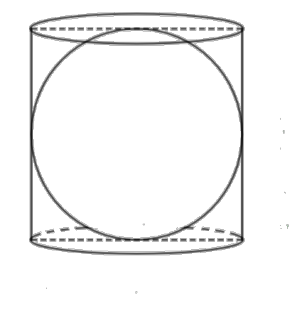
9. A right circular cylinder just encloses a sphere of radius $\text{r}$ (see figure). Find
i. surface area of the sphere,
Ans:
The surface area of the sphere is $\text{4 }\!\!\pi\!\!\text{ }{{\text{r}}^{\text{2}}}$.
ii. curved surface area of the cylinder,
Ans:
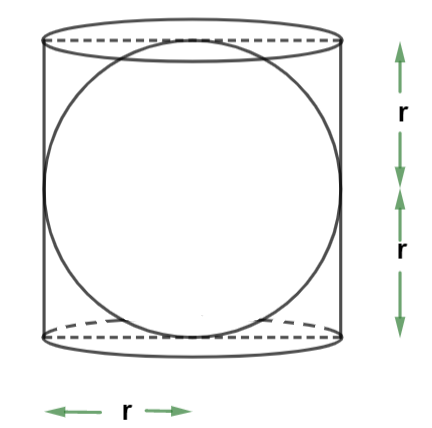
Given the radius of cylinder $\text{= r}$
The height of cylinder $\text{= r + r = 2r}$
The curved surface area of cylinder $\text{A = 2 }\!\!\pi\!\!\text{ rh}$
$\Rightarrow \text{A = 2 }\!\!\pi\!\!\text{ r }\left( \text{2r} \right)$
$\Rightarrow \text{A = 4 }\!\!\pi\!\!\text{ }{{\text{r}}^{\text{2}}}$
Therefore the curved surface area of the cylinder is $\text{4 }\!\!\pi\!\!\text{ }{{\text{r}}^{\text{2}}}$.
iii. ratio of the areas obtained in i. and ii.
The ratio of surface area of the sphere and curved surface area of cylinder $\text{R = }\frac{\text{4 }\!\!\pi\!\!\text{ }{{\text{r}}^{\text{2}}}}{\text{4 }\!\!\pi\!\!\text{ }{{\text{r}}^{\text{2}}}}$
$\text{R = }\frac{\text{1}}{\text{1}}$
Therefore, the required ratio is $\text{1 : 1}$.
Conclusion
NCERT Solutions for Maths Exercise 11.2 Class 9 Chapter 11 - Surface Areas and Volumes by Vedantu provides clear and simple explanations for calculating the surface areas and volumes of various shapes like cuboids, cubes, cylinders, cones, and spheres. These solutions follow the latest NCERT guidelines and help students understand and apply important geometry concepts. By practicing these problems, students can strengthen their math skills and perform better in exams. Download the solutions in PDF format for easy access and effective learning.
Class 9 Maths Chapter 11: Exercises Breakdown
CBSE Class 9 Maths Chapter 11 Other Study Materials
Chapter-Specific NCERT Solutions for Class 9 Maths
Given below are the chapter-wise NCERT Solutions for Class 9 Maths. Go through these chapter-wise solutions to be thoroughly familiar with the concepts.
Important Study Materials for Class 9 Maths


FAQs on NCERT Solutions For Class 9 Maths Chapter 11 Surface Areas And Volumes Exercise 11.2 (2025-26)
1. What is covered in NCERT Solutions for Class 9 Maths Chapter 11 Exercise 11.2?
NCERT Solutions for Class 9 Maths Chapter 11 Exercise 11.2 cover all textbook questions from Surface Areas and Volumes, solved step by step as per the NCERT format.
2. Where can students find Class 9 Maths Exercise 11.2 solutions?
Students can find Class 9 Maths Exercise 11.2 solutions on Vedantu, where NCERT Solutions for Surface Areas and Volumes are presented in a clear, exam-oriented structure.
3. Are NCERT Solutions for Exercise 11.2 Class 9 Maths written as per CBSE standards?
Yes, NCERT Solutions for Exercise 11.2 Class 9 Maths are written according to CBSE answer-writing standards expected for Surface Areas and Volumes questions.
4. What type of questions are included in Class 9 Maths Chapter 11 Exercise 11.2?
Class 9 Maths Chapter 11 Exercise 11.2 includes only the questions prescribed by NCERT under the chapter Surface Areas and Volumes, all solved in the same order.
5. Who should use NCERT Solutions for Class 9 Maths Exercise 11.2?
NCERT Solutions for Class 9 Maths Exercise 11.2 are suitable for students who want accurate, NCERT-aligned answers for school work and exams in Surface Areas and Volumes.
6. How are answers presented in Class 9 Maths Exercise 11.2 solutions on Vedantu?
On Vedantu, Class 9 Maths Exercise 11.2 solutions are presented in a stepwise and neatly structured format, matching NCERT and CBSE expectations.
7. Do NCERT Solutions for Surface Areas and Volumes Exercise 11.2 follow the NCERT question sequence?
Yes, NCERT Solutions for Surface Areas and Volumes Exercise 11.2 strictly follow the same question numbering and sequence as the NCERT textbook.
8. Can Class 9 Maths Chapter 11 Exercise 11.2 solutions be used for school exams?
Yes, Class 9 Maths Chapter 11 Exercise 11.2 solutions can be confidently used for school exams as they are fully aligned with NCERT and CBSE guidelines.
9. How is Exercise 11.2 positioned within the chapter Surface Areas and Volumes?
Exercise 11.2 is a core part of Class 9 Maths Chapter 11 Surface Areas and Volumes, and its question formats are commonly assessed in schools.
10. Why do students prefer NCERT Solutions for Class 9 Maths Exercise 11.2 on Vedantu?
Students prefer NCERT Solutions for Class 9 Maths Exercise 11.2 on Vedantu because they offer accurate answers, clear step-by-step presentation, and strict alignment with the NCERT textbook.
