



 Watch Video




Exam-ready answers for Class 9 Maths Lines and Angles Questions with FREE PDF download
As per the CBSE syllabus for Class 9 Maths regular practice of textbook chapters is essential for exam readiness. These NCERT Solutions for Class 9 Maths Chapter 6 Lines and Angles provide a clear reference for checking answers and maintaining proper presentation in examinations. Prepared strictly according to NCERT guidelines, the solutions align closely with the textbook and exam expectations. Students often rely on class 9 maths chapter 6 solutions to practise consistently and avoid common mistakes before tests.
 Table of Content
Vedantu makes these Class 9 Maths NCERT Solutions available with a free PDF download, allowing learners to revise offline and manage their study time more effectively. This page serves as a dependable resource for students preparing for school assessments and exams.
Access Exercise Wise NCERT Solutions for Chapter 6 Maths Class 9


NCERT Solutions For Class 9 Maths Chapter 6 Lines and Angles (2025-26)


 ShareShare
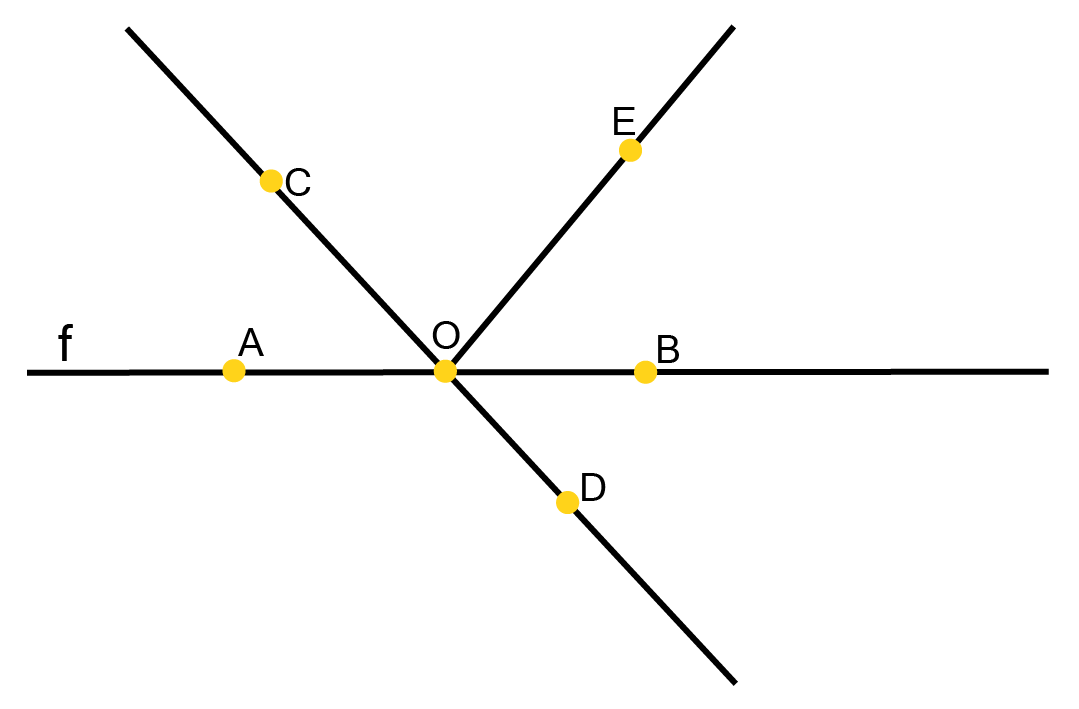
1. In the given figure, lines AB and CD intersect at O. if \[\angle \text{AOC+}\angle \text{BOE=7}{{\text{0}}^{\text{o}}}\] and $\angle \text{BOD=4}{{\text{0}}^{\text{o}}}$find $\angle \text{BOE}$ and reflex $\angle \text{COE}$
Ans:
AB is a straight line, OC and OE are rays from O.
We know that a straight line covers ${{180}^{\circ }}$
\[\text{ }\Rightarrow \angle \text{AOC+}\angle \text{COE+}\angle \text{BOE=18}{{\text{0}}^{\circ }}\]
By clubbing $\angle \text{AOC and }\angle \text{BOE}$ together we can rewrite the above equation as
\[\Rightarrow \left( \angle \text{AOC+}\angle \text{BOE} \right)+\angle \text{COE=18}{{\text{0}}^{\circ }}\]
Putting \[\text{ }\angle \text{AOC+}\angle \text{BOE=7}{{\text{0}}^{\circ }}\]
$\text{ }\Rightarrow \text{7}{{\text{0}}^{\circ }}+\angle \text{COE=18}{{\text{0}}^{\circ }}$
$\text{ }\Rightarrow \angle \text{COE=18}{{\text{0}}^{\circ }}\text{-}{{70}^{\circ }}$
$\text{ }\Rightarrow \angle \text{COE=11}{{\text{0}}^{\circ }}$
Hence reflex $\text{ }\angle \text{COE=36}{{\text{0}}^{\circ }}\text{-11}{{\text{0}}^{\circ }}$
$\text{ reflex}\angle \text{COE=25}{{\text{0}}^{\circ }}\text{ }$
Similarly CD is a straight line, OB and OE are rays from O.
We know that a straight line covers ${{180}^{\circ }}$
\[\text{ }\Rightarrow \angle B\text{OD+}\angle \text{COE+}\angle \text{BOE=18}{{\text{0}}^{\circ }}\]
\[\text{ }\Rightarrow \text{ }{{40}^{\circ }}\text{+}{{110}^{\circ }}\text{+}\angle \text{BOE=18}{{\text{0}}^{\circ }}\]
\[\text{ }\Rightarrow \text{ }\angle \text{BOE=18}{{\text{0}}^{\circ }}\text{-}\left( \text{4}{{\text{0}}^{\circ }}\text{+11}{{\text{0}}^{\circ }} \right)\]
\[\text{ }\Rightarrow \text{ }\angle \text{BOE=18}{{\text{0}}^{\circ }}\text{-}{{150}^{\circ }}\]
\[\text{ }\Rightarrow \text{ }\angle \text{BOE=}{{30}^{\circ }}\]
Hence \[\angle \text{BOE=}{{30}^{\circ }}\] and reflex $\angle \text{COE=25}{{\text{0}}^{\circ }}$
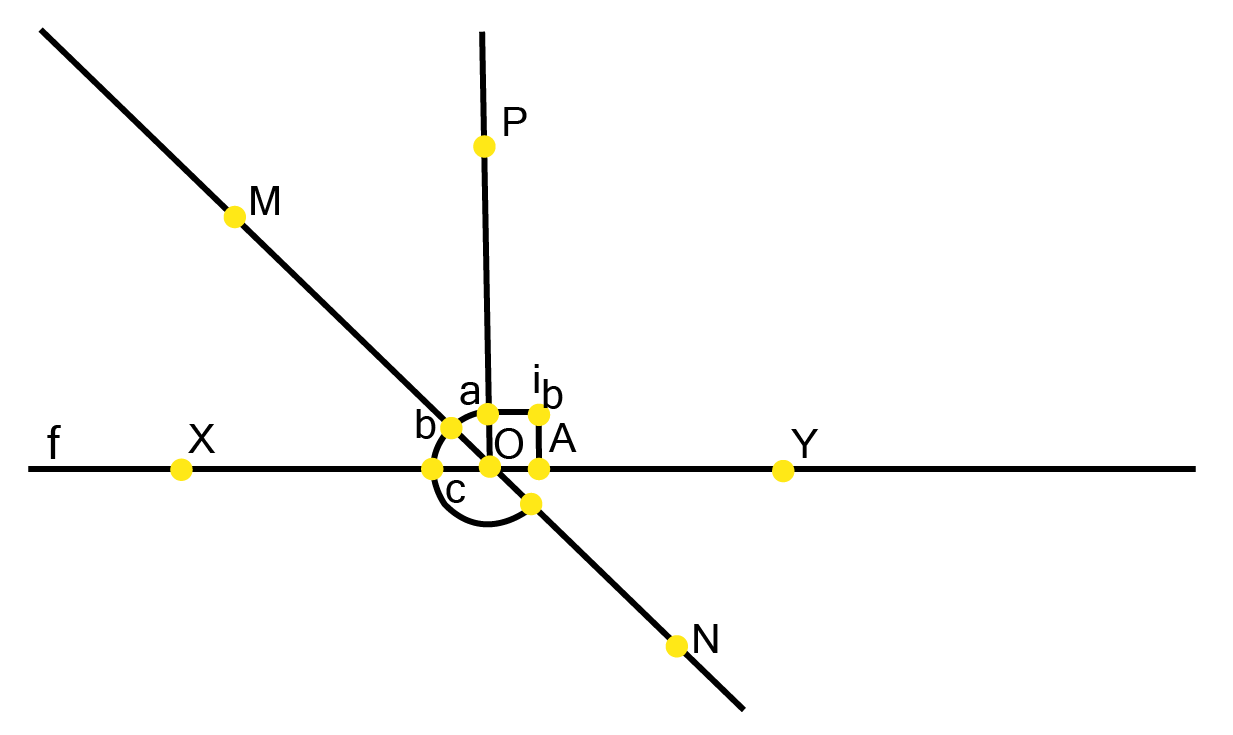
2. In the given figure, lines XY and MN intersect at O. If \[\angle \text{POY=9}{{\text{0}}^{\text{o}}}\] and a: b = 2:3, find c.
Ans:
Let the common ratio between a and b be x.
$\therefore $\[\text{a = 2x}\] , and \[\text{b = 3x}\]
XY is a straight line, OM and OP are rays from O.
We know that a straight line covers ${{180}^{\circ }}$
\[\angle \text{XOM +}\angle \text{MOP +}\angle \text{POY = 18}{{\text{0}}^{\text{o}}}\]
Putting values for \[\angle \text{XOM=b and}\angle \text{MOP=a}\]
\[\Rightarrow \text{ b + a +}\angle \text{POY = 18}{{\text{0}}^{\text{o}}}\]
\[\Rightarrow \text{ 3x + 2x +}\angle \text{POY = 18}{{\text{0}}^{\text{o}}}\]
\[\Rightarrow \text{ 5x = 9}{{\text{0}}^{\text{o}}}\]
\[\Rightarrow \text{ x = 1}{{\text{8}}^{\text{o}}}\]
\[\therefore \text{ a = 2x}\]
\[\Rightarrow \text{ a = 2}\times \text{1}{{\text{8}}^{\circ }}\]
\[\text{ = 3}{{\text{6}}^{\circ }}\]
\[\therefore \text{ b = 3x}\]
\[\Rightarrow \text{ b = 3}\times \text{1}{{\text{8}}^{\circ }}\]
\[\text{ = 5}{{\text{4}}^{\circ }}\]
Similarly MN is a straight line, OX is a ray from O
$\text{ }\therefore \text{b+c=18}{{\text{0}}^{\circ }}$
\[\text{5}{{\text{4}}^{\text{o}}}\text{ + c = 18}{{\text{0}}^{\text{o}}}\]
\[\text{ }c=\text{ }{{180}^{\circ }}\text{ }-\text{ }{{54}^{\circ }}\]
\[\text{ }c=\text{ 12}{{\text{6}}^{\circ }}\]
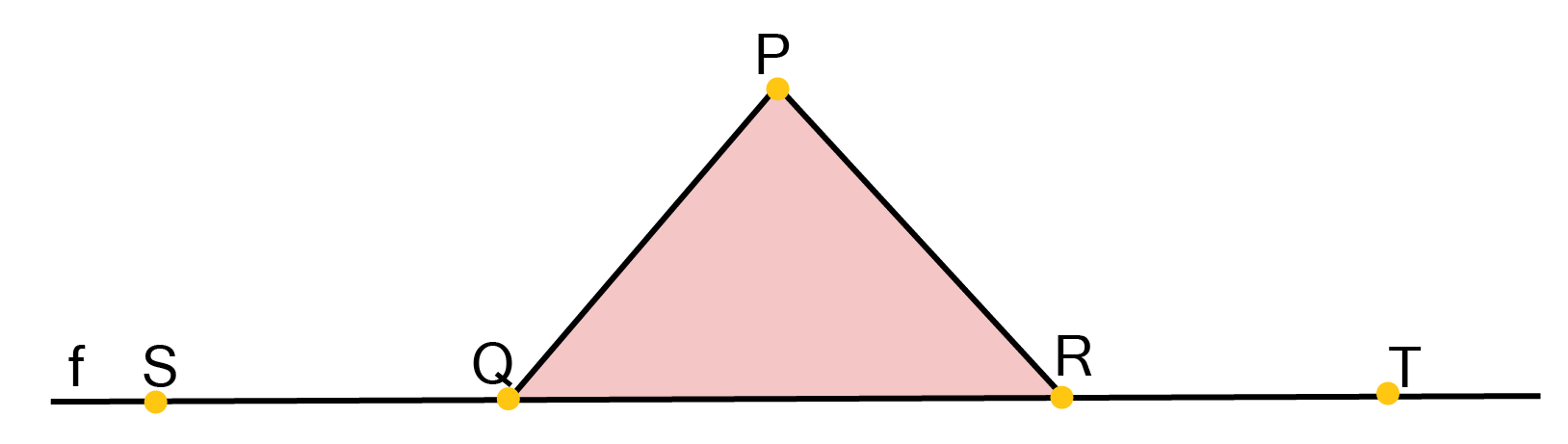
3. In the given figure,$\angle \text{PQR=}\angle \text{PRQ}$ , then prove that $\angle \text{PQS=}\angle \text{PRT}$.
Ans:
ST is a straight line, QP is a line segment from Q in ST to any point P
by Linear Pair property
$\angle \text{PQS+}\angle \text{PQR=18}{{\text{0}}^{\text{o}}}$
$\Rightarrow \text{ }\angle \text{PQR=18}{{\text{0}}^{\text{o}}}\text{-}\angle \text{PQS}$ ......($1$ )
Similarly
$\angle PRT+\angle PRQ={{180}^{\circ }}$
$\Rightarrow \text{ }\angle \text{PRQ=18}{{\text{0}}^{\text{o}}}\text{-}\angle \text{PRT}$ ......($2$ )
Now in the question it is given that $\angle \text{PQR=}\angle \text{PRQ}$
Therefore on equating equation ($1$ ) and ($2$ ) we get
$\text{18}{{\text{0}}^{\text{o}}}\text{-}\angle \text{PQS=18}{{\text{0}}^{\text{o}}}\text{-}\angle \text{PRT}$
$\Rightarrow \text{ }\angle \text{PQS=}\angle \text{PRT}$
Hence proved
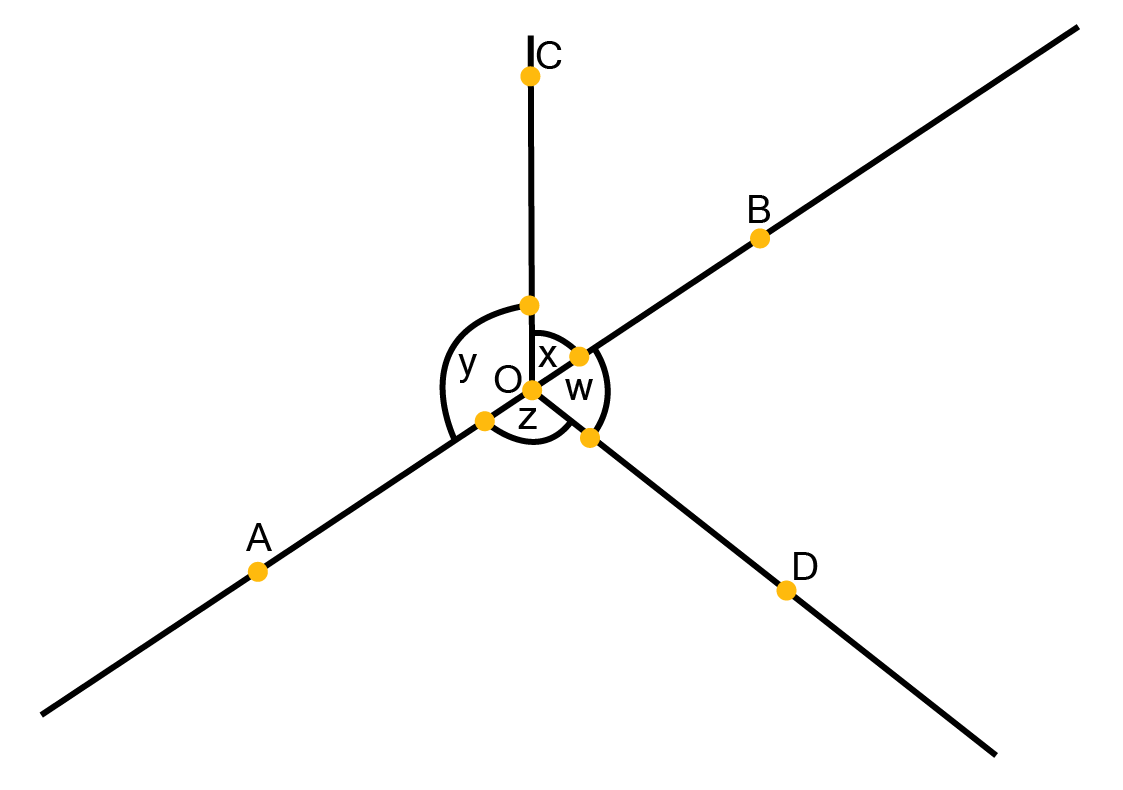
4. In the given figure, if $\text{x+y=w+z}$ then prove that AOB is a line.
Ans:
It can be observed that,
Since there are ${{360}^{\circ }}$ around a point therefore we can write
$x+y+z+w={{360}^{\circ }}$
It is given that,
$\text{x+y=w+z}$
Therefore writing$\text{x+y}$in place of $\text{w+z}$so that we can eliminate w and z, we get
$x+y+x+y={{360}^{\circ }}$
$2\left( x+y \right)={{360}^{\circ }}$
$x+y={{180}^{\circ }}$
Since x and y form a linear pair, hence we can say that AOB is a line.
Hence proved
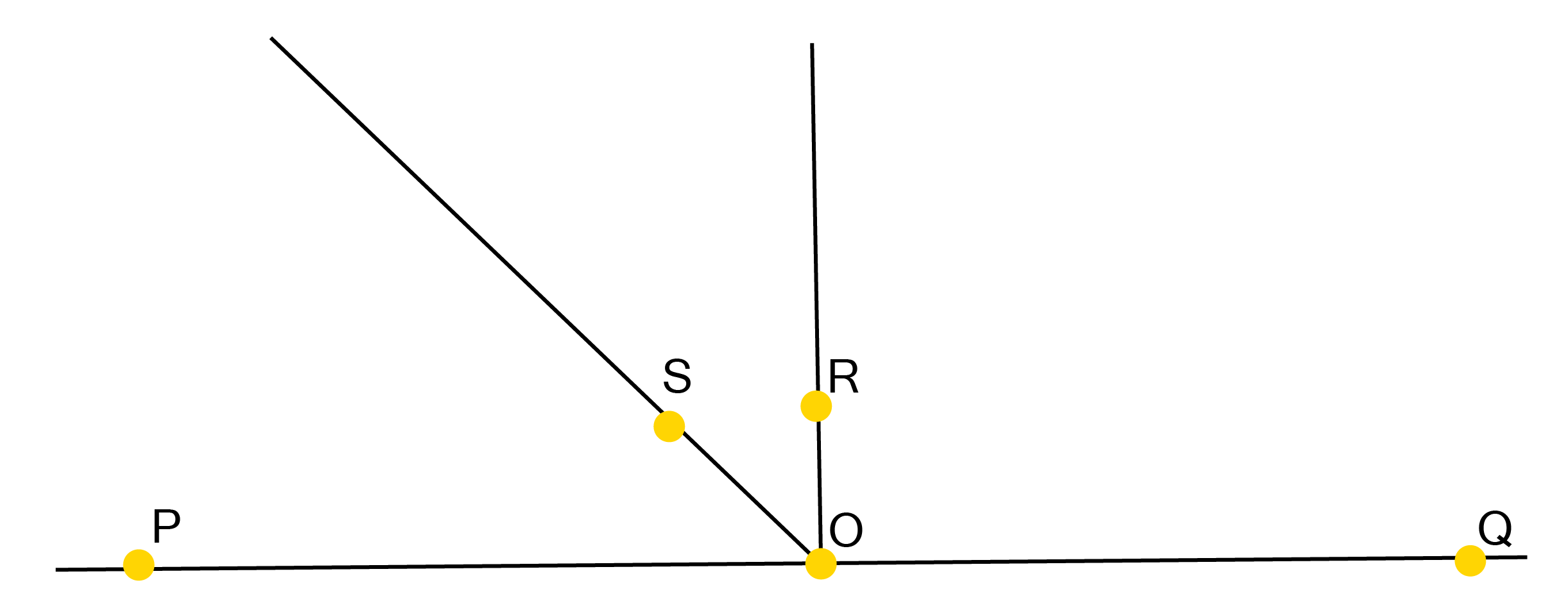
5. In the given figure, POQ is a line. Ray OR is perpendicular to line PQ. OS is another ray lying between rays OP and OR. Prove that
$\angle \text{ROS=}\frac{\text{1}}{\text{2}}\left( \angle \text{QOS-}\angle \text{POS} \right)$
Ans:
Since $\text{OR}\bot \text{PQ}$ therefore
$\angle \text{POR=9}{{\text{0}}^{\text{o}}}$
$\angle POS+ROS={{90}^{\circ }}$
$\Rightarrow \text{ }\angle \text{ROS=9}{{\text{0}}^{\text{o}}}\text{-}\angle \text{POS}$ ...... ($1$ )
Similarly $\angle \text{QOR=9}{{\text{0}}^{\text{o}}}$ (Since $\text{OR }\!\!\hat{\ }\!\!\text{ PQ}$)
$\therefore \angle \text{QOS-}\angle \text{ROS=9}{{\text{0}}^{\text{o}}}$
$\Rightarrow \text{ }\angle \text{ROS=}\angle \text{QOS-9}{{\text{0}}^{\text{o}}}$......($2$)
We can clearly see that on adding equation ($1$ ) and ($2$) ${{90}^{\circ }}$ get canceled out
$\Rightarrow \text{2}\angle \text{ROS=}\angle \text{QOS-}\angle \text{POS}$
Which can easily be written as
$\Rightarrow \angle \text{ROS=}\frac{\text{1}}{\text{2}}\left( \angle \text{ROS-}\angle \text{POS} \right)$
Hence proved
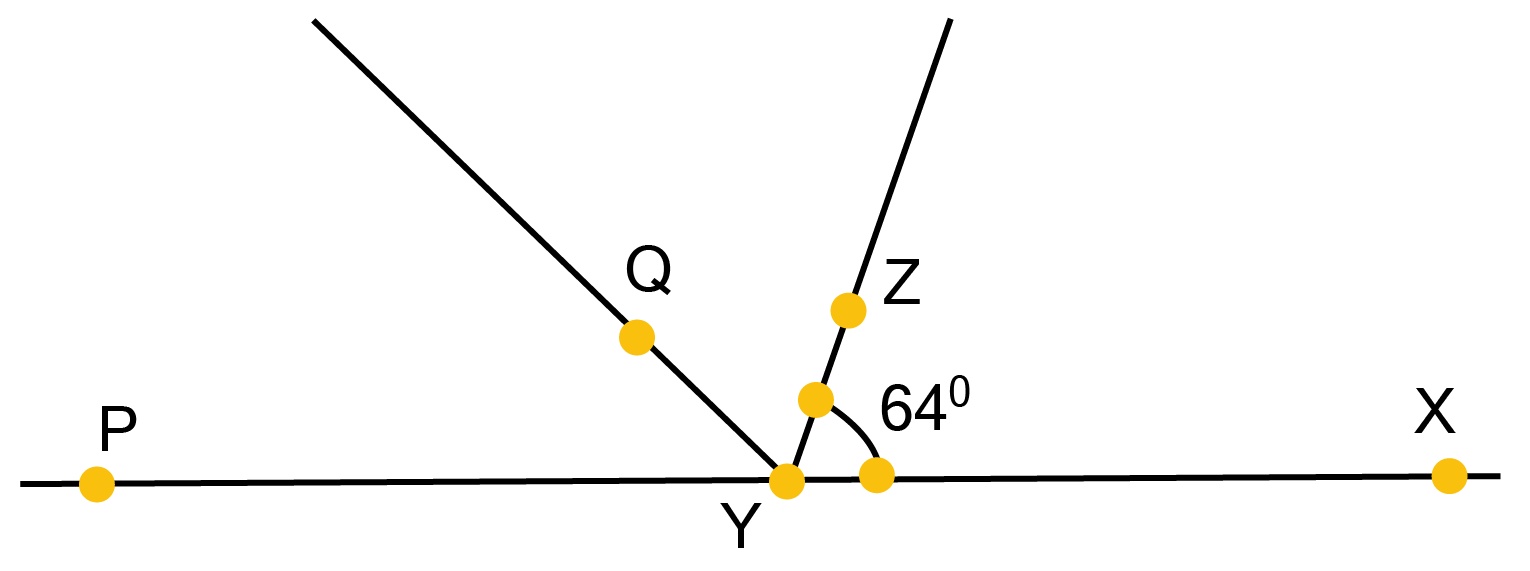
6. It is given that $\text{XYZ=6}{{\text{4}}^{\text{o}}}$ and XY is produced to point P. Draw a figure from the given information. If ray YQ bisects $\text{ZYP}$, find $\text{XYQ}$ and reflex$\text{QYP}$.
Ans:
It is given that line YQ bisects $\angle \text{ZYP}$.
Hence, $\angle \text{QYP=}\angle \text{ZYQ}$
It can easily be understood that PX is a line, YQ and YZ being rays standing on it.
\[\angle \text{XYZ+}\angle \text{ZYQ+}\angle \text{QYP=18}{{\text{0}}^{\text{o}}}\]
From above relation $\angle \text{QYP=}\angle \text{ZYQ}$ we can write
$\text{6}{{\text{4}}^{\text{o}}}\text{+2}\angle \text{QYP=18}{{\text{0}}^{\text{o}}}$
$\Rightarrow \text{ 2}\angle \text{QYP=18}{{\text{0}}^{\text{o}}}\text{-6}{{\text{4}}^{\text{o}}}$
$\Rightarrow \text{ }\angle \text{QYP=5}{{\text{8}}^{\circ }}$
Therefore $\angle \text{ZYQ=5}{{\text{8}}^{\circ }}$
Also Reflex $\angle \text{QYP=30}{{\text{2}}^{\circ }}$
Now we can write $\angle \text{XYQ}$ as below
$\angle \text{XYQ=}\angle \text{XYZ+}\angle \text{ZYQ}$
${{64}^{\circ }}+{{58}^{\circ }}={{122}^{\circ }}$
Therefore we found $\angle \text{XYQ=12}{{\text{2}}^{\circ }}$ and so the Reflex $\angle \text{QYP=30}{{\text{2}}^{\circ }}$
Exercise-6.2
1. In the given figure, if AB \[\parallel \] CD, CD \[\parallel \] EF and y: z = 3:7, find x.
![AB\[\parallel \] CD and CD \[\parallel \] EF](https://www.vedantu.com/seo/content-images/afaa573d-dbd7-4e5d-82bb-36a18cd01a0f.png)
Ans:
It is given that AB\[\parallel \] CD and CD \[\parallel \] EF
$\therefore $ AB\[\parallel \]CD\[\parallel \] EF (Lines parallel to other fixed line are parallel to each other)
It can easily be understood that
$\text{x=z}$ (since alternate interior angles are equal) ...... ($1$)
It is given that y: z = 3: 7
Without any loss of generality we can let $\text{y=3a}$and $\text{z=7a}$
Also, $\text{x+y=18}{{\text{0}}^{\text{o}}}$ (Co-interior angles together sum up to ${{180}^{\circ }}$)
From equation ($1$) we can write z in place of x as shown
$\text{z+y=18}{{\text{0}}^{\text{o}}}$
It can further written as shown
$7a+3a={{180}^{\circ }}$
$\Rightarrow \text{ 10a=18}{{\text{0}}^{\text{o}}}$
$\Rightarrow \text{ a=1}{{\text{8}}^{\text{o}}}$
$\therefore \text{ x=7 }\!\!\times\!\!\text{ 1}{{\text{8}}^{\text{o}}}$
$\therefore \text{ x=12}{{\text{6}}^{\text{o}}}$
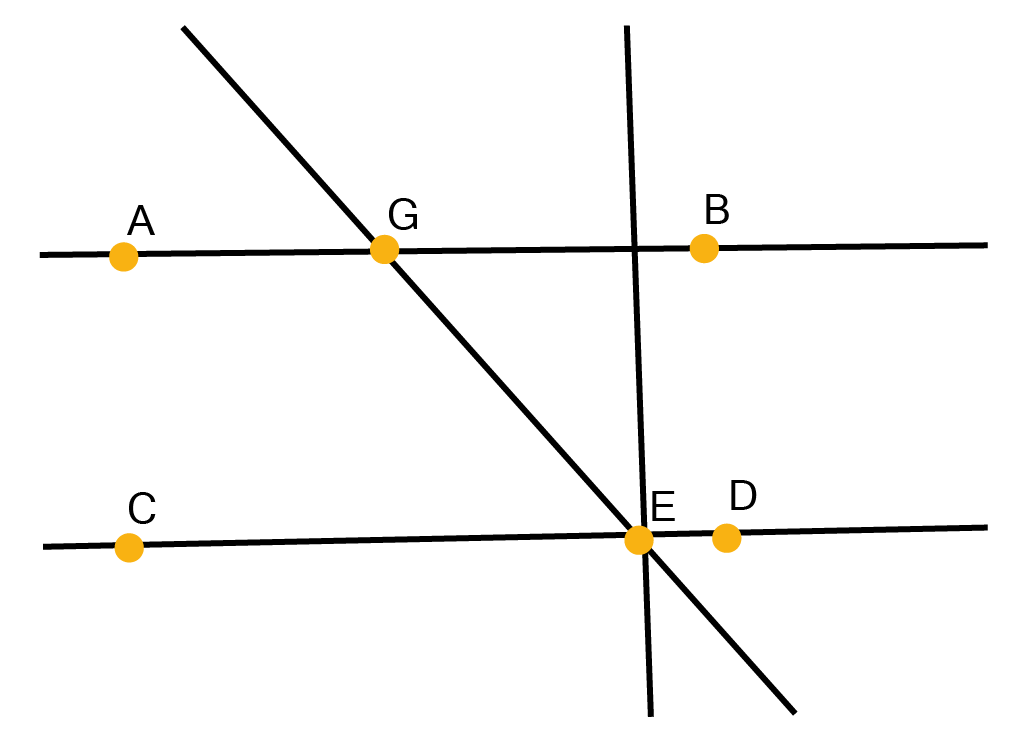
2. In the given figure, If AB\[\parallel \]CD, EF$\bot $ CD and$\angle \text{GED=12}{{\text{6}}^{\text{o}}}$ , find$\angle \text{AGE}$ , $\angle \text{GEF}$and $\angle \text{FGE}$.
Ans:
We are given that,
AB $\parallel $ CD and EF$\bot $ CD and
$\text{ }\angle \text{GED=12}{{\text{6}}^{\text{o}}}$
Which can be written as
$\Rightarrow \angle \text{GEF+}\angle \text{FED=12}{{\text{6}}^{\text{o}}}$
$\Rightarrow \text{ }\angle \text{GEF+9}{{\text{0}}^{\text{o}}}\text{=12}{{\text{6}}^{\text{o}}}$
Hence we can obtain $\text{GEF}$as shown below
$\Rightarrow \text{ }\angle \text{GEF=12}{{\text{6}}^{\text{o}}}\text{-9}{{\text{0}}^{\text{o}}}$
$\Rightarrow \text{ }\angle \text{GEF=3}{{\text{6}}^{\circ }}$
$\angle \text{AGE=}\angle \text{GED=12}{{\text{6}}^{\text{o}}}$ (∠AGE and ∠GED are alternate interior angles)
But
$\angle \text{AGE+}\angle \text{FGE=18}{{\text{0}}^{\text{o}}}$ (because these form a linear pair)
$\Rightarrow \text{12}{{\text{6}}^{\text{o}}}\text{+}\angle \text{FGE=18}{{\text{0}}^{\text{o}}}$
$\Rightarrow \angle \text{FGE=18}{{\text{0}}^{\text{o}}}\text{-12}{{\text{6}}^{\text{o}}}$
$\Rightarrow \angle \text{FGE=5}{{\text{4}}^{\text{o}}}$
Hence, we found $\angle \text{AGE=12}{{\text{6}}^{\text{o}}}$, $\angle \text{GEF=3}{{\text{6}}^{\text{o}}}$ , $\angle \text{FGE=5}{{\text{4}}^{\text{o}}}$
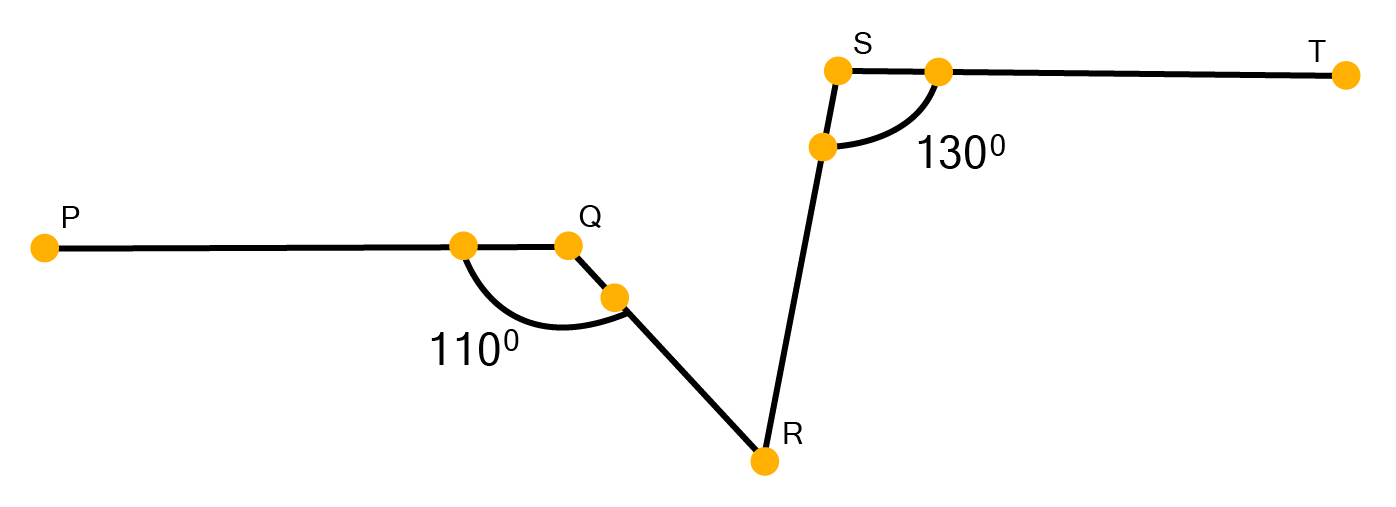
3. In the given figure, if PQ $\parallel $ ST, $\angle \text{PQR=11}{{\text{0}}^{\text{o}}}$ and$\angle \text{RST=13}{{\text{0}}^{\text{o}}}$ , find $\angle \text{QRS}$.
(Hint: Draw a line parallel to ST through point R.)
Ans:
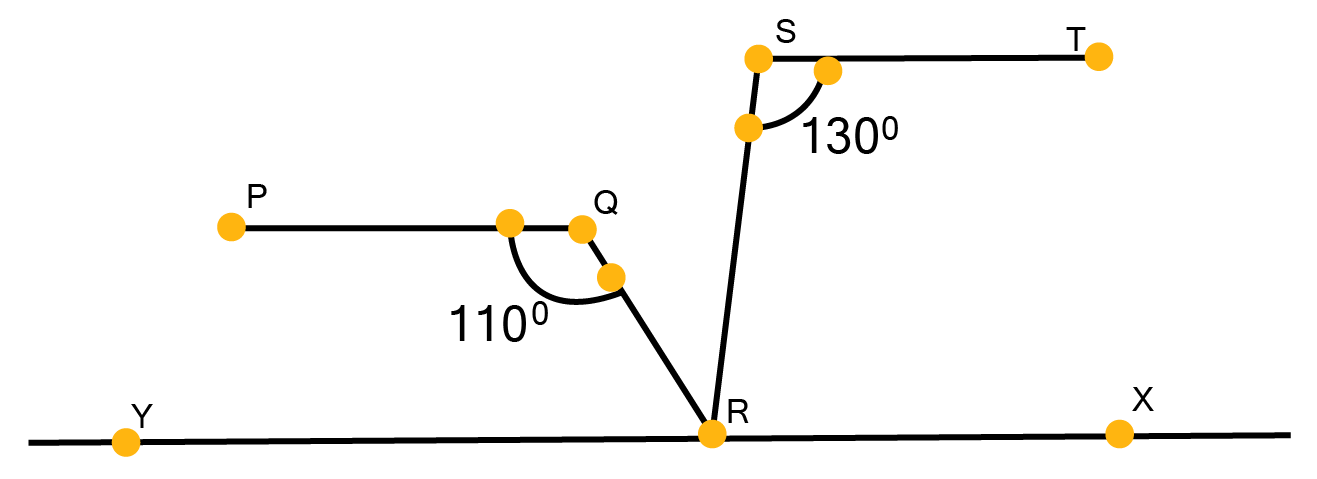
In this question we will have some construction of our own, we draw a line XY parallel to ST and so parallel to PQ passing through point R.
$\angle \text{PQR+}\angle \text{QRX=18}{{\text{0}}^{\text{o}}}$ (Co-interior angles on the same side of transversal QR together sum up to ${{180}^{\circ }}$)
$\therefore \text{11}{{\text{0}}^{\text{o}}}\text{+}\angle \text{QRX=18}{{\text{0}}^{\text{o}}}$
$\Rightarrow \text{ }\angle \text{QRX=7}{{\text{0}}^{\text{o}}}$
Also,
$\angle \text{RST+}\angle \text{SRY=18}{{\text{0}}^{\circ }}$ (sum of Co-interior angles on the same side of transversal SR equals $\text{18}{{\text{0}}^{\circ }}$)
$\Rightarrow \text{ }\angle \text{SRY=18}{{\text{0}}^{\circ }}\text{-13}{{\text{0}}^{\circ }}$
$\Rightarrow \text{ }\angle \text{SRY=}{{50}^{\circ }}$
Now from the construction XY is a straight line. RQ and RS are rays from it.
$\angle \text{QRX+}\angle \text{QRS+}\angle \text{SRY=18}{{\text{0}}^{\circ }}$
$\Rightarrow \text{ 7}{{\text{0}}^{\circ }}+\angle QRS+{{50}^{\circ }}={{180}^{\circ }}$
Hence we found that
$\angle \text{QRS=6}{{\text{0}}^{\circ }}$
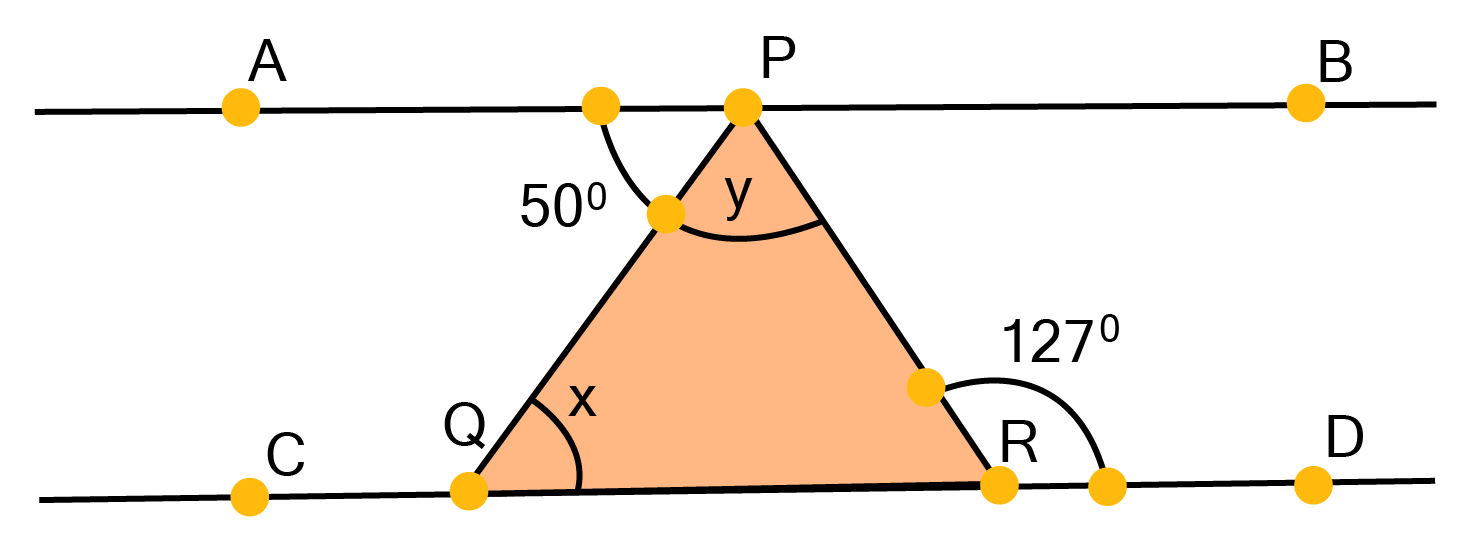
4. In the given figure, if AB $\parallel $ CD, $\angle APQ={{50}^{\circ }}$ and$\angle PRD={{127}^{\circ }}$ , find x and y.
Ans:
$\angle APR=PRD$ (since alternate interior angles are equal)
$\therefore \text{5}{{\text{0}}^{\circ }}+y={{127}^{\circ }}$ (since $\angle APR=\angle \text{APQ+}\angle \text{PQR}$)
$\Rightarrow \text{y=7}{{\text{7}}^{\circ }}$
similarly,
$\angle \text{APQ=PQR}$ ∠APQ = ∠PQR (since alternate interior angles are equal)
$\therefore \text{x=5}{{\text{0}}^{\circ }}$
Therefore we found that $\text{x=5}{{\text{0}}^{\circ }}$ and $\text{y=7}{{\text{7}}^{\circ }}$
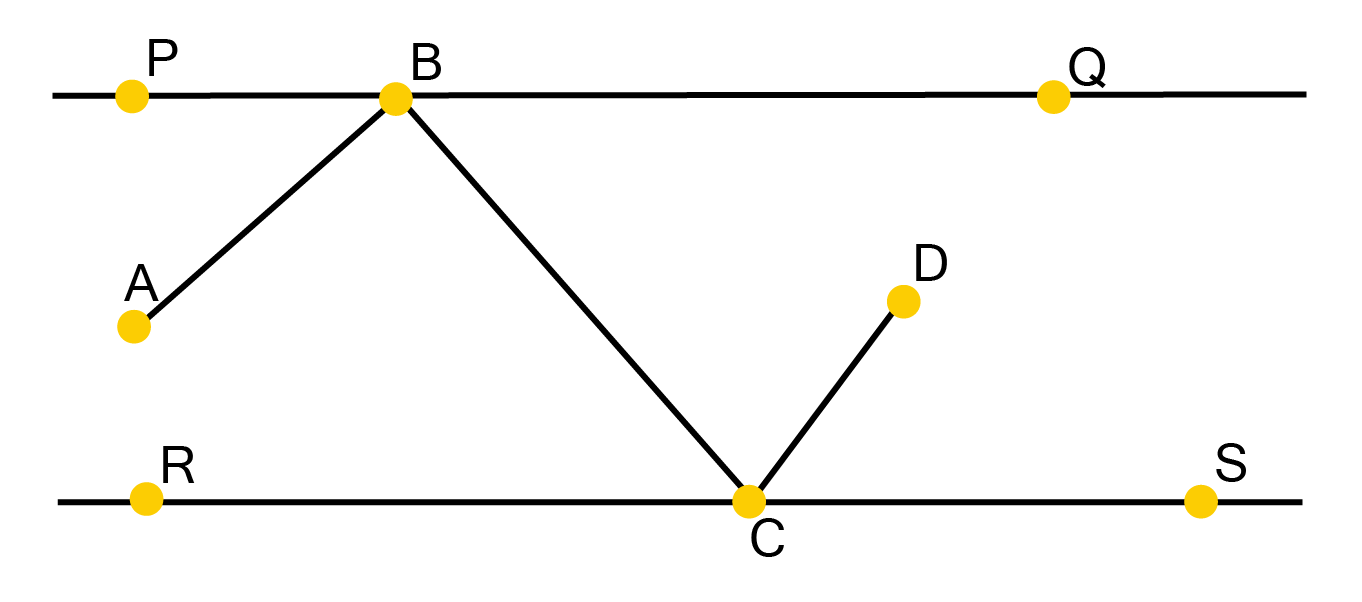
5. In the given figure, PQ and RS are two mirrors placed parallel to each other. An incident ray AB strikes the mirror PQ at B, the reflected ray moves along the path BC and strikes the mirror RS atC and again reflects back along CD. Prove that AB||CD.
Ans:
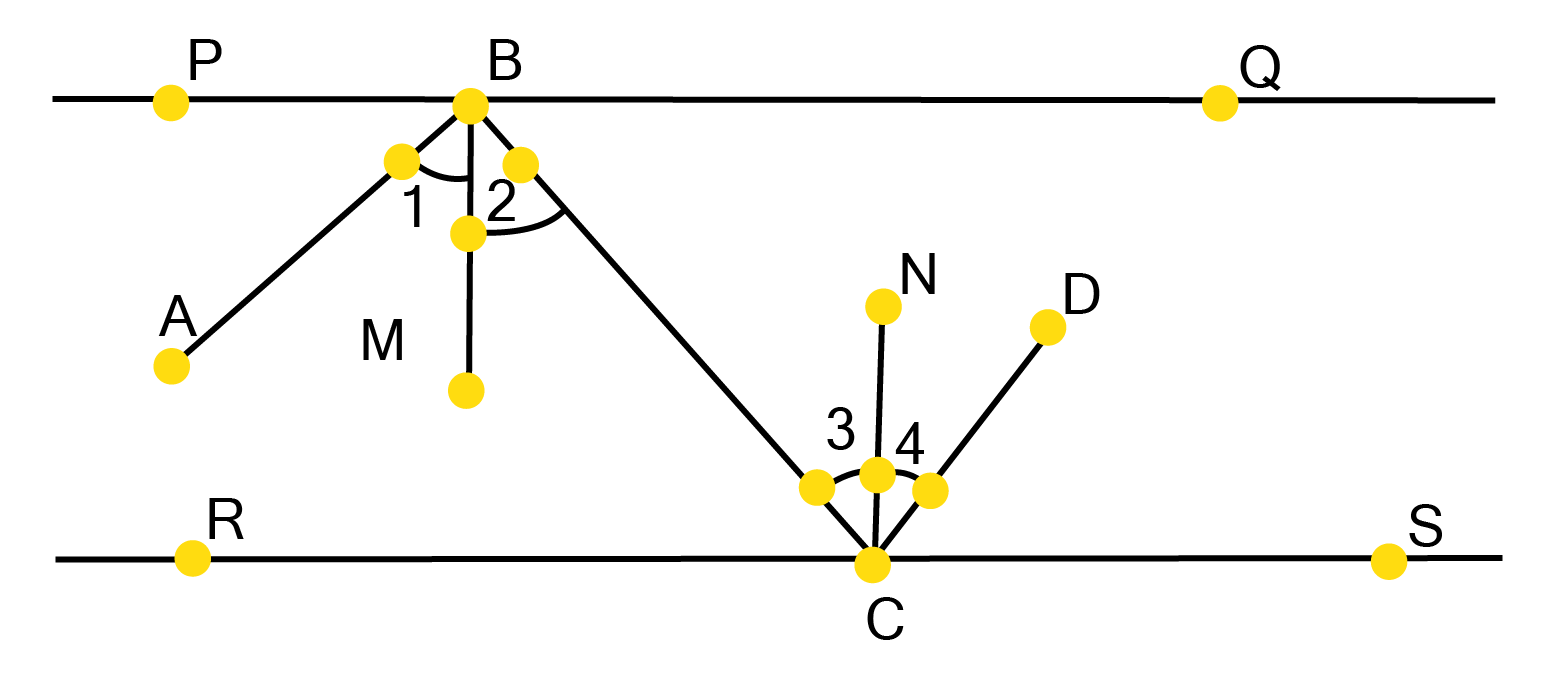
Let us construct BM$\bot $ PQ and CN$\bot $RS.
Since PQ$\parallel $ RS, and so BM $\parallel $ CN
Therefore, CN and BM are two parallel lines and a transversal line BC cuts them at B and C respectively.
∠2 = ∠3......($1$) (since alternate interior angles are equal)
But, by laws of reflection in Physics
∠1 = ∠2 and ∠3 = ∠4
Now from equation ($1$)
∠1 = ∠2 = ∠3 = ∠4
Therefore
∠1 + ∠2 = ∠3 + ∠4
$\angle \text{ABC=}\sum \text{DCB}$
But, these are alternate interior angles.
$\therefore $ AB$\parallel $ CD
Hence proved.
Overview of Deleted Syllabus for Class 9 Maths Chapter 6 Lines and Angles
Conclusion
NCERT Solutions for Chapter 6 Class 9 Math Lines and Angles, covers important concepts and theorems for mastering basic geometry. The chapter emphasizes understanding how lines and angles interact and proving lines parallel using corresponding, alternate, and co-interior angles. Mastering these concepts is crucial for future mathematics topics. The detailed solutions help students approach and solve geometric problems, enhancing their analytical and problem-solving skills. Mastering this chapter is essential not only for exams but also for a deeper understanding of geometry.
Other Study Material for CBSE Class 9 Maths Chapter 6
Chapter-Specific NCERT Solutions for Class 9 Maths
Given below are the chapter-wise NCERT Solutions for Class 9 Maths. Go through these chapter-wise solutions to be thoroughly familiar with the concepts.
Important Study Materials for CBSE Class 9 Maths


FAQs on NCERT Solutions For Class 9 Maths Chapter 6 Lines and Angles (2025-26)
1. Are NCERT solutions available for all exercises in Class 9 Maths Chapter 6?
Yes, NCERT solutions for all exercises in Class 9 Maths Chapter 6 Lines and Angles are available on Vedantu, with every question covered.
2. Do Class 9 Maths Chapter 6 NCERT solutions help in writing proper answers?
Yes, the Class 9 Maths Chapter 6 NCERT solutions on Vedantu help students understand how to write answers in the correct exam format.
3. Can I rely on NCERT solutions for Class 9 Maths Chapter 6 for tests?
Yes, NCERT solutions for Class 9 Maths Chapter 6 Lines and Angles on Vedantu are reliable for school tests as they follow NCERT and CBSE standards.
4. Are Class 9 Maths Chapter 6 solutions written in simple language?
Yes, the Class 9 Maths Chapter 6 solutions provided on Vedantu are written in simple and student-friendly language.
5. Do NCERT solutions for Lines and Angles Class 9 include solved examples?
Yes, the NCERT solutions for Lines and Angles Class 9 on Vedantu include all solved questions as given in the textbook exercises.
6. Is Class 9 Maths Chapter 6 covered completely in NCERT solutions?
Yes, Class 9 Maths Chapter 6 Lines and Angles is covered completely in the NCERT solutions available on Vedantu.
7. Are NCERT solutions for Class 9 Maths Chapter 6 suitable for daily practice?
Yes, students can use NCERT solutions for Class 9 Maths Chapter 6 on Vedantu for daily practice and written work.
8. Do the Lines and Angles Class 9 solutions follow CBSE marking schemes?
Yes, the Lines and Angles Class 9 solutions on Vedantu follow CBSE-recommended answer structure and marking patterns.
9. Can NCERT solutions for Class 9 Maths Chapter 6 be accessed online for free?
Yes, NCERT solutions for Class 9 Maths Chapter 6 Lines and Angles can be accessed online on Vedantu.
10. Is there a single page with all Class 9 Maths Chapter 6 solutions?
Yes, Vedantu provides a single, organised page with all Class 9 Maths Chapter 6 Lines and Angles NCERT solutions.
