



 Watch Video




Class 9 Maths Exercise 9.2 – Circles Solutions
Class 9 Maths Exercise 9.2 focuses on understanding the basic properties of circles and how they apply to different geometry problems. These Class 9 Maths Ex 9.2 solutions explain each question clearly, helping students follow the correct method without confusion.
 Table of Content
The Ex 9.2 Class 9 NCERT solutions are written step by step, making it easier to solve problems related to chords, arcs, and angles in circles. Practising Class 9th Exercise 9.2 helps students gain confidence and accuracy in geometry.
All Class 9 Maths Chapter 9 Exercise 9.2 solutions are prepared by Vedantu’s expert teachers and follow the latest CBSE guidelines. Students can use these answers to complete homework smoothly and understand how marks are awarded in exams.


NCERT Solutions For Class 9 Maths Chapter 9 Circles Exercise 9.2 (2025-26)


 ShareShare
Exercise 9.2
1. Two circles of radii 5 cm and 3 cm intersect at two points and the distance between their centres is 4 cm. Find the length of the common chord.
Ans:
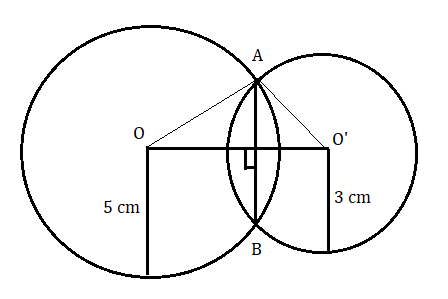
Consider the radius of the circle with centre as $\text{O}$ and ${{\text{O}}^{\prime }}$ be $5~\text{cm}$ and $3~\text{cm}$ respectively.
$\text{OA}=\text{OB}=5~\text{cm}$ (Radius of same circle)
${{\text{O}}^{\prime }}\text{A}={{\text{O}}^{\prime }}\text{B}=3~\text{cm}$ (Radius of same circle)
OO' will be the perpendicular bisector of chord $\text{AB}$.
$\therefore \text{AC}=\text{CB}$
It is given that,
$\text{O}{{\text{O}}^{\prime }}=4~\text{cm}$
Let the length of OC be $\text{x}$ cm. Therefore, O'C will be ($4-\text{x}$) cm.
In $\Delta \text{OAC}$,
$\angle ACO$ is a right angle. Therefore,
Using Pythagoras theorem,
$\text{O}{{\text{A}}^{2}}=\text{A}{{\text{C}}^{2}}+\text{O}{{\text{C}}^{2}}$
$\Rightarrow {{5}^{2}}=\text{A}{{\text{C}}^{2}}+{{\text{x}}^{2}}$
$\Rightarrow 25-{{\text{x}}^{2}}=\text{A}{{\text{C}}^{2}}\quad \ldots \left( 1 \right)$
In $\Delta {{\text{O}}^{\prime }}\text{AC}$,
$\angle ACO'$ is a right angle. Therefore,
Using Pythagoras theorem,
${{\text{O}}^{\prime }}{{\text{A}}^{2}}=\text{A}{{\text{C}}^{2}}+{{\text{O}}^{\prime }}{{\text{C}}^{2}}$
$\Rightarrow {{3}^{2}}=A{{C}^{2}}+{{(4-x)}^{2}}$
$\Rightarrow 9=\text{A}{{\text{C}}^{2}}+16+{{\text{x}}^{2}}-8\text{x}$
$\Rightarrow \text{A}{{\text{C}}^{2}}=-{{\text{x}}^{2}}-7+8\text{x}\,\,\,\,\,...\left( 2 \right)$
From equations (1) and (2), we get
$25-{{x}^{2}}=-{{x}^{2}}-7+8x$
$8x=32$
$\text{x}=4$
Putting the value of $x$ in equation (1), we get
$\begin{align} & \text{A}{{\text{C}}^{2}}=25-{{4}^{2}} \\ & \text{A}{{\text{C}}^{2}}=25-16 \\ & \text{A}{{\text{C}}^{2}}=9 \\ & \text{A}{{\text{C}}^{2}}=\sqrt{9}=3\,\text{cm} \\ \end{align}$
Since,
$\begin{align} & AB=2\times AC \\ & \,\,\,\,\,\,\,\,=2\times 3=6\text{ cm} \\ \end{align}$
Therefore, the common chord of both the circle will pass through the centre of the smaller circle i.e., O' and hence, it will be the diameter of the smaller circle.
2. If two equal chords of a circle intersect within the circle, prove that the segments of one chord are equal to corresponding segments of the other chord.
Ans: Let RS and PQ be two chords of equal lengths, of a given circle and they are intersect each other at point T.
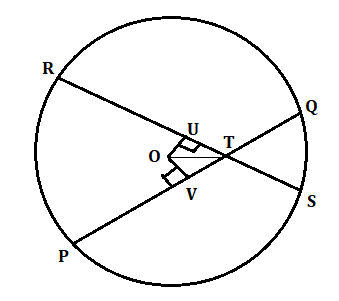
Construct two perpendicular lines $\text{OV}$ and $\text{OU}$ on these chords.
In $\Delta \text{OVT}$ and $\Delta \text{OUT}$,
Since equal chords of a circle are equidistant from the centre. Therefore,
$\text{OV}=\text{OU}$
$\angle OVT=\angle OUT={{90}^{{}^\circ }}$
The side OT is present in both triangles. Therefore,
$\text{OT}=\text{OT}$ (Common)
$\therefore \Delta \text{OVT}\cong \Delta $ OUT (By RHS axiom of congruency)
Hence $\text{VT}=\text{UT}$ …(1)
As they are corresponding parts of the corresponding triangles.
It is also given that $\text{PQ}=\text{RS}$ …(2)
$\Rightarrow \frac{1}{2}\text{PQ}=\frac{1}{2}\text{RS}$
$\Rightarrow \text{PV}=\text{RU}\quad \ldots \left( 3 \right)$
On adding Equations (1) and (3), we obtain
$\text{PV}+\text{VT}=\text{RU}+\text{UT}$
$\Rightarrow \text{PT}=\text{RT}$ …(4)
On subtracting Equation (4) from Equation (2), we obtain
$\text{PQ}-\text{PT}=\text{RS}-\text{RT}$
$\Rightarrow \text{QT}=\text{ST}$ …(5)
From equation (4) and (5) we can conclude that the corresponding segments of chords PQ and RS are congruent to each other.
3.If two equal chords of a circle intersect within the circle, prove that the line joining the point of intersection to the centre makes equal angles with the chords.
Ans: Let RS and PQ be two chords of equal lengths, of a given circle and they are intersect each other at point T.
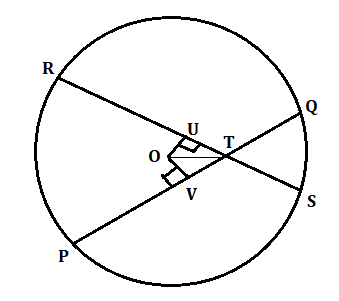
Construct two perpendicular lines $\text{OV}$ and $\text{OU}$ on these chords.
In $\Delta \text{OVT}$ and $\Delta \text{OUT}$,
Since equal chords of a circle are equidistant from the centre. Therefore,
$\text{OV}=\text{OU}$
$\angle OVT=\angle OUT={{90}^{{}^\circ }}$
The side OT is present in both triangles. Therefore,
$\text{OT}=\text{OT}$ (Common)
$\therefore \Delta \text{OVT}\cong \Delta $ OUT (By RHS axiom of congruency)
Hence $\angle \text{OTV}=\angle \text{OTU}$
As they are corresponding parts of the corresponding triangles.
Therefore, it can be concluded from above that the line joining the point of intersection to the centre makes equal angles with the chords.
4. If a line intersects two concentric circles (circles with the same centre) with centre $\text{O}$ at $\text{A},\text{B},\text{C}$ and $D$, prove that $AB=CD$ (see figure).
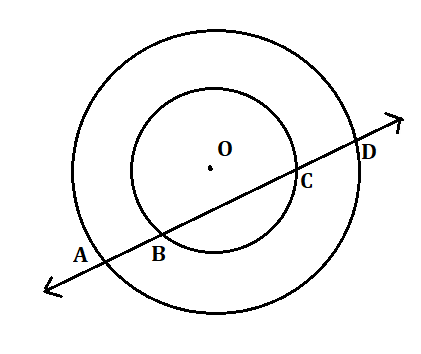
Ans: Construct a perpendicular line OM on line AD.
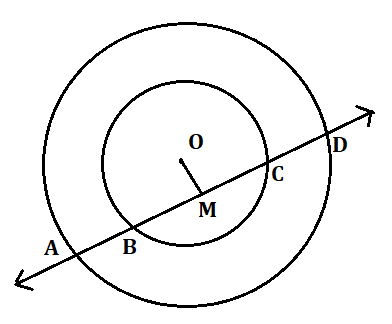
It can be observed that the chord of the smaller circle is BC and the chord of the bigger circle is AD.
Perpendicular drawn from the centre of the circle bisects the chord.
\[\begin{align} & \therefore \,\,\,\,\,\,\,\,\,BM=MC\,\,\,\,\,\,\,\,\text{ }.\,..\text{ }\left( 1 \right) \\ & \text{and, }AM=MD\,\,\,\,\,\,\,\,\text{ }...\text{ }\left( 2 \right) \\ \end{align}\]
On subtracting Equation (2) from (1), we obtain
AM − BM = MD − MC
∴ AB = CD
5. Three girls Reshma, Salma and Mandip are playing a game by standing on a circle of radius 5 m drawn in a park. Reshma throws a ball to Salma, Salma to Mandip, Mandip to Reshma. If the distance between Reshma and Salma and between Salma and Mandip is 6 m each, what is the distance between Reshma and Mandip?
Ans: Construct two perpendicular line OA and OB on line RS and SM respectively.
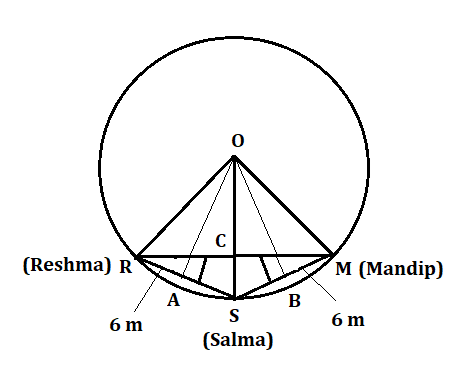
$\text{AR}=\text{AS}=\frac{6}{2}=3\,\text{m}$
$\text{OR}=\text{OS}=\text{OM}=5~\text{m}$. (Radii of the same circle)
In $\Delta \text{OAR}$,
Using Pythagoras theorem,
$\text{O}{{\text{A}}^{2}}+\text{A}{{\text{R}}^{2}}=\text{O}{{\text{R}}^{2}}$
$\Rightarrow$ $\text{O}{{\text{A}}^{2}}+{{(3~\text{m})}^{2}}={{(5~\text{m})}^{2}}$
$\Rightarrow$ $\text{O}{{\text{A}}^{2}}=(25-9){{\text{m}}^{2}}=16~{{\text{m}}^{2}}$
$\Rightarrow$ $\text{OA}=4~\text{m}$
ORSM will be a kite as pair of adjacent sides are equal $(\text{OR}=\text{OM}$ and $\text{RS}=\text{SM}$ ). Since the diagonals of a kite are perpendicular and the diagonal common to both the isosceles triangles is bisected by another diagonal.
$\angle $ RCS will be of ${{90}^{{}^\circ }}$ and $\text{RC}=\text{CM}$
Area of $\Delta \text{ORS}=\frac{1}{2}\times \text{OA}\times \text{RS}$
$\Rightarrow$ $\frac{1}{2}\times \text{RC}\times \text{OS}=\frac{1}{2}\times 4\times 6$
$\Rightarrow$ $\text{RC}\times 5=24$
$\Rightarrow$ $\text{RC}=4.8$
$\text{RM}=2\text{RC}=2(4.8)=9.6$ m
Therefore, Reshma and Mandip are $9.6~\text{m}$ apart.
6. A circular park of radius 20 m is situated in a colony. Three boys Ankur, Syed and David are sitting at equal distance on its boundary each having a toy telephone in his hands to talk each other. Find the length of the string of each phone.
Ans:
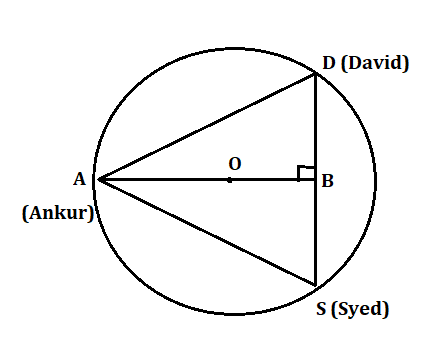
As all the sides of the triangle are equal. Therefore,
$\Delta ASD$ is an equilateral triangle.
OA (radius) $=20~\text{m}$
Since circumcentre(O) is the point of intersection of all the medians of equilateral triangle ASD. We also know that medians intersect each other in the ratio \[2:1\]. Since $\text{AB}$ is the median of equilateral triangle ASD, we can write it as,
$\Rightarrow \frac{\text{OA}}{\text{OB}}=\frac{2}{1}$
$\Rightarrow \frac{20~\text{m}}{\text{OB}}=\frac{2}{1}$
$\Rightarrow \text{OB}=\left( \frac{20}{2} \right)=10~\text{m}$
$\text{AB}=\text{OA}+\text{OB}=(20+10)\text{m}=30~\text{m}$
In $\Delta \text{ABD}$,
Using Pythagoras theorem,
$\text{A}{{\text{D}}^{2}}=\text{A}{{\text{B}}^{2}}+\text{B}{{\text{D}}^{2}}$
$\Rightarrow$ $\text{A}{{\text{D}}^{2}}={{(30)}^{2}}+{{\left( \frac{\text{AD}}{2} \right)}^{2}}$
$\Rightarrow$ $\text{A}{{\text{D}}^{2}}=900+\frac{1}{4}\text{A}{{\text{D}}^{2}}$
$\Rightarrow$ $\frac{3}{4}\text{A}{{\text{D}}^{2}}=900$
$\Rightarrow$ $\text{A}{{\text{D}}^{2}}=1200$
$\Rightarrow$ $\text{AD}=20\sqrt{3}\,\,\text{m}$
Therefore, the length of the string of each phone will be $20\sqrt{3}~\text{m}$.
Conclusion
NCERT Solutions for Class 9 Maths Chapter 9 Exercise 9.2 - Circles provides detailed explanations and solutions to all exercises in circle geometry. This exercise has a total of 6 questions with fully solved solutions. It covers important topics like tangents, angles, and circle properties in an easy-to-understand way. Students can learn how to calculate the circumference, area, and other geometric dimensions of circles. Students can use Class 9 Maths Chapter 9 Exercise 9.2 resources to understand circle properties and their real-world applications while improving their geometry knowledge.
Class 9 Maths Chapter 9: Exercises Breakdown
CBSE Class 9 Maths Chapter 9 Other Study Materials
Chapter-Specific NCERT Solutions for Class 9 Maths
Given below are the chapter-wise NCERT Solutions for Class 9 Maths. Go through these chapter-wise solutions to be thoroughly familiar with the concepts.
Important Study Materials for CBSE Class 9 Maths


FAQs on NCERT Solutions For Class 9 Maths Chapter 9 Circles Exercise 9.2 (2025-26)
1. What does Exercise 9.2 include in Class 9 Maths?
Exercise 9.2 is part of Class 9 Maths Chapter 9 – Circles and includes all NCERT textbook questions that are solved step by step in the official solutions.
2. Where can students find solutions for Class 9 Maths Exercise 9.2?
Students can find complete solutions for Class 9 Maths Exercise 9.2 on Vedantu, where answers are presented exactly as per the NCERT textbook structure.
3. Are the solutions for Class 9 Maths Exercise 9.2 aligned with CBSE standards?
Yes, the solutions for Class 9 Maths Chapter 9 Exercise 9.2 are written according to CBSE answer-writing standards, with proper steps and clear presentation.
4. What type of questions are covered in Class 9 maths Chapter 9 Circle Exercise 9.2?
Exercise 9.2 covers only the questions prescribed in Class 9 Maths Chapter 9 Circles, and each question is solved in the same sequence as given in NCERT.
5. Who should use the Class 9 maths Chapter 9 Circle solutions of Exercise 9.2?
The solutions of Exercise 9.2 Class 9 Maths are suitable for students who want NCERT-aligned answers for homework, practice work, and school examinations.
6. How are answers presented in Class 9 Maths Exercise 9.2 solutions?
Answers in Class 9 Maths Chapter 9 Exercise 9.2 are presented in a clean, stepwise format to help students understand the marking approach used in exams.
7. Do Class 9 maths Chapter 9 Circle solutions follow the same order as the ex 9.2 NCERT book?
Yes, the solutions strictly follow the same question numbering and order as given in NCERT Class 9 Maths Chapter 9 Circles Exercise 9.2.
8. Can Class 9 maths Chapter 9 Circle Exercise 9.2 solutions be used for school exams?
Yes, the solutions for Exercise 9.2 Class 9 Maths can be confidently used for school exams as they are fully aligned with NCERT and CBSE guidelines.
9. How is Exercise 9.2 positioned within Chapter 9 Circles?
Exercise 9.2 is an important exercise within Class 9 Maths Chapter 9 Circles, and its question formats are commonly assessed in school-level tests.
10. Why do students prefer NCERT solutions for Exercise 9.2 on Vedantu?
Students prefer NCERT solutions for Class 9 Maths Exercise 9.2 on Vedantu because they provide accurate answers, clear stepwise working, and strict alignment with the NCERT textbook.
