



 Watch Video




Class 9 Gravitation – Exercise-wise Questions and Answers
Gravitation Class 9 introduces important physics concepts related to gravitational force and its applications. The Class 9 Gravitation NCERT solutions provide clear, step-by-step answers to all exercise and in-text questions from Class 9 Science Chapter 9, helping students understand both theory and numerical problems.
 Table of Content
These Gravitation Class 9 questions and answers are written in simple language and cover all NCERT exercise questions as per the latest CBSE syllabus. Students can also download the Gravitation Class 9 questions and answers PDF for free. All NCERT solutions for Class 9 Science Chapter 9 exercise questions are prepared by subject experts at Vedantu to ensure accuracy and syllabus alignment.


NCERT Solutions For Class 9 Science Chapter 9 Gravitation - 2025-26


 ShareShare
Intext Exercise 1
1. State the universal law of gravitation.
Ans: Every object in the universe attracts every other object with some force which is directly proportional to the product of their masses and inversely proportional to the square of the distance between them. The force acts along the line joining the centres of two objects.
Let the two objects \[A\] and \[B\]of masses \[M\]and \[m\] lie at a distance \[d\] from each other. Let the force of attraction between two objects be \[F\].
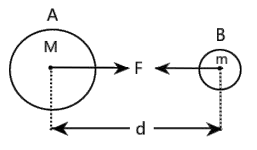
\[F=\frac{GMm}{{{r}^{2}}}\]
Where,
\[G\]is the universal gravitation constant which is given by:
\[G=6.67\times {{10}^{-11}}N{{m}^{2}}k{{g}^{-2}}\]
2. Write the formula to find the magnitude of the gravitational force between the earth and an object on the surface of the earth.
Ans: Let the mass of the Earth be \[M\] and the mass of an object on its surface be \[m\]. If \[R\]is the radius of the Earth, then according to the universal law of gravitation, the gravitational force (\[F\]) that acts between the Earth and the object can be given by the relation:
\[F=\frac{GMm}{{{R}^{2}}}\].
Intext Exercise 2
1. What do you mean by free fall?
Ans: Each object is drawn towards the centre of the Earth by its gravity. When any object is released from a certain height, under the impact of gravitational force, it falls to the Earth's surface. The movement of the object is said to be in free fall.
2. What do you mean by acceleration due to gravity?
Ans: When any object falls freely from a certain height towards the earth's surface, its velocity changes with respect to time. This change in velocity causes acceleration. This acceleration is known as the acceleration due to gravity (\[g\]). The value of acceleration due to gravity is \[9.8m{{s}^{-2}}\].
Intext Exercise 3
1. What are the differences between the mass of an object and its weight?
Ans: The difference between the mass of an object and its weight is given in the table below:
2. Why is the weight of an object on the moon \[\frac{1}{6}th\] its weight on the earth?
Ans: Let the mass of the Earth be \[{{M}_{E}}\] and the mass of an object on the surface of earth \[=m\] and the radius of earth \[{{R}_{E}}\].
According to the Universal law of gravitation, weight \[{{W}_{E}}\] of the object on the surface of the earth is given by,
\[{{W}_{E}}=\frac{G{{M}_{E}}m}{{{R}_{E}}^{2}}\]
Let \[{{M}_{M}}\] and \[{{R}_{M}}\] be the mass and radius of the moon. Then, according to the universal law of gravitation, weight \[{{W}_{M}}\] of the object on the surface of the moon is given by:
\[{{W}_{M}}=\frac{G{{M}_{M}}m}{{{R}_{M}}^{2}}\]
So, ratio of weight of object on moon to weight on earth is
\[\frac{{{W}_{M}}}{{{W}_{E}}}=\frac{{{M}_{M}}{{R}_{E}}^{2}}{{{M}_{E}}{{R}_{M}}^{2}}\]
Where, \[{{M}_{E}}=5.98\times {{10}^{24}}kg\]
\[{{M}_{M}}=7.36\times {{10}^{22}}kg\]
\[{{R}_{E}}=6.4\times {{10}^{6}}m\]
\[{{R}_{M}}=1.74\times {{10}^{6}}m\]
Substituting the values in the ratio,
\[\Rightarrow \frac{{{W}_{M}}}{{{W}_{E}}}=\frac{7.36\times {{10}^{22}}\times {{\left( 6.37\times {{10}^{6}} \right)}^{2}}}{5.98\times {{10}^{24}}\times {{\left( 1.74\times {{10}^{6}} \right)}^{2}}}\]
\[\Rightarrow \frac{{{W}_{M}}}{{{W}_{E}}}=0.165\approx \frac{1}{6}\]
Hence, the weight of an object on the moon is \[\frac{1}{6}th\] of its weight on the Earth.
Intext Exercise 4
1. Why is it difficult to hold a school bag with a strap made of a thin and strong string?
Ans: Pressure can be given by the formula,
\[P=\frac{F}{A}\]
Pressure is inversely proportional to the surface area on which the force is acting. The smaller is the surface area, the larger will be the pressure on the surface on which the force is being acted upon. In the case of a thin strap of the school bag, the contact surface area is very less. Hence, the pressure exerted on the shoulder is very high. Therefore, it becomes difficult to hold a school bag with a thin strap.
2. What do you mean by buoyancy?
Ans: The liquid exerts an upward force on any object when it is immersed in a liquid or fluid. The tendency of the liquid to exert such an upward force on the object is called buoyancy, and the upward force which is exerted on the object by the liquid is called the buoyant force.
3. Why does an object float or sink when placed on the surface of the water?
Ans: If the density of an object is greater than the density of the liquid, it will sink into the liquid. This is due to the buoyant force which is acted by the object is less than the force of gravity.
On the contrary, if the density of the object is less than the density of the liquid, it floats on the liquid's surface. This is because the force that is acting on the object is greater than the force of gravity.
Intext Exercise 5
1. You find your mass to be \[42\] kg on a weighing machine. Is your mass more or less than \[42\]kg?
Ans: An upward force acts on our body when we weigh our body while standing on a weighing machine. The buoyant force is which is a upward force that is acting. Consequently, the body is pushed up slightly, resulting in the weighing machine showing less reading than the real value.
2. You have a bag of cotton and an iron bar, each indicating a mass of \[100kg\] when measured on a weighing machine. In reality, one is heavier than other. Can you say which one is heavier and why?
Ans: Weight measured \[=\] Actual weight \[-\] buoyant force
Therefore, Actual weight \[=\] Weight measured \[+\]buoyant force
As the surface area of the cotton, the bag is greater than the iron bar, more buoyant force acts on the bag than that on the iron bar. Hence, the mass of the cotton bag is more than that of the iron bar.
NCERT Exercise
1. How does the force of gravitation between two objects change when the distance between them is reduced to half?
Ans: According to the universal law of gravitation, the gravitational force (\[F\]) acting between two objects of mass \[{{m}_{1}}\]and \[{{m}_{2}}\], separated by a distance ‘\[r\]’ is given by
\[F=\frac{G{{m}_{1}}{{m}_{2}}}{{{r}^{2}}}\]
Where \[{{m}_{1}}\]and \[{{m}_{2}}\]are the masses of two bodies and \[r\]is the distance between them, \[G\] is the universal gravitational constant.
When the distance is reduced to half, i.e., \[{r}'=\frac{r}{2}\]
\[\Rightarrow F=\frac{G{{m}_{1}}{{m}_{2}}}{{{\left( \frac{r}{2} \right)}^{2}}}\]
\[\Rightarrow F=\frac{G{{m}_{1}}{{m}_{2}}}{\frac{{{r}^{2}}}{4}}\]
\[\Rightarrow F=\frac{4G{{m}_{1}}{{m}_{2}}}{{{r}^{2}}}\]
Hence, if the distance is reduced to half, then the gravitational force becomes four times that of the previous value.
2. Gravitational force acts on all objects in proportion to their masses. Why then, a heavy object does not fall faster than a light object?
Ans: All the objects fall towards the ground with constant acceleration, called acceleration due to gravity (if there is no air resistance present). It is constant and independent of the mass of the object. Hence, heavy objects do not fall faster than light objects.
3. What is the magnitude of the gravitational force between the earth and a \[1kg\]object on its surface? (Mass of the earth is \[6\times {{10}^{24}}kg\] and radius of the earth is \[6.4\times {{10}^{6}}m\]).
Ans: According to the Universal law of gravitation, the gravitational force exerted on an object of mass \[m\]is given by:
\[F=\frac{GMm}{{{r}^{2}}}\]
Where,
Mass of Earth, \[M=6\times {{10}^{24}}kg\]
Mass of object, \[m=1kg\]
Universal gravitational constant, \[G=6.7\times {{10}^{-11}}N{{m}^{2}}k{{g}^{-2}}\]
Since the object is on the surface of the Earth, \[r=\]radius of the Earth (\[R\])
\[r=R=6.4\times {{10}^{6}}m\]
Gravitational force,
\[F=\frac{GMm}{{{r}^{2}}}\]
\[\Rightarrow F=\frac{6.7\times {{10}^{-11}}\times 6\times {{10}^{24}}\times 1}{{{\left( 6.4\times {{10}^{6}} \right)}^{2}}}=9.8N\].
The magnitude of the gravitational force between the earth and a \[1kg\]object on its surface is \[9.8N\].
4. The earth and the moon are attracted to each other by gravitational force. Does the earth attract the moon with a force that is greater or smaller or the same as the force with which the moon attracts the earth? Why?
Ans: According to the Universal law of gravitation, two objects attract each other and according to Newton's third law of motion, the force of attraction between two objects is the same but acts in the opposite direction. Thus, the earth attracts the moon with the same force as the moon exerts on earth but the force acts in the opposite direction.
5. If the moon attracts the earth, why does the earth not move towards the moon?
Ans: The Earth and the moon experience equal gravitational forces acting towards each other.
By Newton's Second Law, \[F=ma\]
\[\Rightarrow a=\frac{F}{m}\]
For a certain force, acceleration is inversely proportional to the mass of an object.
\[a\propto \frac{F}{m}\]
Mass of the Earth \[>>\] Mass of the moon.
Hence, the acceleration experienced by earth due to the gravitational pull of the moon is very small when compared to that experienced by the moon due to earth. That is why the Earth does not move towards the moon.
6. What happens to the force between two objects, if
a) The mass of one object is doubled?
Ans: According to the universal law of gravitation, the force of gravitation between two objects is given by: \[F=\frac{GMm}{{{r}^{2}}}\]
\[F\]is directly proportional to the product of masses of the two objects.
\[F\propto Mm\]
If the mass of one object is doubled, then the gravitational force will also change to double the original.
b) The distance between the objects is doubled and tripled?
Ans: \[F\]is inversely proportional to the square of the distance between the objects.
If the distance between the objects is doubled, then the gravitational force becomes one-fourth of its original value. Also, if the distance is tripled, then the gravitational force becomes one-ninth of its original value.
c) The masses of both objects are doubled?
Ans: \[F\]is directly proportional to the product of masses of the objects.
\[F\propto Mm\]
If the masses of both the objects are doubled, then the gravitational force becomes four times the original value.
7. What is the importance of the universal law of gravitation?
Ans: The universal law of gravitation states that every object in the universe attracts every other object.
The force of gravitation binds us to the earth.
It is the cause for the motion of the moon around the earth and planets around the sun.
It results in the formation of tides due to the moon and the Sun. High tide occurs at the side where the moon pulls towards itself.
8. What is the acceleration of free fall?
Ans: A free-falling object is an object that is falling due to gravity without any air resistance. When it falls, there is a variation in velocity with respect to time that is associated with it.
Acceleration of free fall is denoted by \[g\]and its value on the surface of the earth is \[9.8m{{s}^{-2}}\], which is constant for all objects (irrespective of their masses).
9. What do we call the gravitational force between the Earth and an object?
Ans: The gravitational force between the earth and an object is called the weight of that object. It is equal to the product of acceleration due to the gravity and mass of the object.
10. Amit buys a few grams of gold at the poles as per the instruction of one of his friends. He hands over the same when he meets him at the equator. Will the friend agree with the weight of gold bought? If not, why? (Hint: The value of g is greater at the poles than at the equator).
Ans: Weight of a body on the Earth is given by:
\[W=mg\]
Where,
\[m=\]Mass of the body
\[g=\]Acceleration due to gravity
The shape of Earth is not a perfect sphere. As the radius of the earth increases from the poles to the equator, the value of \[g\]becomes greater at the poles than at the equator. Since the value of \[g\] is greater at the poles than the equator.
Therefore, gold at the equator weighs less than at the poles. Hence, Amit’s friend will not agree with the weight of the gold bought.
11. Why will a sheet of paper fall slower than one that is crumpled into a ball?
Ans: When a sheet of paper is crumbled into a ball, then its surface area becomes much lesser than the surface area of a plain non-crumpled sheet of paper.
Hence, the upward force exerted by air on the sheet is greater as compared to the one exerted on the ball. Hence the sheet falls slower as compared to a paper ball.
12.Gravitational force on the surface of the moon is only \[\frac{1}{6}\] as strong as the gravitational force on the Earth. What is the weight in newtons of a \[10kg\]object on the moon and on the Earth?
Ans: It is provided that, \[Weight\text{ }of\text{ }an\text{ }object\text{ }on\text{ }the\text{ }moon=\frac{1}{6}\times Weight\text{ }of\text{ }an\text{ }object\text{ }on\text{ }the\text{ }Earth\]
Also,
\[Weight=\,Mass\times Acceleration\]
Acceleration due to gravity, \[g=9.8m{{s}^{-2}}\]
Therefore, the weight of a 10 kg object on the Earth \[=10\times 9.8N=98N\]
Weight of the same object on the moon \[=\frac{1}{6}\times 9.8N=16.3N\]
13. A ball is thrown vertically upwards with a velocity of \[49m{{s}^{-1}}\]. Calculate
a) The maximum height to which it rises.
Ans: According to the equation of motion under gravity:
\[{{v}^{2}}-{{u}^{2}}=2gh\]
Where,
\[u=\]Initial velocity of the ball
\[v=\]Final velocity of the ball
\[h=\]Height achieved by the ball
\[g=\]Acceleration due to gravity
At maximum height, final velocity of the ball is zero, i.e., \[v=0\]
\[u=49m{{s}^{-1}}\]
During upward motion, \[g=9.8m{{s}^{-2}}\]
Let \[h\] be the maximum height attained by the ball.
Hence,
\[\Rightarrow {{\left( 0 \right)}^{2}}-{{\left( 49 \right)}^{2}}=2\times \left( -9.8 \right)\times h\]
\[\Rightarrow h=\frac{49\times 49}{2\times 9.8}=122.5\]
b) The total time it takes to return to the surface of the earth.
Ans: Let \[t\] be the time taken by the ball to reach the height \[122.5m\], then according to the equation of motion:
\[v=u+gt\]
Substituting the values and solving,
\[\Rightarrow 0=49+t\times \left( -9.8 \right)\]
\[\Rightarrow 9.8t=49\]
\[\Rightarrow t=\frac{49}{9.8}=5s\]
However,
Time of ascent = Time of descent
Therefore, the total time taken by the ball to return is \[5+5=10s\].
14. A stone is released from the top of a tower of height \[19.6m\]. Calculate its final velocity just before touching the ground.
Ans: According to the equation of motion under gravity:
\[{{v}^{2}}-{{u}^{2}}=2gh\]
Where,
\[u=\]Initial velocity of the stone \[=0\]
\[v=\]Final velocity of the stone
\[s=\]Height of the stone \[=9.6m\]
g = Acceleration due to gravity \[=9.8m{{s}^{-2}}\]
\[\Rightarrow {{v}^{2}}-{{0}^{2}}=2\times 9.8\times 19.6\]2
\[\Rightarrow {{v}^{2}}=2\times 9.8\times 19.6={{\left( 19.6 \right)}^{2}}\]
\[\Rightarrow v=19.6m{{s}^{-1}}\]
Hence, the velocity of the stone just before touching the ground is \[19.6m{{s}^{-1}}\].
15. A stone is thrown vertically upward with an initial velocity of \[40m{{s}^{-1}}\]. Taking \[g=10m{{s}^{-2}}\], find the maximum height reached by the stone. What is the net displacement and the total distance covered by the stone?
Ans: According to the equation of motion under gravity:
\[{{v}^{2}}-{{u}^{2}}=2gh\]
Where,
\[u=\]Initial velocity of the stone \[=40m{{s}^{-1}}\]
\[v=\]Final velocity of the stone\[=0\]
\[s=\]Height of the stone
g = Acceleration due to gravity \[=-10m{{s}^{-2}}\]
Let \[h\] be the maximum height attained by the stone.
Therefore,
\[\Rightarrow 0-{{\left( 40 \right)}^{2}}=2\times h\times \left( -10 \right)\]
\[\Rightarrow h=\frac{40\times 40}{20}=80m\]
Therefore, the total distance covered by the stone during its upward and downward journey is \[80+80=160m\].
The net displacement of the stone during its upward and downward
journey is \[80+\left( -80 \right)=0m\].
16. Calculate the force of gravitation between the earth and the Sun, given that the mass of the earth \[=6\times {{10}^{24}}kg\] and of the Sun \[=2\times {{10}^{30}}kg\]. The average distance between the two is \[1.5\times {{10}^{11}}m\].
Ans: According to the Universal l law of gravitation, the force of attraction between the Earth and the Sun is given by:
Given,
\[{{M}_{Sun}}=\]Mass of the Sun \[=2\times {{10}^{30}}kg\]
\[{{M}_{Earth}}=\]Mass of the Earth \[=6\times {{10}^{24}}kg\]
\[R=\] Average distance between the Earth and the Sun \[=1.5\times {{10}^{11}}m\]
\[G=\]Universal gravitational constant \[=6.7\times {{10}^{-11}}N{{m}^{2}}k{{g}^{-2}}\].
\[F=\frac{G{{M}_{Sun}}{{M}_{Earth}}}{{{R}^{2}}}\]
\[\Rightarrow F=\frac{6.7\times {{10}^{-11}}\times 2\times {{10}^{30}}\times 6\times {{10}^{24}}}{{{\left( 1.5\times {{10}^{11}} \right)}^{2}}}\]
\[\Rightarrow F=3.57\times {{10}^{22}}N\]
Hence, the force of gravitation between the earth and the sun is \[3.57\times {{10}^{22}}N\].
17. A stone is allowed to fall from the top of a tower \[100m\] high and at the same time another stone is projected vertically upwards from the ground with a velocity of \[25m{{s}^{-1}}\]. Calculate when and where the two stones will meet.
Ans: Let the two stones meet after time \[t\]from the start.
a) For the stone dropped from the tower:
Initial velocity, \[u=0\].
Let the displacement of the stone in time t from the top of the tower be s.
Acceleration due to gravity, \[g=9.8m{{s}^{-2}}\]
From the equation of motion,
\[s=ut+\frac{1}{2}g{{t}^{2}}\]
\[\Rightarrow s=0\times t+\frac{1}{2}\times 9.8\times {{t}^{2}}\]
\[\Rightarrow s=4.9{{t}^{2}}\]……. (1)
b) For the stone thrown upwards:
Initial velocity, \[u=25m{{s}^{-1}}\]
Let the displacement of the stone from the ground in time \[t\]be \[{s}'\].
Acceleration due to gravity, \[g=9.8m{{s}^{-2}}\]
Equation of motion,
\[{s}'=ut+\frac{1}{2}g{{t}^{2}}\]
\[\Rightarrow {s}'=25t-\frac{1}{2}\times 9.8\times {{t}^{2}}\]
\[\Rightarrow {s}'=25t-4.9{{t}^{2}}\]…… (2)
The combined displacement of both the stones at the meeting point is equal to the height of the tower \[100\]m.
\[s+{s}'=100\]…… (3)
Substituting equation (1) and (2) in (3),
\[4.9{{t}^{2}}+25t-4.9{{t}^{2}}=100\]
\[\Rightarrow 25t=100\]
\[\Rightarrow t=\frac{100}{25}=4s\]
In \[4s\], the falling stone has covered a distance given by equation (1) as
\[s=\frac{1}{2}\times 9.8\times {{4}^{2}}=78.4m\]
Therefore, the stones will meet after \[4s\] at a height \[\left( 100-78.4 \right)=21.6m\] from the ground.
18. A ball thrown up vertically returns to the thrower after \[6s\]. Find
a) The velocity with which it was thrown up,
Ans: Time of ascent is equal to the time of descent. The ball takes a total of \[6s\]for its upward and downward journey.
Hence, time taken for upward journey, \[t=\frac{6}{2}=3s\]
Final velocity of the ball at the maximum height, \[v=0\]
Acceleration due to gravity, \[g=9.8m{{s}^{-2}}\]
Equation of motion, \[v=u+gt\]will give,
\[\Rightarrow 0=u+\left( -9.8\times 3 \right)\]
\[\Rightarrow u=9.8\times 3=29.4m{{s}^{-1}}\]
Hence, the ball was thrown upwards with a velocity of \[29.4m{{s}^{-1}}\].
b) The maximum height it reaches
Ans: Let the maximum height attained by the ball be \[h\].
Initial velocity during the upward journey, \[u=29.4m{{s}^{-1}}\]
Final velocity, \[v=0\]
Acceleration due to gravity, \[g=-9.8m{{s}^{-2}}\]
\[s=ut+\frac{1}{2}a{{t}^{2}}\]
From the equation of motion,
\[h=29.4\times 3+\frac{1}{2}\times \left( -9.8 \right)\times {{\left( 3 \right)}^{2}}=44.1m\]
c) Its position after \[4s\].
Ans: Ball attains the maximum height after \[3s\]. After attaining this height, it will start falling downwards.
In this case, Initial velocity, \[u=0\]
Position of the ball after \[4s\] of the throw is given by the distance
travelled by it during its downward journey in \[4s-3s=1s\]
Equation of motion,
\[s=ut+\frac{1}{2}a{{t}^{2}}\]
will give,
\[s=0\times t+\frac{1}{2}\times 9.8\times {{1}^{2}}=4.9m\]
Total height \[=44.1m\]
This means that the ball is \[44.1m-4.9m=39.2m\] above the ground
after \[4\]seconds.
19. In what direction does the buoyant force on an object immersed in a liquid act?
Ans: An object immersed in a liquid is acted upon by the buoyant force in the vertically upward direction.
20. Why does a block of plastic released under water come up to the surface of water?
Ans: The number of forces acting on a certain item in water are two. The first one is the gravitational force pulling down the object, and the other is the buoyant force pushing up the object. If the buoyant force acting in the upward direction is higher than the gravitational force that is acting downward, then the object goes up to the water's surface as quickly as it is released into water. That is why a block of plastic released under the water comes up to the surface of the water.
21. The volume of \[50g\]of a substance is \[20c{{m}^{3}}\] . If the density of water is \[1gc{{m}^{-3}}\], will the substance float or sink?
Ans: If the density of an object is more than the density of a liquid, then it sinks in the liquid. If the density of an object is less than the density of a liquid, then it floats
\[Density\text{ }of\text{ }the\text{ }substance=\frac{Mass\text{ }of\text{ }the\text{ }substance}{Volume\text{ }of\text{ }the\text{ }substance}\]
\[\Rightarrow Density\text{ }of\text{ }the\text{ }substance=\frac{50}{20}\]
\[\Rightarrow Density\text{ }of\text{ }the\text{ }substance=2.5gc{{m}^{-3}}\].
The density of the substance \[>\] The density of water \[\left( 1gc{{m}^{-3}} \right)\].
Hence, the substance will sink in water.
22. The volume of a \[500g\] sealed packet is \[350c{{m}^{3}}\]. Will the packet float or sink in water if the density of water is \[1gc{{m}^{-3}}\]? What will be the volume of the water displaced by this packet?
Ans: If the density of an object is greater than the density of a liquid, then the object will sink in the liquid. If the density of an object is less than the density of a liquid, then it will float on the surface of the liquid.
\[Density\text{ }of\text{ }the\text{ }500\text{ }g\text{ }sealed\text{ }packet=\frac{Mass\text{ }of\text{ }the\text{ }packet}{Volume\text{ }of\text{ }the\text{ }packet}\]
\[\Rightarrow Density\text{ }of\text{ }the\text{ }500\text{ }g\text{ }sealed\text{ }packet=\frac{500}{350}\]
\[\Rightarrow Density\text{ }of\text{ }the\text{ }500\text{ }g\text{ }sealed\text{ }packet=1.428gc{{m}^{-3}}\]
The density of the substance is more than the density of water \[\left( 1gc{{m}^{-3}} \right)\].
Hence, the object will sink in water.
Clearly, the mass of water displaced by the packet can be considered equal to the volume of the packet\[=0.350g\].
Class 9th Science Gravitation Class 9 - Quick Overview of Detailed Structure of Topics
Class 9 Science Ch 9 Gravitation - Important Formula and Concepts
The universal law of gravitation: The force of attraction between any two objects is proportional to the product of their masses and inversely proportional to the square of the distance between them.
Archimedes’ Principle: When a body is immersed fully or partially in a fluid, it experiences an upward force that is equal to the weight of the fluid displaced by it.
\[F=\frac{GMm}{{{r}^{2}}}\]
Where \[G\]is the universal gravitation constant, which is given by:
\[G=6.67\times {{10}^{-11}}N{{m}^{2}}k{{g}^{-2}}\]
Weight of the object on the moon = (1/6) × its weight on the earth.
Pressure= Thrust/Area
Benefits of Vedantu’s NCERT Class 9 Science Gravitation Question Answer
Vedantu’s solutions explain all key concepts covered in Ch 9 Science Class 9, including the Universal Law of Gravitation, acceleration due to gravity, the distinction between mass and weight, free fall, and gravitational fields.
Class 9 Science Gravitation Question Answers are presented in a step-by-step format, making it easier for students to follow and understand the problem related to the motion of objects under the influence of the gravitational force of the earth, pressure, and Thrust.
Vedantu’s NCERT Gravitation Class 9 Questions And Answers help students prepare effectively for their exams.
The solutions include various types of questions, from multiple-choice to descriptive, ensuring comprehensive exam readiness.
Class 9 Gravitation Question Answers are prepared by Vedantu Master Teachers with a deep understanding of the curriculum and examination patterns. This ensures that the content is accurate, reliable, and aligned with the latest syllabus.
Using Class 9 Gravitation NCERT Solutions, students can save time by quickly finding answers and explanations for their doubts and questions. This allows them to allocate more time to practice and revision.
Vedantu’s Class 9 Chapter 9 Science solutions are available online, making them accessible anytime and anywhere. This flexibility supports continuous learning and allows students to study independently.
Related Study Materials for Class 9 Science Ch 9 Gravitation
Conclusion
Vedantu’s NCERT Class 9 Gravitation NCERT Solutions is an important study material. They provide clear explanations and step-by-step solutions, helping students grasp important concepts like the laws of gravitation, mass, weight, and gravitational force. Focusing on these areas is essential, as they form the chapter's foundation. In previous years, around 7-8 questions on gravitation have been asked in exams, highlighting its importance. By using Gravitation Class 9 Questions And Answers, students can effectively prepare, clear their doubts, and perform well in their exams, ensuring a strong understanding of gravitation.
NCERT Solutions for Class 9 Science - Chapter-Wise Links
NCERT Study Resources for Class 9 Science


FAQs on NCERT Solutions For Class 9 Science Chapter 9 Gravitation - 2025-26
1. How does Class 9 Science Chapter 9 help students understand gravitation concepts?
Class 9 Science Chapter 9 – Gravitation introduces students to how objects attract each other due to gravitational force. Through NCERT textbook questions and numericals, students learn about the universal law of gravitation, motion of falling objects, and the difference between mass and weight.
2. Are gravitation Class 9 questions and answers explained as per NCERT methodology?
Yes, gravitation Class 9 questions and answers are solved strictly using NCERT-prescribed formulas, definitions, and problem-solving steps. The solutions follow the same approach expected in CBSE exams.
3. How can NCERT Solutions help students handle gravitation numericals confidently?
Class 9 gravitation NCERT solutions break down numerical problems into simple steps writing the formula, substituting values, and applying correct units. This helps students avoid common mistakes and understand the logic behind each solution.
4. Do NCERT Solutions cover all exercise questions of Class 9 Science Chapter 9?
Yes, NCERT solutions for Class 9 Science Chapter 9 exercise questions include answers to all in-text questions, numericals, and end-of-chapter exercises without skipping any NCERT problems.
5. Is the gravitation Class 9 questions and answers PDF useful for regular practice?
The gravitation Class 9 questions and answers PDF is useful for practising NCERT problems regularly and revising concepts offline. It allows students to focus only on textbook-based questions without distractions.
6. How do NCERT Solutions explain concepts like free fall and acceleration due to gravity?
In Class 9 Science Chapter 9, NCERT Solutions explain free fall and acceleration due to gravity using simple explanations supported by textbook numericals. This helps students understand how gravity affects objects in motion.
7. Are NCERT Solutions enough for school exams in Class 9 Science Chapter 9?
Yes, practising NCERT Solutions for Class 9 Science Chapter 9 is sufficient for school-level exams since CBSE question papers are framed directly from NCERT concepts and exercises.
8. How do NCERT Solutions help in writing structured answers in exams?
Class 9 gravitation NCERT solutions present answers in a stepwise and organised format. This helps students learn how to write clear, complete answers that align with the CBSE marking scheme.
9. Who should refer to NCERT Solutions for Class 9 Science Chapter 9?
Students who want clear explanations of textbook questions and wish to strengthen their understanding of Class 9 Science Chapter 9 Gravitation should regularly practise using NCERT Solutions.
10. Why is gravitation in Class 9 important for higher classes?
Gravitation Class 9 forms the foundation for physics topics studied in higher classes. Concepts learned here are expanded further in later chapters, making this chapter important for future learning.
