



Complete Guide to Types of Epithelial Tissue, Characteristics, and Role in the Human Body
Epithelial tissue is one of the four basic tissue types of the human body and is responsible for covering body surfaces, lining body cavities, lining hollow organs, and forming glands. It is present on both the external surface of the body and the internal surfaces of organs and cavities. Because of this wide distribution, epithelial tissue performs several important protective and functional roles in the body.
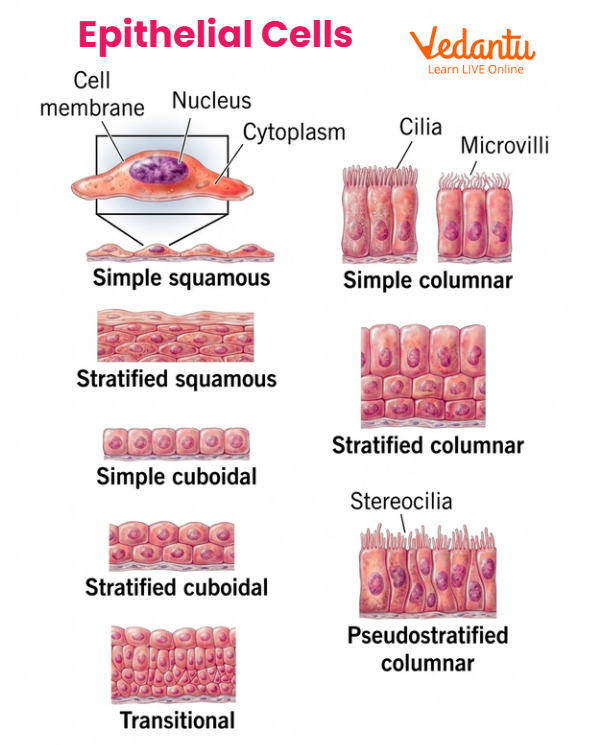
This tissue is important not only in anatomy but also in physiology and pathology because every substance entering or leaving an organ must pass through an epithelial lining first. That is why epithelial tissue is closely associated with protection, secretion, absorption, excretion, filtration, diffusion, and sensory reception. Its structure changes depending on its location and the job it performs.
Epithelial tissue is a specialised body tissue that:
covers the body surface
lines internal organs
lines body cavities
forms the major tissue of glands
Examples of Epithelial Tissue in the Body
Some common places where epithelial tissue is found include:
the epidermis or outer layer of skin
the lining of the intestine
the lining of the respiratory tract
the lining of body cavities
sweat glands and many other glands
Because it is found in so many organs and body systems, epithelial tissue does not have only one form. Instead, its structure is adapted according to function.
Epithelial Tissue as One of the Four Main Tissues
The body has four primary tissue types:
epithelial tissue
Among these, epithelial tissue is the one most directly involved in:
forming body coverings
lining surfaces
controlling the exchange of substances
creating glandular tissue
This makes it one of the most functionally versatile tissues in the body.
Structure of Epithelial Tissue
The structure of epithelial tissue depends on the shape of its cells, the number of layers, and the surface specialisations present on the cells.
Epithelial tissue is made of epithelial cells, which may vary in shape and arrangement depending on where they are located and what they need to do.
Basic Cell Structure
Like other cells, epithelial cells have three main parts:
Cell membrane – controls the movement of substances into and out of the cell
Nucleus – contains genetic material
Cytoplasm – contains cellular components required for cell function
Although this is true of all cells, epithelial cells often exhibit specialised surface modifications that enable them to perform specific functions more effectively.
Surface Specialisations in Epithelial Tissue
Some epithelial cells possess specialised structures on their free surface. These modifications are crucial for understanding the function of epithelial tissue.
1. Microvilli
Microvilli are small, finger-like, non-motile projections on the cell surface. Their main function is to increase surface area, allowing the cell to absorb substances more efficiently.
Example
The epithelial cells lining the small intestine have numerous microvilli. These help absorb nutrients from digested food and also help protect the body from intestinal bacteria.
2. Cilia
Cilia are tiny, hair-like, motile structures found on the surface of some epithelial cells. Unlike microvilli, cilia can move. Their function is to move substances across the epithelial surface.
Examples
In the respiratory tract, cilia trap dust and other inhaled particles and move them upward so they do not enter the lungs.
In the fallopian tubes, cilia help move the egg from the ovary toward the uterus.
3. Stereocilia
Stereocilia are specialised microvilli that resemble cilia but are structurally different. They are important in the inner ear, where they help in hearing and balance.
These surface modifications show how epithelial tissue structure is closely related to its function.
Characteristics of Epithelial Tissue
The important characteristics of epithelial tissue can be understood through its location, arrangement, and functions.
It covers body surfaces and lines internal cavities.
It is made of closely packed cells.
It may consist of one layer or several layers.
It performs protection, secretion, absorption, excretion, and filtration.
It forms the major tissue of glands.
It may have cilia, microvilli, or stereocilia depending on function.
Types of Epithelial Cells Based on Shape
The first major way to classify epithelial tissue is by cell shape.
1. Squamous epithelium
Squamous epithelial cells are flat and sheet-like. These cells are thin, which makes them suitable for diffusion and filtration.
2. Cuboidal epithelium
Cuboidal cells are cube-shaped, meaning their height, width, and depth are nearly equal. These cells are commonly associated with secretion and absorption.
3. Columnar epithelium
Columnar cells are taller than they are wide, giving them a column-like appearance. These are commonly seen where absorption and secretion are prominent.
Types of Epithelial Tissue Based on Arrangement
The second method of classification is by the number and arrangement of cell layers.
1. Simple Epithelium
Simple epithelium consists of only one layer of cells. Because it is thin, it is usually associated with absorption, secretion, filtration, or diffusion.
2. Stratified Epithelium
Stratified epithelium consists of more than one layer of cells. Its main role is protection because multiple layers make it more resistant to damage.
3. Pseudostratified Epithelium
Pseudostratified epithelium appears multilayered because its cells are of different heights, but it is actually a single layer.
This type is common in areas such as the respiratory tract.
Types of Epithelial Tissue in the Human Body
When cell shape and arrangement are combined, the main types of epithelial tissue become:
Simple squamous epithelium
Simple cuboidal epithelium
Simple columnar epithelium
Stratified squamous epithelium
Stratified cuboidal epithelium
Stratified columnar epithelium
Pseudostratified columnar epithelium
Transitional epithelium
Glandular epithelium
Olfactory epithelium
Now let us study each in detail.
1. Simple Squamous Epithelium
Simple squamous epithelium is made of a single layer of flat cells.
Location
It usually lines:
blood vessels
body cavities
Function
Its main role is to regulate the passage of substances into underlying tissues. Since the cells are thin, materials can pass through easily.
Importance
This type is ideal wherever rapid diffusion or filtration is required.
2. Simple Cuboidal Epithelium
Simple cuboidal epithelium is made of a single layer of cube-shaped cells.
Location
It is commonly found in:
glandular tissue
kidney tubules
Function
It mainly performs:
secretion
absorption
Its shape gives the cells enough internal space for active metabolic work.
3. Simple Columnar Epithelium
Simple columnar epithelium consists of a single layer of column-like cells.
Location
It lines:
stomach
intestines
Function
It is especially adapted for:
absorption
secretion
Many of these cells have microvilli or cilia, which further improve their function. In the intestine, microvilli significantly increase the absorptive surface area.
4. Stratified Squamous Epithelium
Stratified squamous epithelium consists of many layers of cells, with the surface cells becoming flattened.
Location
A major example is:
the epidermis of the skin
Function
Its main role is protection:
prevents invasion by microorganisms
reduces water loss
protects deeper tissues from friction and wear
Because it has multiple layers, it is highly effective under high mechanical stress.
5. Stratified Cuboidal Epithelium
Stratified cuboidal epithelium is made of more than one layer, with cuboidal cells in the outer layer.
Location
It is less common and occurs in:
excretory ducts of sweat glands
excretory ducts of salivary glands
Function
It mainly provides:
protection
some secretory support
6. Stratified Columnar Epithelium
Stratified columnar epithelium is also relatively uncommon.
Location
It is found in:
mucous membrane lining the eyelids, especially the conjunctiva
Function
It performs:
protection
mucus secretion
7. Pseudostratified Columnar Epithelium
Pseudostratified columnar epithelium looks layered but is actually a single layer of cells of unequal height.
Location
It lines the:
upper respiratory tract
Function
It usually contains many cilia and helps in:
trapping particles
moving mucus
protecting the respiratory system
This tissue is highly important in preventing dust and microorganisms from reaching the lungs.
Specialised Epithelial Tissues
Apart from classification by shape and layers, some epithelial tissues are categorised based on specialised functions.
8. Transitional Epithelium
Transitional epithelium, also called urothelium, is a special type of stratified epithelium.
Key feature
Its cells can change shape and become flatter when stretched.
Location
It lines most of the:
urinary tract
urinary bladder
Function
It allows organs like the bladder to expand and stretch without tearing.
9. Glandular Epithelium
Glandular epithelium is specialised for secretion.
Function
It produces and secretes substances such as:
hormones
proteins
enzymes
fluids
water
Location
It forms the secretory part of glands.
Since glands are vital for endocrine and exocrine functions, glandular epithelium is one of the most important specialised epithelial tissues.
10. Olfactory Epithelium
Olfactory epithelium is found in the nasal cavity.
Special feature
It contains olfactory receptor cells with specialised cilia that trap odour molecules. These signals are then transmitted to the brain, where smell is interpreted.
Function
Its main role is sensory reception, specifically smell.
Function of Epithelial Tissue
The function of epithelial tissue varies by location, but overall it performs several life-supporting roles.
1. Protection
Epithelial tissue protects deeper tissues and organs from:
mechanical injury
microorganisms
dehydration
chemical damage
For example, skin protects underlying muscles, blood vessels, and internal organs. The cilia of the respiratory epithelium also help protect the lungs from foreign particles.
2. Secretion
Glandular epithelium secretes:
enzymes
hormones
mucus
body fluids
This is essential in digestion, endocrine signalling, lubrication, and many other physiological functions.
3. Absorption
Certain epithelial linings absorb useful substances. For example:
The intestinal epithelium absorbs nutrients
Some internal linings absorb specific molecules needed by the body
4. Excretion
Epithelial tissue in structures such as:
kidneys
sweat glands
helps remove waste products from the body.
5. Filtration
The epithelial tissue of:
kidneys
respiratory tract
helps filter blood or inspired air. In the respiratory tract, it traps particles and helps clean inhaled air.
6. Diffusion
Simple squamous epithelium permits the selective diffusion of substances. Diffusion supports:
filtration
absorption
secretion
7. Sensory Reception
Some epithelial tissues contain sensory nerve endings or specialised receptor cells. Examples include:
stereocilia in the ear for hearing and balance, taste buds in the tongue epithelium
Thus, epithelial tissue is not just a covering tissue. It is also deeply involved in transport, communication, and homeostasis.
Conditions Affecting Epithelial Tissue
Because epithelial tissue lines and covers many body structures, it is involved in many diseases and conditions.
1. Cancer
One of the biggest medical concerns involving epithelial tissue is the development of malignancy.
2. Adenocarcinoma
Adenocarcinoma affects glandular epithelial tissue and is one of the most common cancer types in organs. It is responsible for:
almost all prostate cancers
most breast cancers
about 96% of colorectal cancers
approximately 95% of pancreatic cancers
around 40% of non-small cell lung cancers
3. Papillary thyroid carcinoma
This epithelial cancer represents up to 80% of thyroid cancers. It usually grows slowly and responds well to treatment.
4. Other Conditions Involving Epithelial Tissue
Asthma
In asthma, the bronchial epithelium becomes modified and fragile.
Celiac disease
In celiac disease, ingestion of gluten leads to immune-mediated damage of the microvilli on intestinal epithelial cells. This reduces nutrient absorption.
Human papillomavirus (HPV)
Certain HPV strains cause warts on the stratified squamous epithelium of the epidermis.
Vertigo
An abnormal growth of epithelial cells in the ear, such as cholesteatoma, can cause vertigo and hearing problems.
These examples show how essential epithelial tissue is in both normal function and disease.
Tests Related to Epithelial Tissue
Because epithelial tissue is involved in many organs, several medical tests examine epithelial cells.
1. Epithelial Cells in Urine
In urinalysis, the number of epithelial cells in urine is checked under a microscope. A small number is normal, but a large number may indicate infection, kidney disease, or another serious condition.
2. Pap Smear
A Pap smear checks for abnormal cervical epithelial cells that may be cancerous or precancerous.
3. Biopsy Tests
Biopsies remove tissue samples for microscopic examination. Many biopsies examine epithelial tissue, such as:
Prostate biopsy
Intestinal biopsy for celiac disease
4. Cytology tests
Cytology involves examining cells from tissues or fluids. Several cytology tests focus on epithelial cells, including:
gynecologic cytology
thyroid cytology
respiratory cytology
eye cytology
Difference Between Epithelium, Endothelium and Mesothelium
This is a very important conceptual distinction.
1. Epithelium
Epithelium generally lines pathways open to the external environment, such as:
respiratory tract
digestive tract
2. Endothelium
Endothelium lines fully internal pathways such as:
blood vessels
vascular system
cornea
3. Mesothelium
Mesothelium lines major body cavities, including:
peritoneum of the abdominal cavity
pleura of the lung cavity
pericardium of the heart cavity
It also secretes serous fluid, which acts as a lubricant.
Related Topics to Explore


FAQs on Epithelial Tissue Explained With Types, Functions, Structure and Diagram
1. What are the 4 types of epithelial tissue?
The four commonly listed major types of epithelial tissue are:
Simple squamous epithelium
Simple cuboidal epithelium
Simple columnar epithelium
Pseudostratified epithelium
These are mainly classified based on the shape and arrangement of cells. In a broader epithelial tissue flow chart, stratified and specialised epithelial tissues are also included.
2. What is epithelial tissue and its function?
Epithelial tissue is the tissue that covers body surfaces, lines internal organs and cavities, and forms glands. The main function of epithelial tissue is to act as a protective covering, but it also performs secretion, absorption, filtration, diffusion, excretion, and sensory reception depending on its location.
3. Which is a function of epithelial tissue?
A major function of epithelial tissue is protection. In addition, epithelial tissue can also perform secretion, absorption, filtration, excretion, diffusion, and sensory functions.
4. What are the 5 layers of the epithelium?
If this question refers to the epidermis of thick skin, the five layers are:
Stratum basale
Stratum spinosum
Stratum granulosum
Stratum lucidum
Stratum corneum
These are layers of the skin epithelium, not the general classification of all epithelial tissue.
5. What organs contain epithelial tissue?
Many organs contain epithelial tissue, including:
Skin
Intestines
Stomach
Lungs
Kidneys
Blood vessels
Respiratory tract
Sweat glands
Salivary glands
Almost every organ has some form of epithelial lining or covering.
6. What is the second name for epithelial tissue?
Another name often used for epithelial tissue is epithelium. This is the short and direct term commonly used in biology and medicine.
7. What are the diseases of the epithelial tissue?
Some diseases and conditions that affect epithelial tissue include:
Eczema
Psoriasis
Epithelial carcinoma
Asthma
Celiac disease
HPV-related warts
These conditions affect epithelial linings in the skin, respiratory tract, intestine, and other body parts.
