






Solanaceae Family Characteristics, Floral Formula, Diagram, and Examples Explained
The Solanaceae family, commonly known as the nightshade family, is a large and economically important group of flowering plants. Members of this family include major food crops, medicinal plants, ornamental species, and some poisonous plants. These plants are widely distributed across tropical, subtropical, and temperate regions, with maximum diversity in Central and South America. The family is easily recognized by its floral structure, presence of alkaloids, and characteristic fruit types such as berries and capsules.
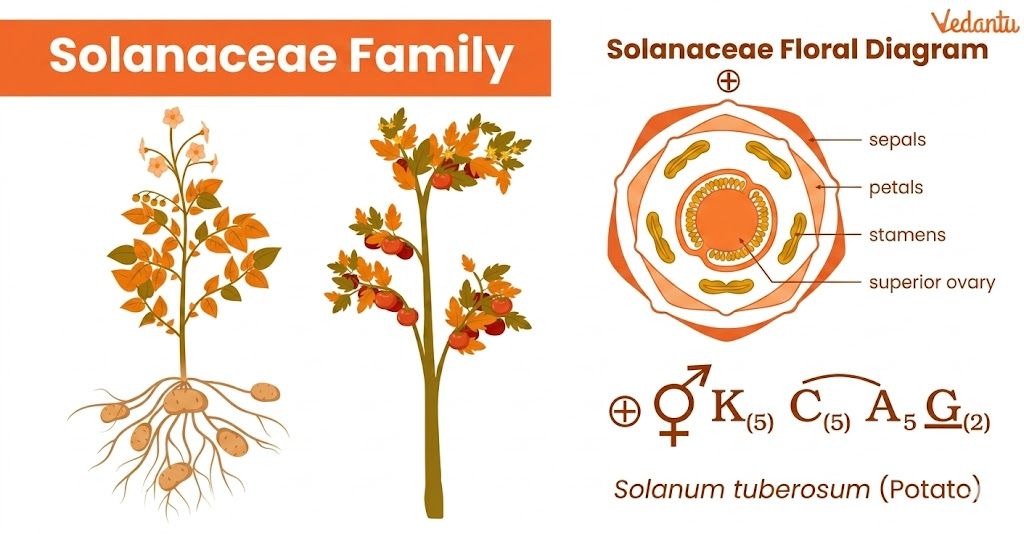
Systematic Position of Solanaceae
The solanaceae family includes well-known plants like tomato, potato, chilli, brinjal, tobacco, petunia, and belladonna. The classification of the Solanaceae family is given below:
Floral Diagram of Solanaceae
The floral diagram of solanaceae shows:
five fused sepals
five fused petals
five epipetalous stamens
bicarpellary ovary
axile placentation
superior ovary
The diagram is circular and pentamerous.
Solanaceae Family Characteristics
The solanaceae family characteristics include distinct vegetative and floral features that help identify members of this family.
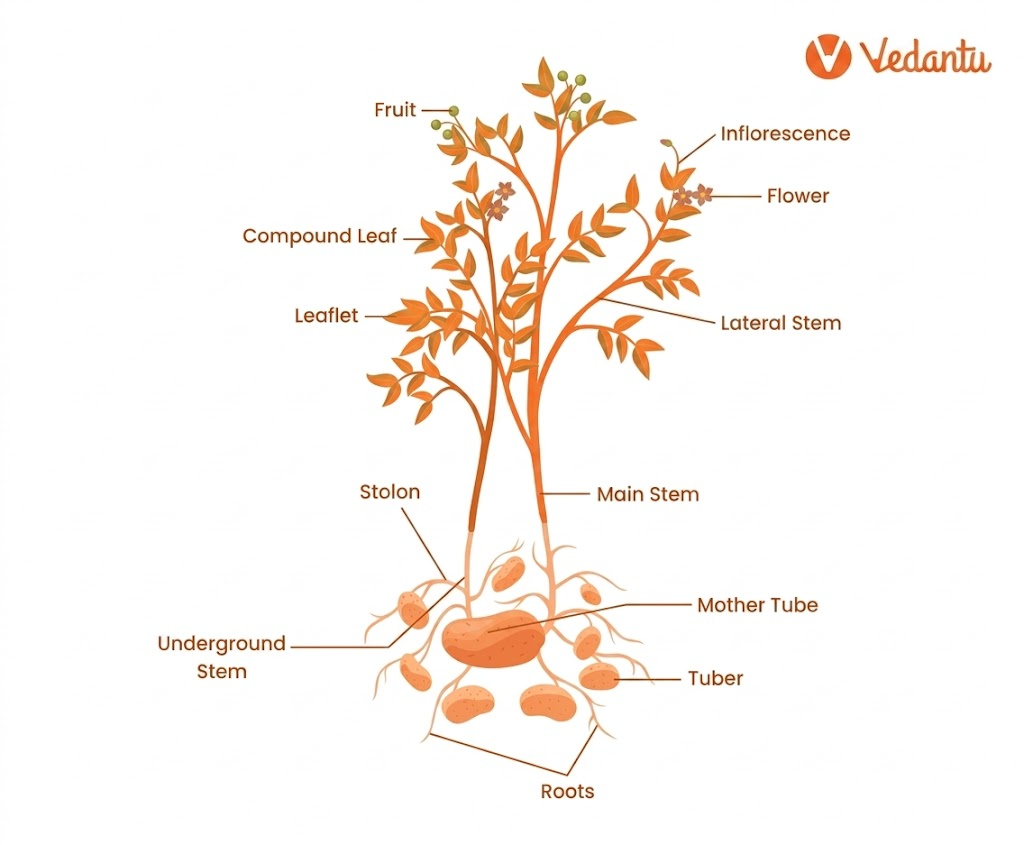
Habit
Plants belonging to this family show different growth forms:
Mostly herbs (Solanum nigrum)
Some shrubs (Datura)
Few climbers (Solanum dulcamara)
Rarely small trees (Cestrum)
Many members contain alkaloids which may be medicinal or poisonous.
Habitat
Plants grow in diverse habitats such as:
cultivated fields
gardens
forests
tropical regions
temperate climates
Most species prefer warm climates.
Vegetative Characters of Solanaceae
1. Root
The root system is usually tap root with lateral branches. In some species, storage modifications occur. For example, a potato has an underground tuber which is a modified stem.
2. Stem
Stem characteristics include:
erect or climbing
branched
herbaceous or woody
cylindrical or angular
sometimes hairy
Some species show underground modifications.
3. Leaves
Leaves show typical features:
simple leaves
alternate arrangement
exstipulate (no stipules)
reticulate venation
entire or lobed margins
Leaves often produce a distinct smell when crushed.
Floral Characteristics of Solanaceae
The floral features are very important for identification.
1. Inflorescence
Inflorescence is usually cymose. It may be:
solitary
axillary
dichasial cyme
mixed cyme
Flowers may also appear solitary.
2. Flower
Flowers of solanaceae family are:
bisexual
actinomorphic
complete
pentamerous
hypogynous
pedicellate or sessile
These features help identify the family.
3. Calyx
Calyx characteristics:
5 sepals
gamosepalous
persistent
valvate aestivation
The calyx often remains attached to fruit.
4. Corolla
Corolla features:
5 petals
gamopetalous
funnel shaped or tubular
valvate aestivation
showy and colored
This is important for pollination.
5. Androecium
Androecium characteristics:
5 stamens
epipetalous
anthers dithecous
basifixed
longitudinal dehiscence
Stamens are attached to corolla.
6. Gynoecium
Gynoecium features:
bicarpellary
syncarpous
superior ovary
bilocular
axile placentation
many ovules
Style is simple and stigma is bilobed.
Floral Formula of Solanaceae
The floral formula of solanaceae is:
⚥ ⊕ K(5) C(5) A5 G̲(2)
Explanation:
⚥ → bisexual flower
⊕ → actinomorphic symmetry
K(5) → gamosepalous calyx
C(5) → gamopetalous corolla
A5 → five stamens
G̲(2) → bicarpellary superior ovary
This formula is commonly asked in NEET.
Fruit and Seeds of Solanaceae
1. Fruit
Fruit is usually:
berry (tomato, brinjal)
capsule (Datura, Petunia)
The berries are fleshy while the capsule is dry.
2. Seeds
Seed characteristics:
numerous seeds
flattened seeds
endospermic
embryo curved
These features help seed dispersal.
Solanaceae Family Examples
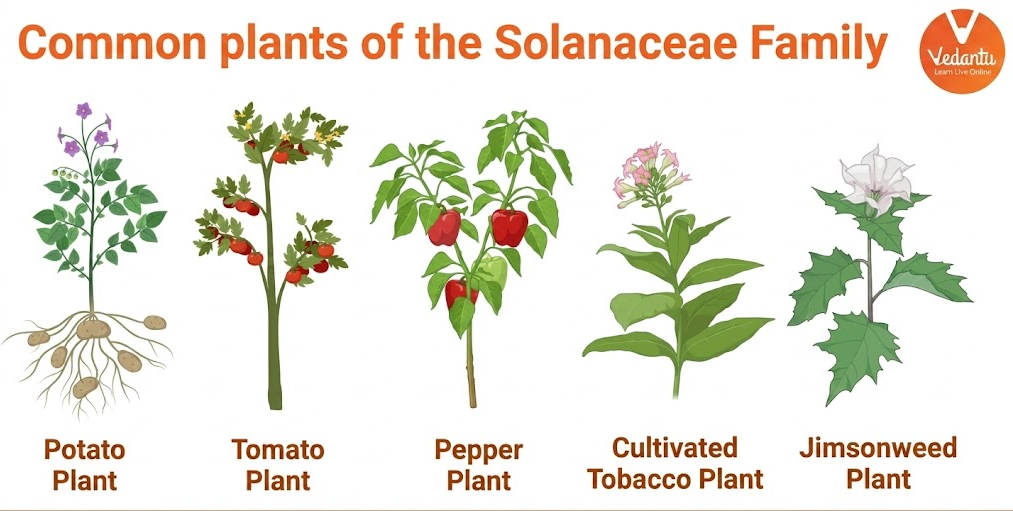
Some important solanaceae family examples include:
Tomato (Solanum lycopersicum)
Potato (Solanum tuberosum)
Brinjal (Solanum melongena)
Chilli (Capsicum annuum)
Tobacco (Nicotiana tabacum)
Petunia (Petunia hybrida)
Belladonna (Atropa belladonna)
These are commonly studied examples.
Economic Importance of Solanaceae
The solanaceae family is economically important.
1. Food crops
Many members are vegetables:
tomato
potato
chilli
brinjal
These are staple foods worldwide.
2. Medicinal plants
Some species contain alkaloids:
Atropine
Nicotine
Scopolamine
Used in medicine.
3. Ornamental plants
Some members are ornamental:
Petunia
Solanum
Brugmansia
Used in gardens.
4. Poisonous plants
Some plants are toxic:
Belladonna
Datura
Contain strong alkaloids.
FAQs on Solanaceae Family: Floral Formula, Floral Diagram, Characteristics and Examples
1. What plants are in the Solanaceae family?
Plants in the Solanaceae family include many important food, medicinal, and ornamental plants. Common members are potato, tomato, brinjal, chilli, capsicum, tobacco, belladonna, and petunia. These are some of the best-known Solanaceae family examples studied in botany and NEET.
2. What is a Solanaceae also known as?
The Solanaceae family is also known as the nightshade family or the potato family. It is one of the most useful plant families because it includes several common vegetables, medicinal plants, and ornamental species.
3. What are the examples of the Solanaceae family?
Some common Solanaceae examples are:
Potato
Tomato
Brinjal or eggplant
Chilli and capsicum
Tobacco
Belladonna
Petunia
These plants are often used as standard solanaceae family examples in classification and floral morphology.
4. What is the description of Solanaceae?
The Solanaceae family is a large family of flowering plants that includes herbs, shrubs, and small trees. Its members usually have alternate, simple, exstipulate leaves and bisexual, actinomorphic, pentamerous flowers. The calyx and corolla are usually fused, stamens are epipetalous, and the ovary is superior and bicarpellary. The fruit is commonly a berry or capsule. Many plants in this family contain alkaloids and are economically important.
5. Is petunia a Solanaceae?
Yes, Petunia belongs to the Solanaceae family. It is one of the common ornamental plants included in this family and is often cited in solanaceae family examples.
6. What are the common Solanaceae vegetables?
Common vegetables of the Solanaceae family include:
Potato
Tomato
Brinjal
Capsicum
Chilli
These are some of the most familiar edible members of the family.
7. Which popular foods are Solanaceae?
Popular foods that belong to the Solanaceae family include potato, tomato, eggplant, chilli, and capsicum. These crops are widely consumed and make the family agriculturally very important.
8. How to identify plants in the Solanaceae family?
Plants of the Solanaceae family can be identified by their general vegetative and floral characters. They usually have simple alternate leaves, often without stipules, and flowers that are bisexual, actinomorphic, and pentamerous. The petals are fused, stamens are usually five and epipetalous, and the fruit is commonly a berry or capsule. These are important solanaceae family characteristics used for identification.
9. What is the floral formula of Solanaceae?
The floral formula of Solanaceae is:
⚥ ⊕ K(5) C(5) A5 G̲(2)
This shows that the flower is bisexual, actinomorphic, with five fused sepals, five fused petals, five stamens, and a bicarpellary superior ovary.
10. What does the floral diagram of Solanaceae show?
The floral diagram of Solanaceae shows a pentamerous flower with fused sepals, fused petals, five epipetalous stamens, and a bicarpellary superior ovary with axile placentation. It helps in understanding the floral arrangement and family identification.
11. What are the main Solanaceae family characteristics?
The main solanaceae family characteristics include:
Herbs, shrubs, or small trees
Simple, alternate, exstipulate leaves
Bisexual and actinomorphic flowers
Gamosepalous calyx
Gamopetalous corolla
Five epipetalous stamens
Bicarpellary superior ovary
Fruit usually berry or capsule
These features are important for NEET and board-level botany.
