




Discuss the various forms of bacteria
Answer
 Verified
600.9k+ views
Hint: Bacteria are prokaryotes. Bacteria (eubacteria) are microscopic simple prokaryotic organisms whose cells lack a nucleus. Bacteria have simple internal structures. Most of the bacteria are small in size and range from 0.2-2 micrometers in diameter and 0.5-5.0 micrometers in length.
Complete answer:
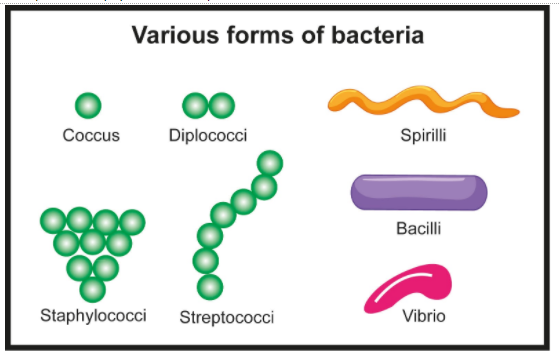
The cell shape of a bacteria is a characteristic of a given bacterial species. They are classified on the basis of their physical features- Shape and Appearance. The four basic shapes of bacteria are Coccus (spherical or ovoid), bacillus (rod-like), vibrio (comma-shaped ), and spirilla (spiral or helical shaped).
Bacillus - These are rod-like, gram-positive bacteria found in soil and water. The term bacillus has two meanings. One refers to bacterial shapes and the other is related to genus(capitalized and italicized).
Example - Bacillus anthracis, cause anthrax. Bacillus bacteria occur in chains.
Coccus - These are spherical shaped bacteria. When these bacteria divide, their cells attach to one another. They show specific characteristic arrangements used for identification.
1) Bacteria whose cells divide and remain attached to each other are known as Streptococci.
2)Tetrads- Some cocci divides into two planes and remain in a group of four, forming squares known as tetrads.
3)Sarcinae- Some cocci divide into three planes and are attached in a cubelike group of eight is known as Sarcinae.
4)Staphylococci - Some cocci divides in a multiple plain and form grapelike clusters are known as Staphylococcus bacteria.
Vibrio- These are comma-shaped ,gram-negative bacteria. They are highly motile and facultative anaerobes. They have one to three whip-like structures called flagella at one end. They are aquatic microorganisms and cause serious diseases in humans and animals.
Examples - Vibrio Cholarae causes Cholera disease in humans.
Spirilla-These are spiral or helical shaped, gram-negative bacteria. They have whip-like flagella at each end.
Note: Most bacteria maintain a single shape called monomorphic and some bacteria like Corynebacterium have many shapes that lack a single characteristic shape.
-Gram-negative bacteria - they are doubled layered and have a wavy cell wall. These bacteria have a thin layer of peptidoglycan and teichoic acid is absent. Produce endotoxin and exotoxin.
Examples are salmonella, Escherichia, etc.
Gram-positive bacteria- they are single and have a smooth cell wall. These bacteria have a thick layer of peptidoglycan and teichoic acid is present.
Examples are Staphylococcus, Streptococcus, etc.
Complete answer:
The cell shape of a bacteria is a characteristic of a given bacterial species. They are classified on the basis of their physical features- Shape and Appearance. The four basic shapes of bacteria are Coccus (spherical or ovoid), bacillus (rod-like), vibrio (comma-shaped ), and spirilla (spiral or helical shaped).
Bacillus - These are rod-like, gram-positive bacteria found in soil and water. The term bacillus has two meanings. One refers to bacterial shapes and the other is related to genus(capitalized and italicized).
Example - Bacillus anthracis, cause anthrax. Bacillus bacteria occur in chains.
Coccus - These are spherical shaped bacteria. When these bacteria divide, their cells attach to one another. They show specific characteristic arrangements used for identification.
1) Bacteria whose cells divide and remain attached to each other are known as Streptococci.
2)Tetrads- Some cocci divides into two planes and remain in a group of four, forming squares known as tetrads.
3)Sarcinae- Some cocci divide into three planes and are attached in a cubelike group of eight is known as Sarcinae.
4)Staphylococci - Some cocci divides in a multiple plain and form grapelike clusters are known as Staphylococcus bacteria.
Vibrio- These are comma-shaped ,gram-negative bacteria. They are highly motile and facultative anaerobes. They have one to three whip-like structures called flagella at one end. They are aquatic microorganisms and cause serious diseases in humans and animals.
Examples - Vibrio Cholarae causes Cholera disease in humans.
Spirilla-These are spiral or helical shaped, gram-negative bacteria. They have whip-like flagella at each end.
Note: Most bacteria maintain a single shape called monomorphic and some bacteria like Corynebacterium have many shapes that lack a single characteristic shape.
-Gram-negative bacteria - they are doubled layered and have a wavy cell wall. These bacteria have a thin layer of peptidoglycan and teichoic acid is absent. Produce endotoxin and exotoxin.
Examples are salmonella, Escherichia, etc.
Gram-positive bacteria- they are single and have a smooth cell wall. These bacteria have a thick layer of peptidoglycan and teichoic acid is present.
Examples are Staphylococcus, Streptococcus, etc.
Recently Updated Pages
Master Class 11 Economics: Engaging Questions & Answers for Success

Master Class 11 English: Engaging Questions & Answers for Success
Master Class 11 Maths: Engaging Questions & Answers for Success
Class 11 Question and Answer - Your Ultimate Solutions Guide
Master Class 11 Social Science: Engaging Questions & Answers for Success
Master Class 11 Business Studies: Engaging Questions & Answers for Success
Trending doubts
One Metric ton is equal to kg A 10000 B 1000 C 100 class 11 physics CBSE
There are 720 permutations of the digits 1 2 3 4 5 class 11 maths CBSE
Differentiate between an exothermic and an endothermic class 11 chemistry CBSE
In what year Guru Nanak Dev ji was born A15 April 1469 class 11 social science CBSE
Difference Between Prokaryotic Cells and Eukaryotic Cells
State and prove Bernoullis theorem class 11 physics CBSE