



Social Science Economics Notes for Chapter 2 Sectors of the Indian Economy Class 10 - FREE PDF Download
Sectors of the Indian Economy Class 10 notes explains how the Indian economy is divided into three main sectors: primary, secondary, and tertiary. The sectors of indian economy class 10 notes pdf explains how each sector contributes to the economy and their roles in economic development.
 Table of Content
Vedantu’s class 10 sectors of indian economy notes are designed according to the CBSE Class 10 Economics Syllabus. These notes simplify complex ideas, making it easier for you to grasp key concepts and prepare effectively for your exams.

Introduction
Sectors are groups of people who engage in diverse activities including the production of commodities or services. Economic activities are those that result in revenue and profit. A farmer, for example, harvests crops in order to sell and profit; an industry, on the other hand, produces things or services for people in order to profit.
Different Sectors of the Indian Economy
1. Primary Sector: The primary sector is when we make a product by extracting and collecting natural resources. Farming, forestry, hunting, fishing, and mining are just a few examples.
2. Secondary Sector: It includes operations that include the transformation of natural goods into new forms through various manufacturing processes. After primary school, it's time to go on to secondary school. In this case, some production steps are required. The industrial sector is another name for it. For example, we spin yarn and make cloth from the plant's cotton fiber. Sugar or Gur is produced using sugarcane as a basic ingredient.
3. Tertiary Sector: Activities that aid in the growth of the elementary and secondary sectors are included in the tertiary sector. These actions do not generate a good in and of itself, but they help or support the production process. It's also known as the service sector. Teachers, doctors, washermen, barbers, cobblers, lawyers, call centres, software businesses, and so on are some examples.
Difference Between the Three Sectors of the Economy
All three sectors, primary, secondary, and tertiary, are interdependent and interconnected in the day-to-day performance of diverse economic activities. It's nearly hard to keep track of all the activities that go into producing the final goods or services.
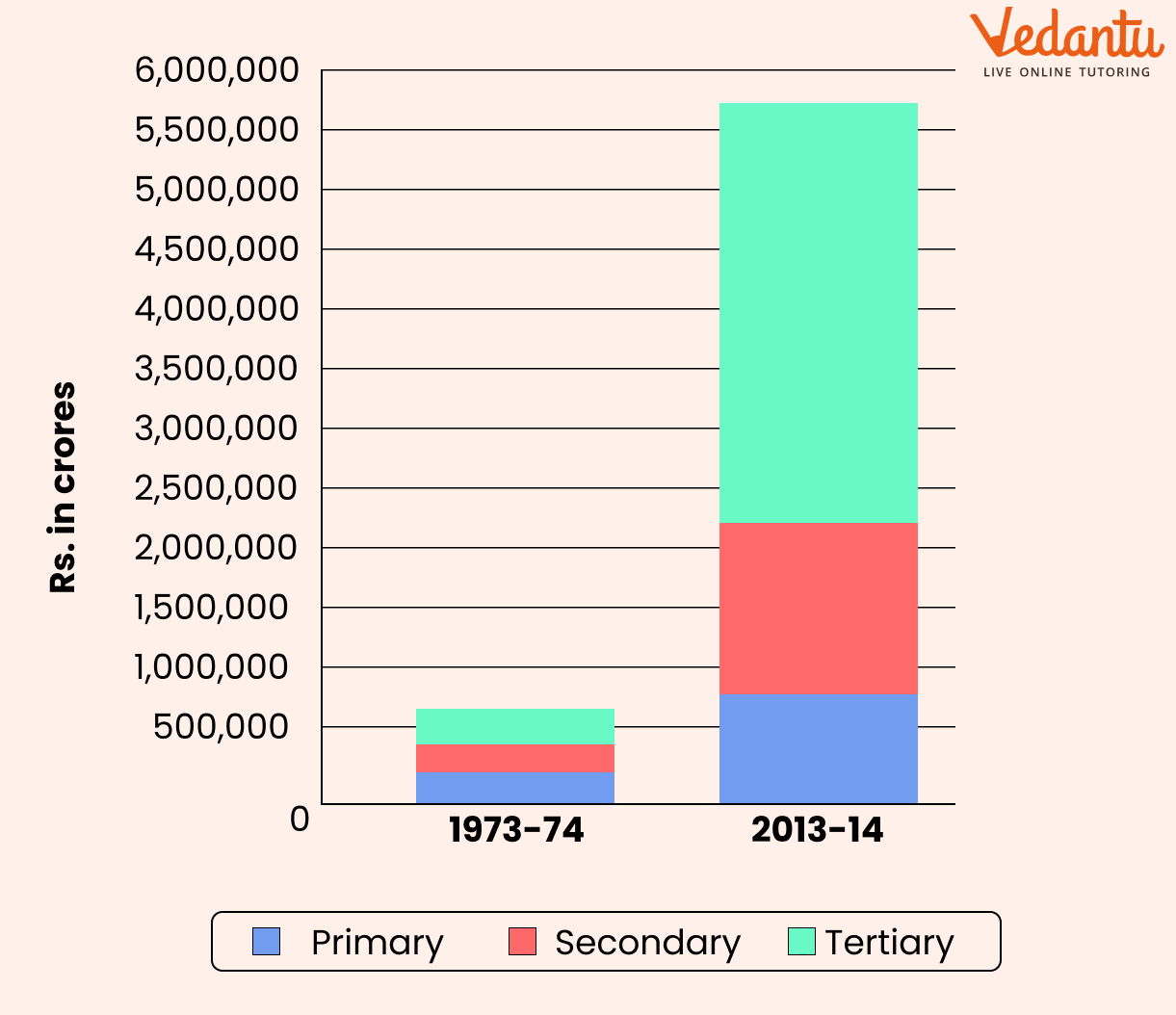
Gross Domestic Product (GDP): The sum of the output that is once done through primary, secondary, and tertiary activities is known as the Gross Domestic Product (GDP). The value of all of these final goods from all three sectors would be counted into the gross domestic product, and when we talk about the net domestic product, we eliminate any depreciation from that gross number to get the net product.
The below graph shows how the GDP varies from each sector
Historical Changes in Sectors:
1. The primary sector was the most important sector of economic activity in a country throughout its early phases of development.
2. The agriculture sector began to generate significantly more food than before as a result of technological advancements in farming processes.
3. People began working in factories. Some persons are also involved in the transportation industry.
4. The secondary sector gradually became the most important in terms of the economy and employment.
5. A great variety of industries relating to food processing, equipment manufacturing, and textiles are present.
6. This resulted in the establishment of services such as banking, health care, and education.
7. In terms of total production, the service industry has overtaken manufacturing as the most significant sector, and it has begun to employ more people.
Where are Most of the People Employed?
The tertiary sector overtook the primary sector as India's largest producing sector in 2013-14. The tertiary sector in India has been increasingly important for the following reasons:
1. Hospitals, educational institutions, post and telegraph services, police stations, courts, village administrative offices, municipal corporations, defense, transportation, banks, insurance businesses, and other services are considered vital for everyone.
2. Agriculture and industry expansion lead to the expansion of services such as transportation, commerce, and storage.
3. As people's incomes rise, they expect more luxuries like dining out, tourism, shopping, private hospitals, private schools, professional training, and so on.
4. During the recent decade, several new information and communication technology-based services have become increasingly important and indispensable.
Disguised Unemployment: Unemployment is the only aspect of the economy that has no bearing on overall output. When productivity is low and there are too many people for too few jobs, this happens. It can apply to any group of people that aren't working to their full potential.
How to Create More Employment?
People can find work by locating industries and services in semi-rural areas and identifying, advertising, and locating them. Every state or region has the potential to boost its residents' income and job opportunities. Tourism, regional craft industries, and emerging services like IT can all help. According to NITI Aayog, research undertaken by the Planning Commission, approximately 20 lakh employments can be produced in the education sector alone.
In 2005, the Mahatma Gandhi National Rural Employment Guarantee Act (MGNREGA) was enacted by the central government of India to implement the Right to Work in about 625 districts across the country.
Mahatma Gandhi National Rural Employment Guarantee Act (Mgnrega):
It is primarily used by persons who live in rural areas who are able and willing to work. Every year, the MGNREGA gives at least 100 days of work to rural households that voluntarily volunteer to conduct unskilled work.
The MGNREGA scheme is open to any Indian citizen over the age of 18 who lives in a rural area.
Another goal of the MGNREGA act is to give rural communities long-term assets such as roads, wells, and ponds.
If the government fails to produce jobs, the people will be forced to rely on unemployment benefits.
It is implemented without the use of contractors or agents in gram panchayats.
This law aids in the preservation of the village environment, the empowerment of rural women, the promotion of social equality, the reduction of migration to urban regions, and the provision of essential services, among other things.
Different Sectors in Terms of Operations
Counting Goods and Services
The health and number of the goods and services sectors in a country reflect its economic condition - whether it is good or bad. But a country produces so many goods and services. Counting all of them will result in chaos. So Economics Class 10 Ch 2 Notes suggest that we should not count the number of goods and services. Rather we should count the value of these goods and services. We should also remember that while counting the value of the goods and service we must count the final product - The product that reaches the end consumers.
So now, if we count the values of all the final products in a sector we will get the value of the total production of that sector. The notes of Economics Class 10 Chapter 2 informs that if we add the total production of all the three sectors we get the GDP of the country.
The Growth of the Service Sector in India
When India gained independence, the economy was mostly based on agriculture. Later we started bringing out more minerals and metals from our resources. Now as these basic sectors got developed, the demand to sustain these sectors increased. And how do you sustain these Primary sectors? By building a service or Tertiary sector around these sectors - like transport, storage etc.
Again as the standard of living of the Indians improved, their demands and aspirations got higher. This resulted in the advent of more service sectors - like restaurants, cinema halls etc. This is specifically true in urban areas.
Furthermore, in the past 20 years or so, the IT sector in India has flourished a lot. Many overseas companies find it cost-effective to outsource their IT related work to India. Indians are hardworking and they know English well. So they, unlike the Chinese, can easily mingle with the foreign companies and work well with them.
Imbalance Among the Sectors
It is true that the IT sector and other such advanced sectors hire educated people and give them handsome salaries. There are, however, many people who are not fortunate enough to work in these sectors primarily because of the lack of education and secondarily because there are not enough jobs in the service sectors.
Even in this 21st century, most Indians are still connected with the primary sector - especially the agricultural sector. Our class 10 Economics Chapter 2 Notes explain these imbalances in detail.
Government Responsibilities
The government is responsible for many key activities, including:
1. Funding Services: The government raises money through taxes and other means to cover the costs of its services.
2. Infrastructure Development: It undertakes major spending on building roads, bridges, railways, harbours, generating electricity, and providing irrigation through dams. It ensures these facilities are accessible to everyone.
3. Supporting the Private Sector: The government supports certain activities to encourage private sector production and business.
4. Subsidising Essentials: In India, the government buys wheat and rice from farmers at fair prices and sells them at lower rates through ration shops to support both farmers and consumers.
5. Providing Essential Services: The government is responsible for running schools, offering quality education, and providing health services for all.
6. Human Development: It also focuses on human development aspects such as safe drinking water, housing for the poor, food and nutrition, and addressing the needs of the most neglected regions.
5 Important Topics of Economics Sectors of the Indian Economy Class 10 Notes
With these sectors of Indian economy class 10 notes, you get an understanding of all the important topics from Chapter 2. Download the sectors of Indian economy class 10 notes PDF and use them as your go-to resource for assignments, revisions, and self-study.
Related Study Materials for Class 10 Economics Chapter 2 Sectors of the Indian Economy
Chapter-wise Revision Notes Links for Class 10 Economics
Important Study Materials for Class 10 Social Science - Economics
FAQs on CBSE Notes Class 10 social science economics Chapter 2 - Sectors of the Indian Economy - 2026-27
1. What are the three sectors of the Indian economy covered in Class 10 notes?
The three sectors explained in sectors of Indian economy class 10 notes are the primary sector (agriculture and related activities), secondary sector (manufacturing and industry), and tertiary sector (services).
2. Why is the study of sectors of the Indian economy important for Class 10 students?
Understanding the sectors of the Indian economy helps students learn how different economic activities are classified, their contribution to national income, and their role in the country's development.
3. What topics are included in the Class 10 sectors of Indian economy notes PDF?
The class 10 sectors of Indian economy notes PDF covers key topics like classification of sectors, comparison between organized and unorganized sectors, formal and informal sectors, and the importance of each sector in India’s economy.
4. How can I download the sectors of Indian economy class 10 notes PDF for exam preparation?
You can download the sectors of Indian economy class 10 notes PDF directly from this page to get all important topics, summaries, and definitions for quick and effective revision.
5. What is the difference between the organized and unorganized sectors explained in class 10 economics chapter 2 notes?
The economics class 10 chapter 2 notes explain that the organized sector is regulated by government rules and offers job security and benefits, while the unorganized sector lacks job security, regular income, and government regulations.
6. How do these sectors of the Indian economy class 10 notes help with CBSE exam preparation?
These class 10 economics chapter 2 notes provide concise explanations, summary tables, important questions, and model answers to help students revise quickly and score better in their Social Science exam.
7. What are the key questions from economics class 10 chapter 2 for board exams?
Important questions from economics class 10 chapter 2 notes include definitions of sectors, differences between formal and informal sectors, sector-wise employment, and the role of government in different sectors.
