



How Big Is the Barbados Threadsnake? Size, Habitat, and Diet Facts
The Barbados Threadsnake is one of the most fascinating reptiles on Earth. It holds the record as the world’s smallest known snake! This tiny, worm-like snake lives in the Caribbean and often surprises people with its size. Despite being so small, it plays an important role in nature. Let’s explore amazing Barbados Threadsnake facts, its habitat, diet, life cycle, characteristics, and why this mini reptile is so special.
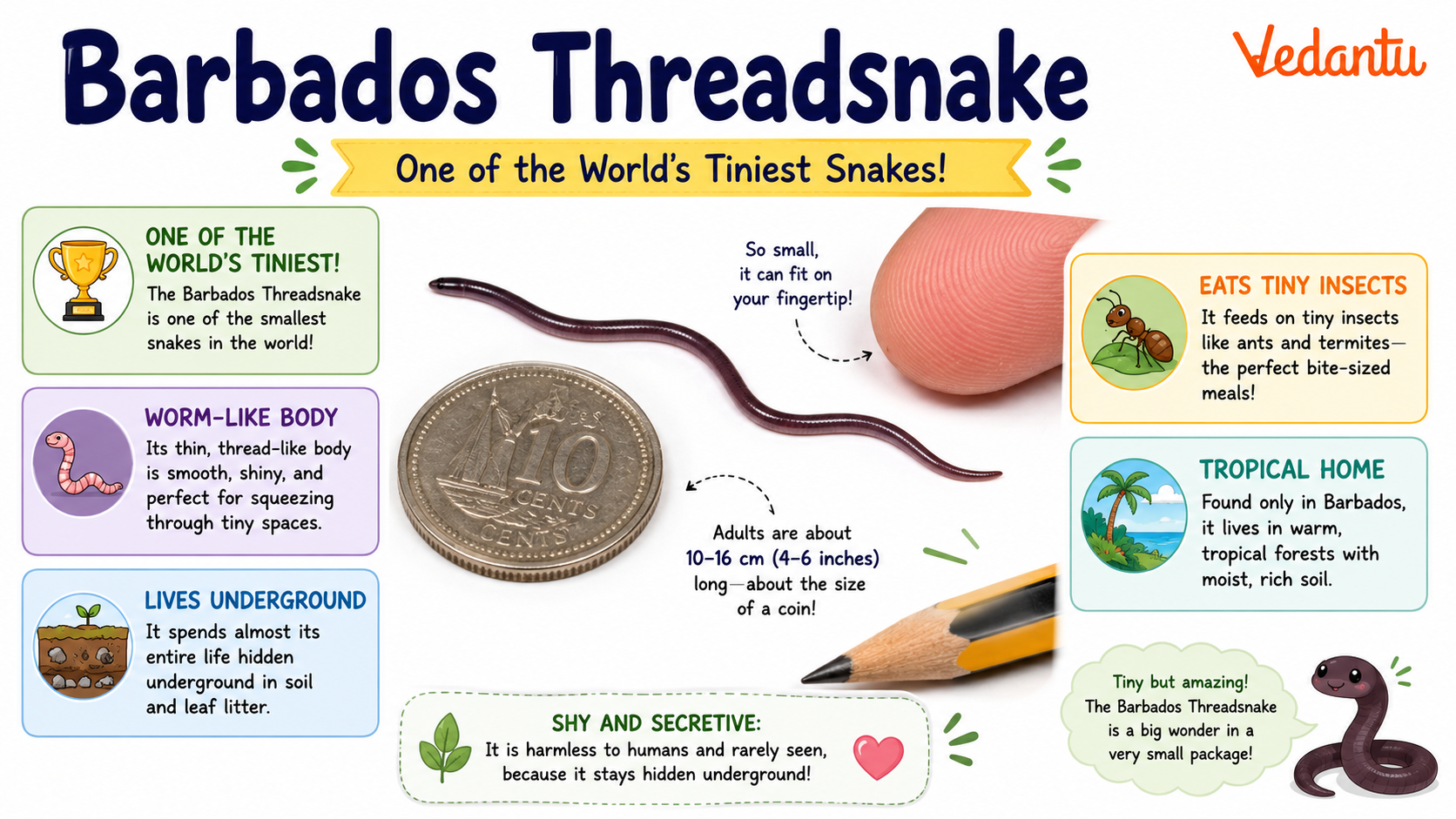
Quick Facts About Barbados Threadsnake
| Feature | Details |
|---|---|
| Common Name | Barbados Threadsnake |
| Scientific Name | Tetracheilostoma carlae |
| Animal Group | Reptile |
| Size | About 10 cm (4 inches) |
| Weight | Less than 1 gram |
| Diet | Ant and termite eggs |
| Habitat | Forests of Barbados |
| Conservation Status | Critically Endangered |
Appearance and Physical Characteristics
- Very thin, thread-like body
- Shiny dark brown or black colour
- Small, rounded head
- Tiny eyes covered with scales
- Smooth, glossy scales
- Blunt tail that looks similar to its head
Barbados Threadsnake Habitat and Distribution
The Barbados Threadsnake habitat is limited to the island of Barbados in the Caribbean. It is found nowhere else in the world.
- Lives in tropical forests
- Found under rocks, leaf litter, and soil
- Prefers warm and moist environments
- Spends most of its life underground
Diet and Feeding Habits
The Barbados Threadsnake diet mainly includes very tiny prey.
Ant eggs and termite eggs.
Slips into ant or termite nests to eat eggs.
Has small teeth to grip soft eggs.
Controls insect populations.
Behaviour and Lifestyle
- Non-venomous and harmless to humans
- Mostly active underground
- Solitary in nature
- Moves by slithering through soil and leaf litter
- Uses its small size to hide from predators
Barbados Threadsnake Life Cycle
- Egg Laying: Female lays only one egg at a time.
- Hatching: Baby snake hatches fully formed.
- Growth: Young snakes look like tiny versions of adults.
- Adult Stage: Reaches about 10 cm in length.
The Barbados Threadsnake life cycle is simple compared to insects. There is no metamorphosis — baby snakes look like miniature adults.
What Makes the Barbados Threadsnake Special?
Importance and Role in Nature
Amazing Barbados Threadsnake Facts
- It was officially described in 2008.
- It is thinner than most pencils.
- Females lay only one egg at a time.
- Its closest relatives are other threadsnakes found in the Americas.
- It has reduced eyesight because it lives underground.
- Habitat loss is a major threat to its survival.
Interesting Facts About Barbados Threadsnake
Fun Facts for Kids
FAQs on Barbados Threadsnake: The World’s Smallest Snake Explained
1. What is a Barbados Threadsnake?
The Barbados Threadsnake is the world’s smallest known snake species.
- Its scientific name is Tetracheilostoma carlae
- It belongs to the blind snake family
- It looks like a tiny piece of thread
- It is native to Barbados, a Caribbean island
- It is often confused with an earthworm because of its size
2. How small is the Barbados Threadsnake?
The Barbados Threadsnake is extremely small—about the length of a coin.
- Grows only about 10 cm (4 inches) long
- As thin as a strand of spaghetti
- Considered the smallest snake in the world
- Babies are about half the size of the adult
3. Where does the Barbados Threadsnake live?
The Barbados Threadsnake lives only on the Caribbean island of Barbados.
- Found in forests and gardens
- Lives under rocks and in soil
- Prefers warm, tropical environments
- Spends most of its time underground
4. What does the Barbados Threadsnake eat?
The Barbados Threadsnake eats very tiny insects and eggs.
- Feeds mainly on ant larvae
- Eats termite eggs
- Hunts underground in soil
- Uses its small mouth to grab soft prey
5. Is the Barbados Threadsnake blind?
The Barbados Threadsnake is almost blind but can sense light.
- It belongs to the blind snake family
- Has very tiny eyes covered by scales
- Can detect light and dark
- Uses smell and touch to find food
6. Is the Barbados Threadsnake dangerous to humans?
The Barbados Threadsnake is completely harmless to humans.
- It is non-venomous
- Too small to bite people
- Does not attack or chase humans
- Prefers hiding underground
7. When was the Barbados Threadsnake discovered?
The Barbados Threadsnake was officially described in 2008.
- Discovered by scientist S. Blair Hedges
- Found in a small forest area in Barbados
- Recognized as the world’s smallest snake
- Its discovery surprised many wildlife experts
8. How does the Barbados Threadsnake reproduce?
The Barbados Threadsnake lays eggs like other reptiles.
- Females lay only one egg at a time
- The egg is large compared to the mother’s body
- Baby snakes hatch fully formed
- Young snakes are about half the adult size
9. Why is the Barbados Threadsnake important?
The Barbados Threadsnake is important because it supports the balance of its ecosystem.
- Controls ant and termite populations
- Shows how animals adapt to island habitats
- Helps scientists study miniaturization in reptiles
- Represents unique Caribbean biodiversity
10. Is the Barbados Threadsnake endangered?
The Barbados Threadsnake may be at risk due to habitat loss.
- Lives in a very small geographic area
- Forests in Barbados are shrinking
- Urban development reduces natural habitats
- Conservation efforts help protect native species
