



How to Identify Bollworm Damage and Prevent Infestations in Cotton and Corn
Bollworm is a common agricultural pest that attacks crops like cotton, corn, tomatoes, and pulses. Though it looks like a small caterpillar, it can cause huge damage to farmers’ fields. The larval stage feeds on flower buds and fruits, reducing crop yield. Learning about bollworm characteristics, habitat, diet, and life cycle helps us understand how this tiny insect affects food production and why it is important in agriculture studies.
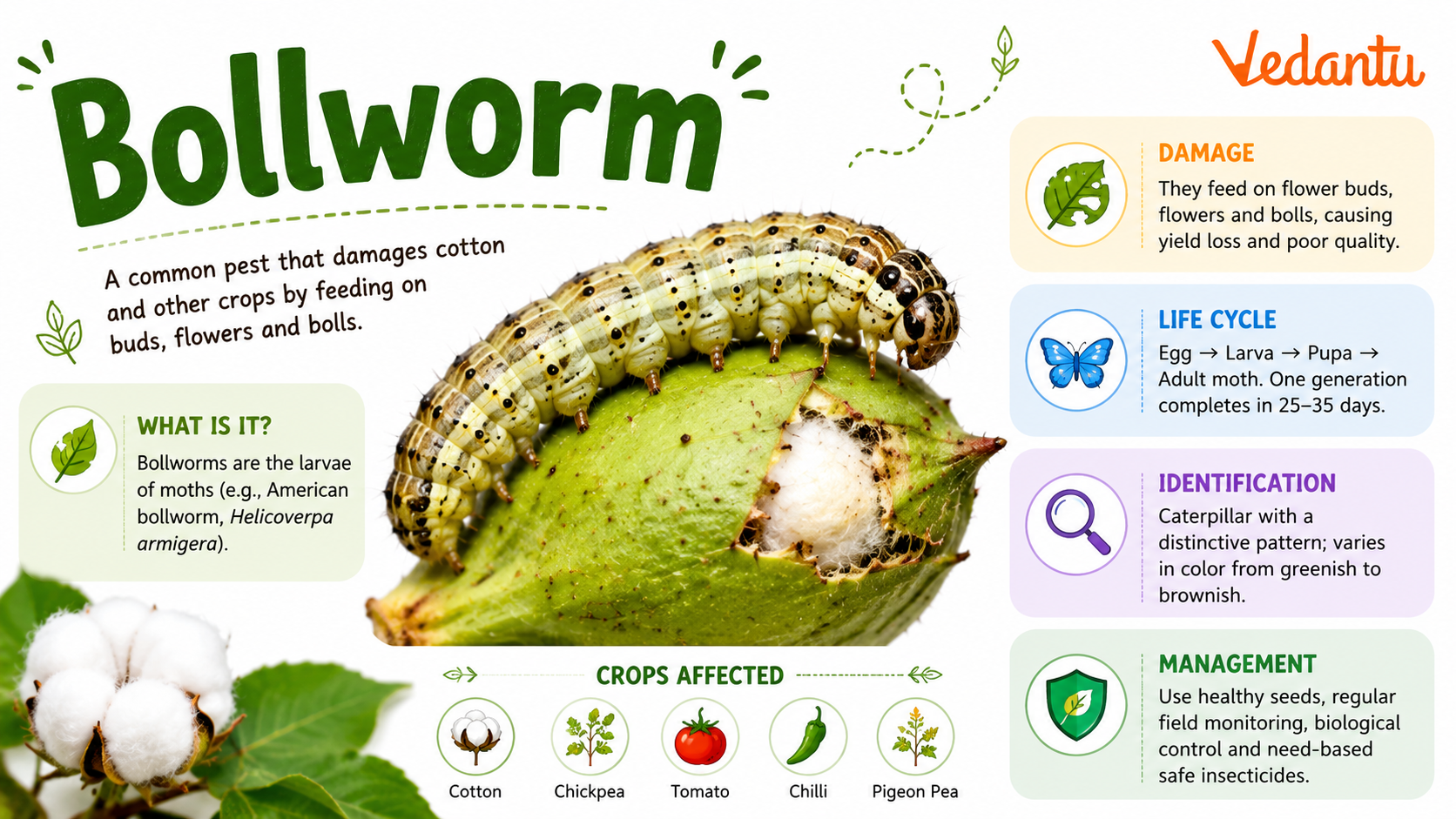
Quick Facts About Bollworm
| Feature | Details |
|---|---|
| Common Name | Bollworm |
| Scientific Name | Helicoverpa armigera (Common species) |
| Animal Group | Insect |
| Type | Caterpillar (larval stage of a moth) |
| Length | 3–4 cm (larva) |
| Diet | Plant parts like buds, flowers, fruits |
| Habitat | Crop fields and agricultural lands |
| Life Cycle | Egg → Larva → Pupa → Adult Moth |
Appearance and Physical Characteristics
- Soft, cylindrical body.
- Colour varies: green, brown, yellow, or pinkish.
- Has small dark spots along the body.
- Three pairs of true legs and several false legs (prolegs).
- Strong chewing mouthparts for feeding on plants.
Bollworm Habitat and Distribution
- Found mainly in agricultural fields.
- Common in cotton-growing regions.
- Also found in Asia, Africa, Australia, and parts of Europe.
- Prefers warm climates.
Bollworm Diet and Feeding Habits
- Feeds mainly during the larval (caterpillar) stage.
- Eats flower buds, cotton bolls, fruits, and seeds.
- Uses strong jaws to bore into plant parts.
- Damages crops from inside, making control difficult.
Behaviour and Lifestyle
- Active mostly at night (nocturnal feeding).
- Larvae stay hidden inside buds or fruits.
- Adult moths are good fliers and can travel long distances.
- Reproduces quickly in warm seasons.
Bollworm Life Cycle
- Egg: Female moth lays eggs on leaves or flower buds.
- Larva: Caterpillar hatches and feeds on crops for 2–3 weeks.
- Pupa: Forms a cocoon in soil.
- Adult: Emerges as a moth and lays eggs again.
What Makes Bollworm Special?
Importance and Role in Nature
Amazing Bollworm Facts
- One female moth can lay hundreds of eggs.
- Larvae can damage multiple plants in a short time.
- Bollworm is one of the most studied crop pests.
- It mainly attacks cotton bolls, giving it the name “bollworm.”
- It can survive in different types of crops.
- Warm weather increases its population rapidly.
Interesting Facts About Bollworm
- It is sometimes called cotton bollworm or corn earworm.
- The adult moth is less harmful than the larva.
- Farmers use biological control methods to manage it.
- It can migrate across regions with the help of wind.
Fun Facts for Kids
FAQs on Bollworm Facts, Life Cycle, and Crop Protection Tips
1. What is a bollworm?
A bollworm is a destructive caterpillar that feeds on crops like cotton, corn, and tomatoes.
- The term bollworm usually refers to the larva of the Helicoverpa moth.
- It attacks cotton bolls, flower buds, and fruits.
- It is considered a major agricultural pest worldwide.
- Farmers monitor bollworm infestations to protect crops and reduce damage.
2. What crops do bollworms attack?
Bollworms attack many important food and fiber crops.
- Cotton (most common target)
- Corn (maize)
- Tomatoes
- Soybeans
- Chickpeas and pulses
- Other vegetable and field crops
3. Why is the bollworm harmful to farmers?
The bollworm pest is harmful because it damages crops and lowers farm production.
- It eats developing bolls, buds, and fruits.
- It causes economic losses for farmers.
- Infested crops may become unsuitable for sale.
- Farmers must spend money on pest control methods.
4. What does a bollworm look like?
A bollworm larva looks like a small, striped caterpillar.
- It can be green, brown, or yellow in color.
- It has a soft body with faint stripes along its back.
- It grows up to about 3–4 cm long.
- It later changes into a moth after pupation.
5. What is the life cycle of a bollworm?
The bollworm life cycle has four main stages of complete metamorphosis.
- Egg – Laid on leaves or buds.
- Larva (caterpillar) – Feeds on crops and causes damage.
- Pupa – Develops in the soil.
- Adult moth – Emerges and lays eggs again.
6. How do farmers control bollworms?
Farmers control bollworm infestations using different pest management methods.
- Planting Bt cotton (genetically modified crops).
- Using approved insecticides.
- Encouraging natural predators like birds and parasitic wasps.
- Practicing crop rotation and field monitoring.
7. What is Bt cotton and how does it stop bollworms?
Bt cotton is a genetically modified plant that produces a protein harmful to bollworms.
- It contains a gene from the bacterium Bacillus thuringiensis (Bt).
- The Bt protein is toxic to bollworm larvae.
- It reduces the need for chemical sprays.
- It helps increase cotton production.
8. Are bollworms found all over the world?
Yes, bollworms are found in many parts of the world.
- Common in Asia, Africa, Australia, and the Americas.
- Prefer warm climates and farming regions.
- Spread easily through crop trade and migration.
- Adapt well to different environmental conditions.
9. How can you identify bollworm damage in crops?
You can identify bollworm damage by looking for feeding signs on plants.
- Holes in cotton bolls or fruits.
- Damaged flower buds and leaves.
- Presence of caterpillars inside fruits.
- Droppings (frass) near feeding areas.
10. Do bollworms affect food supply?
Yes, severe bollworm outbreaks can affect food and fiber supply.
- They reduce yields of corn, tomatoes, and pulses.
- They damage cotton production used for clothing.
- They increase farming costs.
- They may raise market prices if crops are heavily damaged.
