



What Is a Coucal? Habitat, Diet, Calls, and Unique Traits Explained
The Coucal is a large, crow-like bird known for its long tail, bright eyes, and secretive nature. Often seen walking through bushes instead of flying high in the sky, this bird is famous for its deep, bubbling call. Found mostly in Asia and Africa, coucals are important for controlling insects and small pests. Let us explore amazing Coucal facts, its habitat, diet, characteristics, life cycle, and why it is special in the bird world.
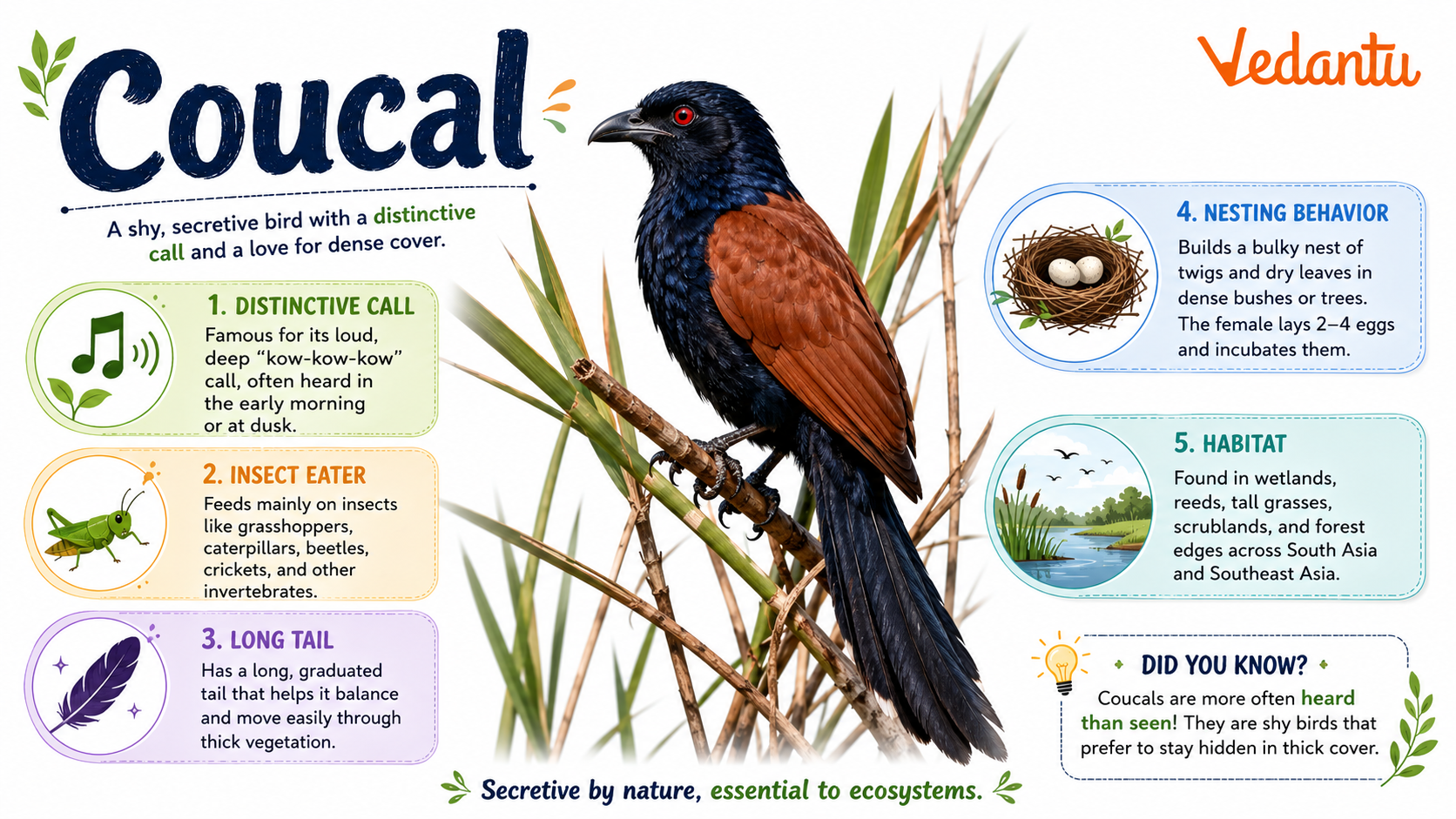
Quick Facts About Coucal
| Feature | Details |
|---|---|
| Common Name | Coucal (also called Crow Pheasant in India) |
| Scientific Genus | Centropus |
| Animal Group | Bird |
| Size | About 40–50 cm long |
| Habitat | Grasslands, wetlands, bushes, gardens |
| Diet | Insects, small reptiles, eggs, snails |
| Movement | Walks and hops on ground; short flights |
| Sound/Call | Deep “coop-coop-coop” sound |
| Conservation Status | Least Concern (most species) |
Appearance and Physical Characteristics
- Large body with a long, broad tail.
- Glossy black head and body in many species.
- Reddish-brown wings (especially in the Greater Coucal).
- Bright red eyes that stand out clearly.
- Strong legs for walking on the ground.
Habitat and Distribution
- Found in Asia, Africa, and Australia.
- Common in India, Sri Lanka, Southeast Asia.
- Lives in:
- Grasslands
- Wetlands and marshes
- Agricultural fields
- Gardens and village areas
- Prefers warm and tropical climates.
Diet and Feeding Habits
The Coucal diet mainly includes small animals and insects. It is a skilled ground hunter.
- Insects (grasshoppers, beetles, caterpillars)
- Snails and worms
- Small snakes and lizards
- Frogs
- Bird eggs
Behaviour and Lifestyle
- Usually solitary or seen in pairs.
- More active during early morning and evening.
- Prefers walking or hopping instead of flying.
- Builds nests in thick bushes.
- Very shy and hides quickly when disturbed.
Sound or Call
The Coucal is famous for its deep, bubbling call that sounds like “coop-coop-coop”. This call is:
- Heard mostly during breeding season.
- Used to attract mates.
- Used to mark territory.
Life Cycle and Reproduction
- Nest Building: Builds a dome-shaped nest in bushes or tall grass.
- Eggs: Lays 2–5 white eggs.
- Incubation: Both parents help keep eggs warm.
- Chicks: Hatch after about 15–18 days.
- Growth: Young birds grow feathers and learn to hunt.
The Coucal life cycle shows strong parental care compared to many other cuckoos.
What Makes Coucal Special?
Unlike other cuckoos, coucals raise their own young.
Walks confidently through dense bushes and grass.
Eats insects and small reptiles that harm crops.
Its sound can travel far across fields and wetlands.
Flight Adaptations
- Rounded wings for short-distance flights.
- Strong chest muscles for quick take-off.
- Long tail helps in balance and direction.
- Lightweight bones like most birds.
Importance and Role in Nature
The Coucal importance in nature is mainly as a natural pest controller and a part of the wetland and grassland ecosystem.
Amazing Facts About Coucal
- Also known as the “Crow Pheasant” in India.
- Has bright red eyes that look glowing in sunlight.
- Belongs to the cuckoo family.
- Builds a dome-shaped nest.
- Can eat small snakes without fear.
- Its call is often heard before rainfall in some regions.
- Found in both rural and urban areas.
Interesting Facts About Coucal
Fun Facts for Kids
- The coucal sounds like it is saying “coop-coop”!
- It loves walking in tall grass.
- It has shiny black feathers.
- It is bigger than many common garden birds.
- It can eat insects that damage crops.
FAQs on Coucal Bird: Fascinating Facts, Habitat, and Behavior
1. What is a Coucal?
A Coucal is a large, ground-loving bird that belongs to the cuckoo family (Cuculidae). Unlike many cuckoos, it builds its own nest and raises its own babies.
- Found in Africa, Asia, and Australia
- Known for its long tail and deep "coop-coop" call
- Often seen in grasslands, forests, and wetlands
- Also called crow pheasant in some regions
2. Where do Coucals live?
Coucals live in warm regions with thick plants and bushes. They prefer places where they can hide and hunt easily.
- Africa (especially sub-Saharan regions)
- South and Southeast Asia
- Australia and nearby islands
- Habitats include marshes, forests, grasslands, and farmlands
3. What does a Coucal look like?
A Coucal bird has a strong body, long tail, and bright eyes that make it easy to recognize.
- Long, broad black or dark-colored tail
- Rich brown or chestnut wings
- Red or ruby-colored eyes
- Medium to large size compared to other cuckoos
4. What do Coucals eat?
Coucals are carnivorous birds that mainly eat insects and small animals.
- Insects like grasshoppers and beetles
- Snakes and lizards
- Small frogs and rodents
- Sometimes bird eggs
5. How is a Coucal different from other cuckoos?
Unlike many cuckoos, the Coucal builds its own nest and cares for its chicks.
- Does not lay eggs in other birds’ nests
- Builds a large nest made of grass and leaves
- Both parents may help feed the chicks
- Spends more time on the ground than other cuckoos
6. What is the call or sound of a Coucal?
The Coucal call is a deep, booming “coop-coop-coop” sound that echoes through fields and forests.
- Low and repetitive tone
- Often heard during early morning or evening
- Used to mark territory and attract mates
7. Is the Coucal a good or bad bird?
The Coucal bird is considered helpful because it eats harmful insects and small pests.
- Controls snakes and insects
- Rarely harms crops
- Important part of the ecosystem
8. How do Coucals build their nests?
Coucals build dome-shaped nests hidden in thick bushes or tall grass.
- Made from grass, leaves, and twigs
- Usually close to the ground
- Provides safety from predators
9. Are Coucals endangered?
Most Coucal species are not endangered, but habitat loss can affect some populations.
- Many species are listed as Least Concern
- Threats include deforestation and wetland loss
- Protected in several wildlife areas
10. Why are Coucals important in nature?
Coucals play an important role in keeping the ecosystem balanced.
- Control populations of insects and small reptiles
- Serve as prey for larger animals
- Help maintain biodiversity in grasslands and wetlands
