



Where Do Frilled Lizards Live and How Do They Use Their Frill?
The Frilled Lizard is one of the most fascinating reptiles in the world. Famous for the large, colourful frill around its neck, this unique lizard can suddenly open its “collar” to scare enemies away. Found mainly in Australia and New Guinea, it is known for its quick movements and surprising behaviour. Learning about Frilled Lizard facts, habitat, diet, characteristics, and life cycle helps us understand why this reptile is truly one of nature’s most dramatic performers.
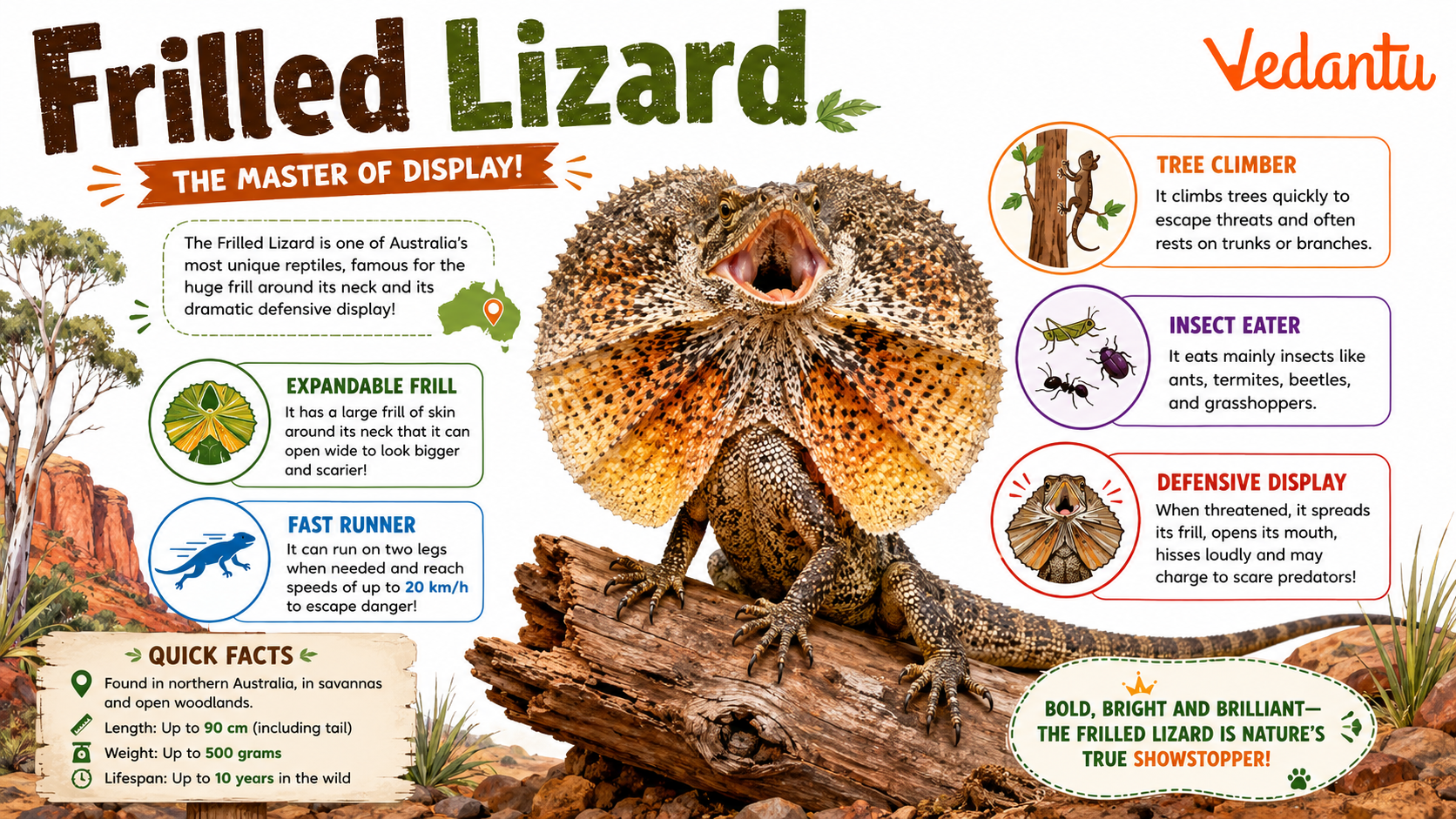
Quick Facts About Frilled Lizard
| Feature | Details |
|---|---|
| Common Name | Frilled Lizard |
| Scientific Name | Chlamydosaurus kingii |
| Animal Group | Reptile |
| Size | Up to 90 cm (including tail) |
| Weight | Around 0.5–1 kg |
| Lifespan | 10–15 years (in the wild) |
| Habitat | Woodlands and savannas |
| Diet | Insects, spiders, small animals |
| Special Feature | Large expandable neck frill |
| Conservation Status | Least Concern |
Appearance and Physical Characteristics
- Long tail that helps in balance while climbing.
- Strong hind legs for quick running.
- Scaly skin in shades of brown, grey, or reddish colour.
- Sharp claws for gripping tree bark.
- Frill supported by long cartilage spines.
Habitat and Distribution
The Frilled Lizard habitat mainly includes warm tropical regions.
- Northern Australia
- Southern New Guinea
- Dry forests and open woodlands
- Savannas with scattered trees
Diet and Feeding Habits
The Frilled Lizard diet mainly consists of small animals. It is a carnivorous reptile.
Behaviour and Lifestyle
- Mostly solitary animals.
- Active during the day (diurnal).
- Excellent climbers but can run very fast on two legs.
- Uses its frill as a defence mechanism.
Life Cycle of a Frilled Lizard
What Makes the Frilled Lizard Special?
Importance and Role in Nature
Amazing Frilled Lizard Facts
- The frill can be larger than the lizard’s head.
- It can stay still for long periods to avoid detection.
- Its frill is usually brightly coloured inside.
- It inspired dinosaur-like creatures in movies.
- It can climb trees very quickly.
- Its scientific name honours Captain Phillip Parker King.
Fun Facts for Kids
FAQs on Frilled Lizard: Amazing Facts About This Frill-Necked Reptile
1. What is a Frilled Lizard?
The Frilled Lizard is a unique reptile famous for the large frill of skin around its neck that opens like a fan when it feels scared or excited.
- Scientific name: Chlamydosaurus kingii
- Also called: Frill-necked Lizard or Frilled Dragon
- Found in: Northern Australia and New Guinea
- Known for: Its dramatic neck frill display and ability to run on two legs
2. Why does a Frilled Lizard open its frill?
A Frilled Lizard opens its frill mainly to scare away predators and protect itself from danger.
- Makes the lizard look bigger and more frightening
- Shows bright colors like orange, yellow, or red
- Often hisses and opens its mouth at the same time
- Used during territorial fights and mating displays
3. Where do Frilled Lizards live?
Frilled Lizards live in warm, tropical regions with plenty of trees and dry forests.
- Native to Northern Australia
- Also found in southern New Guinea
- Prefer woodlands, savannas, and tropical forests
- Spend much of their time climbing trees
4. What do Frilled Lizards eat?
Frilled Lizards are carnivores, meaning they eat mostly insects and small animals.
- Main diet: ants, termites, spiders, and beetles
- Sometimes eat: small mammals and reptiles
- Young lizards mostly eat small insects
- They hunt during the daytime (diurnal behavior)
5. How big can a Frilled Lizard grow?
Frilled Lizards can grow up to 3 feet (90 cm) long, including their tail.
- Body length: About 2–3 feet
- Tail makes up most of their total length
- Adults weigh around 1 pound (0.5 kg)
- Males are usually larger than females
6. Can a Frilled Lizard run on two legs?
Yes, a Frilled Lizard can run on its two back legs when escaping from predators.
- This behavior is called bipedal running
- They run quickly toward the nearest tree for safety
- Their tail helps with balance
- This makes them look like small dinosaurs
7. Are Frilled Lizards dangerous to humans?
Frilled Lizards are not dangerous to humans and usually try to run away instead of attacking.
- They may hiss or display their frill if threatened
- Rarely bite unless handled roughly
- Generally shy and non-aggressive reptiles
- Popular in wildlife education and zoos
8. How long do Frilled Lizards live?
Frilled Lizards can live up to 10–15 years with proper care.
- Wild lifespan: Around 10 years
- In captivity: Up to 15 years
- Life expectancy depends on diet and habitat conditions
- Protected from many predators in zoos
9. How do Frilled Lizards reproduce?
Frilled Lizards reproduce by laying eggs during the warm season.
- Females lay about 8–23 eggs at a time
- Eggs are buried in sandy soil
- Incubation lasts around 2–3 months
- Baby lizards are independent at birth
10. What are the predators of a Frilled Lizard?
Frilled Lizards have several natural predators in the wild.
- Birds of prey like hawks and eagles
- Snakes
- Larger monitor lizards
- Wild mammals such as dingoes
