



Why Do Lemmings Migrate? Habitat, Life Cycle, and Surprising Facts
Lemmings are small, furry rodents that live in cold Arctic regions. Though they look like tiny hamsters, they are famous for their surprising population booms and dramatic migrations. These energetic animals play a very important role in Arctic ecosystems. Learning about lemming facts, lemming habitat, lemming diet, and lemming life cycle helps us understand how nature stays balanced in some of the coldest places on Earth.
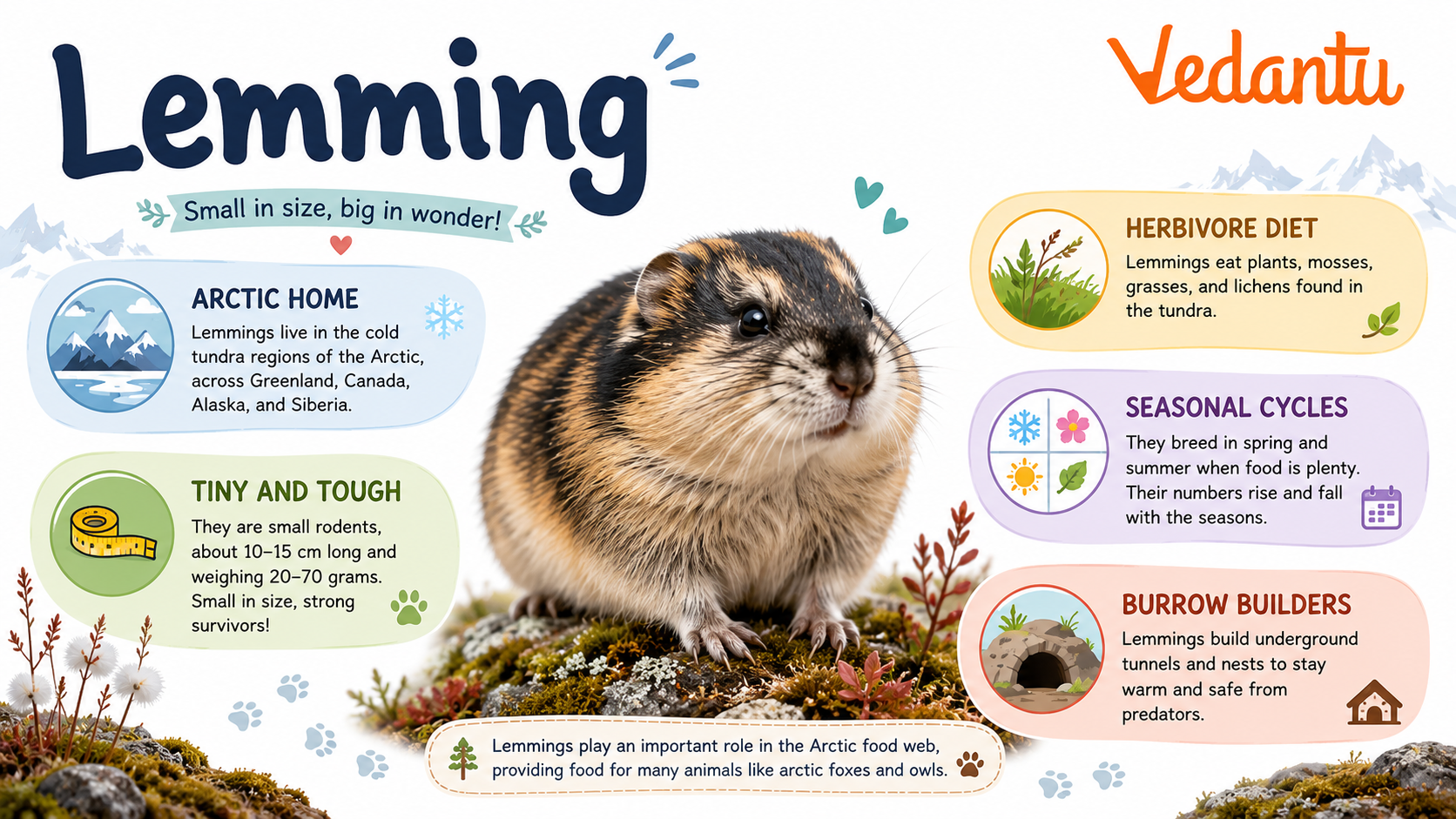
Quick Facts About Lemming
| Feature | Details |
|---|---|
| Common Name | Lemming |
| Scientific Family | Cricetidae |
| Animal Group | Mammal (Rodent) |
| Size | 8–15 cm long |
| Weight | 30–112 grams |
| Lifespan | 1–3 years |
| Habitat | Arctic tundra |
| Diet | Grasses, moss, roots |
| Conservation Status | Least Concern (most species) |
Appearance and Physical Characteristics
- Small, round body with short legs.
- Short tail compared to other rodents.
- Thick fur to survive freezing temperatures.
- Colors include brown, grey, black, or mixed patterns.
- Sharp front teeth for gnawing plants.
Lemming Habitat and Distribution
The lemming habitat is mainly found in the Arctic tundra. They live in some of the coldest regions of the world.
- Northern Canada
- Alaska
- Greenland
- Scandinavia
- Russia
Diet and Feeding Habits
The lemming diet mainly consists of plant material. They are herbivores and spend most of their time eating.
Grasses, mosses, and sedges found in the tundra.
Roots, bark, and underground plant parts.
Constant nibbling to store energy for cold weather.
Important prey for Arctic foxes, owls, and weasels.
Behaviour and Lifestyle
- Active both day and night.
- Usually live alone but stay close to others.
- Known for sudden population explosions every 3–4 years.
- Move in large groups during migration periods.
- Dig complex tunnel systems.
Lemming Life Cycle
- Birth: Baby lemmings are born in nests made of grass under snow.
- Young Stage: They grow very quickly and can reproduce in just a few weeks.
- Adult Stage: Adults breed several times a year when food is plenty.
- Lifespan: Most live up to 1–3 years in the wild.
What Makes Lemmings Special?
Their numbers rise and fall dramatically every few years.
Thick fur and snow tunnels protect them from freezing temperatures.
They reproduce quickly when food is available.
They are a key food source for many Arctic predators.
Importance and Role in Nature
Essential prey for snowy owls, Arctic foxes, and ermines.
Their population affects predator numbers.
Burrowing helps mix soil and improve plant growth.
Scientists study them to understand population cycles.
Amazing Lemming Facts
- Lemmings can swim across rivers during migration.
- There are about 20 different species of lemmings.
- They remain active even under thick snow layers.
- Predator populations often increase when lemmings are abundant.
- They have continuously growing teeth.
- Lemmings communicate using squeaks and scents.
Fun Facts for Kids
FAQs on Lemming Animal Guide: Habitat, Diet, Behavior & Myths
1. What is a lemming?
A lemming is a small Arctic rodent that looks like a tiny hamster and lives in cold northern regions.
- Scientific group: Small mammals in the rodent family
- Habitat: Arctic tundra of North America, Europe, and Asia
- Size: About 3–6 inches long
- Diet: Plants, moss, grass, and roots
- Often compared to voles and hamsters
2. Where do lemmings live?
Lemmings live in the cold Arctic tundra biome, where temperatures are very low.
- Regions: Alaska, Canada, Norway, Sweden, Russia
- Environment: Snow-covered plains and treeless lands
- Shelter: Underground burrows and tunnels under snow
- Adapted to survive harsh Arctic climate
3. What do lemmings eat?
Lemmings are herbivores, which means they eat only plants.
- Main food: Grass, moss, leaves, and roots
- Winter diet: Bark and twigs under the snow
- They must eat often to keep warm in the cold Arctic
- Part of the Arctic food chain
4. Do lemmings really jump off cliffs?
No, the idea that lemmings jump off cliffs is a myth, not true behavior.
- Migration: They move in large groups when searching for food
- Accidents: Some may fall while crossing rivers or steep areas
- The myth became popular after a 1950s wildlife film
- Lemmings do not commit mass suicide
5. Why do lemming populations increase so quickly?
Lemming populations grow fast because they reproduce very quickly.
- Breeding age: As young as one month old
- Litters: Several babies at a time
- Population cycles: Numbers rise and fall every 3–4 years
- Important for ecosystem balance in the tundra
6. What animals eat lemmings?
Lemmings are important prey animals in the Arctic ecosystem.
- Predators: Snowy owls, Arctic foxes, ermines, and hawks
- Food chain role: Primary food source for many carnivores
- When lemming numbers drop, predator numbers may also decrease
- Vital part of the Arctic food web
7. How do lemmings survive in winter?
Lemmings survive winter by staying warm under thick snow layers.
- Snow tunnels: Create insulated pathways
- Thick fur: Keeps their bodies warm
- Constant feeding: Helps maintain body heat
- Well adapted to the polar climate
8. How big is a lemming?
A lemming is a small rodent about the size of a mouse or hamster.
- Length: 3–6 inches (8–15 cm)
- Weight: Around 1–4 ounces
- Body: Short legs and a tiny tail
- Covered in thick brown or gray fur
9. Are lemmings endangered?
Most lemming species are not endangered, but climate change can affect them.
- Conservation status: Generally stable
- Threats: Climate change and habitat loss
- Arctic warming: Reduces snow cover needed for shelter
- Important for maintaining biodiversity
10. Why are lemmings important to the ecosystem?
Lemmings play a key role in keeping the Arctic ecosystem balanced.
- Food source: Feed many Arctic predators
- Plant control: Help manage tundra vegetation
- Population cycles: Affect other animal species
- Essential part of the Arctic wildlife community
