



Puma Animal Facts: Habitat, Diet, Behavior, and Hunting Skills
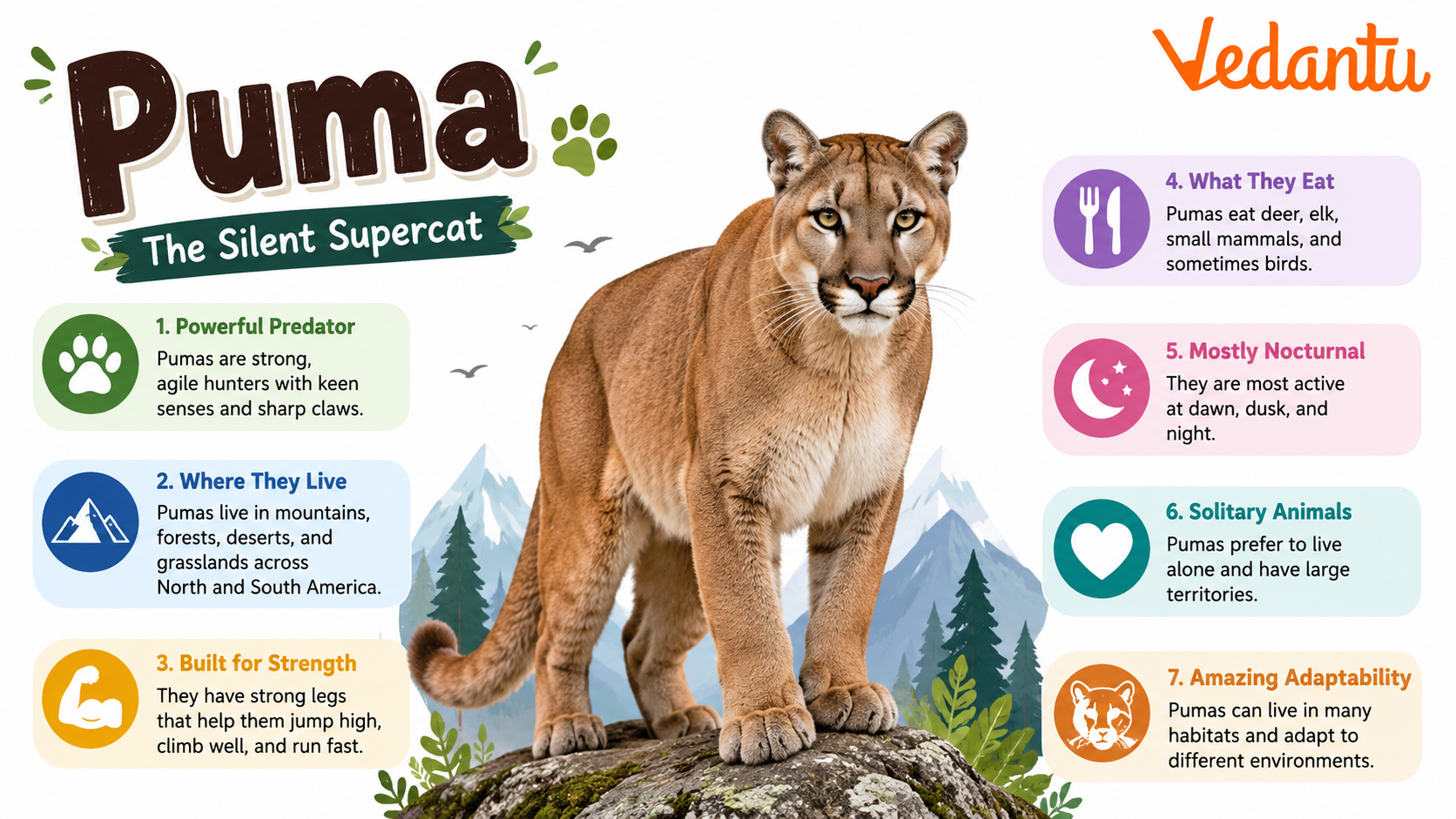
Quick Facts About Puma
| Feature | Details |
|---|---|
| Common Name | Puma / Cougar / Mountain Lion |
| Scientific Name | Puma concolor |
| Animal Group | Mammal |
| Size | Up to 2.4 meters (including tail) |
| Weight | 29–100 kg |
| Lifespan | 8–13 years (wild) |
| Habitat | Forests, mountains, deserts, grasslands |
| Diet | Carnivore (meat-eater) |
| Conservation Status | Least Concern (but threatened in some regions) |
Appearance and Physical Characteristics
- Large, muscular body built for power and speed.
- Short fur, usually tan, brown, or greyish in colour.
- Long, thick tail used for balance while running and jumping.
- Strong back legs help it leap very high and far.
- Sharp claws and teeth for hunting.
One of the most interesting Puma characteristics is its flexible body and strong hind legs. It can jump up to 5 meters high and 12 meters forward in a single leap!
Puma Habitat and Distribution
- Found across North and South America.
- Lives in forests, mountains, swamps, deserts, and grasslands.
- Prefers areas with thick vegetation for hiding and hunting.
- Can survive in both cold and warm climates.
The Puma habitat is one of the largest ranges of any wild land mammal in the Western Hemisphere. It can adapt easily to different environments, which makes it highly successful.
Diet and Feeding Habits
In the food chain, the Puma is an apex predator. This means it sits at the top and helps control the population of other animals.
Behaviour and Lifestyle
- Pumas are mostly solitary animals.
- They are active during dusk and dawn (crepuscular).
- Excellent climbers and swimmers.
- Mark territory using scent marks and scratches.
- Usually avoid humans and prefer to stay hidden.
Life Cycle of a Puma
- Mating: Can happen any time of the year.
- Birth: 1–6 cubs are born after about 3 months of pregnancy.
- Cubs: Born with spotted fur and blue eyes.
- Growing Up: Stay with mother for up to 2 years.
- Adult Stage: Leave to find their own territory.
The Puma life cycle shows strong maternal care, as mothers protect and teach cubs how to hunt.
What Makes the Puma Special?
Importance and Role in Nature
- Controls deer populations.
- Maintains balance in ecosystems.
- Prevents overgrazing of plants.
- Keeps prey animals healthy by hunting weak individuals.
The importance of Puma in nature is huge because it keeps ecosystems stable and balanced.
Amazing Puma Facts
- Pumas can run up to 80 km/h for short distances.
- They can leap across wide rivers and cliffs.
- Each Puma has a large territory.
- They communicate using body language and sounds.
- They have retractable claws like domestic cats.
- They can drag prey heavier than themselves.
Interesting Facts About Puma
Fun Facts for Kids
- Pumas are sometimes called “ghost cats” because they move so quietly.
- They can jump higher than a basketball hoop!
- Their long tail helps them balance like a tightrope walker.
- Baby Pumas are called cubs.
- They look like giant house cats.
FAQs on Puma: The Powerful and Mysterious Wild Cat of the Americas
1. What is a Puma?
A Puma is a large wild cat known for its strength, speed, and ability to live in many different habitats.
- The Puma is also called a mountain lion, cougar, or panther.
- It belongs to the big cat family but cannot roar like a lion.
- Pumas are native to North and South America.
- They are powerful predators and excellent climbers.
2. Where do pumas live?
Pumas live in a wide range of habitats across the Americas.
- They are found in mountains, forests, deserts, and grasslands.
- Pumas adapt well to different climates, from cold Canada to warm South America.
- They prefer areas with plenty of prey and hiding spots.
3. What do pumas eat?
Pumas are carnivores, which means they eat meat.
- Their main food is deer.
- They also hunt rabbits, rodents, and sometimes livestock.
- Pumas are ambush predators, meaning they quietly stalk and surprise their prey.
4. How big is a puma?
A puma is one of the largest wild cats in the Americas.
- It can grow up to 8 feet long including its tail.
- Adult pumas weigh between 64 to 220 pounds.
- Male pumas are usually bigger than females.
5. Are pumas dangerous to humans?
Pumas can be dangerous, but attacks on humans are very rare.
- They usually avoid people and prefer to stay hidden.
- Most pumas hunt animals, not humans.
- If encountered, experts suggest staying calm and not running away.
6. Why does a puma have so many names?
The puma has many names because it lives in many regions with different languages.
- Common names include cougar, mountain lion, panther, and catamount.
- It holds the record for having one of the most names of any animal.
- Different cultures gave it different names over time.
7. How fast can a puma run?
A puma is very fast and agile when hunting.
- It can run up to 50 miles per hour in short bursts.
- Pumas are also strong jumpers and can leap up to 40 feet forward.
- Their speed and jumping skills help them catch prey.
8. Do pumas roar like lions?
Pumas do not roar like lions or tigers.
- They cannot produce a true roar.
- Instead, they make sounds like growls, screams, hisses, and purrs.
- Their scream can sound like a human shouting.
9. Are pumas endangered?
Pumas are not fully endangered, but some populations are at risk.
- The overall species is listed as Least Concern.
- Some groups, like the Florida panther, are endangered.
- Main threats include habitat loss and human activity.
10. How long do pumas live?
Pumas can live for many years in the wild and even longer in captivity.
- In the wild, they live about 8 to 13 years.
- In zoos, they may live up to 20 years.
- Their lifespan depends on food supply and safety from threats.
